Do People Who Resist Arrest Have a Right to Life?

Many questions follow in the wake of police shootings.

Primarily, what could the victim — whether black, white, brown, or other — have done differently? Did he or she remain calm and respectful, doing just as an officer asked?

In some cases, the suspect had no time to be respectful, as the police gave no opportunity to surrender. Look no further than the murder of 12-year-old Tamir Rice. In other cases, such as that of Joseph Carlton, the suspect raises a firearm at an officer, who is then without question justified in opening fire.

Few would argue the suspect who points a gun at the authorities hasn’t sacrificed his or her right to physical safety. The less clear-cut cases are obviously where the controversies lie. Couldn’t the Baton Rouge officers have each grabbed an arm of Alton Sterling if they thought he was reaching for a gun, instead of shooting him repeatedly in the chest? Did Philando Castile tell the officer he had a firearm and a concealed carry permit before he was shot to death? Did Mike Brown actually attack a policeman?

Questions like this have torn the country apart, and won’t be settled here. But perhaps there is a sliver of room for common ground, concerning other cases, that should be explored.

Putting aside the obvious fact that many lives could be spared if American police were armed with rubber-coated bullets and the studies that show implicit biases against minorities make officers more likely to kill them, it does not seem like such a radical idea that when suspects resist arrest — disobey or struggle but do not grab a gun and do not assault an officer — they still have a right to life. That is, they still have a constitutional right, under the 14th Amendment, not to be deprived of life without due process of law (this is not to say those who assault officers deserve to die on the spot — officers should do all they can to prevent civilian deaths while defending themselves; we are simply trying to find common ground here).

After all, this is what each of us would want if the suspect was our own son, brother, father, or husband. We would want our sister, wife, mother, or daughter to retain the right to life even if she makes a terrible decision and grows angry or disrespectful with an officer, disobeys, or even struggles while being handcuffed. We tend to look at people who resist arrest as “criminals” who “get what they deserve” when they are riddled with bullets and bleed out on the sidewalk. Yet this is a standard unlikely to be applied to our own friends and family members were they to exhibit the same behaviors and make the same mistakes. As I wrote elsewhere, in that case people

would expect the police to find a nonviolent, nonlethal solution to the situation. He or she would want to live, or want his or her child to live, to see a constitutionally-guaranteed day in court…

If [one who defends police actions] could say honestly, “If it was my son, the police acted reasonably in killing him” then he or she has been morally consistent… If [one] has a change of heart, and says, “If it was my son, the police actions were not justified,” we can see how bankrupt [our ethics actually are].

If you think the police justified in shooting your father if he was being disrespectful or struggling out of anger, you may as well stop reading this now. But if you think that’s simply not egregious enough to justify the police killing him, you have to extend that standard to others and say that yes, people who resist arrest — excluding those who brandish a gun or actually assault an officer — have an unquestionable right to life.

So when Walter Scott was shot in the back as he ran from an officer, his right to life was violated. When Eric Garner became frustrated and resisted handcuffs and was choked to death, his right to life was violated. When Laquan McDonald, armed only with a small knife, walked past officers at a distance, ignoring their commands, and was shot 16 times, his right to life was violated. When Sam DuBose tried to prevent an officer from opening his car door, also starting his car, and the officer shot him in the head, his right to life was violated. Had an officer in McKinney, Texas, gunned down the girl screaming at him or the boys antagonizing him, he would have violated their rights.

The answer to “Do those who resist arrest have the right to life?” in America today is, in practice, most certainly no. In theory, for too many Americans, it is only yes if your own family is involved. Both of these must change.

And if they do, police officers who violate a citizen’s right to life must spend time behind bars. That is not only justice but also may prevent tragedies in the future.

For more from the author, subscribe and follow or read his books.

Mugshots Matter: Whites, Blacks, and the Stories We Tell

The mug shot of Brock Turner, a Stanford University student convicted of raping an unconscious, intoxicated woman, has at last been made public, after intense criticism of media agencies using a photo of Turner in a suit, hair neatly combed, with a disarming smile. The mug shot emerges 16 months after his initial arrest in January 2015.

Why wasn’t the mug shot used instead? Why did it take so long for the authorities to offer it? The Chicago Tribune explained:

Confusion over which agency’s responsibility it was to release the photo appeared to be behind its absence, the Cut reported. The Stanford Department of Public Safety initially arrested Turner. The case was then handled by the Santa Clara County Sheriff’s Department. Spokespeople for both agencies told the Cut and others that only the other agency could release the photo.

Giving the excuse of simple incompetence the benefit of the doubt, the use of a flattering photograph for this suspected and then convicted rapist raised the issue of whether white suspects and black (and brown) suspects are treated in an equitable manner in the American media.

There is no question that racial prejudice, whether conscious or subconscious, plays a large role in our society, in countless ways leaving blacks and other minorities disadvantaged in the realms of employment, healthcare, education, housing, the criminal justice system, media representation, and so on (a summary of the research confirming these problems can be found on Weekend Collective). For example, blacks convicted of crimes endure longer prison sentences than whites who commit the same crimes. (The 6-month sentence — possibly less if he behaves — for Turner enraged many Americans, some wondering if a black person would have received the same; when a black athlete at Vanderbilt, Cory Batey, raped an unconscious woman, he got 15-25 years minimum). As a second example, studies show blacks are featured in news stories on crime way out of proportion to the percentage of crimes they actually commit; this reinforces negative stereotypes about “violent,” “criminal,” “dangerous” blacks in the minds of media consumers.

As far as mug shots go, the research on differences between use of mug shots for white and black suspects seems to be scant. A 2002 study published in Journal of Research in Crime and Delinquency called “The Racial and Ethnic Typification of Crime and the Criminal Typification of Race and Ethnicity in Local Television News” found that black suspects are more likely to be featured in mug shots than white suspects, as cited by Kelly Welch. More research is perhaps needed to best understand the scope of the problem, but if there is a problem it will, like other ways in which blacks are portrayed in the media, have an effect on white thought. A study from Stanford — Turner’s own university — found that when whites were exposed to a disproportionate number of black mug shots, they supported harsher incarceration policies than when they were exposed to mostly white mug shots.

Serious research should be our guide to understanding if a problem exists, how bad it is, its cause (issues like mug shots are likely due to subconscious biases, pro-white and anti-black, that most people have but don’t even know it), and what can be done to create a more just and equal society. But sometimes, anecdotal evidence can hint at a problem (not always confirmed by scientific experiments and evidence). And there is no shortage of anecdotes, briefly examined here. Images tell stories, and we should perhaps be more careful about the stories we tell.

Gazette Reporting on Burglaries

Screen Shot 2017-11-17 at 10.04.24 AM

via Sott

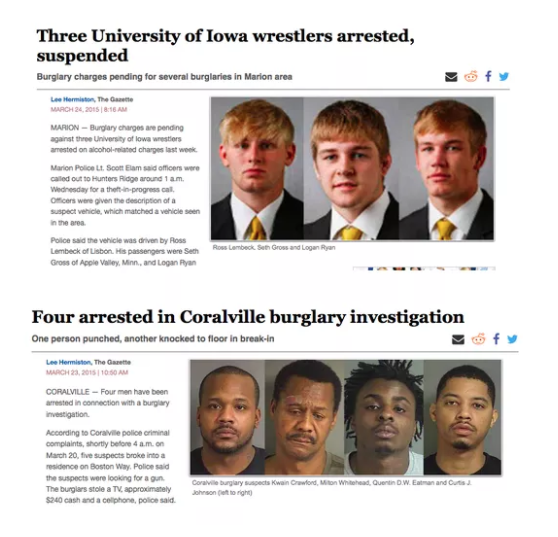
The Iowa Gazette last year featured back-to-back news stories of burglary arrests, one with mug shots of black suspects, the other of yearbook photos of white suspects. It is entirely possible, as one area resident insisted, that mug shots took longer to get from the Iowa county where white men were arrested, whereas the county where the black men were arrested provided mug shots online almost immediately. Regardless, this difference — clean cut, dressed up whites verses casually-dressed blacks, one with a bandaged face — is something journalists must work to avoid, even if it costs time. Apply the same standard to all races, use mug shots for all races, in the interest of equal treatment. Journalists aim to be fair and balanced, and this a noble way of accomplishing that goal.

Media Giants and the DuBose Murder

Screen Shot 2017-11-17 at 10.04.48 AM

via Mic

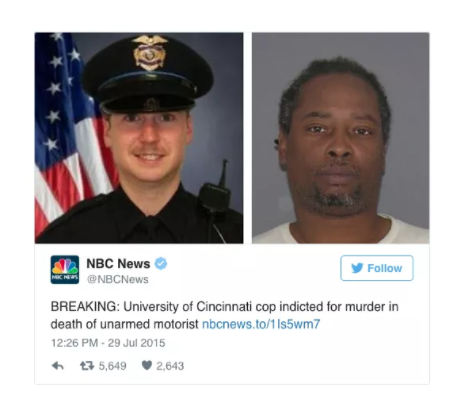
Cincinnati police officer Ray Tensing was declared guilty of murdering an unarmed black man, Sam Dubose, last year. Yet NBC News, People’s Magazine, BBC News, and other media outlets used a mug shot of Dubose — from an entirely unrelated arrest! Could they not have given the victim a bit more dignity, asking for a photo from a family member? In the NBC News version, among others, one might wonder who exactly the victim is at first glance. Tensing, rather than a mug shot after his arrest, is granted his police photo — smiling, confident, a patriot. One might ask how this all would have gone had a black police officer murdered an unarmed white, with a previous, unrelated arrest on his record.

When there is no mug shot…verses when there is

Screen Shot 2017-11-17 at 10.05.25 AM

via Svimme Arnold

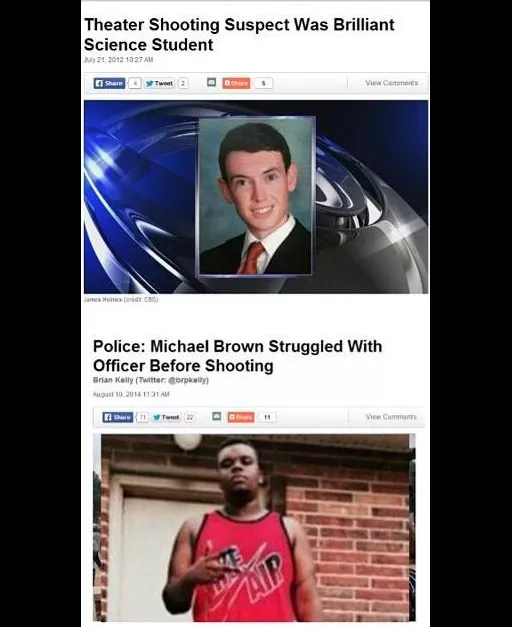
The death of unarmed Michael Brown in Ferguson, Missouri, besides the obvious criticisms, drew much attention to media decision-making concerning photographs. Photos of him scowling, or showing a peace sign, were prominently used. At the time, it was unclear as to whether Brown physically struggled with police before he was shot, causing much controversy. Compare this to the mass shooter James Holmes, who shot up a theater in Aurora, Colorado, in 2012, here featured in a school photo. Was there no school photo of Brown in existence? Is a flattering photo just for someone arrested for a mass shooting, not for a dead man whose death was shrouded in controversy? Surely media outlets can do better. (Note also the rather flattering headline for the white mass shooter, another large difference in treatment of the races, examined elsewhere; much attention has likewise been drawn to Turner’s accomplishments in athletics and academics.)

If they gunned you down, what photo should they use?

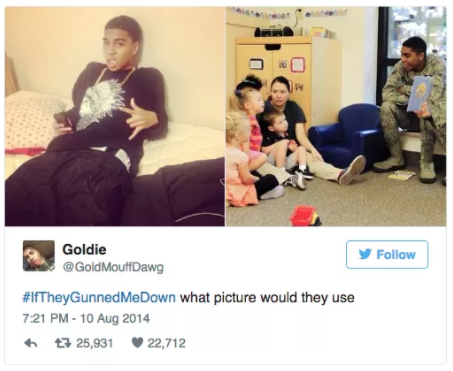
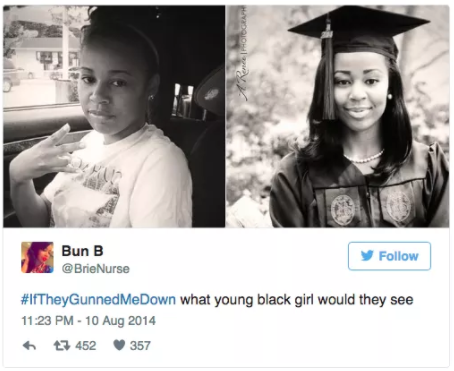
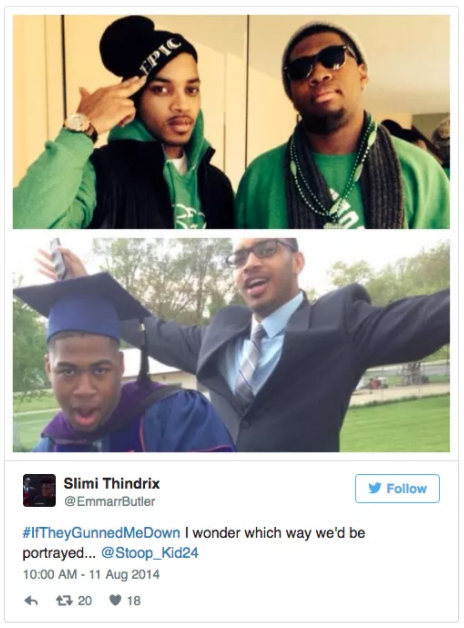
Looking at media use of photographs of Dubose, Brown, and others, it should be no surprise African Americans created the #IfTheyGunnedMeDown discussion on Twitter, which juxtaposed personal photos of themselves dressed down, flashing hand signs, with more serious demeanors, verses themselves in suits, smiling, celebrating accomplishments. If we create a common standard for arrested persons, such as, “No matter your race, the media should print no images except mug shots,” surely we can also establish one for people who die in confrontations or mere benign situations involving the police. For example, “No matter your race, the media should print yearbook photos or other respectful photographs.” We can be more careful, and more equitable, about the stories we tell.

Screen Shot 2017-11-17 at 10.06.10 AM

Screen Shot 2017-11-17 at 10.06.23 AM

Screen Shot 2017-11-17 at 10.06.41 AM

For more from the author, subscribe and follow or read his books.

Is it White Privilege for a White Person to Write a Book on Race?

A number of weeks ago, an African American woman sent me a message concerning my book, Racism in Kansas City: A Short History, which chronicles 200 years of white hatred and anti-black oppression in Kansas City, Missouri.

The woman seemed disappointed that a white person wrote the book. She told me it was “time for reparations” and asked when I would donate some of the profits of the book to the black community in Kansas City. She disliked the idea of me “making money off” and “taking advantage” of the black community.

I assured her that indeed a portion of the money garnered from the book is donated and that profiting off the black struggle and our ugly racial history was not my intent. She pointed out, rightly, that intent and impact are not the same thing. In a public social media post (not a message directed to me), she said I was exercising white privilege.

White privilege clearly exists. If whites bothered to study the evidence of modern prejudice or had any understanding of how past discrimination created disproportionate, intergenerational minority poverty (I recommend Racism in Kansas City: A Short History), the idea that whites generally have an easier time landing a job, getting a good home loan, or driving without being stopped and searched wouldn’t be controversial in the slightest (see How Whites Misunderstand White Privilege). Being divorced from the very possibility of experiencing racism is white privilege. I cannot actually understand how racism feels, having never experienced it. It’s certainly white privilege to write a book on something you will never experience.

The conversation echoed one I had with my brothers (also white) two years ago, in the early stages of writing the book. While documenting a truly horrific local history of segregation, discrimination, and violence, I told my brothers that once the book was in print I would be profiting off that horrific history — profiting off the retelling of the suffering black families and individuals went through and their valiant fight for equality and justice. Was that ethical?

Thus I feel this woman had a point (the foreknowledge that a white person telling this story might raise some eyebrows led me to decide I couldn’t publish it unless it had a foreword from a respected black Kansas Citian — namely, Alvin Brooks). Not that I’m making a great deal of money off Racism in Kansas City — some of the profits go to justice causes, most go to buying more copies of the book or social media advertising — but I am making something.

So indeed, I am benefiting financially from racism past and present — that’s white privilege at its finest. A sentence disturbing to write, but not untrue. Clearly, had so many white Kansas Citians throughout history not been barbaric toward our black neighbors, had slavery and Jim Crow and ideas of racial inferiority or deviancy never existed, Racism in Kansas City: A Short History never would have existed. Who could deny such a statement? In this way, I am benefiting from white privilege in a way most whites are not.

Yet at the same time, my justifications are perhaps reasonable. It wasn’t financial gain that motivated me to create the book, but rather an interest in American racial history and its effects, sparked by writers black and white — from Howard Zinn and Tim Wise to Malcolm X and Cornel West covering our national racial history, with Charles Coulter (Take Up the Black Man’s Burden) and Kevin F. Gotham (Race, Real Estate, and Uneven Development) and others examining race relations in Kansas City. (The book I envisioned, unlike these other local works, would cover all 200 years of Kansas City history, be readable for a high school audience, and sharply focus on the darkest moments.)

Further, the alternatives to writing the work seemed unsatisfactory. Simply not writing the book, to someone kept awake at night obsessing over it, couldn’t be the answer. It was a story I thought Kansas City — particularly white Kansas Citians — needed to read. (One won’t be reading long before figuring out who the book is for.) What other alternatives existed? Finding a black writer and encouraging him or her to take up the project in my stead?

Lastly, it occurs to me that while this is white privilege, surely it must also be “the historian’s privilege,” if you will. Some historians focus on “feel-good” history, where everything is loving Pilgrims feasting with Native Americans. But most histories must contain brutality, oppression, and death, as this is what makes up much of history (and, I will add, makes history important and relevant to today). Can it not be said that any historian who writes and sells a book is in some way profiting from human misery — someone’s misery — of the past?

And when I think of all the people, of all colors, who have told me, often with great emotion, how the book impacted their lives, what it meant to them… Hopefully, despite the brutal history that afforded a young white person the opportunity to write a successful book, history will judge me as having done something good for Kansas City.

For more from the author, subscribe and follow or read his books.

Killing Dr. King

Was the U.S. government involved in the assassination of Dr. Martin Luther King?

His wife, Coretta Scott King, believed so.

A sniper’s bullet tore through King’s face as he stood on the balcony of his motel room in Memphis, Tennessee on April 4, 1968. He was in Memphis to support the strike of local sanitation workers.

A man named James Earl Ray of Illinois was hunted down and arrested in June. He was on the FBI’s Most Wanted Fugitives list before the assassination, having escaped from a Missouri prison in 1967. Ray got a room at a boarding house (the shot’s origin) near King’s motel on the day of the killing, witnesses saw him running from the location, and investigators said his fingerprints were found on the rifle used to kill the civil rights leader.

Ray pleaded guilty, avoiding the death penalty. Yet he almost immediately recanted his plea, claiming he was framed, and spent the rest of his life fighting for a new trial. He later had help from the King family. In 1977, they met publicly with Ray and began to push for the investigation to be reopened.

(Only a year later, the House Select Committee on Assassinations concluded that it was likely Ray killed King as part of a conspiracy, but not one involving local or federal authorities.)

Though Ray died in prison in April 1998, a civil court jury in Memphis (made up of 6 blacks and 6 whites) ruled on December 8, 1999 (King v. Jowers) that the U.S. government was complicit in the killing of King.

In 1993, Lloyd Jowers, the owner of a restaurant below the boarding house where Ray stayed, claimed he had been paid by the Mafia to hire a Memphis policeman to kill King — he didn’t hire Ray. 4 weeks of testimony from 70 witnesses convinced a jury that Ray was not the one who killed King. Details and transcripts of the trial can be found at The Martin Luther King, Jr. Center for Nonviolent Social Change website.

Coretta Scott King, on whose behalf the civil lawsuit was filed against Jowers, declared after the verdict,

The civil court’s unanimous verdict has validated our belief… The Mafia, local, state and federal government agencies were deeply involved in the assassination of my husband.

Dr. King’s son, Dexter, said:

It’s been painful and also has been bittersweet. Bitter because of the tragedy, obviously, but liberating in the sense and sweet that we have been vindicated and ultimately that the significant of this historical verdict that really rewrites history is liberating. Now we can move on with our lives, have a sense of closure and healing.

The New York Times reported that

One juror, David Morphy, said after the trial, ”We all thought it was a cut and dried case with the evidence that Mr. Pepper brought to us, that there were a lot of people involved, everyone from the C.I.A., military involvement, and Jowers was involved.”

Those who agreed with him wondered why a convict on the run would commit so serious a crime, or if government complicity was necessarily out of character during the civil rights era. For instance, the FBI worked with the Chicago police to assassinate Fred Hampton of the Black Panther Party, and in general worked to undermine and destroy civil rights groupsThe FBI “tapped [King’s] private phone conversations, sent him fake letters, threatened him, blackmailed him, and even suggested once in an anonymous letter that he commit suicide. FBI internal memos discussed finding a black leader to replace King. As a Senate report on the FBI said in 1976, the FBI tried ‘to destroy Dr. Martin Luther King’” (see Zinn, A People’s History of the United States). 

The King family lawyer argued King was a special target for his fierce opposition to the Vietnam War and the Poor People’s March on Washington he was planning, which would push for massive redistributions of wealth and political power. According to Probe Magazine,

James Lawson, King’s friend and an organizer with SCLC, testified that King’s stands on Vietnam and the Poor People’s Campaign had created enemies in Washington. He said King’s speech at New York’s Riverside Church on April 4, 1967, which condemned the Vietnam War and identified the U.S. government as “the greatest purveyor of violence in the world today,” provoked intense hostility in the White House and FBI.

Hatred and fear of King deepened, Lawson said, in response to his plan to hold the Poor People’s Campaign in Washington, D.C. King wanted to shut down the nation’s capital in the spring of 1968 through massive civil disobedience until the government agreed to abolish poverty. King saw the Memphis sanitation workers’ strike as the beginning of a nonviolent revolution that would redistribute income.

“I have no doubt,” Lawson said, “that the government viewed all this seriously enough to plan his assassination.”

However, the Department of Justice issued a report calling the trial a sham, insisting no further investigation of the assassination was necessary. It can be found at the Department of Justice website. The Department wrote:

The evidence introduced in King v. Jowers to support various conspiracy allegations consisted of either inaccurate and incomplete information or unsubstantiated conjecture, supplied most often by sources, many unnamed, who did not testify. Important information from the historical record and our investigation contradicts and undermines it. When considered in light of all other available relevant facts, the trial’s evidence fails to establish the existence of any conspiracy to kill Dr. King. The verdict presented by the parties and adopted by the jury is incompatible with the weight of all relevant information, much of which the jury never heard.  

Jowers’ testimony was doubted:

Jowers…has never made his conspiracy claims under oath… In fact, he did not testify in King v. Jowers, despite the fact that he was the party being sued. The one time Jowers did testify under oath about his allegations in an earlier civil suit, Ray v. Jowers, he repudiated them. Further, he has also renounced his confessions in certain private conversations without his attorney… For example, in an impromptu, recorded conversation with a state investigator, Jowers characterized a central feature of his story — that someone besides Ray shot Dr. King with a rifle other than the one recovered at the crime scene — as “bullshit.”

The assistant district attorney of Memphis, John Campbell, who was involved in the earlier criminal proceedings against Ray, said, “‘I’m not surprised by the verdict. This case overlooked so much contradictory evidence that never was presented, what other option did the jury have but to accept [the King family lawyer’s] version?” The New York Times wrote in 2000, “Mr. Campbell has quoted several of Mr. Jowers’ associates as saying he hoped to get a movie or book deal.” Two associates recanted their corroboration of his story and said Jowers made everything up for profit.

But like the King family, others still suspect government involvement. Jesse Jackson, who was with King when he died, told Democracy Now:

The fact is there were saboteurs to disrupt the march. But then our own organization, we found a very key person who was on the government payroll. So infiltration within, saboteurs from without and the press attacks… I will never believe that James Earl Ray had the motive, the money and the mobility to have done it himself. Our government was very involved in setting the stage for and I think the escape route for James Earl Ray. A very painful day.

Just after the Memphis trial, a former FBI agent claimed to have found evidence supporting Jowers’ story in Ray’s car right after the assassination (a claim the Justice Department also disputes), and that he was harassed by the FBI after finally speaking up about it. The agent said he had stayed quiet to protect himself:

I knew that the FBI would go to any lengths to accomplish its ends: assassination, murder, anything. But after I saw Coretta King on television talking so passionately about finding the truth, I decided to step forward.

In 2002, Minister Ronald Wilson in Gainesville, Florida said his father, Henry Clay Wilson, had killed Dr. King. The King family lawyer said

he had been contacted by many people making claims similar to [Ronald] Wilson’s but had discounted most as having no value. ”I have heard from Reverend Wilson over the last couple of years or more but have never seen any hard evidence to justify the allegations now being made.”

For more from the author, subscribe and follow or read his books.

The “Black War on Whites” is Another White Myth

Several weeks ago, in response to one of my writings critical of racist rhetoric, I received the following message from a stranger named “Jeff,” whom I can only assume is white:

All over America, Black on White Hate crimes, “Face Slashings in New York, The “Knock Out Game”, “Polar Bear Hunting”, Beat Whitey Night at the Iowa and Wisconsin State Fair, 10 to 14,000 Black on White Sexual Assaults every year, while White on Black Sexual Assaults are less than 10, drive by murders, assaults, riots, Flash Mob beatings the list is f*cking endless. The Black on White Intifada is the most underreported story in the history of this country.

Only Pat Buchanan, Colin Flaherty and Jack Cashill have the nerve to post the numbers and commentary which reveal a low level civil war in this country on whites, sponsored and supported by the President, the 4th Estate, Colleges and politicians. But oh dear!!!! Quelle Horreur!!! Harsh language is what the nation should focus on.

Shut the f*ck up you piece of sh*t.

I am still dead, in a local Black on White Hate Crime a couple of months ago, when two blacks walked up to me in my drive way while I was working on my truck and shot me in the back of the head. Harsh language my f*cking ass.

Whether or not other whites who today believe in the “Black on White Intifada” and “low level civil war” can relate to being shot dead months ago, this line of thinking is all too popular among extremely conservative whites.

These ideas are largely fictional, easily dispelled with even a cursory look at FBI and Justice Department data on crime, and clearly questionable from the outset considering America’s fairly segregated living arrangements. It also carries on a century-old white tradition of vilifying blacks as having an innately special appetite for rape, theft, murder, drug use, and so on.

Whites commit the most crimes in the U.S., quite predictable considering whites make up nearly 70% of the population, versus only 13% for blacks.

Looking at the FBI’s Crime in the United States report, in 2012 whites were charged with 69% of crimes, blacks 28%. Whites led in categories like rape (65%), assault (63%), and burglary (67%), while blacks led in murder charges (49%, a lead of 1%) and robbery (55%). More minor categories were dominated by whites. Looking at all violent crimes lumped together, blacks committed about 20% of them. If we look at mass shootings in America, some 64% of them were committed by whites since 1982, verses 16% by blacks.

Now to the important question of who is committing crime against whom:

In 2014, about 82 percent of murders involving white victims were committed by other white people, while only 14 percent were committed by black people, according to the FBI.

Among murders involving black victims, just under 90 percent were committed by other black people, while 7 percent were committed by white people.

Crime experts have concluded that homicides are most likely to occur among people of the same race because people are usually murdered by someone they already know, and most people primarily know people of their own race.

Blacks kill blacks 89.9% of the time, whites kill whites 82.3% of the time. A 7% difference somehow does not seem to merit the descriptors “Black on White Intifada” (intifada, by the way, is an Arabic word for uprising against oppressors — probably not a word whites who think that anti-black prejudice is fictional should use), “low level civil war,” or “the most underreported story in the history of this country.”

Looking at Department of Justice data from 1980 to 2008, the percentage difference rises slightly, to 9%. In this period, 84% of white victims were killed by whites, 93% of black victims were killed by blacks. This of course does not mean whites not killed by whites were exclusively killed by blacks, nor that blacks not killed by blacks were exclusively killed by whites. Offenders are sometimes other races — Asians, Hispanics, and so on. In reality, the rate of black-on-white murder was only about 5% higher than that of white-on-black murder:

Screen Shot 2017-11-17 at 9.58.57 AM

via Bureau of Justice Statistics

That there is only a 5% difference is foreseeable. Blacks tend to live and work with other blacks, whites with other whites. So for example, The Civil Rights Project in 2012 found that three-quarters of black students attend minority-majority schools. The most diverse Americans cities tend to be the most segregated. Thus whites tend to rape, kill, and steal from each other; blacks do the same mostly to other blacks.

This does not mean that reverse racism (anti-white racism) does not exist or cannot manifest itself in violence. Yet ultraconservatives take incidents of blacks intentionally targeting whites for crimes like assault (i.e., the “Knockout Game”) and say there’s an “intifada” or “war” being waged! (And of course they use trends that don’t neatly fit a black-on-white narrative: “Face Slashings in New York” actually seem diverse, with black victims and Hispanic attackers, even if a black man did credit his victim’s white race as a motivating factor for an attack.)

FBI data from 2014 shows about 63% of hate crime victims were targeted due to their blackness, 23% targeted due to their whiteness. There were 701 anti-white incidents, 145 committed by other whites, 337 by blacks. There were 1,955 anti-black incidents, 57 committed by other blacks, 1,165 committed by whites. In other words, 48% of anti-white hate crimes are committed by blacks, while 60% of anti-black hate crimes are committed by whites. Clearly, calling 337 black hate crimes in a nation of 200 million whites a “war” reeks of hyperbole — and of course, the fact that whites were guilty of three and a half times more hate crimes will be politely ignored.

In a nation like the United States, it seems understandable that reverse racism would exist. This is not to excuse it, but to explain it. Most blacks are well aware of the realities of modern anti-black discrimination, documented elsewhere on Weekend Collective:

Resumes with “black” names are 50% less likely to earn an interview than identical ones with “white” names… Blacks are less likely to be offered a quality home loan than whites with the same (sometimes worse) qualifications and income levels. Whites receive better medical care than blacks with identical diagnoses, medical histories, healthcare coverage, and so on. Blacks even earn, on average, less than equally qualified white workers in the same occupational positions.

Blacks are more likely to receive longer prison sentences and the death penalty than whites who commit the same crimes. They are more likely to be pulled over and searched while driving lawfully than whites driving lawfully. Unarmed Americans killed by police are usually twice as likely to be black than white. Unsurprising, as experiments show whites in simulations are much quicker to shoot both armed and unarmed blacks than armed and unarmed whites…

About 60% of whites will openly admit to trusting negative stereotypes about lower intelligence, higher aggression, and greater laziness in blacks. 25% of whites say an ideal neighborhood would be free of them. Nearly 90% of whites hold subconscious anti-black biases.

That is on top of a barbaric history of oppression:

There was the savagery of slavery: kidnapping, hunger, torture, execution, degradation, and rape. After the Civil War, white employers refused to pay blacks the same wages as whites, or hire them for more skilled, higher wage positions; white banks refused to provide home loans to blacks; school districts gerrymandered attendance zones to keep black and white schools distinct; white businesses fled from budding areas of black commerce; white producers charged black stores more for goods.

White residents fled from black neighbors; white real estate agents steered blacks far away from nicer homes in white areas; white city councils, city planners, and developers refused to invest and build in black areas; white voters rejected tax increases that would benefit black schools and neighborhoods; white landlords refused to properly maintain property inhabited by black families; white doctors declined to treat black patients. Black history was nowhere to be found in standard history textbooks.

White policemen beat and abused blacks merely suspected of committing crimes against whites, but refused to investigate or prosecute black on black crime; white judges and juries handed black criminals longer prison sentences and more frequent executions; white terrorists shot, hung, burned, beat, mutilated and bombed innocent African Americans to keep them out of stores, schools, public facilities, neighborhoods, voting booths, and political positions. Peaceful protesters exercising First Amendment rights were attacked and killed by police and white vigilantes alike.

Again, this is not to excuse black-on-white hate crimes, but rather to show how history can explain present social conditions — how an ugly, oppressive past might cause a great deal of anger toward whites, whether personally guilty of prejudice and discrimination or not.

“But 13% of the population committing half the murders? How do you explain that barbarism?” some conservative whites will exclaim, inwardly confident that blacks are simply by nature more aggressive, violent, prone to murder and criminality.

These are also fictions. Higher black crime rates are a product of American race relations past and present. Whether black or white, poverty breeds crime, as any study of history conclusively demonstrates. And American blacks have been and are disproportionately poor — four times more likely to grow up poor than whites.

The American landscape is characterized by crime-ridden slums in inner cities dominated by minorities surrounded by wealthier white suburbs. It isn’t exactly a stretch of the imagination to suppose, as the American Psychological Association shows, that children who grow up in poverty are more likely to experience high-stress homes, absent parents, abandonment, displacement, homelessness, hunger, violence and sexual abuse, exposure to alcoholism, drug use, and crime, poor health, depression, developmental delays, decreased concentration and memory capabilities, and a host of other health problems — all issues that contribute to crime rates.

Attorney General Ramsey Clark put it best:

Mark the part of your city where crime flourishes. Now look at the map of your city. You have marked areas where there are slums, poor schools, high unemployment, widespread poverty; where sickness and mental illness are common, housing is decrepit and nearly every site is ugly–and you have marked the areas where crime flourishes… Poverty, illness, injustice, idleness, ignorance, human misery, and crime go together. That is the truth. We have known it all along. We cultivate crime, breed it, nourish it. Little wonder we have so much.

Denying this truth perpetuates racist myths. As I wrote in an article on how black poverty keeps white racism alive: “If one cannot accept that our history led to disproportionate poverty, which led to disproportionate crime, the only alternative is to attribute black crime to innate deviancy and bloodlust.”   

I told “Jeff” that if our places had been reversed — if whites had been enslaved, oppressed, and impoverished in the manner blacks were (and to a dangerous extent are) — it would be whites disproportionately poor and thus disproportionately committing certain crimes.

Obviously, any other belief flirts with very old, racist ideas about blacks being fundamentally inferior to whites.

For more from the author, subscribe and follow or read his books.