The Scope of False Sexual Assault Allegations

When conservatives are confronted by the rise of a “liberal” cause, many find and point to a small problem in order to discredit or divert attention from the immense problem liberals are attacking.

It’s an unhealthy mix of the whataboutism fallacy (citing wrongs of the opposing side instead of addressing the point) and the false equivalence fallacy (describing situations as equivalent [I’ll add “in scope”] when they are not). We observe this during talk on racial violence, when many conservatives pretend hate crimes against whites are just as common as hate crimes against people of color; see “On Reverse Racism.”

Lately, the fallacy was on full display as high-profile men across the country were accused of sexual assault and harassment, many fired or urged to resign. In this frenzy of allegations, some Americans see and cheer a surge in bravery and collective solidarity among victims inspired by each other and seeking justice, while others see and decry a male “witch hunt,” with evil women growing more bold about their lies, perhaps on the George Soros payroll. Where you land is a fairly decent predictor of your political views. Who was accused also determined for many which women to believe, with some conservatives supporting Republican Roy Moore through his rape of underage girls scandal but attacking Democrat Al Franken’s groping of women. Sadly, some liberals did the reverse. I know I witnessed a left-leaning acquaintance or two trying to discredit accusations against Franken, that he publicly apologized for, by slandering the victims. Still, it is typically conservatives (often sexually frustrated men) who, when they encounter liberals talking about rape, sexual assault, sexual harassment, toxic masculinity, and so forth, bring up false rape accusations.

One comment on a mediocre article Men’s Health shared on how to make sure you have consent from a woman typified this. There were of course countless like it, many poorly written: “And remember if she regrets it the next day you’re still fucked”; “I bring my attorney and a notary on all dates and hook ups”; “There’s no such thing as consent anymore, it’s a witch hunt. Just say no gentleman”; “Don’t forget guys… If you have drank 12 drinks and she has 1 sip of beer…… You raped her.” And still more angry with the article’s existence: “Men’s health turning into click bate leftist agenda”; “Did a feminist write this?”; “Did a woman write this?” It’s sad consent is a liberal, feminist scheme. But this comment got much attention and support, likely because people found it thoughtful and measured for some odd reason:

This is a touchy subject. Yes, respect women—We all know that. Have a woman’s consent—Yes, we all know that. Do not rape or sexually assault a woman—Yes we all know that. We respect the rules. However, there are some women that exploit and take advantage of the rules. It’s sad to say, there are some out there that falsely accuse a man of rape or sexual assault—ruining their lives. Being a man in today’s era, I’m afraid to ask a woman on a date. I feel sometimes a man needs a contract just to protect himself. Yes, this might sound objectionable and supercilious—but you can’t be too careful nowadays. We live in a different time now. Men: We need to change our attitudes and treatment of women. However, it’s okay that we protect ourselves—and we shouldn’t be demonized or vilified for doing so. I don’t want to be viewed or portrayed as the enemy, nor be apologetic for being a man.

An amusing writing. “We all know” not to rape, assault, or harass women? If the collective male “we” legitimately “knew,” such things would be a thing of the past and a primer on consent unnecessary. “We live in a different time” where men are “afraid to ask a woman on a date”! If you’re going to “protect” yourself in some way, you wouldn’t be “demonized” for actually getting consent in some formal sense; only if you used illegal and unethical methods to “protect” yourself, like the secret filming of sex. And where are these women asking men to apologize for being a men, rather than for specific behaviors or attitudes that make them uncomfortable, scared, unsafe, or physically violated?

This is a perfect example of the fallacy above. “Men sexually assault women and shouldn’t, but what about the women who make false accusations?” The latter part is clearly his main concern — he didn’t stop by to condemn rapists, he came with another purpose. They may not intend to or even realize it (some do), but when men (or women) do this they position false reports as a problem of the same significance or nearing the same significance as actual sex crimes. As if the scope, the prevalence, is comparable. That’s what taking a conversation on consent and redirecting it to one of false accusations does. It says, “This is what’s important. It’s what we should be talking about.” It’s like bringing up asthma when everyone’s discussing lung cancer. It deflects attention away from a problem that is much more severe. It’s a subtle undermining of the credibility of rape victims. It’s not wrong to discuss small problems, of course, but they should always be kept in perspective. It’s my view that comments about hate crimes against whites or false accusations against men that don’t include the enormous asterisks that these are minuscule percentages of overall hate and sex crimes should never have been uttered at all. In that way, we can think about others first. We can protect the credibility of real victims. We can remain rooted in the facts — not imply a small problem is large, or vice versa. Naturally, including those caveats undermines the usual function of bringing up these issues, but no matter.

Yes, lying about sex crimes in an issue that exists. Yes, there should be some legal punishment for such an immoral act (not anywhere near the punishment for sexual assault and harassment, obviously, because these are not in any way morally equivalent crimes). Yes, people are innocent until proven guilty, which is why men are safe from prison until they see their day in court, even if they face social consequences like losing a job due to presumed guilt — which you can oppose on ethical grounds, but not so stable ground as you would hope, especially when a man is accused by a coworker, family member, or someone else in close proximity. Is it most ethical to oppose a firing until a trial and risk keeping a rapist around the workplace? Putting others in danger? Forcing a victim to clock in next to him each day? Or is it most ethical to fire him and risk tearing down the life of an innocent man? It’s an unpleasant dilemma for any employer, university administrator, or whomever, but ethically there’s not much question. One risk is far graver, thus the answer is simple. This only grows more axiomatic when we acknowledge the likelihood of events.

The prevalence of proven false accusations of sexual assault is somewhere between 2% and 8% of cases. The National Sexual Violence Research Center documents a 2006 study of 812 cases that found 2.1% were false reports, while a 2009 study of 2,059 cases and a 2010 study of 136 cases estimated 7.1% and 5.9%, respectively. Research from 2017 revealed a 5% false claim rate for rape. The Making a Difference Project, using data from 2008, estimates 6.8%. These numbers are mirrored in prior American decades and in similar countries. While we can acknowledge that some innocent people in prison never see justice, are never set free, since 1989 there have only been 52 men released from prison after it was determined their sexual assault charges were based on lies. This compared to 790 murder exonerations; the number of people in state prisons for murder vs. sexual assault/rape is about the same (though the former crime is far less common than the latter), making the low exoneration rate for sex crime convictions all the more significant.

Myriad definitions of both “false report” and “sexual assault” make the precise percentage difficult to nail down, and these statistics only address proven false reports (there are many cases in limbo, as conservative writers are quick to point out), but this research gives us a general idea. Reports of high percentages of false claims are typically not academic studies or have rather straightforward explanations, for example when Baltimore’s “false claim” rate plunged from 31% to under 2% when the police actually went through some training and “stopped the practice of dismissing rapes and sexual assaults on the scene”! It’s remarkable how legitimate investigations and peer-reviewed research can bring us closer to the truth.

In other words, when observing any sexual misconduct scandal, there is an extremely high chance the alleged victim is telling the truth. This is why we believe women. This is why they should be given the benefit of the doubt, not accused men. It’s why the moral dilemma for employers and the like is hardly one at all. Were precisely 50% of sexual assault allegations lies, it would still be most ethical to take the risk of firing a good man rather than the risk of keeping a predator around. But since women are most always telling the truth? Well, the decision is that much easier and ethical.

In the U.S., there are some 321,500 rapes and sexual assaults per year, and 90% of adult victims are women (you’ve probably noticed how “men are raped too” is used in a similar manner to all this). One in six women are rape or attempted rape survivors. For every 1,000 rapes, 994 perpetrators (99%) will never go to prison.

For more from the author, subscribe and follow or read his books.
Which U.S. Wars Actually Defended Our Freedoms?

When pondering which of our wars literally protected the liberties of U.S. citizens, it is important to first note that war tends to eradicate freedoms. Throughout U.S. history, war often meant curtailment of privacy rights (mass surveillance), speech rights (imprisonment for dissent), and even the freedom to choose your own fate (the draft).

It also should be stated upfront that this article is only meant to address the trope that “freedom isn’t free” — that military action overseas protects the rights and liberties we enjoy here at home (even if virulent bigotry meant different people had very different rights throughout our history and into our present). It will not focus on the freedoms of citizens in other nations that the U.S. may have helped establish or sustain through war, nor non-American lives saved in other countries. However, it will address legitimate threats to American lives (such a right to life is not de jure, but expected).

As a final caveat, I do not in any way advocate for war. That has been made exceptionally clear elsewhere. While violence may at times be ethically justified, in the vast majority of cases it is not, for a broad array of reasons. So nothing herein should be misconstrued as support for imperialism or violence; rather, I merely take a popular claim and determine, as objectively as possible, if it has any merit. To a large degree I play devil’s advocate. To say a war protected liberties back home is not to justify or support that war, nor violence in general, because there are many other causes and effects to consider which will go unaddressed.

In “A History of Violence: Facing U.S. Wars of Aggression,” I outlined hundreds of American bombings and invasions around the globe, from the conquest and slaughter of Native Americans to the drone strikes in Yemen, Pakistan, Somalia, and elsewhere today. It would do readers well to read that piece first to take in the scope of American war. We remember the American Revolution, the Civil War, the World Wars, Korea, Vietnam, Iraq, and the War on Terror. But do we recall our bloody wars in Guatemala, Haiti, Mexico, and the Philippines? Since its founding in 1776, 241 years ago, the United States has been at war for a combined 220 years, as chronicled by the Centre for Research on Globalization (CRG). 91% of our existence has been marked by violence.

How many of those conflicts protected the liberties of U.S. citizens? How many years did the military literally defend our freedoms?

Well, what precisely is it that poses a threat to our freedoms? We can likely all agree that what qualify as freedoms are 1) rights to actions and words that can be expressed without any retribution, guaranteed by law, and 2) the total avoidance of miseries like enslavement, imprisonment, or death. Thus, a real threat to freedom would require either A) an occupation or overthrow of our government, resulting in changes to or violations of established constitutional liberties, or B) invasions, bombings, kidnappings, and other forms of attacks. If you read the article mentioned above, it goes without saying the U.S. has much experience in assaults on the freedoms of foreign peoples. Much of our violence was the violence of empire, with the expressed and sole purpose of seizing natural resources and strengthening national power.

So what we really need to ask is how close has the U.S. come to being occupied or U.S. citizens attacked? How many times have either of these things occurred? We must answer these questions honestly. Should it be said fighting Native American or Mexican armies protected freedom? No, the only reason our nation exists is because Europeans invaded their lands. We will include no war of conquest, from our fight with Spain over Florida to our invasion of Hawaii. We killed millions of innocent people in Vietnam. Were they going to attack America or Americans? No, we didn’t want the Vietnamese to (democratically) choose a Communist government. Now, you can believe that justifies violence if you wish. But the Vietnam War had nothing to do with defending our freedoms or lives. Neither did our invasion of Cuba in 1898. Nor our occupation of the Dominican Republic starting in 1916. Nor our wars with Saddam’s hopelessly weak Iraq. Nor many others.

Using this criteria, my estimate to the titular question is that only four wars, representing 19 years, could reasonably meet Qualification 1 (some also meet the second qualification). These conflicts protected or expanded our liberties by law:

The American Revolution (1775-1783): While the Revolution was partly motivated by Britain’s moves to abolish slavery in its colonies, it did expand self-governance and lawful rights for white male property-holders.

The War of 1812 (1812-1815): While U.S. involvement in the War of 1812 had imperialist motives (expansion into Indian and Canadian territories) and economic motives (preserving trade with Europe), Britain was kidnapping American sailors and forcing them to serve on their ships (“impressment”). This war might have simply been included below, in Qualification 2, except for the fact that Britain captured Washington, D.C., and burned down the Capitol and the White House — the closest the U.S. has ever come to foreign rule.

The Civil War (1861-1865): Southern states, in their declarations of independence, explicitly cited preserving slavery as their motive. Four years later, slavery was abolished by law. Full citizenship, equal protection under the law, and voting rights for all men were promised, if not given.

World War II (1941-1945): The Second World War could also have simply been placed in Qualification 2 below. Beyond freeing Southeast Asia and Europe from the Axis, we would say the U.S. was protecting its civilians from another Pearl Harbor or from more German submarine attacks on trade and passenger ships in the Atlantic. Yet it is reasonable to suppose the Axis also posed a real threat to American independence, the only real threat since the War of 1812.

Had Germany defeated the Soviet Union and Britain (as it might have without U.S. intervention), establishing Nazi supremacy over Europe, it is likely its attention would have turned increasingly to the United States. Between the threat of invasion from east (Germany) and west (Japan), history could have gone quite differently.

German plans to bomb New York were concocted before the war; Hitler’s favorite architect described him as eager to one day see New York in flames. Before he came to power, Hitler saw the U.S. as a new German Empire’s most serious threat after the Soviet Union (Hillgruber, Germany and the Two World Wars). Some Japanese commanders wanted to occupy Hawaii after their attack, to threaten the U.S. mainland (Caravaggio, “‘Winning’ the Pacific War”). After Pearl Harbor, the U.S. did not declare war on Germany; it was the reverse. Japan occupied a few Alaskan islands, shelled the Oregon and California coasts, dropped fire balloons on the mainland, and planned to bomb San Diego with chemical weapons. Germany snuck terrorists into New York and Florida. The Nazis designed their A-9 and A-10 rockets to reach the U.S., under the “Amerika Bomber” initiative. Also designed were new long-range bombers, including one, the Silbervogel, that could strike the U.S. from space. Hitler once said, “I shall no longer be there to see it, but I rejoice on behalf of the German people at the idea that one day we will see England and Germany marching together against America.” While an Axis invasion of the United States is really only speculation, it has some merit considering their modus operandi, plus an actual chance at success, unlike other claims.

19 years out of 220 is just 8.6% (we’ll use war-time years rather than total years, erring on the side of freedom).

Qualification 2 is harder to quantify. U.S. civilians in danger from foreign forces is a far more common event than the U.S. Constitution or government actually being in danger from foreign forces. We want to include dangers to American civilians both at home and overseas, and include not just prolonged campaigns but individual incidents like rescue missions. This will greatly expand the documented time the military spends “protecting freedom,” but such time is difficult to add up. Many military rescue operations last mere weeks, days, or hours. The Centre for Research on Globalization’s list focuses on major conflicts. We’ll need one that goes into detail on small-scale, isolated conflicts. We’ll want to look not just at the metric of time, but also the total number of incidents.

But first, we will use the CRG list and its year-based metric to consider Qualification 2. The following wars were meant, in some sense, to protect the lives of U.S. citizens at home and abroad. They do not meet the first qualification. Conflicts listed in Qualification 1 will not be repeated here. Five wars, representing 36 years, meet Qualification 2:

The Quasi-War (1798-1800): When the United States refused to pay its debts to France after the French Revolution, France attacked American merchant ships in the Mediterranean and Caribbean.

The Barbary Wars (1801-1805, 1815): The United States battled the Barbary States of Tripoli and Algiers after pirates sponsored by these nations began attacking American merchant ships.

The Anti-Piracy Wars (1814-1825): The U.S. fought pirates in the West Indies, Caribbean, and Gulf of Mexico.

World War I (1917-1918): The Great War nearly found itself in Qualification 1. After all, Germany under Kaiser Wilhelm II made serious plans, in the 1890s, to invade the United States so it could colonize other parts of Central and South America. During World War I, Germany asked Mexico to be its ally against the U.S., promising to help it regain territory the U.S. stole 70 years earlier. However, invasion plans evaporated just a few years after 1900, and Mexico declined the offer. The Great War appears here for the American merchant and passenger ships sunk on their way to Europe by German submarines (not just the Lusitania).

The War on Terror (1998, 2001-2017): It is very difficult to include the War on Terror here because, as everyone from Osama bin Laden to U.S. intelligence attests, it’s U.S. violence in the Middle East and Africa that breeds anti-American terror attacks in the first place. Our invasions and bombings are not making us safer, but rather less safe by widening radicalism and hatred. However, though this predictably endless war is counterproductive to protecting American lives, it can be reasonably argued that that is one of its purposes (exploitation of natural resources aside) and that killing some terrorists can disrupt or stop attacks (even if this does more harm than good overall), so it must be included.

36 years out of 220 is 16.4%. Together, it could be reasonably argued that 25% of U.S. “war years” were spent either protecting our constitutional rights from foreign dismemberment or protecting citizen lives, or some combination of both.

But we can also look at the total number of conflicts this list presents: 106. Four wars out of 106 is 3.8%, another five is 4.7%. Let’s again err on the side of freedom and split the Barbary and Terror wars into their two phases, making seven wars for 6.6%. Adding 3.8% and 6.6% gives us 10.4% of conflicts protecting freedom.

Any such list is going to have problems. What does it include? What does it leave out? Does it describe the motivation or justification for violence? Does it do so accurately? Should recurring wars count as one or many? Does the list properly categorize events? This list labels U.S. forces violating Mexican territory to battle Native Americans and bandits as repeated “invasions of Mexico.” If Mexican forces did the same to the U.S., some of us would call it an invasion, others might rephrase. And couldn’t these incursions into a single nation be lumped together into a single conflict? Oppositely, the list lumps scores of U.S. invasions and occupations of most all Central and South American nations into a single conflict, the Banana Wars — something I take huge issue with. The solution to issues like these is to either create a superior list from scratch or bring other lists into the analysis.

Let’s look at “Instances of Use of United States Armed Forces Abroad,” a report by the Congressional Research Service (CRS). It is a bit different. First, it includes not just major conflicts but small, brief incidents as well, and it’s smarter about lumping conflicts together (no Banana Wars, no Anti-Piracy Wars, but the U.S. incursions into Mexico to fight Native Americans and bandits are listed as one conflict). Thus, 411 events are documented. Second, even this is too few, as the list begins at 1798 rather than 1776. Third, it does not include wars with Native Americans like the first list. This list is highly helpful because the CRS is an agency of the Library of Congress, conducting research and policy analysis for the House and Senate, and thus its justifications for military action closely reflect official government opinion.

We will apply the same standards to this list as to the last. We’ll include the nine conflicts we studied above if the timeframe allows, as well as any events that have to do with civilians, piracy, and counter-terrorism. We will thus modify 411 events in this way:

– 38 incidents/wars that involved “U.S. citizens,” “U.S. civilians,” “U.S. nationals,” “American nationals,” “American citizens,” etc.

– 9 incidents/wars related to “pirates” and “piracy” (does not include the rescue of U.S. citizen Jessica Buchanan, already counted above, nor Commodore Porter’s vicious 1824 revenge attack on the civilians of Fajardo, Puerto Rico, who were accused of harboring pirates)

– 6 official conflicts: the Quasi-War (“Undeclared Naval War with France”), two Barbary Wars, the War of 1812, and two World Wars (the Revolution does not appear on this list due to its timeframe; the Anti-Piracy Wars are included above, the War on Terror below)

+ 1 Civil War (it must be added, as it is not included on this list because it did not involve a foreign enemy)

– 27 incidents/wars related to combating “terrorism” or “terrorists”

That gives us 81 events that match Qualifications 1 and 2. 81 out of 412 is 19.7% — thus about one-fifth of military action since 1798 in some way relates to protecting Constitutional freedoms here at home or the right to life and safety for U.S. civilians around the globe. Of course, were we to only look at Qualification 1, we would have but three events — the War of 1812, the Civil War, and World War II — that preserved or expanded lawful rights, or 0.7% of our wars since 1798.

The CRS list does not break down some incidents into times shorter than years, and documenting those that are by days, weeks, or months is an enormous chore for a later day. Thus the estimation for time spent defending freedom will have to come from the CRG list: 25% of the time the military is active it is involved in at least one conflict that is protecting freedom. Also, just for some added information, there are 20 years on the CRS list where there is not a new or ongoing incident. That’s since 1798. This is almost identical to the 21 years of peace since 1776 in the CRG analysis. So of the 219 years since then, we’ve spent 91% of our time at war, the same as the CRG list since 1776 (or trimmed to 1798).

(A list created by a professor at Evergreen State College goes from 1890-2017 and has five years of peace. We’ve been at war 96% of the time since 1890. It lists 150 conflicts, with only 3 having to do with rescues or evacuations of Americans [2%], 11 having to do with the War on Terror in Arabia and Africa in 1998 and after 9/11 [7.3%], plus World War I [0.6%]. That’s 9.9% for Qualification 2. Throw in another 0.6% for World War II, and thus Qualification 1, and we have 10.5% of conflicts since 1890 protecting freedom. Because this list begins so late, however, we will not use it in our averaging. Doing so would require us to trim the other lists to 1890, cutting out the piracy era, the Revolution, the Civil War, etc.)

Averaging the percentages from the two lists relating to total conflicts gives us 2.3% for Qualification 1 and 15% for Qualification 2. 17.3% all together. Trimming the CRG list to begin at 1798 yields about the same result.

In sum, it could be reasonably asserted that the U.S. military protects our freedoms and lives in 17.3% of conflicts. (If we take out the War on Terror for its deadly counter-productivity, which I would prefer, that number drops to 10.8%, with 17% of war years spent defending American freedom.)

For more from the author, subscribe and follow or read his books.

Even Better Than ‘Angels in the Outfield’

Remember the movie Angels in the Outfield? It’s the classic story of Roger, a foster kid who prays for God to help the Angels win the pennant so that his dad will come back. (Sounds like one truly twisted deal, but Roger’s dad wasn’t at all serious. If we’re being honest, Roger seems old enough to have known about figurative language.)

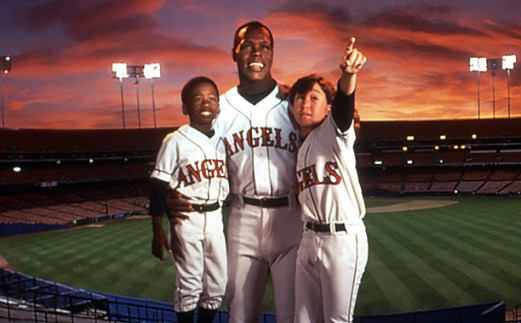
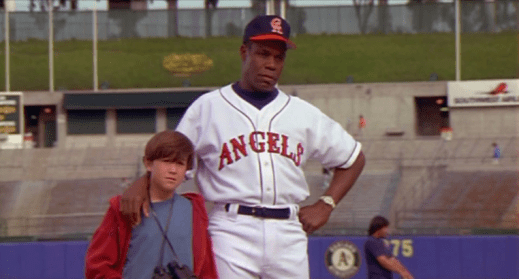
If your memory is as decrepit as the cheap VCR tape of this movie in the box in your basement, this image may help:

Screen Shot 2017-11-27 at 2.08.52 PM

Jesus, Roger looks uncomfortable in this picture. I don’t remember him being on the verge of tears in this scene. This looks like the beginning of an episode of Law and Order: SVU. CHUNG-CHUNG.

This is the scene in which Roger and his best buddy J. P. meet the indelibly cheerful Angels manager George Knox, who grows from skeptic to believer about the whole angels-playing-baseball thing (Roger is the only one that can see them). When Roger does see one, he’s like:

giphy

That’s where that hand motion comes from if you ever see people (me) doing this during a baseball game. The Royals once used the theme music to the movie when someone hit a home run, and I could never understand why I was the only one at Kauffman Stadium doing this while it played.

Also: That moment you realize Roger was played by Joseph Gordon-Levitt of 500 Days of SummerInception, and Dark Knight Rises.

2d274908031122-tease-joseph-gordonlevitt-today-19032015_f206664b5e962821f9652b05c637eb98

Angels in the Outfield is truly the greatest baseball movie of all time (bite me, Kevin Costner), therefore I in no way compare the Kansas City Royals to it casually. But without question, in every arena the Royals’ story rivals and surpasses Roger’s. This is such big news, I’m surprised more media attention hasn’t been paid to it.

KANSAS CITY’S PAIN IS GEORGE KNOX’S PAIN

fRLdWQO

George Knox hates to lose. Can any clip better represent the boiling rage lurking beneath the skin of every Royals fan, just waiting to detonate, through all the miserable seasons of the past years, when Kansas City was the laughingstock of Major League Baseball?

A clip of a nuke wouldn’t suffice. It has to be George Knox marching through a locker room of two dozen half-naked losers and absolutely destroying their fruit and meat platters. That is the pain Royals fans felt after every season–no, every game–before the Royals’ meteoric rise.

And this is Knox after becoming manager rather recently. Multiply this rage by 29 years, and you’ll understand Kansas City’s agony. There’s no comparison.

Even this bloody movie made us look like total twits. Why does this guy not slide? What is he doing?

82zqwaD

MIRACLES CAN HAPPEN

Roger’s story is fictional, with fictional managers, ballplayers, and angels. At least, I hope angels don’t look like this:

1445613876-cl

Honestly, this angel looks like either the uncle you pray to God won’t sit next to you at Thanksgiving or the aunt that’s visibly ready to call your favorite music the work of Satan before you even tell her what it is. Not really sure which one at this point.

But the Royals’ story?

This isn’t a movie. And no players appear to defy physics as an angel lifts them into the air. It’s simply incredible baseball. It’s real life. That’s an important reason the Royals’ story is better.

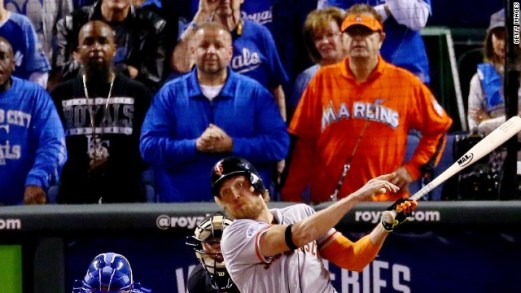
Eric-Hosmer-Kansas-City-Royals.png

Consider last year: Riding Jeremy Guthrie’s 7-inning shutout to beat the White Sox 3-1 on September 26, clinching their first playoff berth in 29 years. Four days later, staging a roaring comeback against the Oakland A’s in the do-or-die American League wild card game, down 3-7 but leveling the game in the 9th inning, eventually winning 9-8 in the 12th, after nearly 5 hours of play.

Sweeping both the American League division and championship series, earning the most consecutive wins in MLB postseason history. Making it to Game 7 of the World Series against the San Francisco Giants, but experiencing the most painful of defeats.

And this year: Winning their first American League Central title since 1985 on September 24 against the Mariners. On the brink of elimination in Game 4 of the AL division series against the Astros, down 4 runs in the 7th, and smashing in 5 runs in the 8th inning and piled on more in the 9th to win the game 9-6. They won the series in the next game.

Winning Game 6 of the AL championship series versus the Blue Jays by Lorenzo Cain scoring from first base on Eric Hosmer’s single, with closer Wade Davis shutting down the Blue Jay’s comeback threat, a runner on first and third.

And last night, Game 1 of the 2015 World Series, verses the New York Mets. Alcides Escobar’s inside-the-park homer, the first in the World Series since 1929, the year the Great Depression began. Winning 5-4 after 14 innings, the longest game in World Series history.

Could all this possibly be topped by the story of guys who only made it to the postseason with divine intervention in sparkling pajamas?

tumblr_inline_n270fiP3Sq1qa12tx

No. They’re cheaters.

Also, that’s Matthew McConaughey being picked up there. Swear to God. As he later said from the driver’s seat of a Lincoln, “Sometimes you’ve got to go back…”

Adrien Brody is also a ballplayer in this movie. McConaughey, Gordon-Levitt, Brody, Danny Glover, Tony Danza, Christopher Lloyd…seriously, is there anyone this film doesn’t have?

THE SMARMY SPORTSCASTER

It has actor and concept art model for Mr. Incredible Jay O. Sanders. He plays Ranch Wilder.

Roger and George Knox had to deal with Ranch Wilder, the “voice of the Angels,” who makes it clear throughout the film he very much wants the Angels to lose. He hates George Knox, and is constantly being a Debbie Downer about the Angel’s postseason prospects.

hqdefault

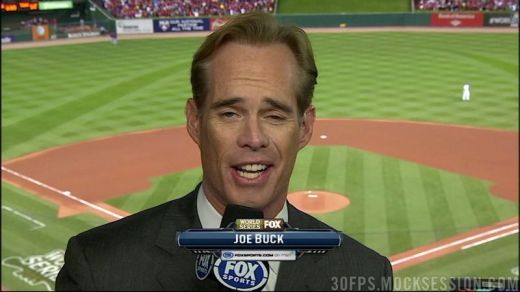
Royals fans get Joe Buck.

ovc1zqgeabdkv7lqwscp

Buck took a lot of heat during the 2014 World Series for what Royals fans perceived to be bias, in support of the Giants…and one pitcher in particular.

Ranch Wilder got fired. Buck is still going strong, back to call this 2015 World Series.

This just makes a better story. No one really seemed to mind Ranch Wilder’s Angel-bashing in the film. He was only fired because he left his mic on when he really went berserk.

But Kansas City’s story has more conflict, more passion and intrigue. Buck is back, and a lot of KC fans are enraged, enough to start petitions and even call the games themselves.

THAT ONE FAN THAT GETS A LOT OF SCREEN TIME AND NO ONE KNOWS WHY

RadiantBelovedHamster-thumb360

Remember this guy? He’s that one fan in the crowd the movie focuses on, and likely the only human who has ever needed to professionally wax the sides of his neck.

He thinks Roger is crazy for seeing angels, he accidentally sits on Christopher Lloyd’s angel character, takes a baseball in the mouth, and at one point screams, “Hemmerling for Mitchell?! Go back to Cincinattiiiiiiii!” Classic quote.

Why is he always on screen? Why does he get so much attention? Why is that so obnoxious? In a way, he’s kind of the movie’s version of…of…

141024123919-marlins-man-01-story-top

Marlins Man.

This mysterious and no doubt totally loaded figure has been spotted behind home plate throughout this postseason and the one in 2014, and works his way to other sports championships as well.

Always on screen, he is the one fan that gets any attention. He gets national attention! Yes, he donates a ton of money to charities, but what of the other 37,000 people in the stands? What about their stories? He leaves them in the dust.

It’s all an intentional thing. He picks his seat so he can be on camera. He loves to rep his completely irrelevant team, which has hopefully fired its graphic design staff by now.

Because he’s desperate as a toddler for attention, I think he successfully one-ups the blowhard from Angels in the Outfield. And anyone who disagrees with me is, to quote J. P., a “Nacho Butt.”

PUSHING THROUGH THE LOSS OF A PARENT

As mentioned, Roger is a foster kid. About two-thirds into the movie, his deadbeat dad–the same one who said if the Angels won the pennant he and Roger could “be a family again”–abandons Roger for good.

“Sorry, boy,” Dad of the Year says as Roger rushes up to him, excited to tell him about how well the Angels are doing. Dad pats Roger on the cheek and walks away, leaving Roger to try to croak out “Where are you going?” before he begins to weep.

Screen Shot 2017-11-27 at 2.33.20 PM.png

If you’re a kid from a stable home watching this movie, it truly influences you, seeing someone your own age abandoned by his father. Not to mention Roger’s mother died, as did J. P.’s dad. Their stories are fictional, yet you know in the back of your mind while watching that millions of children experience abandonment, foster care, homelessness, or have parents deceased or in jail. The movie, unlike the vast majority of children’s films, makes you think about the suffering of others and how to persevere through pain.

And if a fictional story about this is powerful, how much more so is real life?

Sadly, three Royals lost a parent this season.

Mike Moustakas lost his mother Connie on August 9, while Chris Young lost his father Charles on September 26. As reported by The Kansas City Star, Young pitched the next day to honor his dad, and went 5 innings without giving up a hit.

Edinson Volquez pitched last night, in Game 1 of the World Series. His father Daniel died just before the game, and Volquez’s family requested that Royals manager Ned Yost not tell Volquez until after he pitched.

edinson-volquez-101615-getty-ftrjpg_lvveh1cbrtd51uxuw0zocfv83

In other words, the world knew of Volquez’s father’s death before Volquez.

Through all this, the Royals have persevered. Moustakas said after the game, “For all the stuff that’s happened this year, to all of our parents…it has to bring you closer together.”

Eric Hosmer said, “It’s just another angel above, just watching us and behind us through this whole run.”

A HAPPY ENDING?

The Angels in the movie won the pennant (we’re kind of left to wonder about the World Series). Roger and his best friend J. P. get adopted by George Knox and live happily ever after.

I don’t know if Ned Yost will adopt any players, nor if the Royals will finally, after 3 decades, win it all. But there is one thing I know to be true, that applies to touching movies and real life alike:

“It could happen.”

ANGELS IN THE OUTFIELD, Milton Davis Jr., Danny Glover, Joseph Gordon-Levitt, 1994, (c)Buena Vista P

For more from the author, subscribe and follow or read his books.

A Star Wars Redo

Full disclosure here: I have a massive incentive for this idea of remaking Star Wars episodes I, II, and III to take hold and become reality.

A couple years ago I made a bet with my closest friend, whose name just happens to be Luke. Should the prequels not be remade in my lifetime, I must leave all my wealth and possessions to him when I die. If they do get reboots, Luke has to buy my movie tickets when we go see them together. Seems fair, amiright?

That is how confident I am that Disney will begin remaking the Star Wars prequels at some point. Not before the new trilogy is completed in 2019, of course, but perhaps in the 2020s, 2030s, or 2040s.

But in order to encourage the dissemination of the idea, which is actually quite popular among the Star Wars fans whose childhoods were absolutely ruined by George Lucas’ stupidity, I thought it would be wise to lay out a simple argument in support. You know, just in case helping prevent my future wife and children from being left with nothing wasn’t enough motivation for you.

My argument has three points, none of which should be all that controversial.

1. FILM STUDIOS LOVE REBOOTS, ESPECIALLY IF THE ORIGINALS WERE SH*T

Sometimes, studios take god-awful films and have another go. Remember the absolutely abysmal Fantastic Four from 2005 with Chris Evans and Jessica Alba? Disney tried its luck (failing spectacularly) in 2015. They redid the origin story, this time with Micheal B. Jordan, Kate Mara, and Miles Teller. Remember Hulk, then The Incredible Hulk within 5 years? These are examples of film studios taking bad films and trying to breathe new life into them.

Sure, sometimes it doesn’t work, but sometimes it does. Think Star Trek or Batman Begins. And sometimes studios take good movies and redo them, just for kicks. Just for a cash-grab. Remember Spider-Man(2002) with Tobey Maguire? It launched the modern era of superhero flicks. But by 2012 came The Amazing Spider-Man, which retold Peter Parker’s origin story.

No film, no matter how recent or how wonderful, is safe from reboots. Film companies see a market, and they supply. We rightfully gripe about movies whose classics are beloved and well-made, but is anyone pissed we went from the Tim Burton Batman films to those of Christopher Nolan? Sometimes, a story deserves a retelling. There is clearly a Star Wars market, quite larger than that of Fantastic Four, and as the prequels are nearly universally despised, there would be much excitement if the story of Darth Vader was to be retold.

Studios, there is a fortune to be made. And fans, with The Force Awakens, hasn’t Disney proven it can produce a decent Star Wars film?

2. THE PREQUELS WERE SOME OF THE WORST MOVIES EVER MADE

If you’re one of the few who actually like the prequels and (somehow) think their quality rivals that of the original trilogy, I’m sorry. I don’t know if anyone’s ever been more wrong about something. I’ll give you a pass, as you’re likely 9 years old. But let me give you a preview of the future thoughts you’ll have when you actually understand something about what makes a good movie and what makes Bogus with Whoopi Goldberg.

The Star Wars prequels:

  • Had dialogue that sounded like it was written by some of your fellow 9 year olds (Obi-Wan says, “Only a Sith deals in absolutes.” Read it a few times, you’ll get it).
  • Relied overwhelmingly on CGI environments and characters, making everything feel fake.
  • Used two awful actors for Anakin Skywalker, though it’s difficult to decide whether Jake Lloyd or Hayden Christensen was worse.
  • Handed decent actors like Ewan McGregor, Liam Neeson, Samuel L. Jackson, Christopher Lee, and Natalie Portman miserable lines and one dimensional characters and expected them not to be boring.
  • Created extremely unlikeable good guys and entirely boring villains: Anakin Skywalker, Jar-Jar Binks, Count Dooku, General Grievous, Nute Gunray, and so on.
  • Had frighteningly stupid characters: Mace Windu said, “The Dark Side of the Force surrounds the Chancellor” but sounds surprised when Anakin tells him the Chancellor is a Sith; the Jedi think a prophecy about bringing balance to the Force sounds awesome when there’s thousands of them and only two Sith; Anakin doesn’t know what “democracy” means and thinks people “can be made to” agree on issues; Qui-Gon can’t use the Force on Watto to convince him to use Republic currency, but instead of just using the Force on someone else to do a simple currency exchange, Qui-Gon enters into complicated and risky bets on podracing (credit: Mr. Plinkett; see below).
  • Featured a plot so poorly thought out it’s painful:
    • Palpatine tells Nute Gunray to invade Naboo (why is Nute listening to this hologram? What’s in it for him?) so the Senate will impeach the current chancellor and elect Palpatine (who’s from Naboo and therefore was sure to win with a “sympathy vote.” Why the f*ck wouldn’t Palpatine just wait for the next election, then use the Force to get votes? He couldn’t wait a couple more years?
    • Then, in the next two movies, we see Palpatine create another unnecessary crisis. He has Nute’s droid armies go to war with a clone army that he also controls, using the conflict to stay in power longer and also wipe out the Jedi. Why the f*ck wouldn’t he simply use one army to just destroy the Jedi? Why is he destroying the galaxy he wants to rule? Think about a simpler, less destructive solution. A massive, mysterious force appears, wipes out the Jedi in a couple months to a year, and the people of the galaxy, devoid of their protectors, turn to Palpatine to keep them safe. It’s a better story because it’s more believable — the bad guy acts in a way anyone who isn’t an imbecile would act.
    • And of course, Anakin goes from someone who is simply unhappy with the Jedi for asking him to be a spy and not letting him be a master to someone willing to kill them all (children, his friend Obi-Wan, everyone) just so he can get “powerful enough” to “uncover the secret” to keeping Padme alive. Killing Tuskens or Mace Windu in a moment of anger, chaos, or fear made sense, but Anakin being so evil and selfish he’d kill everyone he knows and loves just for the chance of keeping his wife alive? The transition to that stage was hopelessly forced and awkward.

For more, watch Mr. Plinkett’s reviews of each prequel movie, they are absolutely hilarious (minus some bizarre kidnapping scenes) and effectively tear each movie the new one it deserves.

3. OBJECTIONS TO A REBOOT ARE FAIRLY PATHETIC

My third point addresses possible objections to the idea of remaking the Star Wars prequels (“Hey, the prequels were pretty damn good!” has already been addressed, you ignoramus. Unless you mean the Auralnauts versions, that is). Most of these objections come from some article on FuriousFanBoys.com.

  1. They won’t remake the prequels, they’re canon! Don’t be an idiot. The word “canon” means absolutely nothing to Disney. Remember how violated you felt when they dismissed the Expanded Universe like a left swipe on Tinder? Canon is something you care about. You will of course say the comic books, novels, and video games aren’t as “canon-y” as the films themselves, and if that helps you sleep at night then keep telling yourself that. You know in your heart Disney doesn’t give a sh*t. They care about profits.
  2. Disney doesn’t have the rights! They will. 20th Century Fox may own the first six movies now, but those rights are slated to pass to Disney, for most of the movies by 2020. Then it’s all fair game.
  3. Remaking the Star Wars prequels will mess up The Clone Wars and RebelsIn case you’re unaware, these are cartoons set in the prequel era. Yes, this is an actual argument posited by thinking human beings. I encourage you to see #1 above.
  4. Disney won’t spend money on reboots over new movies like Episodes VII, VIII, and IX, plus all the spin-offs like Rogue OneSure, for the time being. But in 20 years? 40 years? You really think they won’t ever decide to profit off fixing the biggest f*ck-up in film history for the most obsessive fan base of all time?
  5. The prequels make money! Yes, FuriousFanBoys.com assures us, the DVDs of Episodes I-III are such “big sellers” there would be no financial incentive for Disney to reboot the trilogy. I’ll leave aside the fact the writer doesn’t bother to provide a source for his claims, but assuming it’s all true, I don’t think he quite understands how this whole money-making thing works. Let me spell it out for him: Disney…could…make…even…more…money…
  6. If we allow the prequels to be remade, what’s to stop them from remaking the original trilogy? Basically nothing — in fact, there’s nothing to stop Disney from remaking the original trilogy even if the prequels aren’t rebooted. In the same way there’s nothing to stop a redo of the miserable prequels, there’s nothing to stop a redo of the originals… Or is there? The only real force to prevent such a thing is fan backlash and a pitiful sales forecast. If that happens when Disney considers rebooting the prequels, the project may be scrapped. If it happens when Disney considers rebooting the original trilogy, the idea may be abandoned. A reboot of each is in the realm of the possible, but one is much more likely to actually happen because the backlash will be slight and the sales forecast delightful (hint: it’s the one that blows).             

Every Star Wars fan has his or her own ideas about how the prequels should have gone. Arguing for remaking the Star Wars prequels is good enough for me (and I encourage you to sign this petition if you agree), but I like the idea of a love triangle between Obi-Wan, Anakin, and Padme (mirroring the Luke-Han-Leia triangle of the original), giving Anakin a reason to try to kill Obi-Wan in a fit of jealous rage. A great way to fall to the Dark Side.

Whatever is created will be far superior, in each and every way, to the human waste George Lucas offered. Belated Media’s videos on the topic are decent. The future is full of possibility, and it’s hard not to be excited about that after watching.

For more from the author, subscribe and follow or read his books.

Capitalists Speaking Frankly

Capitalist interest in preserving and profiting from the economic power of the rich was verbalized in a 2005 Citigroup equity strategy report called “Plutonomy: Buying Luxury, Explaining Global Imbalances.”[1] It was never meant to be public.

Its language reveals the wealth and position of its writers, who head their sections with phrases like “Welcome to the Plutonomy Machine,” “Riding the Gravy Train,” “How to Play Plutonomy,” and “the New Managerial Aristocracy.” It is enlightening because it is honest: the authors point to capitalism as what births plutonomies—economies powered by the super-rich—in their analysis of how investors can profit from the great consumption of the wealthy. They believe the “wealth waves” created by new technology, productivity gains, patents, and “capitalist-friendly” governments are “exploited best by the rich and educated of the time,” creating a massive wealth gap. They write, “At the heart of plutonomy is income inequality.” They insist “society and governments need to be amenable to disproportionately allow/encourage the few to retain the fatter profit share. The Managerial Aristocracy…needs to commandeer a vast chunk of that rising profit share, either through capital income, or simply paying itself a lot.” The workers who made those profits possible be damned.

It is clear the Citigroup executives are wary of changing attitudes among the citizenry:

Perhaps one reason that societies allow plutonomy is because enough of the electorate believe they have a chance of becoming a Pluto-participant. Why kill it off, if you can join it? In a sense this is the embodiment of the ‘American Dream’. But if voters feel they cannot participate, they are more likely to divide up the wealth pie, rather than aspire to being truly rich.

This neatly summarizes the way the conservative dogma of rugged individualism protects the interests of the upper class. How right Marx was when he noted, “The ruling ideas of each age have ever been the ideas of its ruling class.”[2]

In a 2006 follow-up report entitled “Revisiting Plutonomy: The Rich Getting Richer,” the corporation noted how the rich get richer “at the relative expense of labor,” how wages for workers are kept low (you have to “keep wage inflation in check”) while the capitalist owners reap more profits than they used to:

We believe that the rich are going to keep getting richer in coming years, as capitalists (the rich) get an even bigger share of GDP as a result, principally, of globalization. We expect the global pool of labor in developing economies to keep wage inflation in check, and profit margins rising – good for the wealth of capitalists, relatively bad for developed market unskilled/outsource-able labor.[3]

Capitalism, the capitalists understand, transforms the hard work of the many into the wealth of the few. Good for capitalists, bad for labor. The document also revealed Citigroup’s fear of the citizenry demanding greater income equality:

Our whole plutonomy thesis is based on the idea that the rich will keep getting richer. This thesis is not without its risks…the rising wealth gap between the rich and poor will probably at some point lead to a political backlash. Whilst the rich are getting a greater share of the wealth, and the poor a lesser share, political enfrachisement remains as was – one person, one vote (in the plutonomies). At some point it is likely that labor will fight back against the rising profit share of the rich and there will be a political backlash against the rising wealth of the rich… We don’t see this happening yet, though there are signs of rising political tensions. However we are keeping a close eye on developments.[4]     

The minority is always fearful of the majority. They know, as Marx wrote, that

…the proletarian movement is the self-conscious, independent movement of the immense majority in the interest of the immense majority. The proletariat, the lowest stratum of our present society, cannot stir, cannot raise itself up, without the whole superincumbent strata of official society being sprung into the air.[5]

Citigroup would soon see their fears realized with the rise of the Occupy Wall Street movement and a louder dialogue about the income inequality and wage theft of capitalism.

For more from the author, subscribe and follow or read his books.

Notes

[1] http://delong.typepad.com/plutonomy-1.pdf

[2] Marx, Communist Manifesto, 26

[3] http://www.correntewire.com/sites/default/files/Citibank_Plutonomy_1.pdf

[4] http://www.correntewire.com/sites/default/files/Citibank_Plutonomy_1.pdf

[5] Marx, Communist Manifesto, 18