‘Atheist Delusion’ Review

The tagline of Ray Comfort’s new documentary, The Atheist Delusion, promised atheism would be “destroyed with one scientific question.”

Kirk Cameron said it featured “high-resolution logic,” Ken Ham called it “compelling.” The trailer featured atheistic young people calling Comfort’s questions “eye-opening,” saying “I’ll definitely consider this” and even “I’m lying to myself.” The movie was supposed to explain “Why Millions Deny the Obvious” (a second tagline).

As a former Christian and current atheist, such things caught my attention. What were these claims that were supposedly opening the minds of atheists to the “Truth”? Could they possibly take more than mere minutes to dismantle? Upon viewing the film, there is truthfully just one word in the English tongue to properly describe it: embarrassing.

The atheists whose gears are clearly turning at half-speed, who fail to see each of Comfort’s points from a mile away, who are left utterly struggling for words are embarrassing (though, in their defense, even pastors have off days sometimes).

Comfort’s arguments, which rely on hopelessly weak analogies, silly metaphors, gaps in humanity’s scientific knowledge, and meaningless semantics are all embarrassing. The only thing this film “destroys” is a segment of poorly prepared college students from the University of California — Irvine who apparently need to read this article as badly as Christians.

First, Comfort recycles the famous “watchmaker” analogy, here using a book. Could a book make itself? When the inevitable answer is No, that is somehow evidence that existence must also have a creator.

This is, to any critical thinker, rather unsatisfying, as the creator’s existence would by extension of this hopeless analogy also require a creator. But to the religious, existence needs an explanation, but God does not. Something has to be the “uncaused,” as Comfort calls God. Strange that it would be something we have no proof of (a deity) that a thoughtful person would deem the “uncaused,” but not something we do have proof of (existence itself). It is further strange that Christians deem life and planets and existence so complex they all must require a deity, while that deity, being able to create existence, would be even more complex and marvelous than existence! So how is it that we then give deities a free pass? To the atheist, it is just as sensible (if not more so) to suppose existence has always existed, that it was “uncaused,” and that “nothing” was never a thing.

“But the Big Bang — ” the creationist objects. Comfort doesn’t really discuss the Big Bang specifically, but does insist something can’t come from nothing. All that needs to be said here is that we do not know for certain that existence did not “exist” before the Big Bang. We do not know if there was nothing, nor if true nothingness is even possible. Can Comfort prove for certain that there was true nothingness? That would be impressive, as astro-physicists cannot. It is, and perhaps always will be, beyond the scope of human science. We may never be able to confirm if theories concerning existence before (or independent of) the Big Bang, multiverse theories — parallel universes, daughter universes, bubble universes, infinite universes, and so on — are valid. At the moment, Comfort is simply filling a gap in scientific knowledge with God (a strategy used by humans since we cowered at thunder) and relying on an unproven premise at the same time.

It would indeed be wonderful if a loving deity that required no explanation for his existence created our existence. But the idea has no real explanatory value concerning our existence. And there certainly isn’t hard evidence for it.

Regarding evidence, Comfort addresses another topic. He asks the atheists, “Are you open to evidence?” As sensible people, they say Yes. One woman said, “It would just have to be extraordinarily compelling.”

Comfort then presents his cringe-worthy “evidence.” He explains that DNA, as scientists say, is “the instruction book for life,” that there are 3.2 billion letters in the 46 chromosomes making up the human genome. “DNA is the genetic information encoded in the cells of every living thing,” he explains, “that instructs our cells in how to grow and how to function.”

“The fact that there is intelligent information tells us there must be an intelligent designer.” Such “intelligent information” works “to selectively arrange the building blocks of life. That knowhow and forethought does not exist in any of the materials from which life is made.” DNA has an “external nature.” He concludes, “Where did that specified information come from? It’s origin is certainly supernatural.”

The atheists struggle to even form words to counter this, to my astonishment. Allow me to assist again.

First, “intelligent information” is hollow semantics. Comfort puts the word “intelligent” in front of “information” to make his argument sound more reasonable, in the same way he emphasizes how DNA is like a “book” with “letters” to prop up his analogy. Yes, DNA contains “information,” but putting an adjective in front of it doesn’t make it supernatural. Neither does suggesting genetic coding has “knowhow” and “forethought” independent of its material nature.

Second, explaining that DNA determines how our cells grow, change, and function is as far as Comfort will go in his explanation of what DNA is, relying on vague terms like “letters” — and perhaps “information” is even too vague. Why doesn’t he explain the “information” is entirely made up of chemicals? Why not explain that the “letters” in the “book” are adenine, guanine, cytosine, and thymine, chemicals held together by sugar phosphate? Why not describe purines and pyrimidines, the organic bits that make up the chemicals? Why not talk about the nitrogen atoms of the purines and pyrimidines? Why not describe how the arrangement of A, G, C, and T determines what a cell is and does? How the arrangement is used by enzymes to make mRNA and then proteins, from which a cell is mostly built?

Because doing that would point out the obvious: the “information” isn’t external, it’s biological. It isn’t independent of matter, it cannot exist without it. The code doesn’t have “forethought”; it’s an interaction of chemicals. He doesn’t do this because “instructions” coming from the simple arrangement of mindless chemicals doesn’t help his case as well as pretending they aren’t rooted in matter, aren’t related to and could never have come from nature, and that therefore “God did it.” This is nothing more than a religious person believing natural biological processes to be too complex to exist without a designer, like the “gap” argument regarding the Big Bang (only in this case it’s more embarrassing, as much more is known about DNA and how it functions, even if we don’t know for certain yet how it arose).

I sincerely hope the people Comfort interviewed aren’t biology students, because otherwise it’s time to weep for the future of the American scientific community.

Third, I can’t help but mention that Comfort’s point that all life has DNA actually helped scientists prove once and for all that Darwin was right. By mapping the genetic code of Earth’s lifeforms, scientists determined — and continue to determine daily — that all life on earth actually shares the same DNA. DNA is passed on through reproduction. You share more DNA with your parents and siblings than you do with your more distant relatives. In the same way, humans share more DNA with some living things than with others. We share 98% with chimps, 85% with zebra fish, 36% with fruit flies, and 15% with mustard grass. It is not surprising that creatures similar to us (warm-blooded, covered in hair, give birth to live young) are closer relatives than less similar ones. But all life shares DNA, no matter how different. When mapped out by genetic similarity, we see exactly what Darwin envisioned: a family tree with many different branches, all leading back to a common ancestor.

Those are the two major arguments in The Atheist Delusion. Using a lack of scientific knowledge, then ignoring scientific knowledge, to build a case for a deity.

Yes, there is more to the film. Comfort insisting the Bible had some insights into science that man at the time could never have discovered; asking why, if evolution is true, do we not see creatures with “half-evolved teeth” or “half-evolved legs”; asking how a chicken saw without eyes or felt without a brain if it supposedly evolved; asking why trees just happen to provide oxygen and cows just happen to provide leather, meat, and milk; concluding that the atheists he was speaking with still wanted to be atheists because they wanted to continue looking at porn and fornicating. These things would take even less time to level, but as they were not the major arguments in the film, and in the interest of brevity, I will leave that to others.

At the end, some of the atheists said Comfort’s points made them think; others actually said they now believed in God’s existence, that Comfort had given them proof of an intelligent designer; a few said, “Yes, I’m no longer an atheist,” and one even prayed with Comfort to become a Christian.

For more from the author, subscribe and follow or read his books.

On Democracy and Trump’s Nomination

In July 2016, on the first day of the Republican National Convention in Cleveland, a small group of Republican delegates made a final stand against Donald Trump, pushing in vain for a roll call vote on the convention rules, an idea party leaders shot down.

The #FreeTheDelegates and #NeverTrump supporters, led by Colorado delegate and high school teacher Kendal Unruh, aimed to change the convention rules to allow the 1,447 delegates that are required to vote for Trump (in accordance with state voting results) to vote for whomever they wish, which could potentially stop a Trump nomination. The Rules Committee previously voted down the suggestion by an 87-12 margin — and that, and the decision not to hold a roll call vote, should be viewed as the right decision by all people, whether far right, far left, or somewhere in between.

Make no mistake, Donald Trump is a monster, and it is encouraging that some conservatives oppose him. Yet to those who care about democracy, and believe voting should not be a masquerade, the #FreeTheDelegates idea is immensely foolish.

As common citizens, the only political power we have is the ballot. We elect local, state, and national leaders to represent our interests, even if they fail to live up to their assignments. There are few interests every person agrees on, but surely two of them are that if you cast a ballot it should be counted and the candidate with the most votes should get the job. This is not complex and should not in any way be controversial.

Yet here we are, with people in Cleveland and around the country who actually believe that the person with the most votes (and the required minimum number of delegates, 1,237) should not be the party nominee! Had Trump not earned the required number of delegates, this would be a slightly different conversation, though this writer also questions how democratic it is when a candidate earned the most delegates, but didn’t hit the magic number, and through the convention process was not the victor.

We have Americans who actually think a small group of 100 people on a committee, or a small group of about 1,500 delegates, should be able to “do what’s in the best interests of the people” and throw out the candidate who won fair and square — directly contradicting the interests of the people as expressed by the ballot. What that is, dear reader, is centralized control rather than decentralized control, power to the few instead of power to the people, authoritarianism over democracy.

That is not how voting should work. That is not how a democracy (nor a republic) should operate.

When the few can throw out a victor they think is wicked or not actually what’s best for all the silly voters, they can likewise throw out a victor that you think is just what this nation needs. Would you not feel your vote a fraud, democracy itself under attack, had your chosen candidate won fairly and then been turned away by the few? A candidate you thought could do tremendous good, but authoritarians thought would do tremendous harm?

There was fear on the left that this very thing would happen to Bernie Sanders — that he would win fairly but the Democratic superdelegates would hand the election to Hillary Clinton. Fortunately, that did not occur. Clinton won fairly, and though I am disappointed, as a Sanders supporter, I am pleased democracy won the day.

The very possibility of the few overruling the votes of the many, whether it’s superdelegates, a rules committee, or regular delegates, should not exist. A small group should not be able to decide voters were wrong.

Yes, democracy is messy at times. Sometimes voters choose a monster, someone dangerous and wicked. Yet it is the people’s mistake to make. Not that of a centralized committee or convention. That’s why democracy is important. If a small group makes an horrific mistake or grows corrupt, the consequences are inflicted upon the people against their will. If the people make the mistake, there is no one to blame but ourselves, and we will have to work to change the political views of our neighbors and the ideologies of our parties. The burden of the failure lies with those who have power — a power we should refuse to yield no matter how heavy the burden. That’s democracy.

All this is not to say we get rid of checks and balances, impeachment proceedings, term limits, and anything else that can get a madman out of office. It is not to say we, whether conservative or liberal, stop fighting people like Trump. It is only to say that a candidate who fairly wins the primaries, as Trump did, should be the nominee.

Anything else means the one thing ordinary people have power over is gone.

For more from the author, subscribe and follow or read his books.
What Non-Biblical Sources Actually Say About Jesus

Ancient secular writings that mention Jesus Christ — or someone with a similar name or title (“Christ” meaning “anointed one”) — are important to both believers and nonbelievers.

For believers, non-biblical sources are icing on the cake, adding more evidence a divine Jesus existed to the evidence that is the New Testament. For nonbelievers, the gospels are full of fictions, like many other holy books throughout human history, and so it is only reasonable to examine writings by people who weren’t participating in the dissemination of fiction (though such examinations must also include serious scrutiny and skepticism).

Such a statement might raise the inquiry, “Why should writers who weren’t Christians be trusted over those who were? What if secular writers were crafting fiction — purging the story of supernatural happenings?”

That’s possible, and it makes sense that an historian might ignore stories of divine intervention, but there is no evidence secular writers were deliberately suppressing the truth. On the other hand, with multiple copies we can see some of these documents actually becoming more religious as time passes. Christian scribes embellished secular writings (they also modified the bible, by the way, as biblical scholars admit and mention in your bible’s footnotes). That is evidence of changing earlier writings to fit your belief system. We don’t have comparable evidence that the reverse happened, that nonbelievers altered texts that claimed Jesus performed miracles and rose from the dead (with so many diverse supernatural beliefs in the Roman Empire, one might wonder why they would bother).

Also, it seems obvious that the texts with the most extraordinary claims require the largest grain of salt (a parallel to the old saying — very pertinent to religion — that extraordinary claims require extraordinary evidence to be believable). The most outrageous reports need more skepticism than the mundane. So if we have one text that says a man raised a friend from the dead and another text that says the man was a wise leader with a large following, those are very different claims and require different intensities of scrutiny and critical thinking. (Again, that does not mean the mundane claim gets a free pass and should be accepted as truth without question.) In that sense, it may be sensible to more readily accept mundane claims than incredible claims, as a Christian might be incline to do should a Hindu or Muslim speak of miracles or UFO enthusiasts speak of abductions.

Either way, let’s look at the non-biblical writings that mention Jesus of Nazareth, and the reader can decide for him- or herself if they actually aid the extraordinary claims of the New Testament (an important question to ask, I think, is would comparable writings about Muhammad give legitimacy to Islam and the Koran?). Sources include Evidence for the Historical Jesus by well-known Christian apologist Josh McDowell and Godless by pastor-turned-atheist Dan Barker.


Thallus: historian, allegedly writing between AD 50 and 100

None of Thallus’ histories actually survived to the present.

His name is only mentioned because Christian historian Julius Africanus, writing c. AD 221, claims in his Chronography that Thallus took part in the debate over what caused a great darkness to descend upon the earth at the time of Christ’s crucifixion: “Thallus, in the third book of his histories, explains away this darkness as an eclipse of the sun — unreasonably, as it seems to me.” Africanus noted that “it was at the season of the Paschal full moon that Christ died,” arguing correctly that an eclipse cannot occur at the time of a full moon. Obviously, if such a debate occurred and Thallus was attempting to explain away the event, he would be acknowledging that the event occurred.

Yet none of the original writings of Julius Africanus exist, only copies. So we cannot know for certain if this was not inserted by religious scribes. If we were able to rule that possibility out, there would still be no way to know if Africanus was being truthful or accurate. There is no other ancient document that even mentions Thallus. Some believe one document written by Eusebius in the 4th century mentions him — though the manuscript is damaged and cuts off the beginning of the name, leaving merely “__allos.”

Dan Barker notes that there is no other evidence, beyond the insistence of Africanus and the gospels (with the possible exception of Phlegon; see below), of an eclipse when Christ died, quite surprising considering its natural impossibility and the fact that Josephus, and other secular historians, also recorded the events of that age.

(Some prominent historians of the age and time, it should be noted, did not mention Jesus at all. Philo of Alexandria [Philo-Judaeus], a writer who chronicled Jewish history during the time of Jesus’ life and was a resident of Jerusalem during all the Gospel events, never mentioned Jesus. Likewise, historian Justus of Tiberius was a native of Galilee. His history of the Jews is lost, but Christian scholar Photius complained in the 9th century [Bibliotheca, code 33] that Justus didn’t mention Jesus.)


Flavius Josephus: Jewish historian, Galilean military commander, aide to Emperor Vespasian, writing AD 93

A Jew named Josephus, in The Antiquities of the Jews, wrote of John the Baptist and his death by order of Herod. He mentions that John’s baptisms were not conducted “to gain pardon for whatever sins they committed” but as an outward expression of devotion coming only after “the soul was already cleansed by right behavior.” Later, Josephus writes of “James, the brother of Jesus who was called the Christ” and James’ trial and execution before the Sanhedrin. Josephus also writes a paragraph on Christ himself (now called the Testimonium), though many Christian and secular scholars agree it was doctored by later Christian copyists (for instance, Edwin Yamauchi acknowledges this in Lee Strobel’s widely-read Case for Christ). The passage reads:

Now, there was about this time, Jesus, a wise man, if it be lawful to call him a man, for he was a doer of wonderful works — a teacher of such men as receive the truth with pleasure. He drew over to him both many of the Jews, and many of the Gentiles. He was the Christ; and when Pilate, at the suggestion of the principal men amongst us, had condemned him to the cross, those that loved him at the first did not forsake him, for he appeared to them alive again the third day, as the divine prophets had foretold these and ten thousand other wonderful things concerning him; and the tribe of Christians, so named for him are not extinct to this day.

The pieces believed to be authentic by Christian scholars and some secular ones include Jesus performing wonderful works, leading many Jews and Gentiles, being condemned to death by Pilate, and his followers not forsaking him.

Yet biblical and secular scholars generally agree that the bit about it not being “lawful to call him a man,” mentioning “the truth,” him rising from the dead, and the use of the word “Christians” and the phrase “to this day” are all changes made to the text later on. The debate about what is authentic is quite long, but there are convincing reasons to be suspect.

For instance, the believer Origen, in the second century, uses Josephus’ book to defend Christianity from the views of Celsum, but never once used the invaluable paragraph! In fact, “no form of the Testimonium Flavianum is cited in the extant works of Justin Martyr, Theophilus Antiochenus, Melito of Sardis, Minucius Felix, Irenaeus, Clement of Alexandria, Julius Africanus, Pseudo-Justin, Tertullian, Hippolytus, Origen, Methodius, or Lactantius. According to Michael Hardwick in Josephus as an Historical Source in Patristic Literature through Eusebius, each of these authors shows familiarity with the works of Josephus.”

The paragraph mentions “Christians,” a term not believed used until the 2nd century. The copies with the paragraph appear only in the 4th century, first quoted by Eusebius, who wrote elsewhere that it was all right for historians to insert fiction into their work (and the Testimonium contains word choices Josephus didn’t typically use but Eusebius often did). The Testimonium sits awkwardly between stories where Josephus condemns Jewish governors, rebels, would-be messiahs, and agitators, and offers lessons with his criticisms — yet the passage on Jesus has a different tone, being positive and supportive, without any sort of moral. After this affectionate paragraph, Josephus tells the story of “another outrage” — making the flow of stories much more sensible when the Testimonium is removed. Perhaps most importantly, despite the passage making it sound as if Josephus believed Jesus was the messiah and rose from the dead, he doesn’t bother writing about him anywhere else in his books! He even devoted twice as much space to John the Baptist.

Josephus’ mention of “James, the brother of Jesus who was called the Christ” being stoned was also possibly inserted later. Hegesippus, a Christian Jew, wrote in 170 AD that Jesus’ brother James was killed in a riot. Somehow, it is likely one of these stories is incorrect.

Since even faithful biblical scholars acknowledge Josephus’ paragraph on Jesus was doctored, it is possible the entire paragraph was inserted later by a priest or scribe.


Plinius Secundus (Pliny the Younger): writer, Roman governor of Bithynia, writing c. AD 112

10 volumes of Pliny’s letters survived to the present.

In Epistles, Pliny wrote to Emperor Trajan asking what methods were permissible in punishing Christians, who refused to worship Roman gods and were thus withholding profits from the temples. “I interrogated them whether they were Christians; if they confessed it, I repeated the question twice, adding the threat of capital punishment; if they persevered, I ordered them executed.” He writes those who recanted were made to worship Trajan’s statue and the Roman gods and “curse Christ.” But Pliny, interested in “the nature of their beliefs,” describes the Christians as indeed regarding Christ a deity. They sang “a hymn to Christ, as to a god” and believed in a “contagious superstition.” Emperor Trajan wrote back, saying the only way the accused could provide “practical proof” of their denial was by “invoking our gods.”

If this is accurate reporting, it tells nothing new: secular scholars know the term “Christian” was used in the 2nd century, that followers believed Jesus was God, and that the Romans didn’t care for them much in those years.


Cornelius Tacitus: historian, Roman senator, Roman consul, proconsul of Asia, writing AD 116

In his Annals, Tacitus wrote of the fire that swept Rome in AD 64. Emperor Nero, to eliminate a rumor that he himself had ordered the fire, allegedly “substituted as culprits, and punished with the utmost refinements of cruelty, a class of men, loathed for their vices, whom the crowd styled Christians. Christus, the founder of the name, had undergone the death penalty in the reign of Tiberius, by sentence of the procurator Pontius Pilatus, and the pernicious superstition was checked for a moment, only to break out once more, not merely in Judea, the home of the disease, but in the capital itself.” The Christians were promptly “torn to death by dogs; or they were fastened on crosses, and, when daylight failed were burned to serve as lamps by night.”

This is likely a valuable corroboration with the New Testament as to what happened to the historical person of Jesus. It may be encouraging to believers, who might ask why such a “superstition” would “break out once more” after being “checked” unless Jesus had actually risen from the dead, but of course there is nothing to say the “break out” didn’t occur after a fictional story of Jesus’ resurrection was concocted while he rotted in the ground like other mortals. Further, most other religions also fail to putter out after a revered leader dies, usually growing stronger (the rise of Islam after Muhammad’s death or the worship of past pharaohs in Egypt, for example, or the fact that Buddha was molded into a divine character after he passed despite his earlier insistence he was just a man).

But some scholars suspect that Tacitus, writing of a time when he was only 8, may have gotten a few facts wrong. Historians are unsure if Christianity reached Rome by 64 AD, nor that Nero actually persecuted Christians — though he likely did persecute Jews. No Christian scholars, priests, or writers quoted this passage in the 2nd century, which doesn’t mean it’s not authentic but may raise some small doubts. However, in the 4th century, one of Sulpicius Severus’ writings (which were full of mythological stories by anyone’s standards) contains an identical passage. The paragraph may have been pulled from Severus’ work and Tacitus’ history doctored with it.

But as we shall see with Suetonius, there may be reason to give Tacitus the benefit of the doubt.


Suetonius: historian, annalist of the Roman Imperial House, writing c. AD 120

Suetonius, in Life of Claudius, wrote: “As the Jews were making constant disturbances at the instigation of Chrestus, [Claudius] expelled them from Rome.” Chrestus is suspected to be a misspelling of Christus, though there is much debate over the matter. However, it could be that hostilities between traditional Jews and Christian preachers led to the expulsion of Jews from Rome (c. AD 50), also mentioned in Acts 18. However, Suetonius may be more important in that his Life of Nero echoes what Tacitus wrote, that after the great fire “punishment was inflicted on the Christians, a body of people addicted to a novel and mischievous superstition.” This is evidence that perhaps Tacitus did write the words above and that they were accurate.

However, “Chrestus” was a common Latin name, and since Jesus is not mentioned by name, this could have been someone else. We also don’t know what kind of disturbances this refers to (simple preaching? riots?), nor if an historian would credit a man long dead with “instigating” anything (mightn’t it be more sensible to either speak of a current leader or clarify that it was the belief in Chrestus that was to blame?), nor why a writer from AD 120 would call the troublemakers “Jews” instead of “Christians” (a label believed to be used by that time).

Barker also mentions that Suetonius wasn’t the best historian anyway: he wrote that Caesar Augustus physically rose to heaven upon his death.


Lucian of Samosata: Greek satirist, writing c. AD 170

Lucian wrote in The Death of Peregrine, “The Christians, you know, worship a man to this day — the distinguish personage who introduced their novel rites, and was crucified on that account… You see, these misguided creatures start with the general conviction that they are immortal for all time, which explains the contempt of death and voluntary self-devotion which are so common among them; and then it was impressed upon them by their original lawgiver that they are all brothers, from the moment that they are converted, and deny the gods of Greece, and worship the crucified sage, and live after his laws.”

Here Lucian is only repeating what Christians believed in the 2nd century. It doesn’t tell us much about Jesus as an historical figure.


Phlegon: historian, writing in the 2nd century

Julius Africanus reports in his Chronography (allegedly — recall none of his originals exist today) that Phlegon (in his Chronicles) “records that in the time of Tiberius Caesar at full moon, there was a full eclipse of the sun from the sixth hour to the ninth.” A Christian writer, Origen, wrote in the early third century (Against Celsus) that Phlegon mentioned in Chronicles the eclipse and a great earthquake at the time of the crucifixion, and even ascribed to Christ “a knowledge of future events (although falling into confusion about some things which refer to Peter, as if they referred to Jesus).”

Here we don’t have the original words of Phlegon, only a mention of his quote by one Christian writer (Origen) who thinks Phlegon was a bit confused as to who said or did what and (perhaps) another Christian writer (Africanus) whose texts might have been altered by others.


The Sanhedrin (Babylonian Talmud): written AD 70-200

This Jewish manuscript says, “It has been taught: On the eve of Passover they hanged Yeshu” because “he practiced sorcery and enticed and led Israel astray.” Hanged was often used at the time to mean crucified, according to scholars — another good corroboration of Jesus’ fate.

Although this is a religious book, like the next one, it seemed important to include because it comes from the Jews (some Jews didn’t take too kindly to the new religion) and because they come relatively soon after Jesus lived (Islamic holy books also mention Jesus, but they arrived many centuries later). This passage suggests Christ had some sort of convincing power, here explained as sorcery. Yet many other people in human history have practiced sorcery, or been accused of doing so, and a Christian would be reasonably skeptical if I suggested a sorcerer could only do what he did because he was God himself.


The Hullin (Tosefta): written AD 70-200

The Jewish Tosefta mentions that a man named Jacob “came to heal” R. Elazar ben Damah, who had been bitten by a snake, “in the name of Yeshu.”

If accurate reporting, this may simply tell us that there were followers of Christ who claimed spiritual powers. Or, like any other tale of the supernatural, whether in a Jewish, Christian, Muslim, or Hindu text, it could simply be fictional.


Mara Bar-Serapion: Syrian, date unknown but likely 3rd century

This personal letter to Mara’s imprisoned son mentions that the Jews had killed their “wise king.”

However, there were many messiahs who were killed in Palestine in these times, for instance the Essene Teacher of Righteousness. Since the letter’s date is probably nowhere near the events of Jesus’ death, and since it does not mention Jesus by name, it is not particularly useful.

For more from the author, subscribe and follow or read his books.

A Guide For Christians to See If You’re Discriminating

Sometimes, it seems as if an important ethical maxim, the Golden Rule, is difficult for people of all religions (or no religion) to put into practice.

The Golden Rule is found in several ancient religious or philosophical texts. In Christianity, it’s found in the book of Matthew: “Do to others what you would have them do to you.” In Islam, it’s in the Hadith: “Not one of you truly believes until you wish for others what you wish for yourself.” Far older than either of these are the words of Confucius, who said in the Analects, “Do not do to others what you do not want done to yourself.” This idea helps create a more tolerant and peaceful society for everyone — if it’s acted upon.

A simple role reversal is required to put this rule into practice. All people must engage in this reversal, but in a nation with a Christian majority, the news is often chock-full of events where Christians are clearly failing to engage in it, which leads to discrimination against certain groups, and makes an article like this necessary, as embarrassing as that is.

In a decent and diverse community such as our own, religion cannot serve as an excuse for discrimination. You are free to practice your religion as you wish, as long as it doesn’t infringe upon the rights of others or wander into the political sphere — this is, after all, a secular nation. It is a nation for all people and all religions, not just the majority faith. When you are forced to stop discriminating (yes, forced to go against the ancient edicts of your deity), that is not discrimination against you, just like if an atheist or a person of another religion was forced to stop discriminating against Christians it would not be discrimination against them. When the State enforces policies aimed to broaden equality, you are not a victim. Don’t think of yourself as one. Think of yourself as helping bring the Golden Rule to life.

Discrimination happens when you don’t apply the Golden Rule. Equality is what happens when you do. Therefore, the rule is a call for equality.

So without further ado, some role reversals.


You just refused to provide goods, services, or education to someone who’s gay.

If someone refused to provide goods, services, or education to you because you’re a Christian, would it be discrimination?


You just said keeping Muslims out of your country and monitoring mosques are smart ideas.

If someone wanted to keep Christians out of certain neighborhoods or an entire nation, or monitor churches, would it be discrimination?


You think people should swear oaths on the Bible, display the 10 Commandments on government property, and say prayers to God in Congress.

If someone said they thought people should swear on the Quran, wanted the words of Muhammad displayed at government offices, or wanted to allow prayers to Allah in Congress, would that sound like nonsense?


You think stores and schools that celebrate “holidays” instead of “Christmas” are waging a war on Christianity.

If someone said stores and schools celebrating “holidays” instead of Kwanzaa or Hanukkah were waging wars on African-Americans or Jews, wouldn’t you laugh at them?


You think trans people should be forced to use a bathroom that doesn’t match their gender identity.

If you were born one gender but identified as the other, and wanted to use the bathroom that matched your identity, but someone wanted to ban you from doing so, wouldn’t that be an unnecessary violation of your personal liberty and privacy?


You think Christian creationism should be taught in public schools, but not Greek, Native American, Hindu, or Islamic creation stories.

If someone wanted public schools to teach other creation stories but leave out Christianity’s, wouldn’t that be rude?

For more from the author, subscribe and follow or read his books.

Study Shows No Racial Bias in Police Shootings. Or Does It?

Harvard economics professor Roland Fryer, Jr., in what he calls “the most surprising result of my career,” found in a new study that during police-civilian interactions officers were not more likely to shoot African Americans than whites.

After the New York Times reported the study, conservative outlets were quick to declare “Harvard Study Debunks Shooting Myth” (Commentary Magazine), “Does Race Play a Role When Police Kill Civilians? The Crime Data Say No, Not Likely” (National Review), and even “The New York Times and the Left Have Blood on Their Hands” (Real Clear Politics) — because apparently both have been pushing lies that ended up killing officers in Dallas (the writer didn’t explain why the Times would break now from its liberal propaganda and publish information that countered the narrative of its untruthful agenda, but no matter).

The results of Fryer’s study are encouraging, but should be taken with a grain of salt, as anyone who actually read the New York Times piece or the study itself might surmise.

First, it’s wise to keep in mind what police departments (and how many) were examined. The study looked at about 1,300 shootings in 10 police departments in three states from 2000-2015. Cities included Houston, Austin, Orlando, Los Angeles, and Jacksonville. The Times noted that Fryer’s

results may not be true in every city. The cities Mr. Fryer used to examine officer-involved shootings make up only about 4 percent of the population of the United States, and serve more black citizens than average.

Though 10 police departments of 12,000 in the U.S. may or may not be an adequate sample size, perhaps more important is that the areas examined had higher black populations, which could have a positive effect on police-minority relations.

Screen Shot 2017-11-17 at 10.10.20 AM

via The New York Times

After all, Intergroup Contact Theory, the idea that increased contact between majority and minority groups reduces prejudice, is well established, and studies specifically relating to African Americans and the police align neatly: a 2006 study showed that “officers with positive contact with Black people in their personal lives were particularly able to eliminate [racial] biases with training.” Police departments around the country are trying to increase contact between the officers and the people they serve. Areas with more African Americans may have more African American police officers, too — a benefit for both white officers and relations with the black community.

In other words, it could very well be that American cities and towns with fewer black citizens — less interaction — may see more bias in police shootings.

And, as Dara Lind wrote,

Different cities have different approaches to police-community relations; different tensions; different standards for use of force… In fact, the cities Fryer and his team worked with are all members of a White House initiative on policing data launched in 2015 — and the kind of department that thinks data collection and transparency are important is likely to have different priorities in other regards than one that isn’t.

The 10 police departments involved in this study may be more pro-active in preventing police abuse than others.

Secondly, the 10 departments were examined to see who the police shot at and what the victims were doing (for example, “Black and white civilians involved in police shootings were equally likely to have been carrying a weapon”), finding they shot blacks and whites at equal rates, but this didn’t examine frequency of encounters — and higher frequency can mean a higher death toll. Fryer and colleagues, as the Times puts it,

focused on what happens when police encounters occur, not how often they happen. (There’s a disproportionate number of tense interactions among blacks and the police when shootings could occur, and thus a disproportionate outcome for blacks.)

In other words, Fryer did not look into the frequency of incidents and how that might affect the total killed. He looked at what happened when there was an incident. So even if, and we can hope this is true, cops shoot blacks and whites at equal rates, wouldn’t increased incidents lead to higher death tolls for blacks — not just increased incidents resulting from blacks disproportionately living in poor neighborhoods, which tend to have higher crime, but also through police harassment and racial profiling, where blacks are much more likely to be pulled over or searched than whites exhibiting the same behaviors (which Fryer did find to be a severe problem)?

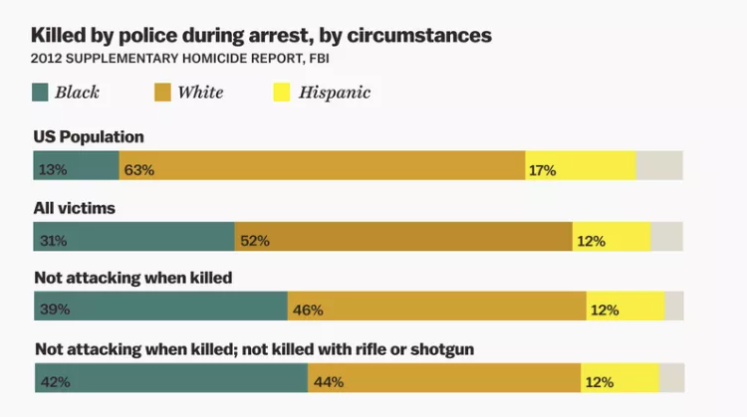
Perhaps a grave issue, then, still exists. Perhaps this research does not contradict disturbing trends found in policing previously, like unarmed Americans killed by the police being twice as likely to be black than white, across the entire nation, in the first half of 2015, or blacks who were not attacking an officer when killed making up 39% of total deaths in 2012, way out of proportion to a small black population, 13% of Americans (compared to 46% of total deaths being white, who are nearly 70% of the American population).

Screen Shot 2017-11-17 at 10.10.38 AM

via Vox

As Lind put it,

when people talk about racial disparities in police use of force, they’re usually not asking, Is a black American stopped by police treated the same as a white American in the same circumstances?… They’re saying that black Americans are more likely to get stopped by police, which makes them more likely to get killed.

Putting aside the fact that people are indeed asking that first question, you get the point. As Fryer writes in the study,

The empirical thought experiment here is that a police officer arrives at a scene and decides whether or not to use lethal force. Our estimates suggest that this decision is not correlated with the race of the suspect. This does not, however, rule out the possibility that there are important racial differences in whether or not these police-civilian interactions occur at all.

Glenn C. Loury, a mentor and colleague of Fryer, made this point as well (Making Sense, Harris) when he noted that because the study only looked at arrest data (if there is no arrest or violent incident, there is no police report), it “assumed that the processes leading to an arrest work in the same way regardless of race of the suspect.” The study showed that among the black arrestees there were more women and more unarmed persons, for instance, compared to white arrestees. Loury notes that the police may be “discriminatory in how they decide about arresting people and are quicker to arrest blacks who are less threatening than whites,” and this could possibly explain why the rate of blacks being shot is lower in the study. If the police are arresting blacks who are less of an actual danger, there may be less need to fire a weapon at them. This fact, if indeed a fact, could even coexist with the more abusive behavior against blacks. Discriminatory initiation of interactions and arrests, discriminatorily roughing someone up, but not actually needing to pull the trigger. It’s not contradictory.

Third, this study has not yet been peer-reviewed — where fellow scholars analyze Fryer’s methods to determine validity — nor published in an academic journal. It is currently a working paper for the National Bureau of Economic Research. Now, this does not at all mean it is seriously flawed, but it may be prudent to wait until the academic process is complete before celebrating the end of racism. Studies that have undergone peer scrutiny are usually the most reliable.

Fourth, Fryer’s data was provided by police departments, whose reports are not always truthful. The Guardian, which the FBI director called a leader in the documentation of police shootings, wrote that Fryer collected his information

largely by coding police narratives rather than considering the testimonials of witnesses or suspects (assuming that the suspects were not killed by the police in the shooting). The study therefore assumes police reports are unbiased sources of information about facts like whether or not the officer shoots the suspect before being attacked.

For this and other reasons, the Guardian sees the study as “misleading.”

Fryer admits that “the penalties for wrongfully discharging a lethal weapon in any given situation can be life altering, thus, the incentive to misrepresent contextual factors on police reports may be large” and that “we don’t typically have the suspect’s side of the story and often there are no witnesses.”

Fifth, and finally, it would be very remarkable if blacks were discriminated against in every arena of policing except for police shootings. Again, Fryer’s look at incidents where shots weren’t fired found significant differences in how blacks and whites are treated in comparable situations:

Screen Shot 2017-11-17 at 10.11.03 AM

via The New York Times

It would also be miraculous if experiments conducted with civilians and police officers where both were quicker to shoot armed and unarmed blacks than armed or unarmed whites did not translate into similar problems in the real world.

Studies show police officers associate blacks — innocent blacks included — with aggression and criminality (a stereotype most civilians have as well, whether or not they are aware of it). Studies like one in 2002 show that ordinary civilians in simulations are far quicker to shoot armed blacks than armed whites, and decide quicker to spare an unarmed white than an unarmed black. 2005 research in Psychological Science showed police officers were more likely to mistakenly shoot unarmed blacks than unarmed whites. Happily, the bias diminished with extensive time in the simulation.

The 2006 study mentioned earlier, published in Basic and Applied Psychology, found that during simulations, as Fair and Impartial Policing put it,

Officers with negative attitudes toward Black suspects and negative beliefs regarding the criminality of Black people tended to shoot unarmed Black suspects more often in the simulation than officers with more positive attitudes and beliefs toward Blacks.

Studies from 2007 and 2009 suggest that officers with anti-black biases won’t act on them if they’ve gone through high-quality use-of-force training that diminishes implicit prejudice, a factor related to our first point above — some police departments have much more effective training than others, which can be the difference between life and death for civilians.

Jordan Weissmann writes:

Why would police officers be more likely to get rough with black and Hispanic subjects, but not more likely to fire on them? Fryer suggests it might be a matter of stakes. In theory, police stand to lose a lot more if they shoot the wrong guy than if they give him a blow with a nightstick. But there isn’t hard proof for that narrative, and frankly, given how rarely police appear to be punished after shootings, it’s not especially satisfying.

The Guardian wrote:

Fryer assumed shootings are not necessarily linked to a more general use of police force. Such an assumption seems hard to support: a black person in New York who is stopped by the police is 24% more likely to have a gun pointed at them than a white person, so why would they be no less likely to be shot by an officer? The two seem inextricably linked.

All this is not to say with certainty that Fryer’s work is flawed. But there are reasons to ask serious questions.

Inarguably, it is hardly time for black and white liberals to breathe a sigh of relief and make the Black Lives Matter movement a thing of the past, nor is it time for conservative Americans to pat themselves on the back for being right about racism being fictional. One study — or even two or three — isn’t quite enough for that, especially one that hasn’t been published and may not even contradict other research.

There is a mountain of evidence that both overt and subconscious racism greatly affect the lives of people of color (see The Evidence of Widespread American Racism). Even if, somehow, American police officers were never affected by implicit or explicit biases when reacting or deciding, there would still be much work to be done in the battle against discrimination.

Likewise, even if the police killed civilians without racial bias, mass protests against unnecessary police force would be a very positive thing for our society.

For more from the author, subscribe and follow or read his books.