A Guide For Christians to See If You’re Discriminating

Sometimes, it seems as if an important ethical maxim, the Golden Rule, is difficult for people of all religions (or no religion) to put into practice.

The Golden Rule is found in several ancient religious or philosophical texts. In Christianity, it’s found in the book of Matthew: “Do to others what you would have them do to you.” In Islam, it’s in the Hadith: “Not one of you truly believes until you wish for others what you wish for yourself.” Far older than either of these are the words of Confucius, who said in the Analects, “Do not do to others what you do not want done to yourself.” This idea helps create a more tolerant and peaceful society for everyone — if it’s acted upon.

A simple role reversal is required to put this rule into practice. All people must engage in this reversal, but in a nation with a Christian majority, the news is often chock-full of events where Christians are clearly failing to engage in it, which leads to discrimination against certain groups, and makes an article like this necessary, as embarrassing as that is.

In a decent and diverse community such as our own, religion cannot serve as an excuse for discrimination. You are free to practice your religion as you wish, as long as it doesn’t infringe upon the rights of others or wander into the political sphere — this is, after all, a secular nation. It is a nation for all people and all religions, not just the majority faith. When you are forced to stop discriminating (yes, forced to go against the ancient edicts of your deity), that is not discrimination against you, just like if an atheist or a person of another religion was forced to stop discriminating against Christians it would not be discrimination against them. When the State enforces policies aimed to broaden equality, you are not a victim. Don’t think of yourself as one. Think of yourself as helping bring the Golden Rule to life.

Discrimination happens when you don’t apply the Golden Rule. Equality is what happens when you do. Therefore, the rule is a call for equality.

So without further ado, some role reversals.


You just refused to provide goods, services, or education to someone who’s gay.

If someone refused to provide goods, services, or education to you because you’re a Christian, would it be discrimination?


You just said keeping Muslims out of your country and monitoring mosques are smart ideas.

If someone wanted to keep Christians out of certain neighborhoods or an entire nation, or monitor churches, would it be discrimination?


You think people should swear oaths on the Bible, display the 10 Commandments on government property, and say prayers to God in Congress.

If someone said they thought people should swear on the Quran, wanted the words of Muhammad displayed at government offices, or wanted to allow prayers to Allah in Congress, would that sound like nonsense?


You think stores and schools that celebrate “holidays” instead of “Christmas” are waging a war on Christianity.

If someone said stores and schools celebrating “holidays” instead of Kwanzaa or Hanukkah were waging wars on African-Americans or Jews, wouldn’t you laugh at them?


You think trans people should be forced to use a bathroom that doesn’t match their gender identity.

If you were born one gender but identified as the other, and wanted to use the bathroom that matched your identity, but someone wanted to ban you from doing so, wouldn’t that be an unnecessary violation of your personal liberty and privacy?


You think Christian creationism should be taught in public schools, but not Greek, Native American, Hindu, or Islamic creation stories.

If someone wanted public schools to teach other creation stories but leave out Christianity’s, wouldn’t that be rude?

For more from the author, subscribe and follow or read his books.

The Bible is Rife With Contradictions and Changes

During discourse on religion, nonbelievers generally acknowledge that criticism of character doesn’t prove fictionality.

In other words, showing that the Judeo-Christian god is a monster because he murders innocent people for the crimes of others, commands his followers to commit genocide against women and children, orders the execution of nonbelievers, non-virgins, and homosexuals, or simply lies to people (see Absolutely Horrific Things You Didn’t Know Were in the Bible) does not mean he does not exist. Showing God is an evil madman because he crafts a divine plan in which one age calls for followers to destroy their neighbors and the next calls for them to love their neighbors (see Either God Changes or He’s Psychotic: Comparing Testaments Old and New) does not mean he’s complete fiction.

A deity could exist but simply be violent, morally inept, or unpleasant. Or, from the perspective of the religious, God could use violence and oppression out of “love” for his favored creations, wiping out civilizations so the Jews could get their land or destroying sinners so others would be scared straight.

Now, there are many sensible reasons to suppose the Judeo-Christian god, like so many others, is a man-made fiction, but they are not addressed here. Instead, our attention must turn to the common claims that the Bible has never been changed over time by various scribes nor contains internal contradictions.

Showing that it has and does will of course not disprove God either (just as showing changes to or contradictions in Homer’s works will not disprove the Greek gods). It could be a deity exists that does not mind flawed or edited scriptures. Yet showing such common claims are demonstrably false is valuable in itself, because the truth seems important to most people.

Contradictions

The Bible’s internal contradictions vary in their degree of debatability.

Take for example Genesis 6:3, where God says to himself, “My Spirit will not contend with humans forever, for they are mortal; their days will be a hundred and twenty years.” Yet in Genesis 9:29, Noah dies at the ripe old age of 950. Other characters live for many centuries after this as well. Though this is strange, perhaps we can say God changed his mind (if that is even possible for a being that knows the future), only meant average people and not special folks like Noah, or was actually speaking of how many years remained before the flood that destroyed humanity.

Next, as Moses is trying to free his people from Pharaoh, God’s fifth plague is the “plague on livestock,” during which “all the livestock of the Egyptians died” (Exodus 9:6). But during the seventh plague, the hail, the Egyptians have livestock again: “Those who ignored the word of the Lord left their slaves and livestock in the field” (Exodus 9:21-22). After the hail, the firstborn of the livestock then died in the tenth plague (Exodus 12:29). Perhaps we can imagine that Egypt quickly imported new cattle.

When God says “And of every living thing of all flesh, two of every sort shalt thou bring into the ark, to keep them alive with thee; they shall be male and female” in Genesis 6:19, but then says “Take with you seven pairs of every kind of clean animal, a male and its mate, and one pair of every kind of unclean animal, a male and its mate” in Genesis 7:2-3, was he changing his mind? Or was he simply clarifying, in that all creatures would have at least one pair, but some special ones would have more?

Sometimes reimagining the timing of events can help fix contradictions. Why would Matthew 26:17-20, Mark 14:12-17, and Luke 22:7-14 explicitly state that Jesus and the 12 ate the Passover the evening before he was killed, but the pharisees in John 18:28, when Jesus is being convicted and murdered, be thinking of eating the Passover that evening — indicating it hasn’t happened yet? John 19:14 stresses the point: the crucifixion occurs on the “day of Preparation of the Passover” — the Passover meal is coming up. (Mark 15:42 mentions a day of preparation, but for the Sabbath, something different that occurs each week.) John 13:1 has a last supper, but it isn’t described as the Passover. So which is it, was Jesus killed after Passover or before? Well, one can imagine Jesus simply broke tradition and ate his own private Passover a day early (on the evening the Day of Preparation begins rather than on the evening it ends, when Jews were supposed to, for those of you who know how Jewish days worked). Jesus knew he would be killed the next day, after all, and wouldn’t get to eat the Passover on the appropriate evening. The first three gospels never indicate this is an early, non-traditional Passover, they simply say it was the Passover meal. The last supper in John is described as “just before” the Passover festival, but isn’t called the Passover at all. Still, the gospels never say it wasn’t an early Passover meal, so why not assume it was to avoid contradiction? People say the Bible has never been changed, but we can change it in our heads.

It has been pointed out, we should note, that placing the crucifixion before the Passover neatly makes Jesus the symbolic, sacrificial lamb — lambs were killed on the Day of Preparation, after noon. John is the only gospel to refer to Jesus as the “lamb of God” and also the gospel that moved up the execution to before Passover (Jesus, Interrupted, Ehrman).

Now, consider who went to Jesus’ tomb with Mary Magdalene. Is Mary Magdalene seemingly alone (as in John 20:1), with “the other Mary” (Matthew 28:1), with the other Mary and Salome (Mark 16:1-2), or with Mary the mother of James, Joanna, and “the other women” (Luke 24:10)? Are these conflicting accounts? Or do some authors just not bother to mention some of the folks with Mary Magdalene? (Note also how Peter appears to run to the tomb alone in Luke 24:9-12, but has John with him in John 20:1-10.) Likewise, it’s interesting that while both Matthew and Luke have Jesus born in Bethlehem and then settle down in Nazareth, the two stories are dramatically different, in that neither mentions the events of the other. King Herod kills children and Jesus flees to Egypt in Matthew, but Luke doesn’t bother mentioning either. Luke has the ludicrous census (everyone in the Roman Empire returning to the city of their distant ancestors, creating mass chaos, when the point of a census is to see where people live currently), the full inn, and the manger, but Matthew doesn’t. The family seems to move to Nazareth from Egypt in Matthew (2:8-23), after Herod dies, but in Luke (2:16-39) the move to Nazareth appears to occur just after the family visit to Jerusalem, which took place after Jesus was thirty-three days old (see Leviticus 12, which outlines the rituals conducted in Luke), no flight to Egypt mentioned. These stories can be jammed together into a mega-narrative successfully, but it takes some work. Other musings should be made concerning who buried Jesus. Was it Joseph of Arimathea, a member of the Sanhedrin council, seemingly alone (Mark 15:43-46)? Did Nicodemus, also a member of the Sanhedrin (John 3:1) help him (John 19:39-40)? Or was it seemingly the Sanhedrin as a whole (Acts 13:27-29), even though “all the council sought testimony against Jesus to put Him to death” (Mark 14:55)? Why would they all help bury him if they were the ones who pushed Pilate to kill him?

And what of the incident in the temple-turned-market? While Matthew (21:12-13) and Mark (11:15-17) have Jesus driving the merchants from the temple at the end of his ministry, John has it at the beginning (2:15-16), right after Jesus’ very first miracle! The stories are clearly the same: he overturns the tables of the money changers and dove sellers, then says, “It is written…‘My house will be called a house of prayer,’ but you are making it ‘a den of robbers'” (Matthew, Mark) or “Stop turning my Father’s house into a market!” (John). Are we to believe the same incident happened twice? And each author ignored one of them? Or does temporal sequence really not matter at all?

Next look at Matthew 16:27-28, when Jesus, after describing returning with his angels and rewarding all according to his or her deeds, says to the people with him, “Some who are standing here will not taste death before they see the Son of Man coming in his kingdom.” Matthew 24:3-35 says at “the end of the age” the “stars will fall from the sky,” with “the Son of Man coming on the clouds of heaven, with power and great glory,” sending forth “his angels with a loud trumpet call.” Jesus tells his followers that “this generation will certainly not pass away until all these things have happened.” (The same is promised in Mark 8:38-9:1 and 13:24-30, with the same context: “after that tribulation” [NASB]. It is also promised in Luke 21:25-36.) This very much sounds like the Last Judgement discussed in Revelation, when Jesus will be “coming with the clouds” (1:7), the “armies of heaven” (19:14) with him, but also his “reward,” to “give to each person according to what they have done” (22:12-13).

Yet the people Jesus spoke to are all dead.

They tasted death before the Last Judgement. (The myth of the Wandering Jew, someone from Jesus’ time who is still alive today and will be until Jesus’ return, arose in the Middle Ages to “fix” this problem.) But we shall keep an open mind. Perhaps Jesus changed his mind or was speaking about his crucifixion and resurrection as many believers insist, despite blatant references and similarities to the Last Judgement story.

Consider another example. Although we are assured that “it is impossible for God to lie” (Hebrews 6:16-18), we are also assured God can in fact “deceive” people (Ezekiel 14:9, Ezekiel 20:25-26), even that “God shall send them strong delusion, that they should believe a lie” (2 Thess. 2:11-12). So is it possible for God to “deceive” and “delude” people, but not “lie” to them? Perhaps a believer would insist a lie has to be spoken, whereas a deception or delusion doesn’t, so there is no contradiction. But others would say that because a lie is a deception, and God is capable of deception, that it is possible for God to lie — meaning this is a contradiction.

Excuses become a bit harder to create with other verses.

Consider:

Mark 15:37-38: “With a loud cry, Jesus breathed his last. The curtain of the temple was torn in two from top to bottom. And when the centurion, who stood there in front of Jesus, saw how he died, he said, ‘Surely this man was the Son of God!'”

Matthew 27:50-52: “And when Jesus had cried out again in a loud voice, he gave up his spirit. At that moment the curtain of the temple was torn in two from top to bottom. The earth shook, the rocks split and the tombs broke open.”

Both describe the same event: the temple curtain is torn in two when Jesus dies.

Now to Luke 23:44-46:

It was now about the sixth hour, and there was darkness over the whole land until the ninth hour, while the sun’s light failed. And the curtain of the temple was torn in two. Then Jesus, calling out with a loud voice, said, “Father, into your hands I commit my spirit!” And having said this he breathed his last.

In Luke, the temple curtain is torn before Jesus dies. There is even enough time for Jesus to say his final words in between.

Believers may shrug this off (“What difference does it make?”), but this is precisely what nonbelievers mean when we talk about internal contradictions. Both stories cannot be true — unless we suppose the Bible breaks out of chronological patterns at our convenience (so Luke is accurate, and Mark and Matthew align neatly because “the curtain of the temple was torn in two” refers to an event before Jesus breathes his last, even though it’s positioned after, alongside other events that do happen after, such as an earthquake). In this effort, the word “then” is simply ignored as meaningless.

Other contradictions have even less wiggle room.

  • Matthew 8:5, Luke 7:3, and Luke 7:6 are confused as whether the centurion found Jesus himself or if he sent elders (or “friends”).
  • In Matthew 27:3-8, Judas hangs himself; in Acts 1:16-19 he falls headlong and his body bursts, spewing his bowels on the ground.
  • In Matthew 27:3-10, the chief priests buy a field (the Field of Blood) with the blood money Judas returned to them; in Acts 1:16-19, Judas himself bought the Field of Blood with the blood money, which he kept.
  • Mark 5:21-43 and Matthew 9:18-26 tell the story of a synagogue leader (named Jairus in Mark) who comes to Jesus begging him to heal his daughter. Jesus goes with the man, but is interrupted by a woman, who has suffered from bleeding for 12 years, touching Jesus’ clothing to heal herself. The woman is magically cured, and Jesus continues on and raises Jairus’ daughter from the dead. But in Mark, Jairus says his “daughter is at the point of death” (5:23) to Jesus but is informed when he arrives home that “your daughter is dead” (5:35). But in Matthew, Jairus originally says to Jesus, “My daughter has just died” (9:18). Did Jairus believe his daughter was about to die or already had passed?
  • Exodus 33:20 and John 1:18 claim no one has ever seen God and lived, forgetting Moses, Aaron, Nadab, Abihu, and 70 other people (Exodus 24:9-11), Adam and Eve during their time in the Garden, Hagar (who seems amazed to have “stayed alive here after seeing Him,” Genesis 16:13, NLV), and Abraham (Genesis 18:1-13).
  • Matthew 21:12-19 and Mark 11:12-17 can’t agree on whether Jesus cursed a fig tree before driving merchants from the temple or the day after.
  • 2 Kings 8:26 says Ahaziah was 22 when he began to reign; some versions of 2 Chronicles 22:2 say 42. (Some Biblical scholars, even those at Ken Ham’s ultraconservative Answers in Genesis, admit this may be a copyist’s error!) Biblical footnotes acknowledge this error:
Screen Shot 2017-11-17 at 9.33.45 AM

via Biblehub

  • 2 Kings 24:8 says Jehoiachim was 18 when he became king; 2 Chronicles 36:9 says he was 8. (This difference has likewise been called a copyist error by Christian groups like Third Millennium Ministries.) This is also described as a mistake in Bible footnotes:
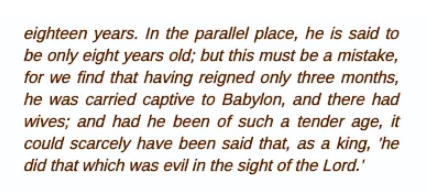
Screen Shot 2017-11-17 at 9.35.55 AM

via Biblehub

  • Mark 15:25 says Jesus was crucified at the third hour (9 a.m.), after being convicted by Pilate, mocked, beaten, and made to carry his cross; John 19:14-15 says Jesus wasn’t even convicted by Pilate until the sixth hour (noon). Some apologists insist Mark was using Jewish timekeeping (so the third hour was 9 a.m., three hours after sunrise) and John was using Roman timekeeping (so the sixth hour was actually 6 a.m., six hours after midnight — not noon). Yet two dozen translations of John (NIV, NLT, MSG, etc.) say it was “noon.” Only four say it was “six in the morning” (GW, HCSB, ICB, NOG). Which is it?
  • 2 Samuel 6:23 says Michal had no children before she died; 2 Samuel 21:8 says she had five (at least, some versions do; as Answers in Genesis explains, some manuscripts have “Michal” but others have “Merab,” Michal’s sister, which is now widely used in modern Bibles).
  • Acts 9:7 says the men with Paul on the road to Damascus heard the sound of the Lord; Acts 22:9 says they did not.
  • In Matthew 28:2, the stone of Jesus’ tomb is rolled away by an angel in front of the women who come to visit, during an earthquake; in the other gospels, the stone has already been rolled away when they arrive.
  • Matthew 28:2-7 and Mark 16:5 say one angel (Mark actually says “man”) appeared to the women; Luke 24:4 and John 20:12 say it was two (Luke actually says “men”).
  • Mark 16:8 says the women said nothing of their experience; in the other gospels they report it immediately.
  • In Matthew 28:2-9, Mary does not see Jesus before going back from the tomb to the disciples; in John 20:2-14, she does.
  • Jesus first appears to all 11 disciples either on a mountain in Galilee (Matthew 28:5-17) or in a room in Jerusalem (Luke 24:33-39, John 20:1-20).
  • While Matthew 10 and Mark 3 include Thaddeus in the 12 disciples, he is not mentioned in Luke, John, or Acts (instead, there is a Jude/Judas, son of James, who is not in Matthew or Mark). Also, in John chapter 1, it is implied that a Nathanael joins Christ’s 12. He is not mentioned in the other gospels or Acts.
  • In John 13-17, the Last Supper scene, Jesus marvels, saying, “Now I am going to the one who sent me, yet none of you asks me, ‘Where are you going?'” (John 16:5) right after Peter asks him, “Lord, where are you going?” (13:36) and Thomas says, “Lord, we do not know where you are going” (14:5).
  • Deuteronomy 5:1-22 makes clear the 10 Commandments we all know were written on the first stone tablets, the ones Moses later smashed apart (Exodus 20 and 31:18 imply the same). Exodus 34:1-27 makes clear that the new, second tablets have a very different 10 Commandments (“Do not cook a young goat in its mother’s milk”). A rewrite isn’t necessarily a contradiction, but Exodus 34:1 says God was going to “write on them the words that were on the first tablets,” as does Deuteronomy 10:1-5. Did God change his mind last minute?
  • In Acts 9:17-27, it very much appears that Paul, after seeing Jesus on the road to Damascus, spends some time in Damascus and then goes to Jerusalem and meets the apostles. But in Galatians 1:15-20, Paul insists he did not go to Jerusalem for years after his conversion and only met one apostle there. In verse 20, he even insists he is not lying — suggesting some controversy around this issue.
  • Genesis 1:11-27 says plants and vegetation were created before Adam; Genesis 2:4-7 says Adam was created first.
  • 2 Samuel 24:1-10 and 1 Chronicles 21:1-8 disagree over the count of David’s census (and while they were perhaps both involved, the former ignores Satan’s role and the latter ignores God’s role).
  • When Jesus sends out the 12, he either orders them to take a staff (Mark 6:6-11) or forbids it (Matthew 10:1-14).     

Though the human imagination can conjure explanations for why two stories are radically different (“Judas hung himself, but the rope snapped and his body exploded when he hit the ground”), this doesn’t rule out the possibility that one of the stories, or both, are flawed or fictional.

Changes

An easy way to begin this topic is to simply consider the names of biblical characters. Christians don’t want to believe that biblical translations over time altered original stories, but one small way they obviously did was by giving characters altered names. Jesus did not consort with John and James. They were in the Middle East, not an English pub. Instead, Yeshua (ישוע) consorted with Yohhanan (יוחנן) and Ya’akov (יעקב). Hebrew and Aramaic names were translated into Greek and later into English (and other tongues), resulting in names of different pronunciation than were actually used. Mattityahu became Matthaios and finally Matthew. (No, English speakers did not independently have a name like “John” and then “translated” Yohhanan [Hebrew] or Ioannes [Greek] to the pre-existing John, as if there was some magical lingual match or a “Hey, this name sounds a bit like one of ours” situation! Study the etymology of these names. The only reason John existed in English is because over centuries the name Yohhanan, thanks to the bible, spread beyond Palestine, through other parts of Europe, and finally to the English-speaking world, changing along the way.) If something as simple as names and their pronunciations could change from actual people to written text, and then translation to translation, could other things have changed, too?

New Testament scholar Bart Ehrman (Misquoting Jesus) was shocked to discover for himself the story of Christ and the adulteress (“Let he who is without sin throw the first stone”) is not in our oldest copy of John. He says:

The story is not found in our oldest and best manuscripts of the Gospel of John; its writing style is very different from what we find in the rest of John (including the stories immediately before and after); and it includes a large number of words and phrases that are otherwise alien to the Gospel. The conclusion is unavoidable: this passage was not originally part of the Gospel.

This is admitted by Biblical scholars and often found in footnotes to John in both physical and online Bibles:

Screen Shot 2017-11-17 at 9.36.55 AM

via Bible Gateway

Likewise, the last 12 verses of the Gospel of Mark are missing in our earliest manuscripts (see biblical footnotes). They end with Mary Magdalene and two women finding the empty tomb and meeting an angel who says Jesus has risen from the dead. The earliest texts end with verse 16:8: “Trembling and bewildered, the women went out and fled the tomb. They said nothing to anyone, because they were afraid.”

Perhaps we can give these texts the benefit of the doubt, and suppose they were included but were lost over time — even though many New Testament scholars admit this is probably not the case, and Biblical footnotes are quite open about the issue:
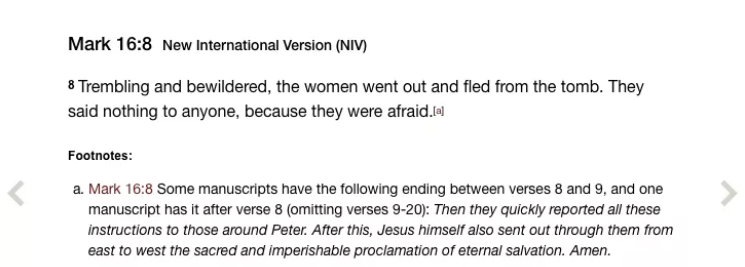
Screen Shot 2017-11-17 at 9.37.46 AM

via Bible Gateway

In addition, there’s the Comma Johanneum. While later New Testament texts included an explicit mention of a Trinity in 1 John 5:7-8, earlier texts do not. The Latin Vulgate reads:

These are three that bear witness in heaven: the Father, the Word, and the Spirit, and these three are one; and there are three that bear witness on earth, the Spirit, the water, and the blood, and these three are one.

But earlier Greek manuscripts read:

These are three that bear witness: the Spirit, the water, and the blood, and these three are one.

Christian sites like Compelling Truth admit:

The evidence for this longer, more direct statement as part of the original text of 1 John, however, is not strong. Its presence was not known in Greek until manuscripts of the fifteenth century. Even then, most versions are found only in Latin translations. The Greek linguist Erasmus did not include this longer ending in his earlier editions of the Greek New Testament, yet included it in later editions (beginning with the third edition) after pressure from the Roman Catholic Church.

Today, some Bibles stick with the original Greek, admitting in footnotes that the later Latin Vulgate speaks of the Trinity but that it’s “not found in any Greek manuscript before the fourteenth century”:

Screen Shot 2017-11-17 at 9.39.23 AM

via Bible Gateway

Further, the traditional ending of the Lord’s Prayer (“For yours is the kingdom and the power and the glory…”) was an addition to later manuscripts of Matthew 6, as stated in biblical footnotes. Some manuscripts added the appearance of an angel to John 5:3-4 and words from Philip to Acts 8:36-37. The Book of Daniel had three stories added to it when translated into Greek; these additions were mostly removed, but can still be found in some translations, such as the NABRE. Greek-speaking translators also altered Psalms 40:6 from “ears you have opened” to “body you have prepared.” In Mark 14:30, Jesus tells Peter that Peter will deny him before the rooster crows twice, but the word “twice” does not appear in some early manuscripts. (The addition creates a contradiction with Matthew 26:34, Luke 22:34, and John 13:38, where Jesus says this will occur before the rooster crows at all.) Today 2 Samuel 21:19 may say Elhanan “killed the brother of Goliath,” but the original Hebrew does not have “the brother of.”

As Ian McEwan notes in “The End of the World Blues,” one of the earliest copies we have of Revelations 13:18, the Oxyrhynchus P115, gives the number of the beast as 616, not 666!

The same is true of a few other younger manuscripts (Codex C/04 from the 1500s, for example). So even while Christian writers point out that many more manuscripts contain 666, they must admit that “two equally old papyri have both readings – 666 and 616” — our two oldest papyri, to be specific, both from the 3rd century. A famous bishop named Irenaeus, writing Against Heresies around 175-185 A.D., even had to argue that 666 was the correct number: “I do not know how it is that some have erred following the ordinary mode of speech, and have vitiated the middle number in the name, deducting the amount of fifty from it, so that instead of six decads they will have it that there is but one.” Whichever number came first is up for debate (perhaps we can trust Irenaeus had seen the original texts or was incapable of error, though we have zero evidence of this), it doesn’t really matter to our purposes here.

What matters is that someone, at some point, changed something. Bibles with errors existed — and still do.

For more of the thousands of changes enacted accidentally (through translation and copy errors) and intentionally (to serve personal preferences and beliefs, and to try to create a consistent doctrine) by Christian scribes and church leaders, see Misquoting Jesus. (There also exist stories that have simply been recycled in the Bible: see Genesis 19:4-8 and Judges 19:22-24 for similar stories of men surrounding a house to rape male houseguests and the homeowner offering his virgin daughters to them instead. A patriarch pretends his wife is his sister to avoid being killed by foreigners, but the foreign king learns the truth, at the start of Genesis 12, 20, and 26.)  

When you read the New Testament you may become suspicious right off the bat regarding changes to the stories. The following is more speculative than what we’ve seen thus far, but interesting to think about. Just as the earliest copies of Mark lack the final 12 verses, the book contains no virgin birth story or claim. Jesus first appears as an adult. It may seem odd that Mark, the earliest gospel, did not mention such an incredible, supernatural origin (nor did Paul’s letters, most written even earlier!). That tale isn’t told until several years later, with the Book of Matthew. Believers typically insist that when a gospel doesn’t mention a miracle, speech, or story it’s because it’s covered in another. (When the gospels tell the same stories it’s “evidence” of validity, when they don’t it’s no big deal.) This line only works from the perspective of a later gospel: Luke was written after Matthew, so it’s fine if Luke doesn’t mention the flight to Egypt to save baby Jesus from Herod. Matthew already covered that. But from the viewpoint of an earlier text this begins to break down. It becomes: “No need to mention this miracle, someone else will do that eventually.” So whoever wrote Mark ignored one of the biggest miracles in the life of Jesus, proof of his divine origins? Or did the author, supposedly a disciple, not know about it? Or did gospel writers conspire and coordinate: “You cover this, I’ll cover that later.” Is it just one big miracle, with God ensuring that what was unknown or ignored (for whatever reason, maybe the questionable “writing to different audiences” theory) by one author would eventually make it into a gospel? That will satisfy most believers, but an enormous possibility hasn’t been mentioned. Perhaps the story of Jesus was simply being embellished — expanding over time, like so many other tales and legends (see Why God Almost Certainly Does Not Exist).

Consider a similar example. The last gospel written, John (90-95 AD), is quite different from Mathew, Mark, and Luke (which are called the synoptic gospels because they are more similar in stories and phrasing — scholars suspect plagiarism). Not only does John contain tales and miracles the earlier authors don’t bother to mention, but Jesus is more clear about who he is. In the synoptic gospels, Jesus says he is the messiah (Christ), the Son of Man, and the Son of God (for example, Mark 14:61-62), but nowhere explicitly claims he is God himself. (This is not to say the gospel writers did not believe Jesus to be God himself — Matthew 1:23 gives Jesus a name meaning “God with us” — but rather this is about changes to the words attributed to Jesus, changes to make him more clear about who he was.) As such terms were applied to others who were not believed to be God (angels in Genesis 6:1-2, for example), scholars debate their meaning; one can at best say Jesus only implied oneness or equality with God. Regardless, all agree John is more explicit. Jesus says, “I and the Father are one” (10:30) and “The one who has seen me has seen the Father” (14:9). Jesus refers to himself as “I AM,” the name God called himself with Moses. We know such things were bolder and more explicit because in the gospels the Jews only pick up stones to kill Jesus after he says this in John 8:58-59 — it was more blasphemous. All this raises an obvious question. If Jesus said such bold things (in public, to disciples and observers, not just to John), why do Matthew, Mark, and Luke not bother to include them? Jesus clearly calling himself God is a hugely important statement. The most sensible answer is that the story of Christ was growing more embellished — new words were put in his mouth to clarify once and for all who he was. There were in fact various Christian sects at this time that had different ideas of whether Jesus was God, less than God, just a man, etc. The author of John appears to be joining this debate, and taking a side. See How Jesus Became God, Ehrman.

The scriptures are still changing in substantial ways today, from the English Standard Version making it sound like women are the source of marital conflict to the Christian Standard Bible replacing male-centric language with gender-inclusive language (or “political correctness,” as critics put it). There have also been efforts to make the text less explicitly sexist. For example, most translations of Isaiah 19:16 (NLT, KJV, NASB, ESV, etc.) say that Egyptians will become fearful “like women,” accurately using the original Hebrew word nashim (women), the NIV changes it to “weaklings.” It does the precise same thing with Nahum 3:13.

The places where different translations of the bible substantially change the text are indeed too numerous to list here in full, but one common one is 1 Samuel 6:19, where God either kills 70 people or 50,070 people.

Screen Shot 2018-03-21 at 10.21.06 PM

via Bible Gateway

Another is 1 Chronicles 20:3. Some translations have David putting captives “to work with saws” (NRSV), others say David “cut them with saws” (KJV). The psalmist is either instructed by his heart (NIV), his kidneys (JUB) or reins (KJV), or his mind (NASB) in Psalm 16:7. God has the strength of wild ox (NIV) or unicorn (KJV) in Numbers 24:8 and 23:22. Isaiah 59:5 speaks of either vipers (NIV) or cockatrices (KJV), a mythical dragon creature with legs, plus the head of a rooster. Isaiah 13:21 features either wild goats (NIV) or satyrs (KJV), the mythological half-man, half-beast creature. Multiple versions of Deuteronomy 32:22 say “poison of dragons” instead of “poison of serpents.” The King James Version is older, more seeped in ancient thought (though Job still describes a dragon in any version of Job 41:12-34).

Finally, does Isaiah 7:14 say a virgin will give birth to a son, to be named Emmanuel? Or a young woman? The NAB Revised Edition switched from virgin to young woman, as did the Revised Standard Version and others, to better reflect what biblical scholars mostly agree on: the Hebrew word almah did not have anything to do with virginity in this context. Even devout Christian scholars argue this, further insisting that Isaiah 7:14 is not a prophecy of the messiah at all. How can anyone believe their bible has never been changed when “Revised” is in fact in the title? The latest NRSV contains 20,000 changes.

The Most Interesting Contradiction of All

Finally, a closer look at one of the most fascinating contradictions in the Bible.

The lineages of the Hebrews offered in 1 Chronicles 1-3, Matthew 1:1-17, and Luke 3:23-38 are radically different, in the number of generations between certain people, and the people included. All use the “son of” or “father of” line, and all go back at least to Abraham, winding their way to David and later Joseph along different routes.

Matthew has 28 generations from David and Jesus, whereas Luke has 44. Only a few names in these lists are the same, and different people are given for Joseph’s father (Jacob v. Heli), grandfather (Matthan v. Mathat), great-grandfather (Eleazar v. Levi), and more. 1 Chronicles obviously doesn’t go all the way to Jesus, but after David it includes 5 people Matthew leaves out, and has only 3 people Luke mentions. (We’ll put aside the fact that Jesus, not being Joseph’s biological son, wouldn’t actually be part of David’s bloodline — not through his father’s side of the family, anyway.)
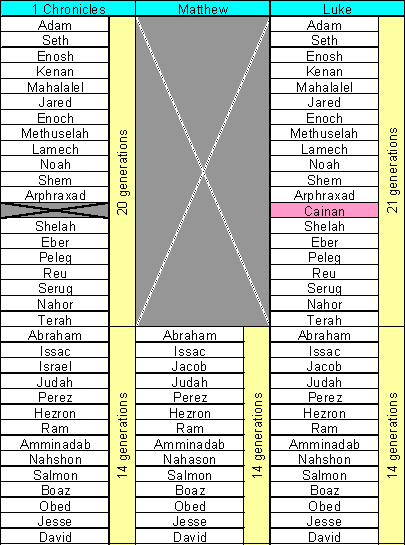

Screen Shot 2017-11-17 at 9.41.49 AM

Screen Shot 2017-11-17 at 9.42.22 AM

via The Atheists

Believers think each list was recording something different. Perhaps Matthew was documenting the passing of the rightful title of king (not always biological descendants, some adopted, nor always direct between generations, as some were not worthy of the title and denied it), Luke was documenting Mary’s lineage (using the males, likewise adopted at times), and Chronicles the direct, biological descendants of Adam. 

Plausible enough. After David, the royal line goes one way with one of his sons, Solomon, Mary’s ancestors another way with an unlucky son, Nathan. Different lists, different people. Some people could end up on both lists, like Shealtiel and Zerubabbel, through adoption, marriage, remarriage, incest — the typical shuffling around of family in ancient times. Zerubabbel is called Shealtiel’s son in Matthew, Luke, and elsewhere, but in Chronicles it’s his nephew; believers speculate that Shealtiel adopted Zerubabbel. There is no problem imagining an adopted son, a nephew, would be called “son” in a lineage. 

Believers speculate, further, that a son-in-law would be called a son, so while in Luke it says Joseph was Heli’s son, perhaps he was Heli’s son-in-law, and the actual son of Jacob. They conclude Heli was Mary’s father, and though the Bible doesn’t say this anywhere, it is possible. And again, Christians claim part of the reason why Matthew has so few generations from David to Jesus is because the royal line could be disrupted or delayed, with the crown, literal or figurative, denied.

But questions persist. If you study the lineages closely, you will notice two interesting things:

First, Matthew leaves out 5 kings from Chronicles. Why doesn’t really matter. Believers claim it was no human error (because that’s impossible when it comes to the Bible), that there were valid reasons: 3 of the kings were evil and thus stripped of or denied their royal title, for example.

But perhaps it was on purpose for a different reason. By leaving out names, Matthew is able to say (Matthew 1:17): “All the generations from Abraham to David were fourteen generations, and from David to the deportation to Babylon fourteen generations, and from the deportation to Babylon to the Christ fourteen generations.” Implied in this is some sort of divine significance.

Perhaps it was indeed a miracle that the royal line was disrupted in such a way that led to numerical balance between major events in Jewish history. But it’s possible the author created the pattern, by leaving out people from the Chronicles lineage. It could easily be man’s miracle, not God’s.

Second, Matthew 1:17 essentially speaks of 42 generations from Abraham to Jesus: if you include Abraham’s generation and Jesus’ generation, that’s 14 individual generations in 3 eras, 14 x 3 being 42. Yet he only mentions 41 names, including Abraham and Jesus, in 1:1-16. It’s a mathematical contradiction. If you included Abraham and Jesus and everyone in between in your total time period in Matthew 1:17 (42 generations in all), you should list 42 specific names to match. The names don’t align with the generations.

  • Abraham to David: Verse 1:17 says 14 generations. The name list confirms: Abraham to David, including David, is 14 people.
  • David to Exile (which begins in Josiah’s generation): 1:17 says 14 generations, but you shouldn’t count David twice, in two generations. It must mean after David. So we don’t include David. The list says Solomon to Josiah is 13 people.
  • Exile to Jesus: 1:17 says 14 generations. Obviously, we can’t count Josiah again. Leave him out. Jechoniah to Christ is 14 people.

41 people total.

The only way to get to 42 names between Abraham and Christ (including Abraham and Christ) is to count someone twice. You can count anyone twice, but it’s usually David, since he is mentioned by name in 1:17. One has to say, “David counts for one person, but two generations” to make it all fit. That doesn’t make sense.

More reasonable? The author left someone out accidentally. A human error, dropping his name count to 41. Or perhaps it was a simple miscount of his total. Intentionality, positioning David back-to-back in 1:17 and hoping no one noticed there weren’t actually 42 generations, is possible as well, if less likely.

For more from the author, subscribe and follow or read his books.

God Ordered Abortions

The Judeo-Christian God instructs his followers to do many disturbing and barbaric things, and indeed does many himself, in the bible — mostly in the Old Testament, but to an extent in the New Testament (see Absolutely Horrific Things You Didn’t Know Were in the Bible).

One interesting decree was in Numbers 5, where God is explaining to Moses how to maintain “The Purity of the Camp,” to quote the chapter title. According to the story, this is when Moses is leading the Hebrews through the wilderness toward the Promised Land, and receives laws of conduct from God at Mount Sinai.

God outlines a way for men to determine if their wives have been unfaithful, and it involves forced abortion for the women who became pregnant due to infidelity.

Women are made to drink a “bitter” “holy water” containing “dust from the Tabernacle floor.” If the woman is innocent of adultery, the water will not harm her. If she is guilty, it will cause her to miscarry, should she be pregnant.

Numbers 5:11-22 (NIV):

Then the Lord said to Moses, “Speak to the Israelites and say to them: ‘If a man’s wife goes astray and is unfaithful to him so that another man has sexual relations with her, and this is hidden from her husband and her impurity is undetected (since there is no witness against her and she has not been caught in the act), and if feelings of jealousy come over her husband and he suspects his wife and she is impure—or if he is jealous and suspects her even though she is not impure—then he is to take his wife to the priest…

“‘The priest shall bring her and have her stand before the Lord. Then he shall take some holy water in a clay jar and put some dust from the tabernacle floor into the water. After the priest has had the woman stand before the Lord, he shall loosen her hair and place in her hands the reminder-offering, the grain offering for jealousy, while he himself holds the bitter water that brings a curse.

“‘Then the priest shall put the woman under oath and say to her, “If no other man has had sexual relations with you and you have not gone astray and become impure while married to your husband, may this bitter water that brings a curse not harm you. But if you have gone astray while married to your husband and you have made yourself impure by having sexual relations with a man other than your husband”—here the priest is to put the woman under this curse—“may the Lord cause you to become a curse among your people when he makes your womb miscarry and your abdomen swell. May this water that brings a curse enter your body so that your abdomen swells or your womb miscarries.”'”

For the people in Moses’ camp, God’s will was for adulterous women to be made to have an abortion, and God himself was the abortion doctor, as the magic potion is presumably magic due only to the power of God. Note that “he makes your womb miscarry” (pronouns for God are not capitalized in the NIV).

The woman, of course, must submit to this without question: “Then the woman is to say, ‘Amen. So be it'” (Numbers 5:22). Unfortunately for her, she may have to do this more than once, as this can occur whenever a man “suspects his wife,” even if there is “no witness,” the act being “undetected” — in other words, when there exists little or no evidence.

One might assume, when a miscarriage or a swollen abdomen tells the priests and husband she is guilty, the woman will be afterwards put to death, given the law of adultery outlined in the previous biblical book.

For nonbelievers, who imagine God is fictional (like so many other deities), this is just another example of primitive peoples behaving in a primitive way. For believers, forcing suspected adulterers to drink a potion that will allegedly kill a fetus is just another example of a perfectly good, all-loving God behaving in a perfectly good, all-loving way. That is, that this law, like so many other equally disturbing ones, was all a part of God’s Plan, which involved humans being cruel to each other long ago, but loving and merciful in modern times (see Either God Changes or He’s Psychotic: Comparing Testaments Old and New).

Of course, God’s Plan would also include 70% of conceptions never resulting in live birth. The natural failure rate of pregnancy is very high. If all things transpire according to his will, God is personally conducting abortions every day of the week.

For more from the author, subscribe and follow or read his books.

Where Does Morality Come From?

How do we know know what’s right and wrong? Is it something we are born with, acquired knowledge, or both? Does it come from a deity or can it be explained through science and anthropology? Are some ideas universal — held by all people in all societies in all ages — or is that nonsense? Is morality static or does it change over time? These are the questions that broaden our understanding of what it means to be human.


Religion-based arguments

In The End of Reason, Christian evangelist Ravi Zacharias writes:

When you assert that there is such a thing as evil, you must assume there is such a thing as good. When you say there is such a thing as good, you must assume there is a moral law by which to distinguish between good and evil. There must be some standard by which to determine what is good and what is evil. When you assume a moral law, you must posit a moral lawgiver…

Objective moral values exist only if God exists. Objective moral values do exist. Therefore, God exists.

This posits that there is an Objective Morality, a code of decent behavior society did not teach us — it was placed within us by God. The existence of this law means we know what is right and what is wrong, but we have the free will to choose either. Even if it goes against all learned behavior, the ways our culture taught us to think and act, we still instinctively know what is good and what is evil.

The weakness of this idea is obvious. If I believe in some sort of Objective Morality, it is only because I already believe in God. Objective Morality cannot be proven; it’s speculation, without basis or evidence. What good is an argument that uses an abstraction to try to prove an abstraction? Plus, this is an example of circular reasoning (when your conclusion is inherent in a premise; when you start with what you’re trying to end up with). Objective Morality and God are essentially the same thing. What good is it to say, “I believe in God because I believe in God’s Moral Code for Man”? Both require belief in something supernatural; both require simple faith, because there is no observable proof. Abstractions can’t rationalize abstractions, so those who posit morals come from Santa have as much evidence (specifically none) as those who insist they come from Yahweh.

But C.S. Lewis would have heartily agreed with Zacharias’ claim that “Objective moral values do exist.” Apparently, it was Lewis’ thoughts on a moral force that governed man’s behavior that led him to believe in God! He devotes the first five chapters of Mere Christianity to the topic. He writes there are two reasons Objective Morality must be true:

The first is…that though there are differences between the moral ideas of one time or country and those of another, the differences are not really very great — not nearly so great as most people imagine — and you can recognize the same law running through them all…

The other reason is this. When you think about these differences between the morality of one people and another, do you think that the morality of one people is ever better or worse than that of another? If not, then of course there would never be any moral progress… The moment you say that one set of moral ideas can be better than another, you are, in fact, measuring them both by a standard…but the standard that measures two things is something different from either.

Regarding the second reason, apparently there’s no chance the standard you’re using to compare two sets of morals might be your own. If I’m comparing the cultural moralities of the Ancient Chinese with those of the 17th century French, couldn’t I be using the moral values of my own present society to decide which is better? If my society doesn’t practice human sacrifice, wouldn’t I frown upon societies that did — and might that change if my society did practice such things?

As for Lewis’ first point, if we engage in a serious study of history, do we actually find that differences in morality are “not really that great”? Let us see.


Wildly Different Human Natures

In the appendix of his Abolition of Man, Lewis lists identical laws from across the globe, spanning many historical epochs; he notes how many civilizations had rules such as “Do not kill” and “Obey your father and mother.” So true, but note he does not list any darker edicts societies had in common: laws relating to slavery, the persecution of women, execution for dissenting political or religious beliefs, etc.

This is the first place his argument starts to break down. The positive laws that man had in common Lewis would say are evidence for an innate understanding of how we are supposed to behave according to an Objective Morality set by God; but more sinister laws he would claim to simply be evidence of how man chooses to do what’s wrong much of the time, how “none of us are really keeping the Law of Nature.”

This is highly convenient. So the Spartans who thought it morally acceptable to destroy disfigured babies, the Aztecs who thought it right to slaughter thousands in a single day of human sacrifice, the Jews who thought it God’s will to stone to death homosexuals, those laws can be constructed by societies of men who chose wrong over right. They couldn’t possibly represent how man innately thought he was supposed to act (but why not? Why could one not say the common oppression of women aligned with God’s standard of right?) In sum, the laws mankind designed are only evidence for an Objective Morality if they align with my present Judeo-Christian values! This reasoning is hollow as well. One could say murdering disfigured infants was a value imparted by a deity and he or she would have just as much evidence (specifically none) as one who says this act was a violation of a deity’s “Law of Nature.”

Look at homosexuality, considered immoral or moral depending on the person, society, and age. Lewis writes the Objective Morality is what men “cannot quite forget even when they try, and which they know they ought to obey.” Thus, if homosexuality is wrong according to the Objective Morality, gay men and women would know their feelings and actions were wrong (as many but not all Christians argue). Homosexuals of course don’t feel they are choosing their sexual orientation or consciously rejecting an instinct toward what is right or natural or good. A Christian might say they just don’t recognize the moral push, which would obviously make the idea of Objective Morality worthless, or one might say they are lying, which would merely point out the existence of Objective Morality could never be proven based on opinion surveys.

Where Lewis’ argument collapses, however, is that the differences concerning morality between time and cultures are as “great” as any imagination could conjure.

English author Chris Harman (How Marxism Works) writes:

“Human nature” does in fact vary from society to society. For instance, competitiveness, which is taken for granted in our society, hardly existed in many previous societies. When scientists first tried to give Sioux Indians IQ tests, they found that the Indians could not understand why they should not help each other do the answers. The society they lived in stressed co-operation, not competition.

The same with aggressiveness. When Eskimos first met Europeans, they could not make any sense whatsoever of the notion of “war.” The idea of one group of people trying to wipe out another group of people seemed to them crazy.

In our society it is regarded as “natural” that parents should love and protect their children. Yet in the ancient Greek city of Sparta it was regarded as “natural” to leave infants out in the mountains to see if they could survive the cold.

He notes that the structure of society changes human nature (“‘Human nature’ as we know it today is a product of our history, not its cause”). Obviously, being born into a society that stresses cooperation and pacifism will create a child of a different nature than one born into a culture that emphasizes competition, individualism, self-servitude, and patriotic war. People today consider it “human nature” that man is too competitive and greedy to move beyond capitalism, but ignore how humans behaved for nearly 100,000 years, in an age called “primitive communism” by historians. Richard Lee, an anthropologist, writes, “Before the rise of the state and the entrenchment of social inequality, people lived for millennia in small-scale kin-based social groups, in which the core institutions of economic life included collective or common ownership of land and resources, generalised reciprocity in the distribution of food, and relatively egalitarian political relations.”

There are many other examples of vastly different human morals in other ages and places.

People in some cultures did not consider forced genital mutilation, human sacrifice, sexism, racism, polygamy, homosexuality, slavery, or murder wrong — but others did. Many Europeans thought divorce a sin, but to the Iroquois it was no big deal. In Somaliland and among the Formosa people, a man had to commit murder to be considered deserving of a wife. Other cultures of the time would be horrified at the very thought, as most are today. In ancient Greece, homosexuality was mainstream and a natural part of society — men who were happily married to a woman often openly had a male partner as well. But the Jews murdered homosexuals (similarly, the prevalence of patriarchy, racism, and so forth vary widely). They further murdered people for not being virgins, for rebelling against parents, going too close to the Tabernacle, working on a holy day, believing in a God other than Yahweh, and many other nonviolent crimes — ideas of right and wrong that changed drastically over time. The Catholic Church considered condom use a sin until 2010; the ancient Romans created condoms from the skin of vanquished enemy soldiers. Just over 100 years ago, the U.S. age of consent for sex was about 10 years old (in Delaware it was 7), and it wasn’t a big deal to most Americans — most being Christians. Today folks think and feel differently. In some cultures, like the Tibetans, one wife had many husbands. In others, like the Mormons or Mongols, one husband had many wives. It was common practice in some societies to lend one’s wife to a guest. Some groups embraced tattoos, but the ancient Greeks considered them a desecration of the body. To some, infanticide was unforgivable, but to others common practice (Plato recommended it to prevent overpopulation). Hebrew, African, Asian, and Australian tribes forced genital mutilation on their young — still others thought it right to castrate themselves to prevent sin, or to punish others for crimes. At the exact same time Middle Eastern and American men were desperate to make sure women revealed no skin in public, women elsewhere were shirtless just like men. (See The Selected Papers of Bertrand Russell and “An Outline of Intellectual Rubbish,” Bertrand Russell.) In some societies, women breastfed piglets. People in other times and places might consider that wrong (see Guns, Germs, and Steel, Jared Diamond). In India, Hindu women would sometimes burn themselves to death at their husbands’ funerals in a ritual called sati. The later British occupiers thought this wrong, so they banned it. European Christian societies spent over a thousand years torturing, murdering, and warring with nonbelievers, something unthinkable today.

And of course, within a single culture at any given time there is debate over what is right or wrong.

This is because morality is affected by many factors: geography, resources and wealth, political institutions (would any argue democracy doesn’t change the way people think?), class structure, religion (a powerful force indeed), education and literacy, traditional or commonly-held ideas, scientific progress, individual observation and experience, family dynamics, economic systems, and so on, all varying within a complex society. And these interact with and affect each other; Will and Ariel Durant wrote in The Lessons of History, “Political forms, religious institutions, cultural creations, are all rooted in economic realities.”

Consider the fierce disagreement over slavery in the United States. Racism and slavery were cultural creations, and we can see how economic circumstances affected them. Geography and climate did not make slavery as economically sensible in the North (tobacco and cotton did not grow well), and thus it slowly died out; thoughts on the moral status of slavery changed with it. While Quakers preached abolition in the North, Protestant preachers in the South upheld slavery as ethical, as “God’s Will,” pointing to many Bible verses (see The Slave Community, John Blassingame). Slaveowners saw nothing wrong with slavery, but black slaves certainly did.

Today there is much debate among Christian sects and individuals over what is right or wrong, concerning sex before marriage (and other sex acts besides intercourse), homosexuality, alcohol and drug use, war, assisted suicide, condom and contraceptive use, etc. Whether one is religious or not, there is always debate about when to lie (is it morally right if a killer just asked where your family is hiding?), when to kill (is it morally right if you’re a soldier and your government told you to?), and so on.

Clearly, human values are fluid and varied, constructed by those who came before you, determined by the society into which you were born. Your society, and your place in it, will decide how you think and feel about everything, from violence to competition to sex.


A More Scientific Answer

Readers who object, “You can’t compare ethics in ancient times to modern times!” or “Other cultures thought horrible things were morally right because they didn’t believe in (the Judeo-Christian) God or have his laws!” are not thinking critically. An Objective Morality is clearly nonsense, even if those objections are spot on.

First, an Objective Morality (an innate sense of right or wrong) would not require people to know Yahweh. You can claim people just need to accept Christ, then they will know how to live, according to guidelines in the Bible — yet obviously that is not innate, it is acquired knowledge. Second, if Objective Morality exists, one would think it would be constant between ancient and modern times. Why should people think it morally right to commit mass human sacrifice, or enslaved people, long ago, but not today? Christians tend to think Jesus Christ came along, gave a message of love and peace, and changed the rules. But again, this is acquired knowledge; it was a message apostles had to go out and preach. Further, it does not explain the ethical advancements made by societies that aren’t Christian. How could Confucius and Buddha have conjured a Golden Rule, and their followers put it into practice, long before Christ or Christianity even existed?

One might suppose an all-powerful God could change humanity’s innate moral compass over time, but like God himself this is not provable, and unlikely to convince anyone who does not already believe in him — that is, anyone who trusts that morality can change over time according to societal factors and advancements.

In sum, there is no evidence of Objective Morality. Lewis’ idea that the differences between “moral ideas of one time or country and those of another…are not really very great” is clearly absurd. His belief that your standard of judgement must be supernatural (not a predictable result of your current society) is without evidence and ignores better explanations. Zacharias’ insistence that because you have decided one thing is evil and another thing good is devoid of any rational thought or understanding of how, when, and where you are born builds your moral code. And again, using an unfounded idea to prove another unfounded idea is laughable to any thinking person. Proving Objective Morality exists is as impossible as proving God exists.

So “right” and “wrong” are simply ideas, and feelings associated with those ideas (perhaps we feel horrible when we cheat on our spouse and happy when we help others). Morality is relative, changing, unique to each person. It doesn’t exist outside the individual, except by common acceptance — when more than one person begins to believe executing non-virgins is right, that slavery is wrong, and so on. But how did morality arise in the first place?

Morality is “innate” only in the sense that the behavioral gene variants that allowed homo sapiens to better survive were passed on to later generations. Societal factors discussed above, like the growth of capitalism, the emergence of democracy, the weakening of poverty, the rise and fall of religions, and scientific discoveries, will greatly affect moral thought. But there is also scientific evidence to suggest a blueprint for our morality emerged that aided our survival — in the same way all other species developed habits of feeling and behavior that allowed them to better pass on their genes.

Consider why we experience sexual lust and love. A lucky offspring with a random genetic mutation that pumps higher levels of hormones (dopamine, serotonin, and other neurological drugs) into the brain during casual interaction or sex is more likely to seek out more partners, have more children, and pass on the genetic variation before the bitter end. In this way, the species survives better (natural selection).

I preface with this because understanding that “feelings,” “drives,” and “behaviors” are developed through natural selection is crucial to understanding evolutionary morality. Genes determine behavioral characteristics, so as with lust, love, anger, fear, etc., there were certain genes relating to how we feel when we treat others in specific ways that persisted and certain others that did not, some that helped survival and others not so much. One can see how strength in numbers can aid food acquisition and defense, but it goes deeper. Biologist Richard Dawkins writes in The God Delusion:

We now have four good Darwinian reasons for individuals to be altruistic, generous or ‘moral’ towards each other. First, there is the special case of genetic kinship. Second, there is reciprocation: the repayment of favours given, and the giving of favours in ‘anticipation’ of payback. Following on from this there is, third, the Darwinian benefit of acquiring a reputation for generosity and kindness. And fourth…there is the particular additional benefit of conspicuous generosity as a way of buying unfakeably authentic advertising [attracting mates by caring for others].

As humans and our predecessors evolved, those with genetic inclinations to take care of others were more likely to survive. Those who inherited solely aggressive, selfish traits were less likely to survive. And so the gene pool of “good” morals slowly grew. Modern experiments with infants show that even humans three to ten months old demonstrate a rudimentary understanding of empathy for those hurting, fairness for those who have less than others, and a keen interest in seeing kindness rewarded and meanness punished (see Shermer, The Moral Arc). This is not to say that self-preservation, fight or flight, and other such instincts did not evolve right along with them, for they did, but these are not mutually exclusive things. The genetic instinct to care for one’s young accompanies the genetic willingness to fight or kill for one’s resources, one’s home, etc. Both are in the interest of survival. Evolution explains both moral and immoral behavior and urges. These instincts arose before humans had large enough brains to develop the concept of right and wrong; the concept itself arose from these evolutionary instincts, from how it felt to do this or that.

This is not to say all species evolved in this manner. Ours just happens to be one that did. Our primate ancestors evolved to treat each other in certain ways and experience certain feelings following such treatment, and they survived best because of this (we inherited these evolutionary instincts, just like our ape cousins did, and as we evolved we gained the mental capacity to have more complex, abstract thoughts of how we should behave, and those thoughts of right and wrong changed in different eras and places). But other species evolved to behave in other ways. There are many creatures that abandon or devour their young, survive solely by stealing the food of others, and all sorts of nasty things!

According to Dawkins, homo sapiens are similar to many species that care for their young or even younger siblings (for example: bees, ants, wasps, termites, naked mole rats, meerkats, acorn woodpeckers), give something away and expect the favor returned later (vampire bats pay debts in regurgitated blood), build a positive individual reputation to ensure others will provide help in a time of need (primates), and show-off one’s generosity in order to attract a mate (Arabian babblers). Studies reveal that mice show increased concern when familiar mice suffer compared to unfamiliar mice, monkeys starve themselves to save other monkeys from electric shocks, and chimps and dogs are more or less fair to each other when fed (Harris, The Moral Landscape). Species like elephants mourn their dead.

It goes without saying it wasn’t religion that birthed this morality. Our closest cousins on the tree of life, the apes, share many of our moral feelings and behavior. It has been found that Bonobos attempt to control their temper, are happier and manage emotions better if they are loved by a parent, and are quick to hug, kiss, and pat an upset or stressed companion. But apes aren’t particularly religious, one would think. True, one can say God implanted morals into animals as well as humans, but there is no way to prove this and it is not necessary to explain the phenomenon — it all makes sense from an evolutionary perspective.

Overall, not only do many creatures experience the same emotions humans do, many mourn over separation and death, punish cheating, dislike betrayal and unfairness, prefer equality, reconcile after fighting, give gifts of gratitude, comfort others, care for the young of others, form friendships, cooperate and share, help or save others with no benefit for doing so, etc.—and not just when interacting with their own species (see Recio, Inside Animal Hearts and Minds). Our ancestors were much like them — morality was instinct, instinct that aided survival. As our brains evolved and grew larger, we were able to have more complex thoughts on how we should act.

Morality, driven by evolution, came before religious beliefs or complex human societies. It was the trial and error of new gene combinations, and the predator and sexual pressures of natural selection.

Dawkins continues:

Through most of our prehistory, humans lived under conditions that would have strongly favoured the evolution of all four kinds of altruism. We lived in villages, or earlier in discrete roving bands like baboons, partially isolated from neighboring bands or villages. Most of your fellow band members would have been kin, more closely related to you than members of other bands–plenty of opportunities for kin altruism to evolve. And, whether kin or not, you would tend to meet the same individuals again and again throughout your life–ideal conditions for the evolution of reciprocal altruism. Those are also ideal conditions for building a reputation of altruism, and the very same ideal conditions for advertising conspicuous generosity.

By any or all of the four routes, genetic tendencies towards altruism would have been favoured in early humans. It is easy to see why our prehistoric ancestors would have been good to their own in-group but bad–to the point of xenophobia–towards other groups.

For more from the author, subscribe and follow or read his books.

Either God Changes or He’s Psychotic: Comparing Testaments Old and New

What should you make of a deity that instructs you to murder your homosexual friends on Monday, but to love them and treat them with kindness on Wednesday? All because of what happened on Tuesday?

This is the summation of “God’s Plan” outlined in the Old and New Testaments, and many absolutely appalling crimes, committed by man and God alike, could be substituted in for homosexuality: God deceiving, murdering, humiliating, and selling people; men oppressing women, committing genocide, sacrificing humans, enslaving innocents, and executing people for nonviolent crimes — all according to God’s laws, commands, or acquiescence. Yes, the use of a few days is tongue in cheek, but what is 1,000 years to an eternal God?

The other option, of course, is that God changed enormously for the better, spending his younger years a monster but eventually growing up and embracing the ethics of love and mercy. As the idea of a changing God is flatly rejected by Christians (as is the idea of God being manmade and changed by man over time), there is little more to say on the matter.

Instead, believers insist Jesus Christ came (on Tuesday) to do away with all the old, barbaric laws, usually pretending that God himself didn’t write those very laws or personally order the Hebrews to commit atrocities like the slaughter of women and children, as documented in the link above. For those who actually read their Bible and acknowledge these crimes are God’s Will, careful consideration must be made as to what this means concerning God’s character and his “plan.”

Man’s story in the Bible can be divided into 3 parts.

In Part One, man and woman were created and were sinless; this allowed them to dwell with a sinless God in the Garden.

In Part Two, man and woman sinned; the consequence for this was separation from God and the prospect of facing his judgement not only after death but here in this world. Punishments were immediate, either by man or by God. He destroyed the elderly, men, women, and children through flood and fire from Heaven to abolish evil and punish sin, not just ending their lives but, presumably, sending them straight to Hell. 

The way to avoid eternal torture was to stay true to God, live according to the laws of scripture (no matter how many people you had to kill), and pray and offer sacrifices to atone for your sins. According to Christians, if this had not been the way of doing things, God would not have been Good, since by definition everything he does is Good. If he did not command the Hebrews to execute rebellious sons, or ban disabled persons from approaching the holy altar, he was imperfect.

In Part Three, the death and resurrection of Christ offered respite from God’s wrath and judgement. Jesus died as painfully as each sinful person deserved, a single sacrifice to atone for all sin, so the old ways of doing things became unnecessary. God no longer needed to punish evil (during an evildoers’ lifetime) to be Good, nor did man. God’s righteous judgement was therefore confined to the afterlife. The way to avoid Hell was then to believe in Christ’s resurrection and live for him.

What’s interesting about Part Two is that God actually thought it would be a good idea to hand authority to carry out his judgement to men. This put quite a high degree of trust in Jewish leaders and the community at large. How many people died for crimes they did not commit? How many executions were based on sloppy investigations, prejudice, or personal vendettas?

One can only hope God stepped in to prevent such blunders, hopefully saving virgin girls suspected of being non-virgins from execution (the actual non-virgins, of course, got what they deserved). Or perhaps God brought to Heaven those falsely condemned, and punished those who wrongly accused them. Still, one might wonder: Wouldn’t it have been smarter for God to keep such authority for himself, to avoid tragic accidents in the administering of justice?

According to God’s Plan, the time was simply not right for such an idea until after Jesus was resurrected. In Part Three, judgement was withheld until death for those who didn’t believe, and lifted completely for those who did. The death of Jesus ended the period of God pouring wrath upon the earth; even the billions who never heard of Christ were spared, at least until they died and went to Hell (or got a free pass, if you’re one of those “liberal Christians” who thinks such things). Plus, the authority to carry out God’s judgment no longer rested with men. Now leaders and communities were encouraged to help the rebellious son (for it is not the well who need a doctor, but the sick), accept and love a disabled person as if he were Jesus, and preach the Good News to worshippers of other gods all across the globe, rather than murder them. If God did not command these things, he could not be Good.

There are two ramifications of all this.

First, if this was the plan of an all-knowing, unchanging God, he consciously decided that for several thousand years he would slaughter evildoers and send them to Hell, and encourage the Jews to do the same, before offering humanity an end to his own wrath and slaughter!

According to Christians, man’s sin is the true problem. Yet obviously God’s reaction to that sin makes a dramatic, predetermined shift. For 4,000 years, between the fall of man and the salvation of man, righteousness required God to intervene in our world and kill sinners, and instruct man to kill sinners. Then this wrathful God took human form and died, taking a bullet for the sinful people born or living in the 1st century A.D. and onward, accepting his own punishment he used on the wicked. After this, righteousness required God to refrain from intervening in our world to punish evil (saving that for after death), and to instruct man to love sinners, giving sinners their natural lifespans to hear about and accept forgiveness through Jesus Christ.

The second ramification is that if you were born during those 4,000 years, you were simply unlucky.

Are you a homosexual? Someone of a different faith? Someone living on land a God you’ve never heard of claimed for a people you’ve never met? That is unfortunate, for you were born at the wrong place and the wrong time. You will be killed and spend eternity in Hell. People were sinners in Part Two and sinners in Part Three, but you were born in the former and this poor happenstance means you, also a sinner, will be executed rather than loved by the followers of this God.

He dealt you a hand far worse than someone born after 33 A.D., putting you at a distinct disadvantage, as judgement is at this time immediate, and is enacted on Jews and non-Jews alike, by God and man alike. You will have a harder time making it to old age and avoiding Hell, as you have less time here and a slimmer chance to become a devout disciple of God.

Clearly, an omnipotent God could have (and a moral God would have) thought up a plan where the Hebrews were encouraged to love, forgive, and live in peace with one another the moment they left the Garden, where everyone was given a chance to live to old age rather than being snuffed out at God’s hand or man’s. “Thou shalt not kill” could have included rebellious sons; surely humanity could have handled that…surely a loving God would command it.

But that was not this God’s plan. There had to be unimaginable suffering, widespread death, and brutal oppression for a nice long while, to punish all humanity for the actions of two ancestors in a Garden.

Any deity that would construct a plan like this is both wicked and a madman.

For more from the author, subscribe and follow or read his books.