How Insane Do the Police Think Black People Are?

In the wake of the horrific police shooting of Terence Crutcher in Tulsa, Oklahoma, there are few words that can be said that have not been said so many times before.

“He was unarmed.”

“He was someone’s father. He was someone’s brother. He was someone’s son. He was someone.”

“Experiments show police see blacks as more threatening and dangerous than whites — conscious and subconscious racism.”

“Arrest, convict, and imprison officers who use unnecessary lethal force — commit murder. No more commendations. No more paid leaves. Nothing will change without punishment, without justice.”

“He did not deserve to die. Even those who resist arrest have a right to life — or would in a decent society, anyway.”

“Could not rubber-coated bullets and other nonlethal options save lives? In some countries, the police do not even carry guns.”

All true statements. And of course the justifications from the police are consistent, even if at times outright lies (recall the police fabrications about Walter Scott’s murder):

“We thought he was reaching for a gun.”

“We thought he was a threat to our lives.”

The killing of Crutcher, however, raises a question that should spark critical thinking among fellow whites, a question that encourages healthy skepticism of official police reports, a question that harkens back to the death of Michael Brown in Ferguson, Missouri: How insane, how blind with violent rage, do the police think black people actually are? Let me explain what I mean.

Crutcher was walking toward his vehicle with his hands raised, then reaches toward his car door. He had one officer pointing a gun at his back, another following close behind, and within seconds two more officers were on him. But from police accounts, the officers thought, in that moment, that Crutcher was stupid enough to — what? Lunge into his car, grab a gun off the seat, turn toward the officers, and mow all four of them down? Would Crutcher have thought he could survive such a thing?

But no, Crutcher was just a man with car trouble, with no weapon at his side or in his car.

What of Philando Castile in Minnesota?

Castile, sitting in a car with his girlfriend next to him and his girlfriend’s four-year-old daughter in the back seat, with an officer at the window, mere feet away, was supposedly foolish enough to decide to dig for a gun, point it at the officer, and shoot him? As if Castile would have had the time to do such a thing before being shot. How heartless that officer must have viewed Castile, too, if he suspected Castile of trying something so reckless and dangerous with loved ones in the car!

But no, Castile was a man with a conceal carry permit, pulled over because the officer thought he was a thief — because the suspect in a recent robbery nearby was also black. Castile was racially profiled, then killed because an officer thought he was insane enough to reach for a gun and go to war while in a seated position, strapped in a seatbelt, and accompanied by his family.

Likewise, Mike Brown in Ferguson was, in the white imagination, so violent and so thoughtless that after putting some distance between himself and a police officer after they had an altercation, Brown, unarmed, turns around and supposedly rushes toward the armed policeman with the intent of assaulting him! The officer then has no choice but to riddle Brown with bullets.

There are other examples, equally tragic, but the point is obvious. A healthy dose of skepticism is needed when the police offer justifications for their actions (and official accounts of events) because they make assumptions about black rationality — that is, they assume innocent people like Crutcher are going to do the most brash, irrational, suicidal, dangerous thing possible. This belief is unsurprising considering the subconscious prejudices relating to higher aggression (and lower intelligence) in blacks that nearly all white people have, which affect police conduct in many ways, including police killings. The gap between how rational people act (would even the most evil of men run unarmed toward a policeman pointing a gun at him, if he weren’t mentally unwell or suicidal?) and how the police and some whites assume black people will act in moments of tension is indicative of entirely dangerous and delusional anti-black attitudes.

Now true, the police have extremely stressful jobs and will face mentally ill people who act without reason or people wishing to commit “suicide by cop,” but believing that “the police assume everyone is going to behave irrationally and dangerously, they have to” ignores the important reality that unarmed blacks who do not attack police are killed at a rate far out of proportion to the black population, something that cannot be said of similarly acting, murdered whites compared to the white population. In other words, if police treated everyone like a madman — treated them equally — we wouldn’t see disproportionate deaths of nonviolent black people. The police do not treat blacks and whites the same.

When around black people, too many police officers are on high alert when they needn’t be. Their assumptions kill innocent people, and the public is expected to nod agreeably at their justifications, despite the blatant absurdities of the assumptions!

Too many white people drink it up.

For more from the author, subscribe and follow or read his books.

The Armed Whites Flying Confederate Flags at the NAACP are the Stupidest Whites in America

In late August 2016, a group of about 20 people held a “White Lives Matter” protest in front of the Houston, Texas, NAACP building — with Confederate flags on display and assault rifles at the ready.

A protestor explained:

We came out here to protest against the NAACP and their failure in speaking out against the atrocities that organizations like Black Lives Matter and other pro-black organizations have caused the attack and killing of white police officers, the burning down of cities and things of that nature. If they’re going to be a civil rights organization and defend their people, they also need to hold their people accountable…

We’re not out here to instigate or start any problems. Obviously we’re exercising our Second Amendment rights but that’s because we have to defend ourselves. Their organizations and their people are shooting people based on the color of their skin. We’re not. We definitely will defend ourselves, but we’re not out here to start any problems.

And of course, he said they brought the Confederate flags to show Southern pride.

There are so many things wrong in this confection of inanity it is difficult to decide where to begin.

First, let’s go with the notion that the NAACP needs to “hold their people accountable.” What the f*ck are you talking about? The NAACP is not responsible for the actions of all black people (and neither is Black Lives Matter). A civil rights organization is in no way responsible for African Americans who riot against or seek murderous revenge over police misconduct, any more than Greenpeace is responsible for your carbon footprint. Only in a mind clouded by juvenile white delusions would it be the duty of the NAACP to corral and “get under control” all the “troublesome,” “criminal” black people.

And of course, saying that “their organizations,” black organizations like the NAACP, are “shooting people based on the color of their skin” is just thoughtless slander. Just because a black person participates in a riot or targets police officers does not mean the NAACP is behind it.

Second, what in the world does protesting killings of police officers (such as the tragic shooting in Dallas that killed 5 police officers, a revenge attack by a black veteran after police killings of Alton Sterling and Philando Castile) have to do with “Southern pride”? Whites who use this term like to pretend (at least publicly) that the Confederate flag represents all Southern culture, tradition, and history besides slavery, insurrection and secession, Jim Crow laws, white terrorism, lynching, etc. — that it has nothing to do with racism or America’s barbaric racial history. If that’s the case, why bring it to a “White Lives Matter” rally? Your explicit aim is to stop black people from killing whites; what does that have to do with Southern pride, unless Southern pride is just a misnomer for “white pride”?

Could it be that the flag is actually a symbol of racial divisions? That it was birthed and popularized by pure, unadulterated race hatred? Can we stop playing make-believe? It originated as a battle flag for traitorous states that sought to preserve black slavery, and was popularized by a white terrorist group, the Ku Klux Klan, after the war. According to Confederate Vice President Alexander Stephens, the Confederacy’s

…foundations are laid…upon the great truth that the negro is not equal to the white man; that slavery, subordination to the superior race, is his natural and normal condition. This, our new government, is the first, in the history of the world, based upon this great physical, philosophical, and moral truth…

The creator of the flag (which originally had the stars and bars in the corner, the rest white) was quoted in the Daily Morning News on April 23, 1863, as saying:

As a people we are fighting to maintain the Heaven-ordained supremacy of the white man over the inferior or colored race; a white flag would thus be emblematical of our cause.

The Confederate flag has never been about something noble. It was and is used as a symbol of anti-black sentiment; not in all cases, as discussed elsewhere, but at “White Lives Matter” rallies like this, held outside a civil rights organization that had nothing whatsoever to do with the deaths of police officers? There is no question. The protesters operate under a simple premise: black people are out of control. Under this premise, inextricable from white denial, unarmed, nonviolent black people aren’t killed by police way out of proportion to their low population, aren’t drastically more likely than whites to be stopped and searched for no reason, aren’t more likely to be physically abused by police than whites exhibiting the same behaviors, and many other well-documented injustices. Without the understanding that such things lead to race riots and anti-police hatred and violence, the problem is simply that blacks are hateful and violent for no reason — no matter how far below 1% the number of African Americans who actually commit such acts is. To these whites, the problem is black people, their “nature,” their “criminal tendencies.”

Such a view is racism by definition. Whether conservative whites simply don’t know about the mountain of research concerning anti-black discrimination and mistreatment or know of such things and ignore them, the result is the same: racist views about how our black brothers and sisters think and behave.  

Third, perhaps these poor, misinformed souls should pay closer attention to the news — or better yet, actually follow Black Lives Matter or the NAACP on social media. Then perhaps they’d see headlines like “NAACP President Condemns Violence After Michael Brown’s Death” and “NAACP Condemns Senseless Killing of NYPD Police Officers” and “NAACP Condemns Looting and Violence in Baltimore After Freddie Gray Funeral” and “Black Lives Matter Activists, Civil Rights Leaders Condemn Dallas Ambush” and “After Shooting Targeting Police, NAACP Denounces Violence From All Sides” and “Black Lives Matter Leader Condemns Violence at St. Paul Protest.”

Enter “NAACP condemns” or “NAACP denounces” into Google and you could spend days reading the NAACP’s rejection of violence and hate crimes against whites, police, and private or public property. Is this what the protestor meant by “failure in speaking out”? You can find similar condemnations from Black Lives Matter leaders, who believe in peaceful protest as the means for positive change.

There is so much more that could be said about this protest. How marching around with guns and the Confederate flag in the black neighborhood where the NAACP building rests is not going to ease American race relations. How the protestor wore a “Donald Trump ’16” hat and a shirt “with white supremacist symbols” (Washington Post). How he whined about how “We’re being told it’s bad to be white” and insisted Black Lives Matter should be labeled a “hate group or domestic terrorist group” — when there is zero evidence the organization itself called for any sort of violence, and its platform, if one bothered to actually read it, talks of ending mistreatment, violence, and discrimination against blacks, not, for Christ’s sake, mistreating, hurting, or discriminating against white people. In short, they want safety and equality.

After this protest, the term “white delusions” simply cannot do present conditions justice — a more appropriate term is surely “white lunacy.”

For more from the author, subscribe and follow or read his books.

Are Gun Rights the Only Way to Show Conservatives Racism is a Problem?

Both explicit anti-black sentiment and subconscious stereotypes of black people (as more dangerous, more aggressive, lazier, less intelligent) are still enormous American problems, which negatively impact African Americans in all arenas of life — housing, education, employment, policing, courts and prisons, the media, and so on (see The Evidence of Widespread American Racism).

And if the infection of racism is so pervasive, one might muse, could it also affect Second Amendment rights, something held dear by many conservatives? It has in the past, as many gun control policies, some supported by Reagan and the NRA, were racist responses to blacks arming themselves. If black and white gun owners are treated differently today, might the knowledge of a sacred right being violated due only to ethnicity awaken those on the Right who dabble in white denial to the disadvantages faced by black people?

To begin this discussion, a meme comes to mind that read: “It’s only called open carry when the man is white. When he’s black it’s called ‘Oh shit, he’s got a gun!'”

If you felt the pull of a smile at your lips, you’re already partially “woke,” as much as you may not realize it. “It’s only called open carry when the man is white… If he’s black it’s called ‘Oh shit, he’s got a gun!'” is only humorous if you believe there’s some truth behind it. It hints at a world where blacks (exhibiting the same behaviors as whites) are seen as more dangerous, more threatening, more deviant.

Rationalizations that a white person might use in defense have, to put it bluntly, no basis in reality — and rely on black stereotypes. “You’re more likely to be drawn on or shot by a black person”? Not if you’re white. 84% of white people are killed by whites (the “white-on-white crime” epidemic?). Likewise, as the races still live very segregated lives, black people kill other black people the vast majority of the time. With so many more whites in the U.S., a white person’s largest threat is other white people. In 2012, whites were charged with 69% of crimes, blacks 28%. Whites led in categories like rape (65%), assault (63%), and burglary (67%), while blacks led in murder charges (49%, a lead of 1%) and robbery (55%). More minor categories were dominated by whites. Looking at all violent crimes lumped together, blacks committed about 20% of them. And of course, if we look at mass shootings in America, some 64% of them were committed by whites since 1982, verses 16% by blacks, a 4:1 ratio (see The “Black War on Whites” is Another White Myth).

For a white person, it would make much more sense to fear a white man with a gun. (Not that it makes much sense, according to conservatives, to fear anyone with a gun unless he or she starts behaving violently. Conservatives point out conceal carry owners tend to be more law-abiding; as the National Review editor put it in an article celebrating more diversity in gun carrying, “Anybody who is worried about concealed carriers needs his ruddy head looked at.” Really, why fear someone with a gun?)

Yet American society is characterized by the unspoken, unreasonable fear of black people. Surveys indicate about 60% of whites can openly admit belief in stereotypes concerning blacks like higher aggression or greater criminal appetites — but nearly 90% of whites hold subconscious (implicit) anti-black biases. One experiment looked at what whites thought when a white man and a black man came to blows. When the white man pushed the black man first, 17% of white respondents said this was a violent act. But when the black man pushed the white man first? 75% of whites characterized it as violent.

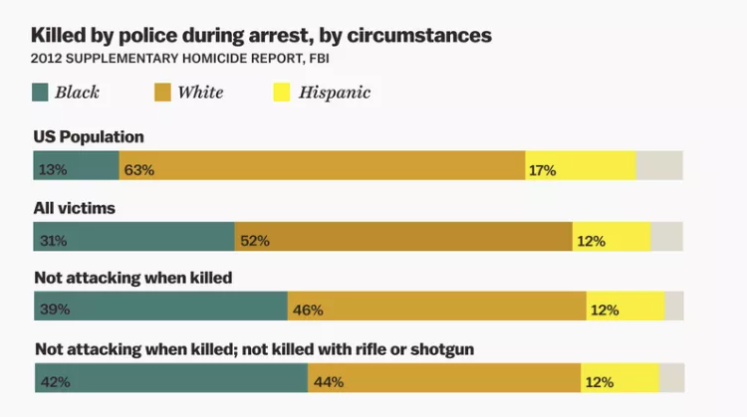
The police are more likely to become physically violent or draw their weapons at blacks than whites in similar situations. Many studies show why. “Seeing Black: Race, Crime, and Visual Processing” showed how police officers associate innocent blacks with criminality and aggression. “The Police Officer’s Dilemma: Using Ethnicity to Disambiguate Potentially Threatening Individuals” showed ordinary civilians in simulations are far quicker to shoot armed blacks than armed whites, and decide faster to spare an unarmed white than an unarmed black. “The Correlates of Law Enforcement Officers’ Automatic and Controlled Race-Based Responses to Criminal Suspects” found that during simulations police officers with anti-black biases shoot unarmed black suspects more often. “The Consequences of Race for Police Officers’ Responses to Criminal Suspects” showed police officers are more likely to mistakenly shoot unarmed blacks than unarmed whites. Unarmed Americans killed in the first half of 2015 were twice as likely to be black than white. Blacks who were not attacking an officer when killed made up 39% of total deaths in 2012, way out of proportion to a small black population, 13% of Americans (compared to 46% of total deaths being white, who are nearly 70% of the American population).

These things are rooted in the fear of the “dangerous, criminal black man.” This fear exists even in the minds of conservatives (and liberals) who encourage African Americans to arm themselves. It affects liberals, conservatives, moderates, civilians, police officers, whites, and sometimes blacks themselves. So it should be no surprise if blacks who carry are treated differently than whites who carry.

The result of one amateur social experiment, where a black man and a white man each strolled around in public with a semiautomatic weapon in an open-carry state, should come as no shock. Watch the video here, then read on.

Each of these men had the right to bear arms in public view. Why, one might ask, should either of them be stopped by police? (Again, why not assume these are “good guys with guns”?) Yet though they exhibited the same behaviors while exercising those rights, the black man was treated as a much graver threat. This is a fine example of how the law is colorblind but those who put it into practice are not. Americans technically have equal rights, but discriminatory practices persist. Thus Tamir Rice, Jermaine McBean, and John Crawford III were shot and killed while holding toy guns in open-carry states, conceal-carry permit holder Clarence Daniels was attacked by a white vigilante who spotted his firearm, Philando Castile was murdered after reportedly telling an officer he had a gun on him and a license for it, and so on.

Many black gun owners say they are treated differently than white gun owners. “If you have a firearm or you scare the wrong people, you’re going to get shot. You’re going to get killed. The perception of the scary black man still exists,” one leading black firearms activist said. Owners understand that carrying can give them the means to protect themselves against crime in their neighborhoods, but know it can make them a target of the police or white vigilantes who may see a white man as a good guy with a gun but a black man as a “thug.” These feelings come from countless incidents, from the Castile shooting to everyday police harassment of black gun carriers to the story of Mark Hughes, a heavily armed black man marching in Dallas right before the killing of multiple police officers, who was wrongly made a suspect and hunted down.

More voices deserve to be heard:

After Earl Brown, a black man working security with a legal firearm, was killed by police in Lauderhill, Florida, his wife Gloria said, “Honestly, I hear the N.R.A. talking about the right to bear arms. He had the right to bear his that night; they just never told us he wouldn’t have the right to life. It seems like white men and police officers are the only ones who have the right to bear arms in this country.”

After the Castile shooting, a member of the Huey P. Newton Gun Club, a group of black gun advocates, said, “It terrifies me. Here I am telling black people: ‘Hey, bear arms legally. You’ll have a better opportunity to protect yourself. Maybe the law will respect you more.’”

Philando Castile himself had discussed the dangers with his sister, who reportedly said, “You know what? I really don’t even want to carry my gun because I’m afraid that they’ll shoot me first and then ask questions later.”

This is not to say misunderstandings, tragedies of police or vigilante shootings, do not happen to white gun owners, because they do. Further, these stories and the experiment above are anecdotal evidence, with sample sizes of one or two, not serious studies. According to The New York Times, “There is no data on whether legally armed white or black people are shot at higher rates in the United States.” So while there are many studies showing how blacks are treated differently by white civilians, judges, lawyers, the police, etc., there are no specific studies yet on how black conceal- or open-carry supporters are treated differently. But no matter where we stand on how grave a problem racial discrimination is today, we should all carefully consider the implications of the possibility.

If it is anything like other complaints of mistreatment, studies may soon exist to assure whites that this issue is not simply a confection of black delusions.

For more from the author, subscribe and follow or read his books.

Police Attacks on Forté Reveal Shocking Ignorance of Race in KC

In early August 2016, Kansas City’s chief of police Darryl Forté was under fire from heads of multiple Kansas City police unions.

The criticism came after Forté told the Kansas City Star:

We have to talk about real issues. Black lives matter. That’s real… As an African American male, with this opportunity in this city, I’m going to talk about it and I’m going to do some things to remedy some of the things we’ve done as an institution. When we talk about institutional racism, it’s real. Some of our policies, some of our practices, it’s real.

I’ll talk about it every time I get the mic because there is an issue with too many African American males being killed by police officers, and part of it, in my opinion, is unreasonable fear. Unreasonable fear is a huge one. And we talk about poor training. We all have to do the right thing every day. And I know we’re going to make mistakes, but that should be our goal, and we shouldn’t accept substandard police service from anybody.

Forté also opened up about his experience as a black man in Kansas City. Glenn Rice wrote in the Star:

Kansas City Police Chief Darryl Forté says he understands the delicate balance between the thin blue line that he swore to uphold and the struggles of being a black man in a society that often views him as a dangerous threat.

More than 30 years ago, shortly before he entered the police academy, Forté was pulled over and made to empty his trunk by white police officers for no discernible reason, he said. As he sought the chief’s job five years ago, a frightening note left in his mailbox so unnerved him that he had his wife and a daughter learn how to shoot a gun. Once he got the job, he was harassed.

“In talking to people, you feel what they feel, and being a black male, I understand what happens in Kansas City… I have experienced racial profiling, I have experienced bullying as a member of this police department. So these things are real and indelible.”

The response was swift. Brad Lemon, the head of Kansas City’s Fraternal Order of Police (Lodge 99), wrote in a statement:

I cannot understand any statement regarding unreasonable fear on our member’s part when dealing with life and death situations. We are humans, not robots. We have families and lives. The fear that officers feel during critical incidents is real. It is not for someone else to tell us what is reasonable or unreasonable.

Lemon praised his fellow officers as “the finest people I have ever known,” who are trained in a “nationally recognized academy.” He continued, “Our training is not sub-standard…in fact, I would challenge anyone to find fault with it.” Then, apparently not realizing his next sentence would be an admission that improvements can always be made, he noted, “Our firearms section was just recognized for identifying several training issues that provides options [sic] to disengage and seek cover while contacting armed and dangerous subjects.”

Scott Kirkpatrick, president of the Fraternal Order of Police (Lodge 4) in Kansas City, Kansas, posted an enraged statement on Facebook, calling Forté’s comments “misguided and dangerous” — and Forté himself a “detriment to our profession.” He spoke of the recent loss of two fellow officers, and how the Kansas City, Kansas, chief has had to work “tirelessly to keep our morale high.” But

your misguided statements in your recent interview have again torn those healing wounds wide open. In your interview, you say that the recent killing of suspects is a result of as you say “UNREASONABLE FEAR.” When I heard those words, I had to listen to them again because I could not believe that the head of a well-respected law enforcement agency, and person who wears the uniform, would make such ridiculous uninformed comments.

First, how would you pretend to know what was in the hearts of any of those officers. You have not spoken to them, nor you do know them. You have not been directly or indirectly involved in the investigation so you could not and do not know all the facts. Nevertheless, your uninformed speculation is just fuel to the fire of those who have already demonstrated a desire and willingness to harm police officers. When the enemies of justice see comments like this from you as a Chief, it gives them all the license they need to engage in unimaginably callous acts against those you are supposed to represent.

Second and most importantly, to suggest that an officer’s fear at any time is per se unreasonable without knowing the facts represents a monumental misunderstanding of the job we are doing out of the streets in the current climate. Officers are rightfully on edge. They have seen their brothers and sisters gunned down in cold blood simply for wearing the uniform. You say that their fear is unreasonable. Well tell that to Det. Lancaster’s wife and daughters. Tell that to Captain Melton’s children and loved ones. Tell that to the families of officers in New York, Dallas and Baton Rouge and as close as Baldwin, Missouri. The fear is real. People are out to harm us. And now your comments will only make things worse.

The fact that white police officers “cannot understand” why Forté would speak of “unreasonable fear” and “poor training” is hardly surprising. Too many whites have turned a blind eye toward the overwhelming evidence that police treatment of blacks is a bit different that police treatment of whites — even in Kansas City.

It’s time for Kansas Citians to wake up.


Wake up to the research regarding explicit and implicit biases.

When Forté says “unreasonable fear,” he means whites (including the police) often consciously or subconsciously view blacks as more suspicious or dangerous than whites.

Surveys indicate about 60% of whites can openly admit belief in stereotypes concerning blacks: greater laziness, higher aggression, or lower intelligence — and 25% of whites say an ideal neighborhood would be totally free of them. But nearly 90% of whites hold subconscious (implicit) anti-black biases.

Implicit biases mean whites hold certain dangerous ideas about blacks without even realizing it or being able to control it, ideas pumped into our consciousness since birth, ideas so strong and so pervasive even some 48% of blacks subconsciously believe them. These are subconscious associations: associating blacks with danger, violence, laziness, and so on, versus more positive associations for whites.

One experiment looked at what whites thought when a white man and a black man came to blows. When the white man pushed the black man, 17% of white respondents said this was a violent act. But when the black man pushed the white man? 75% of whites characterized it as violent.

Those interested in studying implicit biases more should look into Harvard University’s Project Implicit or read Tim Wise’s Colorblind.


Wake up to how biases affect police conduct. 

Mr. Kirkpatrick, Mr. Lemon, clearly Chief Forté is not saying “fear that officers feel during critical incidents” isn’t real. He’s not saying police officers are bad people. He’s not encouraging civilians who hate police and want to kill police to do so. For Christ’s sake, Forté is a police officer. Believe it or not, as the chief stressed in his response to his critics, you can be proud and respectful of officers but also work to address real problems relating to race. He is simply drawing attention to blatant injustices in American policing.

Studies show blacks are are far more likely to be pulled over and searched while driving lawfully than whites driving lawfully. During this War on Drugs, two-thirds of the people thrown in prison for drugs are people of color, even though blacks and whites use illicit drugs at about equal rates (whites are sometimes a bit more likely to do so). When members of your racial group are pulled over, questioned, and searched at drastically higher rates, they will disproportionately fill the jail cells. Blacks are four times more likely to be arrested for marijuana possession.

And as for police shootings? How many studies do we need before you acknowledge a problem might exist?

The police are more likely to become physically violent or draw their weapons at blacks than whites in similar situations. “Seeing Black: Race, Crime, and Visual Processing” (Journal of Personality and Social Psychology) showed how police officers associate innocent blacks with criminality and aggression. “The Police Officer’s Dilemma: Using Ethnicity to Disambiguate Potentially Threatening Individuals” from the same journal showed ordinary civilians in simulations are far quicker to shoot armed blacks than armed whites, and decide faster to spare an unarmed white than an unarmed black.

“The Correlates of Law Enforcement Officers’ Automatic and Controlled Race-Based Responses to Criminal Suspects” (Basic and Applied Psychology) found that during simulations police officers with anti-black biases shoot unarmed black suspects more often. “The Consequences of Race for Police Officers’ Responses to Criminal Suspects” (Psychological Science) showed police officers are more likely to mistakenly shoot unarmed blacks than unarmed whites. Fortunately, the bias diminished with extensive time in the simulation. In fact, “Across the Thin Blue Line: Police Officers and Racial Bias in the Decision to Shoot” (Journal of Personality and Social Psychology) credited time in simulations when police officers (who had implicit biases) did not use lethal force in a biased way during tests. This kind of training, among others, is important.

Unarmed Americans killed in the first half of 2015 were twice as likely to be black than white, the expected result of police officers associating blacks — innocent blacks included — with aggression, danger, criminality. Blacks who were not attacking an officer when killed made up 39% of total deaths in 2012, way out of proportion to a small black population, 13% of Americans (compared to 46% of total deaths being white, who are nearly 70% of the American population).


Wake up to racial injustices in Kansas City. 

Researchers from the University of Kansas write in Pulled Over (2014) that blacks in Kansas City are three times more likely to experience investigatory stops (these are not stops for actual traffic violations), especially in the white suburbs. They are twice as likely to not be told why, and five times more likely to be searched, but less likely to be found with anything illegal — and act no more disrespectfully than similarly treated whites.

One black Kansas Citian spoke of being followed by police for fifteen minutes. “They followed me all the way to the house…. I get out of the car…and they said, ‘Is this your car?’ And I said, ‘Yes’…. They ran the tags [and] I walked on in the house…. They did it for about a couple weeks.” Another described being handcuffed in a white neighborhood while his I.D. was checked to see if he was involved in a recent robbery. “He asked us where we lived and why we were over here. And he made us get out of the car…. I kept my composure…. I didn’t wanna, you know, give him a reason to do anything else…. They put us in handcuffs. And we sat outside for about an hour, and then they just let us go.”

Those are times when no one got hurt. In other incidents, abuse ends in trauma or unnecessary deaths.

  • In 2005, a black family in Kansas City, Kansas, sued after five white police officers entered their home without a warrant during a birthday party. In the ensuing confrontation, they beat adults and children with fists and flashlights, spouted racial slurs, and fired pepper spray.
  • In 2007, Sofia Salva was pulled over (for fake tags) on her way to the hospital. She was pregnant and bleeding, as video shows she calmly told two Kansas City officers. “How is that my problem?” one of them replied. The police jailed her for outstanding warrants. She miscarried the next day.
  • In July 2013, Ryan L. Stokes allegedly refused to stop running from police and was shot and killed by a black officer; the police said Stokes was armed, but that he hid his gun moments before he was shot.
  • In August 2014, graphic designer Jasmine Taylor filed a complaint against the Kansas City Police Department after an officer purportedly struck her in the face and knee during a traffic stop, sending her to the emergency room.
  • In July 2015, Javon Hawkins allegedly refused to put down a sword, and an officer shot him multiple times.

People don’t forget things like this. Every incident, large or small, whether harassment or a standoff that could have been de-escalated or ended with nonlethal weapons, creates a serious strain on police-community relations. As Forté said, they “have created outrage, and to ignore these sentiments and give no thought to what police can do to improve the situation would be irresponsible.”

No, Forté speaking the truth is not going to make things more dangerous for police officers. But willful ignorance of the root causes behind distrust and hatred toward the police — and some barbaric attacks on police officers — certainly will.

Wake up, Kansas City. Wake up.

For more from the author, subscribe and follow or read his books.

Study Shows No Racial Bias in Police Shootings. Or Does It?

Harvard economics professor Roland Fryer, Jr., in what he calls “the most surprising result of my career,” found in a new study that during police-civilian interactions officers were not more likely to shoot African Americans than whites.

After the New York Times reported the study, conservative outlets were quick to declare “Harvard Study Debunks Shooting Myth” (Commentary Magazine), “Does Race Play a Role When Police Kill Civilians? The Crime Data Say No, Not Likely” (National Review), and even “The New York Times and the Left Have Blood on Their Hands” (Real Clear Politics) — because apparently both have been pushing lies that ended up killing officers in Dallas (the writer didn’t explain why the Times would break now from its liberal propaganda and publish information that countered the narrative of its untruthful agenda, but no matter).

The results of Fryer’s study are encouraging, but should be taken with a grain of salt, as anyone who actually read the New York Times piece or the study itself might surmise.

First, it’s wise to keep in mind what police departments (and how many) were examined. The study looked at about 1,300 shootings in 10 police departments in three states from 2000-2015. Cities included Houston, Austin, Orlando, Los Angeles, and Jacksonville. The Times noted that Fryer’s

results may not be true in every city. The cities Mr. Fryer used to examine officer-involved shootings make up only about 4 percent of the population of the United States, and serve more black citizens than average.

Though 10 police departments of 12,000 in the U.S. may or may not be an adequate sample size, perhaps more important is that the areas examined had higher black populations, which could have a positive effect on police-minority relations.

Screen Shot 2017-11-17 at 10.10.20 AM

via The New York Times

After all, Intergroup Contact Theory, the idea that increased contact between majority and minority groups reduces prejudice, is well established, and studies specifically relating to African Americans and the police align neatly: a 2006 study showed that “officers with positive contact with Black people in their personal lives were particularly able to eliminate [racial] biases with training.” Police departments around the country are trying to increase contact between the officers and the people they serve. Areas with more African Americans may have more African American police officers, too — a benefit for both white officers and relations with the black community.

In other words, it could very well be that American cities and towns with fewer black citizens — less interaction — may see more bias in police shootings.

And, as Dara Lind wrote,

Different cities have different approaches to police-community relations; different tensions; different standards for use of force… In fact, the cities Fryer and his team worked with are all members of a White House initiative on policing data launched in 2015 — and the kind of department that thinks data collection and transparency are important is likely to have different priorities in other regards than one that isn’t.

The 10 police departments involved in this study may be more pro-active in preventing police abuse than others.

Secondly, the 10 departments were examined to see who the police shot at and what the victims were doing (for example, “Black and white civilians involved in police shootings were equally likely to have been carrying a weapon”), finding they shot blacks and whites at equal rates, but this didn’t examine frequency of encounters — and higher frequency can mean a higher death toll. Fryer and colleagues, as the Times puts it,

focused on what happens when police encounters occur, not how often they happen. (There’s a disproportionate number of tense interactions among blacks and the police when shootings could occur, and thus a disproportionate outcome for blacks.)

In other words, Fryer did not look into the frequency of incidents and how that might affect the total killed. He looked at what happened when there was an incident. So even if, and we can hope this is true, cops shoot blacks and whites at equal rates, wouldn’t increased incidents lead to higher death tolls for blacks — not just increased incidents resulting from blacks disproportionately living in poor neighborhoods, which tend to have higher crime, but also through police harassment and racial profiling, where blacks are much more likely to be pulled over or searched than whites exhibiting the same behaviors (which Fryer did find to be a severe problem)?

Perhaps a grave issue, then, still exists. Perhaps this research does not contradict disturbing trends found in policing previously, like unarmed Americans killed by the police being twice as likely to be black than white, across the entire nation, in the first half of 2015, or blacks who were not attacking an officer when killed making up 39% of total deaths in 2012, way out of proportion to a small black population, 13% of Americans (compared to 46% of total deaths being white, who are nearly 70% of the American population).
Screen Shot 2017-11-17 at 10.10.38 AM

via Vox

As Lind put it,

when people talk about racial disparities in police use of force, they’re usually not asking, Is a black American stopped by police treated the same as a white American in the same circumstances?… They’re saying that black Americans are more likely to get stopped by police, which makes them more likely to get killed.

Putting aside the fact that people are indeed asking that first question, you get the point. As Fryer writes in the study,

The empirical thought experiment here is that a police officer arrives at a scene and decides whether or not to use lethal force. Our estimates suggest that this decision is not correlated with the race of the suspect. This does not, however, rule out the possibility that there are important racial differences in whether or not these police-civilian interactions occur at all.

Glenn C. Loury, a mentor and colleague of Fryer, made this point as well (Making Sense, Harris) when he noted that because the study only looked at arrest data (if there is no arrest or violent incident, there is no police report), it “assumed that the processes leading to an arrest work in the same way regardless of race of the suspect.” The study showed that among the black arrestees there were more women and more unarmed persons, for instance, compared to white arrestees. Loury notes that the police may be “discriminatory in how they decide about arresting people and are quicker to arrest blacks who are less threatening than whites,” and this could possibly explain why the rate of blacks being shot is lower in the study. If the police are arresting blacks who are less of an actual danger, there may be less need to fire a weapon at them. This fact, if indeed a fact, could even coexist with the more abusive behavior against blacks. Discriminatory initiation of interactions and arrests, discriminatorily roughing someone up, but not actually needing to pull the trigger. It’s not contradictory.

Third, this study has not yet been peer-reviewed — where fellow scholars analyze Fryer’s methods to determine validity — nor published in an academic journal. It is currently a working paper for the National Bureau of Economic Research. Now, this does not at all mean it is seriously flawed, but it may be prudent to wait until the academic process is complete before celebrating the end of racism. Studies that have undergone peer scrutiny are usually the most reliable.

Fourth, Fryer’s data was provided by police departments, whose reports are not always truthful. The Guardian, which the FBI director called a leader in the documentation of police shootings, wrote that Fryer collected his information

largely by coding police narratives rather than considering the testimonials of witnesses or suspects (assuming that the suspects were not killed by the police in the shooting). The study therefore assumes police reports are unbiased sources of information about facts like whether or not the officer shoots the suspect before being attacked.

For this and other reasons, the Guardian sees the study as “misleading.”

Fryer admits that “the penalties for wrongfully discharging a lethal weapon in any given situation can be life altering, thus, the incentive to misrepresent contextual factors on police reports may be large” and that “we don’t typically have the suspect’s side of the story and often there are no witnesses.”

Fifth, and finally, it would be very remarkable if blacks were discriminated against in every arena of policing except for police shootings. Again, Fryer’s look at incidents where shots weren’t fired found significant differences in how blacks and whites are treated in comparable situations:

Screen Shot 2017-11-17 at 10.11.03 AM

via The New York Times

It would also be miraculous if experiments conducted with civilians and police officers where both were quicker to shoot armed and unarmed blacks than armed or unarmed whites did not translate into similar problems in the real world.

Studies show police officers associate blacks — innocent blacks included — with aggression and criminality (a stereotype most civilians have as well, whether or not they are aware of it). Studies like one in 2002 show that ordinary civilians in simulations are far quicker to shoot armed blacks than armed whites, and decide quicker to spare an unarmed white than an unarmed black. 2005 research in Psychological Science showed police officers were more likely to mistakenly shoot unarmed blacks than unarmed whites. Happily, the bias diminished with extensive time in the simulation.

The 2006 study mentioned earlier, published in Basic and Applied Psychology, found that during simulations, as Fair and Impartial Policing put it,

Officers with negative attitudes toward Black suspects and negative beliefs regarding the criminality of Black people tended to shoot unarmed Black suspects more often in the simulation than officers with more positive attitudes and beliefs toward Blacks.

Studies from 2007 and 2009 suggest that officers with anti-black biases won’t act on them if they’ve gone through high-quality use-of-force training that diminishes implicit prejudice, a factor related to our first point above — some police departments have much more effective training than others, which can be the difference between life and death for civilians.

Jordan Weissmann writes:

Why would police officers be more likely to get rough with black and Hispanic subjects, but not more likely to fire on them? Fryer suggests it might be a matter of stakes. In theory, police stand to lose a lot more if they shoot the wrong guy than if they give him a blow with a nightstick. But there isn’t hard proof for that narrative, and frankly, given how rarely police appear to be punished after shootings, it’s not especially satisfying.

The Guardian wrote:

Fryer assumed shootings are not necessarily linked to a more general use of police force. Such an assumption seems hard to support: a black person in New York who is stopped by the police is 24% more likely to have a gun pointed at them than a white person, so why would they be no less likely to be shot by an officer? The two seem inextricably linked.

All this is not to say with certainty that Fryer’s work is flawed. But there are reasons to ask serious questions.

Inarguably, it is hardly time for black and white liberals to breathe a sigh of relief and make the Black Lives Matter movement a thing of the past, nor is it time for conservative Americans to pat themselves on the back for being right about racism being fictional. One study — or even two or three — isn’t quite enough for that, especially one that hasn’t been published and may not even contradict other research.

There is a mountain of evidence that both overt and subconscious racism greatly affect the lives of people of color (see The Evidence of Widespread American Racism). Even if, somehow, American police officers were never affected by implicit or explicit biases when reacting or deciding, there would still be much work to be done in the battle against discrimination.

Likewise, even if the police killed civilians without racial bias, mass protests against unnecessary police force would be a very positive thing for our society.

For more from the author, subscribe and follow or read his books.