U.S., Canadian City Governments Ending Homelessness by Offering Jobs

It is a radical idea: If you have fallen to the bottom of the social pit, found yourself without money, a home, or possessions, and cannot find work in the private sector of the free market, you can go to your city government for a job.

In what is reminiscent of Depression-era New Deal programs that gave work to millions and long-held socialist ideals of guaranteed employment for the poor, some U.S. and Canadian cities are using tax wealth for wages to homeless workers, who clean up and improve communities.

Each year, 3.5 million Americans (1.35 million children) will experience homelessness at some point. 18.5 million homes stand empty in the U.S., waiting for citizens who can afford them, the mark of a social system where goods and services are distributed according to purchasing power, ensuring those with the least purchasing power also have the greatest need for goods and services.

On any given night over 600,000 Americans are homeless, living in shelters, transitional homes, cars, parks, tent cities, or under bridges. 23% are children under 18; 36% of homeless people are homeless with a family; about 10% are veterans; over 40% are disabled; 20-25% suffer from mental illness. 90% of homeless women are domestic abuse victims, most fleeing their tormentors.

Homelessness is both caused and perpetuated by poverty, job loss, eviction or foreclosure, domestic abuse, substance abuse, mental illness, disability, and other factors.

The homeless speak of humiliation, stigmatization, feeling “disconnected from the world,” working “full-time” to survive each day, being denied services at business because of their appearance when they do have cash, denied emergency room care when they needed it because they were suspected of faking to “get out of the rain.” A survey showed about 60% of homeless people perceive discrimination from law enforcement and businesses.

Perhaps this stems from widespread American stereotyping of the poor as being lazy, lacking ambition, willpower, work ethic, common sense, even intelligence…despite the fact that nearly half of Americans now live in poverty or in low-income households.

Even social workers aren’t exempt from this stereotyping. A homeless man, Lars Eighner, remembered:

My interview with the social worker made it clear only three explanations of homelessness would be considered: drug addiction, alcoholism, and psychiatric disorder. The more successful I was in ruling out one of these explanations, the more certain the others would become.

Professional people like to believe this. They like to believe that no misfortune could cause them to lose their own privileged places. They like to believe that homelessness is the fault of the homeless–that the homeless have special flaws not common to the human condition, or at least the homeless have flaws that professional people are immune to. (A People’s History of Poverty in America, Pimpare)

Albuquerque, New Mexico in September 2015 began a program that pays a small crew of homeless workers $9 an hour (and a small lunch) to clean up blighted areas of the city. It is paid for through both private donations and tax funds.

Mayor Richard J. Berry said:

It’s about the dignity of work… If we can get your confidence up a little, get a few dollars in your pocket, get you stabilized to the point where you want to reach out for services, whether the mental health services or substance abuse services — that’s the upward spiral that I’m looking for… The indignity of having to beg for money cuts through the soul.  

One of the workers, Ramona Beletso, who has slept in cardboard boxes and struggled with alcohol use, said, “I worked for my money. And that feels good.”

Theoretically, initiatives such as this need not exclude disabled persons, either, as workers can be paid for non-physical tasks that improve their communities, such as helping children learn to read at public libraries.

At about the same time that program launched, Reno, Nevada started paying its own small group of homeless residents $10 an hour for three days of work each week to clean up the Truckee River. The city will provide recommendation letters and financial and interview training to help workers find employment in the private sector.

A councilwoman said:

The public has expected something creative and different from us, so I’m glad that we have committed funding to this. It’s not only about instilling pride in the workers from a good hard-day’s work, but also cleaning up the river for the community.     

A homeless worker, through tears, promised at a press conference, “We will make you proud.”

In both Reno and Albuquerque, supervising crews are on hand during the work shifts.

A similar program, this one funded through donations and a tax on businesses within a Business Improvement Zone, can be found in Canada. Winnipeg pays homeless persons $11 an hour to pick up trash, shovel snow, and other tasks. In 2014, 86 people worked at various times for the city.

An organizer noted it gives workers experience and references for later use, and that the program lets

People see their capabilities and believe in themselves again. They’ve still got gas in the tank. They’re still capable, and it’s a catalyst to get back into the workforce… When we go out you see innate gifts…the leaders, helpers, caretakers…

A worker named Randy Malbranck discussed the competition for spots on the crews: “You don’t always get in but sometimes — usually — you do.” Oftentimes, people who don’t “get in” end up volunteering. He praised the organizers as “tremendous,” and the job has allowed him to move closer to his goal of renting an apartment. “I think it’s very good. If somebody needs work or needs a little bit of money, it helps… The next step is to just get a full-time job.”

In Albuquerque and Winnipeg, people acknowledge that sometimes paychecks are used for drugs or alcohol or other wasteful things that will perpetuate their societal condition. Malbranck said, “There are some people who use the money for the needs that got them here in the first place. It’s unfortunate, but you have to work with that.” Yet these are not handouts. People are earning money, and spending it how they will. Treatment for mental illness and substance abuse is not an unimportant part of solving homelessness.  

Inspired by what’s happening in these cities, others, like Victoria in Canada, are planning to follow suit. It is part of a more general effort to find humane, effective ways of ending the humiliation and human suffering of homelessness, not just through government initiatives like jobs or housing vouchers, but also private ones.

In Nashville, Madison, and Austin, for example, individuals, ministries, and social activist groups have built tiny homes for the homeless, most charging a small rent. A study in Charlotte, North Carolina found that building even free housing for the homeless is cheaper than leaving them on the streets; massive health care and incarceration costs are cut when people are housed.

Perhaps it is as Nelson Mandela said: “Overcoming poverty is not a task of charity, it is an act of justice. Like Slavery and Apartheid, poverty is not natural. It is man-made and it can be overcome and eradicated by the actions of human beings.”

All this is in stark contrast to the barbaric ways other cities are addressing homelessness. Many major cities, like Washington, D.C., have wiped out homeless camps. A Huffington Post writer summarized:

Cities are increasingly making homelessness a crime. A 2014 survey of 187 cities…found that 24 percent of cities make it a city-wide crime to beg in public, 33 percent make it illegal to stand around or loiter anyplace in the city, 18 percent make it a crime to sleep anywhere in public, 43 percent make it illegal to sleep in your car, and 53 percent make it illegal to sit or lie down in particular public places. And the number of cities criminalizing homelessness is steadily increasing.

Some cities and businesses around the world install spikes under bridges and redesign benches in an attempt to drive away homeless people looking for a place to sleep.

For more from the author, subscribe and follow or read his books.

The Last Article on Guns You Will Ever Need to Read

First off, this writer is a supporter of your right to own and carry firearms. But can such supporters reject certain myths about guns? Are there elements of truth in both liberal and conservative viewpoints? Could there be distractions that mask the heart, or important parts, of the issue? This article explores these questions. 


Moving past liberal distractions

These are less egregious, so they are a good place to begin.

First, my fellows on the left should abandon the use of absolutes: “Guns don’t stop crimes. Guns don’t stop mass killings.” In fact, they sometimes do, as we will see, and in a nation with so many guns and so many responsible gun owners it would be strange if this were otherwise.

Next, liberals sometimes use the wrong statistics to build a case. For instance, I once saw someone using a study showing that Texas felons with conceal carry permits were nearly 5 times more likely to have threatened someone with a firearm than felons without permits as evidence that carrying a gun increases aggressiveness. It somehow seems predictable that people with a propensity to carry might be in a position to more often have a gun to stick in someone’s face. This is not the research you want. There is actual evidence elsewhere that carrying a gun increases aggressiveness (read on).


Moving past conservative distractions

The right’s distractions typically delight in both irrelevancy and complacency — weak excuses designed to favor inaction.

For example, conservatives love to point out that more people die in automobile accidents (and so forth) than by guns. Surely cars don’t kill people, but rather their operators, people, kill people. Are we to outlaw cars?

(Note: this comparison will soon be obsolete, as this year it is expected that deaths by guns will meet and surpass the 30,000-plus Americans killed in or by automobiles each year.)    

This nonsense of course ignores the fact that almost no one supports outlawing cars but almost everyone supports common sense regulations like training, licensing, titling and registration, health requirements, seat belts, traffic laws, and so on. Most liberals don’t want to ban all guns, they want common sense regulations. More importantly, however, all this amounts to a morally bankrupt irrelevancy, essentially saying, “No need to make this safer, there’s a lot of other unsafe things that kill more people.” Why not try to make many unsafe things a bit safer? It’s almost inconceivable that people who consider themselves rational would say something like this (here I will include myself, as I used to parrot this inane argument in my conservative days, like most distractions here).

Another irrelevancy is pointing out that the percentage of Americans killed by guns is extremely low, or that most gun owners are never involved in gun violence. Well, we are trying to save lives anyway. One might wonder just how many people need to die before it becomes unacceptable, before action is taken. Tens of thousands of people dead each year, many children in schools — issues nearly unheard of in other advanced democracies. A distraction along similar lines is the fact that 60% of gun deaths are suicides. As if that justifies doing nothing in the name of the other 40%! (Suicides can in fact be reduced with reductions in gun ownership rates; see below.)

Finally, conservatives also offer false absolutes to justify inaction. For example, many killers and mass shooters passed criminal background checks when buying their weapons. Thus conservatives crow, “Background checks don’t work!” There is some truth in this. A new killer may not have a criminal history. But a more accurate statement would be: “Background checks don’t always work.” Sometimes they do.

Believe it or not, when Americans with criminal histories try to buy guns at licensed firearms dealers, they are turned away because of failed background checks (1.5 million people over the last decade and a half). A 2012 study from the Bloomberg School of Public Health at John Hopkins University (“Reducing Gun Violence in America“) found that forcing licensed gun dealers to enforce background checks translated to a 64% reduction in guns given to criminals. Fortunately for criminals, they can simply go to the gun sellers that do not legally have to check criminal histories: private sellers in most states. Almost a quarter of total gun sales don’t involve a background check, and 50% of private sales do not (rising to 77% if it’s between acquaintances). “Doesn’t work” indeed!

If this private sales loophole did not exist, people would have to resort to theft, increasing the likelihood of being apprehended before committing murder. Or they would have to (illegally) borrow or buy one from a friend, increasing the number of people with knowledge of an impending crime and a personal fear of punishment. Or perhaps they would resort to far less deadly weapons like knives (“If you regulate guns, criminals will just use knives!” Good, knives cannot kill as many people as quickly. We can save some lives). Or perhaps some would give up their plans altogether. That’s the point of gun control: make it harder to get a firearm and you can save many lives — not everyone, but many.

Even with the private sales loophole, this works. According to a John Hopkins University study, when Missouri repealed its background check requirements in 2007, dealers gave more guns to more criminals, and the state saw a 25% increase in firearm homicide rates (and a 14% increase in overall homicides) from 2008-2012. Gun suicides went up 16%. Yet after 1995, “after tightening gun laws, firearm homicide rates dropped 40 percent in Connecticut,” with gun suicides falling 15%. You will see more evidence later on. In sum, is it not utterly ignorant to say background checks don’t work, when in fact they sometimes do, and when there is an obvious way to make ours more effective (universality)?


Guns don’t kill people, societal problems kill people?

Guns are not the problem, people are the problem, to paraphrase the platitude. There is a bit of truth to this. Despite the fact that guns make it much easier to kill (higher risk of death in and out of the home) and kill more people (as in mass shootings), guns are not the only factor, even if they may be the most significant. Societal conditions can breed gun violence, and we must treat all the diseases that cause the symptoms.

Mental illness is one of the diseases, hugely common when it comes to suicides, but overall rare when it comes to crime. Only 3-5% of crimes in the U.S. involve people with mental illnesses, and the mentally ill who commit crimes are less likely to use guns than citizens without psychological issues. As the Washington Post noted, the U.S. has about the same number of mental health professionals and psychiatric beds per 10,000 people, and spends about the same GDP percentage on mental health care, as other advanced nations, but has 20 times the gun violence. World Health Organization research indicates the U.S. has comparable mental health issues to other nations that see far less gun violence. 

This is not to downplay the need to improve the quality and accessibility of mental health care in the U.S., nor to ignore the fact that mass killers are often mentally unstable. A liberal magazine recently examined 62 mass shooters, and while 80% of them got their guns legally, about half had mental health problems — a combination of two problems. A 2001 study looked at 34 adolescent mass murderers from 1958-1999 and found 23% had a history of mental illness; 6% were judged to be psychotic at the time of the killing. These 34 killers were also affected by bullying, social isolation, substance abuse…and a preoccupation with guns.  

Poverty is another disease. According to the Bureau of Justice Statistics, from 2008-2012,

Persons in poor households at or below the Federal Poverty Level…had more than double the rate of violent victimization as persons in high-income households… Persons in poor households had a higher rate of violence involving a firearm (3.5 per 1,000) compared to persons above the FPL (0.8–2.5 per 1,000).

States with the most gun violence also tend to have high poverty rates (also, very lax gun control…such states tend to be Republican-ruled). States with higher economic development, more college graduates, less inequality, and less overall poverty correlate with fewer gun deaths. Poverty breeds crime and violence. As Attorney General Ramsey Clark once put it:

Mark the part of your city where crime flourishes. Now look at the map of your city. You have marked areas where there are slums, poor schools, high unemployment, widespread poverty; where sickness and mental illness are common, housing is decrepit and nearly every site is ugly—and you have marked the areas where crime flourishes… Poverty, illness, injustice, idleness, ignorance, human misery, and crime go together. That is the truth. We have known it all along. We cultivate crime, breed it, nourish it. Little wonder we have so much.  

However, it should be noted that researchers know how to control for factors like crime when determining whether more guns in a community mean more gun deaths. That’s what the scientific method is all about, controlling for other factors to see if your hypothesized factor is causing problems. Overall violent and non-violent crime in the U.S. is comparable to other advanced democratic societies, ours just disproportionately involve guns.

Other diseases include right-wing religious hatred, xenophobia, racism, political extremism, terrorism: the slaughter in San Bernardino, California in 2015 by ISIS sympathizers, yet another reason for a drastic change in U.S. foreign policy; a 2015 killing at a Planned Parenthood in Colorado by a self-described “warrior for the babies“; the massacre of blacks by a white supremacist in Charleston in 2015; the attack on a Jewish community center in Kansas City in 2014; the slaying of Sikhs in Wisconsin in 2012; the murder of a doctor who provided abortions in Wichita in 2009, and so on.

Violent video games appear to have no effect on gun homicide rates. Religious persons who think everyone finding God will reduce gun deaths should note that many countries with hardly any gun deaths are also more atheistic than the U.S. (nations throughout Europe, Japan, China, Australia, etc.). Here human nature comes up, too, but how is it other countries have a better “human nature” than we do?

While it is important to address all legitimate causes of gun violence, it’s even more important not to ignore the biggest one.


The Paradox: Guns can stop gun crimes and prevent death, but also cause more of both overall

In a nation with so many guns and people who carry them, it is expected that bystanders with guns would stop crimes: an Uber driver shoots a man who started firing into a crowd, a bystander with a gun forces a gunman’s surrender in a church, another bystander kills a man who open fired in a barber shop, and so forth. As one conservative writer noted in 2012:

In December 2007, a man murdered two teenagers at the Youth with a Mission training center in the Denver suburbs. He then drove south to Colorado Springs and attacked the New Life megachurch in Colorado Springs. He killed two people in the parking lot and then entered the building, carrying hundreds of rounds of ammunition. Fortunately, a volunteer security guard for the church, Jeanne Assam, was carrying a licensed handgun, and she quickly shot the attacker. According to Pastor Brady Boyd, “she probably saved over 100 lives.”

Elsewhere in the United States, three school shootings have been stopped because teachers or other responsible adults had firearms: Edinboro, Penn.; Pearl, Miss.; and the Appalachian Law School in Grundy, Va.

Truly, these events happen and are not difficult to find. Owning and carrying a gun can reduce your and others’ risk of victimization. The question becomes: What other risks are increased at the same time? Do the risks on one side of the equation outweigh those on the other?

It is in fact a matter of scale, or ratio. In 2012, for every gun killing in self-defense there were 34 criminal gun homicides. In 1998, a study in the Journal of Trauma and Acute Care Surgery found that for every instance a gun was used in a justified way there were four accidental shootings, seven criminal assaults or homicides, and 11 attempted or successful suicides.  

Gun ownership creates troublesome problems. Research indicates it tends to increase paranoia and a 2006 study showed

men exposed to firearms before an experiment had much higher testosterone levels and were three times more likely to engage in aggressive behaviour relative to the subjects not primed with a weapon.

Perhaps this explains why one study showed drivers carrying guns are 44% more likely to make obscene gestures at other motorists, and 77% more likely to aggressively tail others.

Statistically speaking, a gun on one’s person actually increases one’s risk of being shot during an assault (by a factor of 4.5 by one count, 5.5 by another). Why? According to researchers:

A gun may falsely empower its possessor to overreact, instigating and losing otherwise tractable conflicts with similarly armed persons. Along the same lines, individuals who are in possession of a gun may increase their risk of gun assault by entering dangerous environments that they would have normally avoided. Alternatively, an individual may bring a gun to an otherwise gun-free conflict only to have that gun wrested away and turned on them.     

There are studies that show in households with guns your chance of being murdered by a family member skyrockets; women are most at risk. Households with guns are also hugely more likely to see suicide. When you look at these studies, note what they conclude: It is not (merely) that people in these homes are more likely to be murdered with a gun, but more likely to be murdered, period. It is not (merely) that people in these homes are more likely to commit suicide with a gun, but more likely to commit suicide, period.

This is unspeakably tragic, yet expected. The old conservative response “people will just find another way to kill family or themselves” is true in some cases, but the data undeniably shows “another way” often is not found. Guns make killing easy (physically and psychologically), their absence making it more difficult. Murder and suicide are often impulsive decisions; without guns, fewer people act. This highlights how “guns don’t kill people, people kill people” misses the point. If “another way” was found in each case, we would not see homes with guns more likely to experience murder and suicide — homes with guns and without would be about even across the board. Plus, non-gun suicides rates are about the same in states with many guns and those with few. Fewer guns does not mean more suicide via slitting wrists, jumping off buildings, etc. In places like Australia gun control measures did not affect non-gun homicides and suicides.

States with the highest rates of gun ownership have a gun murder rate 114% higher than those with the lowest ownership rates, and, looking at 30 years of data in all 50 states, “for every one percent increase in a state’s gun ownership rate, there is a nearly one percent increase in its firearm homicide rate.” U.S. states with more guns see higher rates of police deaths. And higher suicide rates.

After Australia implemented a gun buyback program, researchers “found that the places where the most guns were removed from public circulation also experienced the largest drops in intentional gun deaths.” Further,

the firearm homicide rate fell by 59 percent, and the firearm suicide rate fell by 65 percent, in the decade after the law was introduced, without a parallel increase in non-firearm homicides and suicides.

A 2016 study from Columbia University published in Epidemiological Reviews examined about 130 studies from 10 nations that enacted gun reforms. When national reforms were packaged together — bans on assault weapons, license to own, universal background checks — gun homicide rates fell. Even other homicides declined a bit! “Firearm homicides in five major South African cities decreased by 13.6 percent per year for the next five years” after that country’s 2000 reforms. “Firearm deaths went down countrywide by an average of 14 percent” in Australian states after its 1996 reforms. Suicides and accidents also fell due to stricter ownership requirements. Conceal carry and Stand Your Ground laws proved to have no affect or made things worse. After a mass shooting in the U.K. in 1996, strict gun control measures were enacted; there has only been one mass shooting there since, and the nation boasts one of the lowest gun homicide rates in the world, with gun crimes overall steeply declining since the reforms.

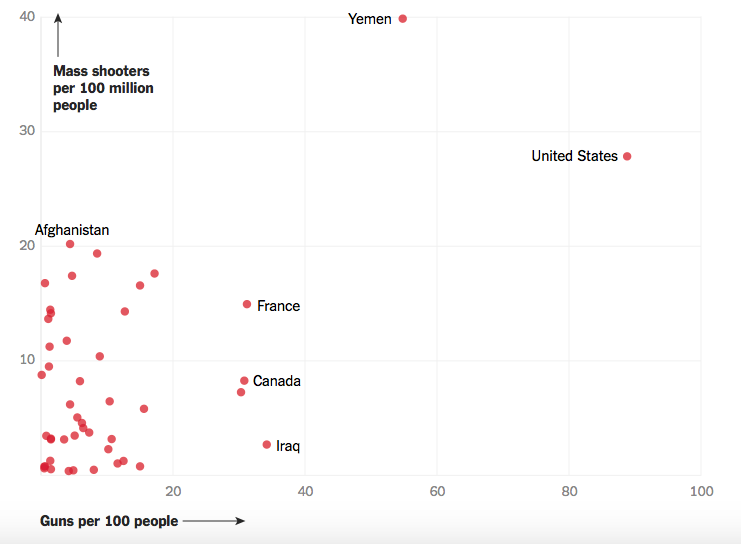
A recent analysis of mass shootings from 1966 to 2012 in 171 nations revealed that the correlation between nations with the highest rate of gun ownership and nations with the most mass shootings is undeniable. It held true for rich and poor nations, advanced and undeveloped, democratic and authoritarian, peaceful and unstable, large and small, etc. The researcher said:

The United States, Yemen, Switzerland, Finland, and Serbia are ranked as the top 5 countries in firearms owned per capita, according to the 2007 Small Arms Survey, and my study found that all five are ranked in the top 15 countries in public mass shooters per capita… That is not a coincidence.    

Visualized, the data looks like this:
Screen Shot 2018-02-19 at 1.10.59 PM

Via The New York Times

This all makes sense. More guns around, more deaths via gun. The U.S. has the highest gun ownership rate and the highest per-capita rate of gun-related deaths among developed countries. The evidence shows this is no coincidence. Some conservatives I’ve spoken to, who preach we need more guns, when confronted with statistics like these will admit this, because it is painfully predictable.

Screen Shot 2017-11-17 at 9.21.02 AM

Others quickly counter: “For every study you give that shows more guns means more gun violence, I can give you one that shows the opposite!”    

Take it from someone who used to use such studies, there is reason to be skeptical. For example, the libertarian Ludwig von Mises Institute presented data in 2015 that showed “There’s No Correlation Between Gun Ownership, Mass Shootings, and Murder Rates.” But the data only looked at a single year! That is far less reliable than studies that look at long-term trends, and of course the information was not peer-reviewed in the scientific method that the most trustworthy studies go through.

As another example, consider the 2007 study published by criminologists in the self-described “conservative,” “student-edited” (!) Harvard Journal of Law & Public Policy that found more guns reduced crime. Unfortunately, this content was not peer-reviewed either, a critical component of locating and eliminating bias in research; that should, quite frankly, make any rational thinker start asking questions.

Economist John Lott examined 30 years of crime data for a book, and made his conclusion the title: More Guns, Less Crime. That is, more concealed carry permits, fewer rapes, robberies, and murders. Yet his research was not peer-reviewed before publication. His work has been checked by other scholars many times and found to have serious flaws. A peer-reviewed study published in the Journal of Criminology looked at counties in the only four states with over a decade of data following concealed-carry legislation and found no consistent effect on crime rates. (Note this is distinct from studies that show higher gun ownership rates lead to more gun violence, which can still be true even if the Journal of Criminology study did not indicate more concealed-carry permits led to more crimes like murder. This makes sense, as permit-carriers tend to be responsible gun owners.)

It’s not that there isn’t bias in all research, but the most trustworthy sources are those that have gone through specific processes that uncover and reduce subjective findings. The best evidence shows a stronger gun culture, easy access to guns, and more guns around means more gun violence.

Despite how obvious such a statement is, the belief that more guns in more hands means fewer deaths persists. For instance, conservatives often bring up Switzerland, but ignore the realities of tight Swiss gun control:

Switzerland has the second-highest gun ownership rate of any developed country, about half that of the United States. Its gun homicide rate in 2004 was 7.7 per million people — unusually high, in keeping with the relationship between gun ownership and murders, but still a fraction of the rate in the United States. Swiss gun laws are more stringent, setting a higher bar for securing and keeping a license, for selling guns and for the types of guns that can be owned.

They bring up cities like Chicago, which, while not having the strictest gun laws in the country, does have tighter gun regulations and a gun crime problem. D.C. is also brought up, for its gun crime and gun bans. Yet cities are not the best test subjects, especially when right next to states with very weak gun laws (Chicago is right next to Wisconsin and Indiana, D.C. being next to Virginia). Predictably, guns are brought into a city from surrounding areas. No, city-only gun control doesn’t work very well when you can go a couple blocks and you’re suddenly in another city or state. That’s why if we want to understand what works we look at communities within bigger entities, like states and nations.

Finally, the notion that a massive increase in gun ownership has led to a drop in homicides in the U.S. is false. While the U.S. homicide rate spiked in the 1960s, and went up and down in the 70s and 80s (staying high), since the 1990s it’s fallen dramatically. Homicides by firearm in 1993 were 7 per 100,000 people, in 2013 3.6 per 100,000.

But during this time, gun ownership rates actually fell. In 1977, 54% of American households had a gun, by 2010 it was 32%. There may be more guns in the U.S. than there used to be (192 million privately owned firearms in 1994, 310 million in 2009), but they are held by fewer families. Today, only 22% of Americans personally own guns. 20% of gun owners have 65% of the guns! 3% have 50% of the guns. The number of non-owners has rapidly outpaced the number of owners. One could just as easily say that lower ownership rates translates to fewer gun homicides! And you’d be supported by evidence.

True, one can still suppose that increased numerical totals of guns and gun owners (ownership rates can shrink while the number of owners increases as long as the number of non-owners rises faster) is responsible for the drop in crime, but here we simply need a reminder that correlation does not always mean causation. The drop in violent crime also correlates with decreased exposure to lead, after all. It takes serious scientific study to determine cause and effect, to affirm causation, not mere assumption.     

There is simply little reason to believe an America without guns would fall into madness and violence, especially if we ease societal conditions like poverty, racism, and mental illness. The U.K., Japan, and other stable democracies have extremely low rates of gun ownership, strict gun regulations and long, serious processes to get one, and extremely low rates of homicide (by any method, not just by gun). That fact is incontrovertible. Less poverty, good healthcare, and other factors contribute, but the absence of guns is undeniably a factor.
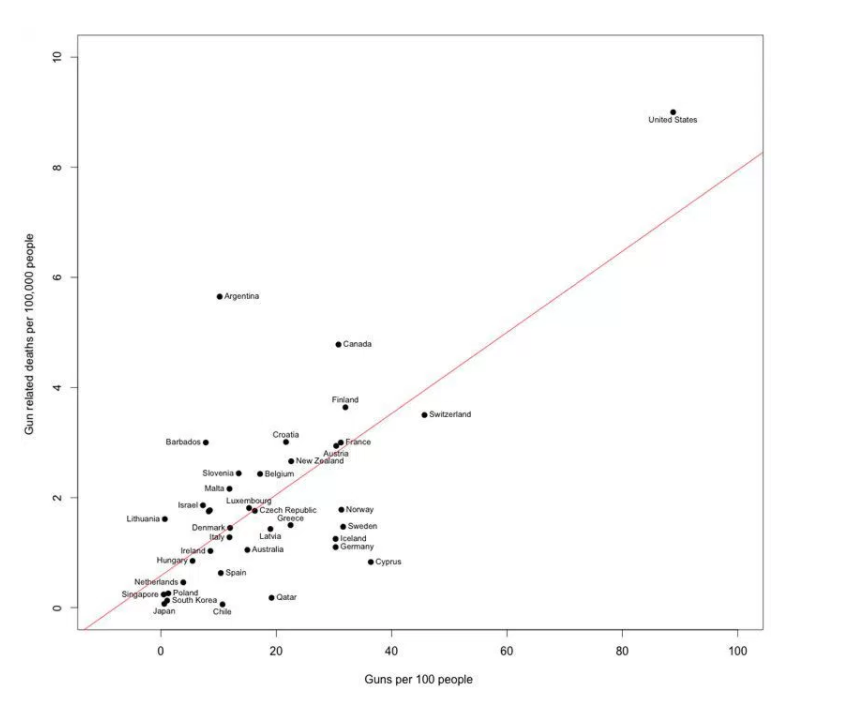
Screen Shot 2017-11-17 at 9.21.47 AM

via Vox

The reforms   

The following are reforms that gun researchers characterize as effective. We need to listen to them. We need to study what other countries are doing and adopt what works.

The U.S. must make background checks universal. Though not a cure-all, it is lunacy to only require criminal background checks for some gun sales (those through licensed firearms dealers). As noted, many guns are sold by private persons, requiring no processing of the buyer through the National Instant Criminal Background Check system. There is no paperwork, making it harder for authorities to match bullets to guns, as well as track where and how a violent criminal got his weapon. I could hop on Armslist.com right now and buy a gun with cash from someone up the street, no questions asked, then proceed to murder someone. I should not be legally allowed to do this; I should be legally required to pass a background check and document the sale for my state or county (in the same way vehicle titles are transferred).

There must be harsh penalties for anyone who sells or gives a gun to another without following proper procedures. People would be less likely to sell a gun illegally, as mentioned, because if the person buying the gun commits a crime and is caught he may tell the police who he bought it from (or the police may find out anyway). The seller would then be arrested and imprisoned for the illegal activity. If it were harder to find a seller, a buyer might have to seek means of obtaining a gun, such as theft, that could lead to his capture before a worse crime. This obstacle may even serve as a deterrent in his quest to illegally obtain a gun, which could lead him to abandon the effort, particularly if racing toward a crime of passion that a little extra time could prevent. 

The U.S. must enact universal gun ownership licensing. In the same way one must have a license to drive a car, one must have a license to own or carry a gun. Not all states have this (some even ban such a law). It would be a simple, common-sense step, and it must be a serious crime to own, carry, or use a gun without an ownership license. A basic safety course, age minimum, and competency test would be prerequisites to licensure.

The U.S. must enact universal firearm titling and registration. It is not such a burden to require Americans to register their gun upon purchase in a county or state gun registry. Each gun must have a title, which can be signed over to another person during a sale, requiring the new owner to re-register the gun. An update to the background check system could then revoke a recent violent felon’s license and registration, in the same way negligent drivers lose their licenses and driving privileges. This can help law enforcement track down the owners of guns found at crime scenes. It may also explain why such methods reduce gun violence in other nations: if potential criminals know guns can be more easily traced back to them, it may serve as a deterrent.

Vehicles are regulated in all these ways, because it is well understood that owning and operating a vehicle puts oneself and others at risk to a certain degree, and that people who use a car during criminal activity can more easily be hunted down. Yet there are no Americans foaming at the mouth over “car control” and how the government is “coming for our cars.” No one is paranoid about the State knowing you have a license and a car, about being “tracked in a database.” Truthfully, it is ethical to give up a little privacy to save the lives of others. These are simple regulations in the name of societal well-being, with potential to do enormous good and little harm, except of course to murderers and other dangerous felons.

The notion that it’s important the State not know you have a gun so the military and police of a tyrannical government won’t come knocking down your door, so you can keep your weapons secret and effectively fight back in the revolution, is ludicrous. Should the State actually wish to disarm its citizens, would not all homes be searched for hidden weapons? How stupid do we imagine an authoritarian government being? (I also find it a bit interesting that those who have such adulation for the troops and the boys in blue firmly avow they will kill anyone coming for their guns…but it won’t be Barack Obama showing up to collect, it will be America’s heroes. Most of us have a point where violence against the authorities becomes justified, but many conservatives don’t seem to realize they are promising to kill police officers and servicemen and women.)  

We should only be allowed to own handguns and hunting rifles. The U.S. must enact a ban on the production, purchase, sale, and ownership of heavier weaponry, like assault weapons. The U.S. took such an action regarding fully automatic weapons in the 1930s and 80s, with significant success — today, machine guns are very difficult to get and extremely expensive, so mass shooters almost exclusively rely on readily-available semi-automatic rifles (possibly modified to shoot like automatics). Machine guns are involved in very few crimes. We should not pretend that machine guns, bazookas, stinger missiles, and grenade launchers are nearly impossible to get through no act of the State. True, the 1994-2004 assault weapons ban in the U.S. wasn’t as effective as some hoped, but this was partly due to enormous loopholes that rendered it inert, and due to a lack of registration, licensing, and other machine-gun level regulations. The truth is that, done the right way, weapons bans can work. Countries like Britain and Japan, which ban almost all firearm ownership, have nearly eliminated gun deaths. Japan has 127 million people but rarely more than 10 gun deaths a year. This does not mean the U.S. wouldn’t have a black market. It certainly would. But a black market is harder to access (knowing, finding the right people), far riskier (police stings, arrest, prison time), and much more expensive (a gun on Australia’s black market costs tens of thousands). This is all too challenging for some people, forcing them to use less deadly weapons or abandoning plans altogether, saving some lives. It won’t stop everyone. But it will stop some. That’s the point.

As for gun-free zones, while we don’t have actual evidence that mass killers choose them purposefully (mass killers tend to attack places they are personally connected to, such as their schools, churches, and workplaces), it is sensible to increase security at government buildings, public schools, and other places that are both gun-free zones and frequent targets. We could require gun-free zones to have armed security. The NRA suggestion of a police officer in every American school is an important reform.

In addition to banning violent ex-felons, domestic abusers, and mentally unstable persons from owning firearms, it might also be wise to make it illegal for people on the terror watch/no-fly list, after some crucial reforms to protect due process, something many on the right and left agree on.  

Finally, it is important to make use of available technology. States with safe storage requirements and trigger lock laws correlate with fewer gun deaths per 100,000 people. And microstamping imprints the gun’s serial number on a bullet as it’s fired, helping police trace crimes to perpetrators. This could make people think twice about using a gun for crime. To prevent accidents and theft, there’s “smart guns” that only fire when held by their owner or other authorized user; despite the potential problems with current smart guns, this may be the weapon of the future.


The Right Direction

We don’t need to repeal the Second Amendment. We don’t need to outlaw all gun ownership or even conceal carry. But we do need to recognize why the gun debate seems to contain a paradox. That small scale facts can appear to contradict large scale facts, but in fact do no such thing. We need to gravitate toward scientific findings concerning gun ownership and gun violence that are most thoroughly vetted. We need to enact reforms that have proven effective, here and abroad, even if they aren’t a cure-all.

The U.S. is moving in the right direction on guns. The percentage of families with guns is falling. 85% of gun owners favor universal background checks. For all Americans, it’s around 90% (and 85% believe those on terror watch lists should be barred from buying). Other reforms mentioned, like a database, an assault weapons ban, and blocking the mentally unwell from owning, have high support. Progress is slow, as Republicans would rather follow the will of N.R.A. money than the people, but with every massacre the call for smarter gun laws grows louder.

Much of America is giving up its gun fetish. With time, gun control and the alleviation of other societal problems will result in a country for our descendants with fewer gun owners, fewer guns, and, if the evidence is to be trusted, fewer deaths of many kinds.

The Australian prime minister wrote to America in 2013:

In the 18 years before the 1996 reforms, Australia suffered 13 gun massacres — each with more than four victims — causing a total of 102 deaths. There has not been a single massacre in that category since 1996.

Few Australians would deny that their country is safer today as a consequence of gun control.

For more from the author, subscribe and follow or read his books.

On the Roswell-Alien Conspiracy Theory


There exists an old phrase in Earth’s scientific community: “Extraordinary claims require extraordinary evidence.” When it comes to alien visits to Earth, we only have one of these.

* * *

The Disclosure Project

In April 1997, 15 witnesses testified in Washington, D.C. of extraterrestrial visits to Earth. Your mind’s eye may construct an unshaven, flannel-garbed man preaching of his abduction or presenting his home-video footage of alien craft.

Nothing so dismissible. The witnesses, speaking at a Center for the Study of Extraterrestrial Intelligence event, included

representatives of more than two dozen US Congressional offices, VIPs from the Executive branch of government and the Pentagon, representatives of the Dutch Embassy, the National Academy of Sciences, and two state Governors’ offices…

All the US government witnesses who were present signed a statement declaring willingness to testify under oath before an open hearing in the US Congress concerning UFO/ET cases and events they personally witnessed.

Dr. Steven Greer, a former physician and founder of CSETI, pointed out, “We had witnesses with top-secret clearances and very sensitive positions, from the Air Force, Navy and Army” who participated in “daylight chases of UFOs” and “attempts to shoot down the objects.” He added he had nearly 100 additional government witnesses.

Greer believes that such witnesses are cracks in a military and government cover-up of alien visits. He offers his evidence, such as eyewitness testimony, video and photographs, and government documents at The Disclosure Project website. He also produced the 2013 documentary “Sirius.” Citizen Hearings on Disclosure now occur annually, presenting testimony old and new.

In May 2001, Greer organized a press conference at the National Press Club, also in D.C. By then, he had 400 government witnesses, with 120 hours of recorded testimony, including that of “Brigadier General Stephen Lovekin of the Army National Guard Reserves and astronaut Gordon Cooper.” 20 witnesses were featured at the event, former military and government personnel.

Witnesses spoke of seeing alien craft, watching NASA technicians airbrush UFOs out of photographs, and helping translate alien languages found on the side of UFO debris.

Greer’s critics point out he has a history of exaggeration, and wonder, since he claims to actually be able to summon aliens to Earth, why he doesn’t do so in a public manner, to put the question to rest for good. It goes without saying any justification he might offer, i.e. preventing mass panic or that aliens will only appear to certain people, is highly convenient. It would also be strange coming from someone desperate to show the world the truth.

For now, less dramatic but nevertheless fascinating events are upheld to support the theory that aliens have visited Earth.

For example, a bizarre 6-inch skeleton (“Ata”) discovered in Chile in 2003, which had 10 ribs (rather than the standard human 12) and a warped skull, was touted by Greer in “Sirius” to be an alien.

However, after Stanford researchers tested its genome, it was determined to be completely human, and only a few decades old. Ata’s B2 haplotype indicates its mother was, predictably, Chilean. It was either a deformed fetus with progeria (rapid aging) that died in the womb or after a premature birth or a child with a severe form of dwarfism. Conspiracy theorists may cry government tampering and cover-up, but the testing was conducted with the approval of the “Sirius” filmmakers. One of the researchers is even featured in the film, before DNA testing was completed.

The Disclosure Project has yet to update its report on the skeleton, which still says “DNA testing continues and is not complete” (its report is dated late April 2013, before the DNA results were announced that May).


Roswell, the Majestic 12, and Pop Culture Coincidences

In the 1980s, conspiracy theorists presented documents they claimed to be classified, leaked from government circles. They were called the “Majestic 12” papers, concerning a secret group of politicians, military leaders, and scientists commissioned by President Harry Truman to recover downed alien spacecraft.

This was allegedly in 1947, the year a rancher living outside Roswell, New Mexico found debris of what local press speculated was a UFO; the Roswell Army Air Field said in a press release that a “flying disk” had been found; a government press conference later that day said it was a weather balloon. (The military later said it was a device used to detect sound waves in the upper atmosphere from Soviet nuclear tests, a top-secret project the RAAF didn’t know about.) The press issued a correction, the rancher said he was sorry for causing confusion.

The story recirculated in the 1980s, which brought it into popularity, but suspicion persisted in New Mexico all the while, fueled by dummy drops and experiments with new technologies and war machines. 

In the 1980s, witnesses spoke of seeing UFOs the day of the Roswell crash, spoke of stumbling upon doctors at Roswell Army Air Field studying alien bodies, and even (in 1995) presented footage of an alien autopsy. The person who presented it later admitted it was a fraud.

Interestingly, the National Enquirer, which re-published the Roswell story claiming a UFO had been spotted (without the later correction), did so a year after the release of the film “Close Encounters of the Third Kind” (1977).

After the movie came out in the UK, the Ministry of Defence received a record number of reports concerning UFO sightings (750 in 1978). Further,

In the year that “Independence Day” and “Mars Attacks” were released there were 609 UFO sightings across the UK, significantly more than the years just before or after.

The year before had 117; this was nearly a 600% increase. The Guardian published in 2009 the number of UFO sightings reported to the Ministry from 1959-2008. It suggests that science fiction television programs and films cause a spike in UFO sightings in either the year of their release and/or the year after. 1967, the year after “Star Trek” debuted, saw a nearly fourfold increase in sightings.

Still, UFO sightings are on the decline. As one senior astronomer at SETI, the Search for Extraterrestrial Intelligence (which has yet to find evidence of alien life), the vast majority of recent UFO sightings occurred in the first half of the last 80 years, despite the fact that billions of humans now have phones with cameras exponentially more advanced than cameras of the past. He suggests advancing technology helps people see more clearly what they are observing, preventing confusion.

Steven Spielberg, the director of “E.T.” and “Close Encounters of the Third Kind,” said:

There are millions of video cameras out there and they’re picking up less videos of UFOs, alleged UFOs, than we picked up in the 1970s and 1980s. There’s 150 per cent more cameras, so why are we getting less from up there?

Perhaps it is also more difficult to create a convincing fake without expensive software. Perhaps the aliens have withdrawn, knowing humans can finally snap a decent photo of their ships. Either way, Adobe’s sales of Photoshop seem secure.

When the Majestic 12 papers surfaced in 1980s, the FBI, predictably, declared them bogus (you can view them here). Critics ridiculed them because

the date format did not conform to governmental style, the papers carried no top secret registration number, military titles were improperly noted, and signatures appeared grafted onto the document. Anachronistic usages like “media” and “impacted” further betrayed the find.   

In other words, a document supposedly from the late 1940s had terms not used until later. Additionally, the 12 supposed members of the secret organization, mentioned in the papers, were dead by 1984, the year the papers surfaced. While conspiracy theorists may call this coincidence (or perhaps a purposeful tactic, see below), others may call it convenient.

Interestingly, Richard Doty, ex-special agent from the U.S. Air Force Office of Special Investigations, claims the Majestic papers were disinformation he spread to UFO researchers to make them think objects in the atmosphere they saw were alien craft, rather than the top secret Air Force projects they were. According to one journalist, the available declassified documents do not point to the Air Force ordering him to do this, as he claims.

One can’t help but think it more likely Doty launched a disinformation campaign (or a campaign to validate the conspiracy theory!) on his own. It would be strange indeed if the military consciously helped fuel a false story that implicated it in a cover up.

A filmmaker and conspiracy theorist named Linda Howe claimed Doty personally confirmed to her the existence of the Majestic 12, that the military was actually leaking the truth, that Doty had promised to release thousands of feet of secret footage of crashed alien ships and even an interview with a surviving extraterrestrial. Doty and the Air Force denied everything Howe said.  

Greer is not only a believer in the Majestic 12, he claims to know its size and sentiments:

There are probably 200 or 300 who really know what’s going on, but only a couple of dozen who are key to the operation, and I know who a few of those people are… there are a number of them who feel that the time has come for disclosure on this. About one-third of the elements within MJ-12 feel that way.  

Based on one of Greer’s sources (actually, the friend of a source; see “Eisenhower Briefing by MAJI”), the Majestic 12 released the Majestic 12 papers as a way to “test the public’s reaction” to the truth. This seems a bit at odds with the Majestic 12’s purpose, but not unimaginable if it was leaked.

According to Greer, this organization operates independently of intelligence agencies like the CIA, of military heads like the Joint Chiefs of Staff, and of course political bodies like Congress. “The US Government, as you and I think of it, and other governments, don’t know about this subject 99 per cent of the time.”

He also claims the Majestic 12 spreads disinformation by setting up hoaxes that the media can expose easily, all to convince the populace that extraterrestrial visits are mythological. Nor does he rule out overactive imaginations. “I’ve gone to hundreds of gatherings and UFO meetings and I would say 90 to 99 per cent of everything I hear and see is utter and complete rubbish,” Greer says.

Greer believes the Majestic 12 is an “international” body, with players in major media outlets. This has allegedly allowed them to cover up the truth around the world, “them” being those “who want to keep this quiet” within the organization, particularly “the older members.” The members that Greer apparently knows, who are giving him information, are sabotaging those efforts.

One might question the ability of such a group to prevent all media, governments, space programs, and astronomical observatories around the globe from either receiving or publicizing hard evidence of alien visits. Surely given the sheer numbers of UFO sightings to investigate, the organization would either have to be everywhere at once, or far more massive than Greer believes. An extraordinary claim, indeed.


Extraordinary Evidence?

More bothersome questions lurk in the back of any rational mind.

Greer and others have testimony from military and government personnel, but why not astronomers, cosmologists, astrophysicists? That is, those with the most advanced technology and greatest experience observing space? Does the Majestic 12 control the hundreds of astronomical observatories around the world (and in space), from Centennial in Idaho to Sankt Andreasberg in Germany?

Are SETI and other well-equipped scientific bodies whose mission is to find evidence of alien life, but haven’t, simply fronts of those wishing to hide the truth? Or are aliens clever enough to avoid their gaze?

If Majestic 12 members are in contact with Greer and trying to expose the truth, why does his “Best Available Evidence” not include more close-up, high-quality photographs of alien beings or craft? (I only write “more” because they do have pictures of Ata). Surely such photos must exist, and whistleblowers in the Majestic 12 would be able to get their hands on them. The fact that many would dismiss such photos as fraudulent is irrelevant. A truth teller would make them public regardless.

Similarly, why does his evidence include so few government documents that discuss investigations of what the authors conclude to be extraterrestrial life or technology? Greer’s documents mention “flying saucers” and “UFOs,” but nearly always within a context of a government agency describing what’s been sighted or unsure as to what’s been observed (i.e., “unidentified”). The descriptions are strange and intriguing, but missing the all-important conclusion. 

Where are the internal memos of the Majestic 12 that discuss observations and investigations that actually assign extraterrestrial origins to specific events? True, Greer has one NSA document that speaks of “extraterrestrial messages” (radio signals from space from an unknown origin) and of course he features the original Majestic 12 papers, but why is there not more? Again, it’s true that “even if he had them, they would just be called fakes,” but that is beside the point. Why are there so few papers a skeptic can call fraudulent, if whistleblowers within the mysterious organization are leaking the truth? Shouldn’t we have better evidence, more evidence?

And shouldn’t we have more physical evidence, rather than just papers or photographs? That is, parts of alien ships, clothing, or flesh that can be examined by any researcher that wants to prove or disprove its extraterrestrial nature?    

Further, if aliens are willing to let Greer take a photograph, why not let it be a decent one? Observe his photograph:

True, it’s allegedly a trans-dimensional being, but surely a decent photo is within their power. They must have the ability to fully enter our dimension, or we would have no bodies (like Ata?) and no craft debris for the Majestic 12 to intercept and spirit away. If aliens will reveal themselves to Greer and colleagues, why not to the rest of the world? What response can possibly hold up to criticism? That humanity isn’t ready?

If the aliens do not believe humanity is ready, why are their ships constantly invading our skies, crashing into our deserts? From 1959-2008, UK citizens reported 11,141 UFOs (221 were given no official explanation from the UK government, due to insufficient information). Even if only 1% wasn’t “rubbish,” that’s 111 actual extraterrestrial sightings in about 50 years over a single nation, which speaks to utterly laughable extraterrestrial incompetence and clumsiness. Even 0.1% would equal 11 embarrassing accidents.

According to the Syracuse New Times, between 2000 and 2013, there were nearly 70,000 UFO sightings in North America; the National UFO Reporting Center had 93,000 reports by late 2014, recorded over a twenty-year period. Were only 0.1% of these sightings otherworldly, that would be 70 legitimate sightings in 13 years, and 93 over 20 years. 0.01% would be 7 and 9 sightings, respectively.

If aliens are seeking to observe Earth and its creatures without detection, they are inept.

If they occasionally allow themselves to be seen or allow a blurry picture to test the world’s reaction, surely advanced beings would understand hysteria is bred best by boogeymen lurking in the dark, not by facts made plain in the light. Their observations would have to conclude that humans fear most what they don’t understand, not what they do…or perhaps conspiracy theorists are right, and aliens think revealing themselves in a more convincing way would mean chaos, the collapse of traditional power structures, religions, etc. Sadly, there is no way to prove the motives of unproven beings.   

If Greer does not think the world is ready to see aliens as he has, then his mission to expose the truth is a fraud, and he is no better than the Majestic 12 or any other force aiming to conceal alien visits.

“Extraordinary claims require extraordinary evidence.” Astronomer Carl Sagan, echoing others, popularized this phrase. David Hume in the 1740s said a wise man “proportions his belief to the evidence.”

Surely aliens visiting Earth is an extraordinary claim. What constitutes “extraordinary evidence” will differ for each person.

Some will find the testimony of highly-qualified military, intelligence, and government personnel enough to believe, despite our scientific understanding of how terribly unreliable eyewitness testimony really is; for others, stories of abduction and how people grow very ill afterwardsfor others, the massive number of photographs and videos of crop circles (even radioactive ones), saucers, or lights in the sky, despite the possibility of forgery or simpler explanations like satellites, drones, meteors, flares, aircraft, weather balloons, toys, birds; for others, government documents specifically discussing the Majestic 12 and extraterrestrials, despite the same possibility of forgery; for still others, physical evidence that can be scientifically examined by any researcher interested, including the staunchest skeptics.

There is surely only one thing constituting extraordinary evidence for each Earthling: A public landing of an alien craft and the emergence of alien life, for all to see, not just the few. Until that happens, we have no extraordinary evidence, and thus no proof of an extraordinary claim.

For more from the author, subscribe and follow or read his books.

Like Jewish Refugees of Old, Syrian Refugees Pose Little Threat

As hard as it is to imagine, American conservatism (and even liberalism) of the 1930s and 1940s was marked by a staunch hatred of the Jews, quite the opposite of the undying, unquestioning support for Israel today.

Adolf Hitler’s persecution of the Jews was well-known in the United States, though President Franklin Roosevelt and his cabinet hesitated to criticize it. In 1934, a resolution in the Senate called for the U.S. government to condemn Hitler’s early discriminatory policies and push for the restoration of Jewish rights, but Roosevelt’s State Department ensured the resolution disappeared in committee (see Offner, American Appeasement). When Roosevelt’s secretary of labor requested priority in immigration be granted to victims of racial and religious persecution, the State Department rejected the idea.

Even after Kristallnacht, November 9, 1938, during which the Nazis murdered dozens of Jews, burned thousands of synagogues, homes, and businesses, and rounded up tens of thousands to be shipped off to concentration camps, most Americans refused compassion. The events were reported in the major American newspapers.

Many Americans feared Jews would steal their jobs, but also widely regarded them as racially inferior Christ-killers; some created myths about Jews taking over the world, which partially inspired Hitler.

There was also fear that Jewish refugees were Nazi spies. “Among the refugees there are some spies,” Roosevelt warned in 1940. The Saturday Evening Post wrote that “disguised as refugees, Nazi agents have penetrated all over the world, as spies, fifth columnists, propagandists, or secret commercial agents.” According to historian Max Paul Friedman, no Jewish refugee was ever discovered to be a spy.

Still, a survey of college students from December 12, 1938 asked if the U.S. should offer a haven for Jewish refugees. 68.8% said no. A January 20, 1939 survey that asked if the government should allow in “10,000 refugee children from Germany — most of them Jewish” saw 61% of Americans polled say no.

By 1938, over 300,000 Germans, mostly Jews, had applied to enter the U.S. Only 20,000 were allowed in. The U.S. rejected anyone who might end up on welfare; many Jews lost everything to the Nazis and would need public assistance. Anne Frank’s family was rejected.

A ship carrying Jewish refugees was turned away on the American shore because of strict immigration quotas. Some of the refugees onboard later died in the Holocaust.

These barriers ensured that the immigration limit on Germans went unfilled until 1938, even though hundreds of thousands wanted in. The 1938-1939 quota for Germans was 27,370. Meanwhile, the quota for Britain and Ireland was 65,721. Though it was an era of high unemployment and it was reasonable to worry about competition for the few jobs available, the fact that many Americans did not alter their views in the face of Hitler’s barbarity is highly disturbing, yet predictable in a time of virulent racism and anti-semitism.

Today, the story is quite similar. 12 million Syrians, half of them children, have fled their homes in the Syrian Civil War that began in 2011. 4 million have left Syria. 700,000 have traveled to Europe in 2015 alone. Having left everything behind to escape the violence and destruction in Syria, they are desperate for shelter, warm clothing, food, clean water, medicine, etc. 3,200 have died on their journey.

The Obama administration will take in 10,000 Syrian refugees, an almost meaningless number in the face of the crisis. 75,000 refugees will be accepted from elsewhere in the world.

There is a huge push from conservatives to stop even this quota. Half of U.S. governors declared refugees unwelcome. The terror attack in Paris on Friday contributed to the intensity of this opposition.

Republican presidential candidate Ted Cruz declared that allowing Syrian Muslim refugees into the U.S. is “lunacy,” that they should be sent to “majority-Muslim countries,” but that “Christians who are being targeted for genocide, for persecution, Christians who are being beheaded or crucified, we should be providing safe haven to them.” Cruz insisted “there is no meaningful risk of Christians committing acts of terror,” ignoring the horrific attacks by extremist Christians in recent memory; Americans are twice as likely to die at the hands of right-wing American terrorists than Muslim jihadists.

Of the 68 people charged in the U.S. for links to ISIS, 55 were U.S. citizens (44 born in America).

Fellow politicians echoed his heartless bigotry, in just the latest chapter of increasing anti-Muslim hatred in America. Many citizens believe all Muslims to be extremist, violent, dangerous, a stereotype they do not often apply to Christians after Christian extremist violence. This writer saw one grammatically-challenged Kansan post on social media:

The pampered Americans have no idea what is going on here. You are not educated at all as to the danger of these immigrants. They will rape our women and destroy our culture. It is foolish and naive to say “let’s be generous and let them all come in. It is the stupidest thing I have ever heard it. You are completely ignorant of the facts of the matter. Would you invite a rapist who wants to rape your wife and kill you in your sleep into your home? This is the way of the Muslims. Dude, they want to conquer the world and their religion is Satanic. Absolutely Satanic. I wish we could prevent all Muslim men from coming over here. Actually, the children are so brainwashed I would be okay with not allowing any Muslims over here.

53% of Americans, according to one poll after the Paris attacks, oppose accepting any refugees from Syria.

Apparently many Americans are having great difficulty grasping the idea that Syrian refugees are men, women, and children fleeing ISIS (which has committed genocide not just against Christians, but also Yezidi, Shi’a Muslims, and even fellow Sunni Muslims), fleeing the oppressive Islamic dictatorship of Syria, and fleeing the war between them. 250,000 have died in Syria so far.

Where surveys have been conducted, Muslims in the region overwhelmingly despise ISIS.

Contrary to the claims of Ben Carson and other conservatives, the majority of the refugees are not young males. Males 18-59 make up 22.1% of the 4 million refugees (males 12-17 make up 6.6%). Of all the refugees the U.S. has accepted thus far, only 2% have been single males of combat age. The State Department is rightly focusing on the most vulnerable: families with children.

Fears of terrorists sneaking in with the refugees are severely misplaced, as Fusion notes. Since 9/11, of the more than 750,000 refugees taken in by the U.S., not one has been arrested for domestic terrorism. Only three have been arrested for financially supporting foreign extremist groups (and only one of these spoke of attacking the U.S.). None were from Syria. About 2,000 Syrians have already entered the U.S. refugee program without incident.

Further, a great many Middle Easterners, non-refugees, have migrated to the U.S. since 9/11:

The U.S. has admitted 1.5 million migrants from the Middle East since September 11, 2001. The terrorist attacks that have occurred since 9/11 have been committed either by American natives or non-refugee immigrants.

A small threat exists in any migration program (even though immigrants are actually less likely to commit crimes than the native-born), but it is not worsened by an inflow of people with refugee status, who see a more rigorous screening process.

The Migration Policy Institute notes:

[The] refugee resettlement program is the least likely avenue for a terrorist to choose. Refugees who are selected for resettlement to the United States go through a painstaking, many-layered review before they are accepted. The FBI, Department of Homeland Security, State Department, and national intelligence agencies independently check refugees’ biometric data against security databases. The whole process typically takes 18-24 months, with high hurdles for security clearance.

As The Hill reported, “A Department of Homeland Security official stated that there is no evidence that refugees accepted into the U.S. are more likely to commit terrorism than anyone else in the country” and that refugee settlement in the Middle East creates a greater risk of refugee radicalization. Better resettlement conditions and distance from the beating heart of extremism contribute to this.

Though not perfect, the refugee path is “the most stringent security process for entering the United States,” as a State Department spokesman said.

When the potential risk is minimal, and the potential human good enormous, the ethics of the matter are plain.

Conservatives who believe in the preservation of gun ownership rights, despite the risk of terror attacks by native-born right-wing extremists, should understand this.

It is interesting that some conservatives, who would perhaps be quickest to compare ISIS to Hitler, are also the ones most ardently refusing to aid the victims of ISIS. They should be the ones pushing hardest to allow in refugees. The fact that many Americans did not alter their views in the face of ISIS’s barbarity is highly disturbing, yet predictable in a time of virulent racism and anti-Muslim hatred.

For more from the author, subscribe and follow or read his books.

The Science of Homosexuality

On November 13, 2015, a juvenile court judge in Utah rescinded his order that an 9-month-old foster child be removed from the home of a lesbian couple and placed in the home of a straight couple, citing research that says children experience greater emotional and mental stability with heterosexual parents. While the baby girl won’t be taken from the couple at this time, a hearing December 4th will determine her fate.  

The alleged research, which the judge hasn’t bothered to make public, reminded me of a study out of the University of Chicago published a weeks ago that found children raised in religious homes are less likely than children from non-religious homes to share with others; they were also more likely to judge and punish others for disagreeable behaviors.

I suppose foster children should therefore be removed from religious homes.

Clearly, even if the mystery study the judge cites is actually legitimate, it is not reason enough to remove children from foster homes. It does not constitute neglect or abuse.

And it is fueled not by concern for children, but by religious hysteria over homosexuality, in the same way conservative terror over gay marriage was not actually driven by a legitimate threat to heterosexual marriage, the so-called “institution” or “tradition.”

Many religious Americans perceive homosexuality as “unnatural” or “a perversion” based on ancient writings of primitive Middle Eastern tribes. Within the Torah, the Christian Bible, and the Koran, we find these descriptions of homosexuality, as well as barbaric edicts from God calling for the execution of homosexuals.

Fortunately, most people (but not all) no longer take such edicts seriously, preferring to focus on more ethical commandments about loving others and judging not. Many of these individuals nevertheless maintain homosexuality is a “sin” because of these ancient texts, a sin that must be “resisted,” “forgiven,” or even “cured.”

Biological research paints a very different picture, one that leads any reasonable person to conclude there is nothing more natural than homosexuality in the human species.

Homosexuality has been observed in many animal species, not just humans. It is often a very small percentage of a group’s population, as with humans, but it persists over generations. And it can actually more accurately be called “bisexuality,” rather than absolute “homosexuality.”

Male lions have sex with each other often. The entire species of dwarf chimpanzees practices bisexuality. Male dolphins sometimes stay with their male mates for years, as can killer whales. Many female Laysan Albatroses pleasure each other and raise children together, as do the males. They are “married” for life. 4-5% of geese and duck couples are homosexual couples. 8% of male domesticated sheep prefer other males, ignoring females completely; their hypothalamus, which releases sex hormones, is smaller than straight male sheep.

Petter Bockman of the University of Oslo, highlighting the difficulty of proving a negative statement like “No geckos are gay,” says, “No species has been found in which homosexual behaviour has not been shown to exist, with the exception of species that never have sex at all, such as sea urchins and aphis.”

Some 1,500 species so far have been researched and found to engage in homosexual intercourse.  

“How would this contribute to the survival of a species?” many ask. Isn’t it unnatural and counterproductive in that sense?

Simple as this sounds, some animals presumably do it because it feels good. This has nothing to do with reproduction. Female Japanese Macaques have lesbian sex much more often than sex with males, and have been observed experimenting with each other to “maximize the genital sensations.”

Other animals, like male fruit flies, simply try to mate with any member of their species the instant they are born, desperate to quickly pass on genes before death. Male flour beetles deposit sperm in each other and then mate with a female to increase their chances of passing on someone’s genes.

In some species, female couples are a response to a shortage of males — raising youth as a couple helps the young survive better than going it alone. Bonobos have a lot of both gay and straight sex, not to mention oral sex, hand jobs, orgies, kissing, and sex with youths.

Scientist think it reduces stress and cements social bonds — it makes the group feel close. Some scientists suggest homosexual males might, by avoiding females, inadvertently maintain female fertility or the female desire to mate. However, some evolutionists suggest it may be a form of population control. There is much more to learn.         

But how did homosexuality arise in the first place? While homosexuality still may not seem conducive to evolving and reproducing, even after noting most creatures that enjoy gay sex still reproduce with a member of the opposite sex, the same can be said of many mutations in genes: Most genetic mutations are not “helpful” in evolution. That is the nature of random mutation. Some will be beneficial, and will be passed on rapidly, others unhelpful, passed on in limited fashion, or eliminated from the gene pool entirely.

Homosexuality has not been eliminated, perhaps because it is helpful in a small way, as noted. In any case, evolution keeps “unhelpful” mutations in check. If all bottlenose dolphins were homosexual, and had no desire for heterosexual sex, the species would fail. But if bisexuality is the norm, or if only 5%, 7%, or 8% of the creatures reject straight sex, the species will survive.

What is clear is that there are genes that determine sexual orientation, discovered through genetic mapping and sociological studies, like looking at twins separated at birth that both turn out to be homosexual. Identical twins are much more likely to have the same sexual orientation as fraternal twins–see Levay’s work below.

A geneticist named Dean Hammer lead the way in this research in the 1990s, discovering a genetic marker on X chromosomes that homosexual men had, but (nearly all) heterosexual men did not. A breakthrough study last year looked at over 800 gay brothers, including non-identical twins, and found similar layouts of genes on the X chromosome and chromosome 8 that aren’t usually a feature in straight men.

A study in 2015 looked at 47 pairs of identical twins and found that homosexual males have a genetic structure difference in nine places compared to their straight identical twins. The presence of these differences predict homosexuality with an accuracy of 70%.  

One might also look into the work of Simon Levay, who discovered in the 1990s that a region of the gay male hypothalamus is smaller than in straight men–just like domesticated male sheep that show homosexual behavior.

What notice when studying all this is that scientists have not yet ruled out environmental factors in homosexuality, as there is increasing evidence that your environment can actually change your genes. Religious persons who insist homosexuality is a choice may delight in this, until the realization dawns that the altering of the epigenome via external influences doesn’t actually constitute a conscious choice.

What is clear is that genetics are everything; that homosexuality is, to an undeniable degree, an integral part of what it means to be human. The only thing that stands in the way of accepting this, for many people, is religion.

For more from the author, subscribe and follow or read his books.