Why 56% of Americans Have Under $1,000 in Savings

The conservative magazine Forbes reported last week that “one in three American families have no savings at all…56.3% of people have less than $1,000 in their checking and saving accounts combined.” Further,

…just 37% of Americans have enough savings to pay for a $500 or $1,000 emergency. The other 63% would have to resort to measures like cutting back spending in other areas (23%), charging to a credit card (15%) or borrowing funds from friends and family (15%) in order to meet the cost of the unexpected event.

Why is this? Forbes explains, “Americans are terrible savers.”

Yes, clearly the only explanation can be innate foolishness, bad choices, the irresponsibility of the poor. This follows conservative ideology neatly: the poor are seen as people with “special flaws” that those better off are “immune to,” as one homeless man, Lars Eighner, observed.

Research a bit deeper and one finds larger problems in American society that may offer a more accurate and complete explanation.

In 2013, Socialist Appeal reported very similar statistics (“40% of Americans have less than $500 in savings. 28% have a grand total $0.00 set aside in the bank for emergencies”) but felt it sensible to include that an estimated “77% of Americans say they are living ‘from paycheck to paycheck.’”

Well there’s an interesting bit of information. Might low incomes, living paycheck to paycheck, help explain empty bank accounts?

Why doesn’t Forbes mention, as CBS News noted, that 48% of Americans now live in poverty or at low income?

That’s over 145 million people, and should come as no surprise, considering in 2013 50% of all jobs in the U.S. paid $34,000 annually or less, according to the Economic Policy Institute. 40% of U.S. workers make under $15 an hour.

Though it varies slightly by state, $34,000 is about $24,000 after taxes, or about $1,980 in take-home pay a month. The cost of living also varies by state (the burden on the poor is much greater on the coasts), but the median cost of just a single-bedroom apartment in the U.S. eliminates about half that take-home pay.

And as Forbes itself reported in early 2015, rent costs are rising rapidly, about twice as fast as wages since 2000. It noted the median cost of rent in cities like Charlotte ($1,235), Denver ($1,827), Los Angeles ($2,460), New York ($2,331).     

The Center for Economic and Policy Research determined in 2012 that only 24.6% of American jobs are “good jobs,” defined as employment that pays at least $18.50 an hour, plus options for health care and retirement planning.

$18.50 hourly is about $38,000 a year (roughly $27,000 after taxes, $2,250 monthly). With exploding health care, education, housing, and other costs, it’s clear the majority of workers, those in “bad” jobs, fight an uphill battle:

20.2 million Americans spend more than half of their income on housing, a 46% rise since 2001. Electricity bills have risen faster than inflation for 5 years running, and water bills have tripled over the last 12 years… According to Bloomberg, since 1978, tuition and fees for college have risen by more than 1,000%, medical expenses by 601%, and food prices by 244%.

At the same time, since 1980, worker wages either stagnated or fell; the bottom 50% of Americans now own just 2.5% of the nation’s wealth.

Even those with a college education struggle to find good jobs: in 2014, a massive 46% of employed college graduates under 27 were working in a job that did not require a college degree, and about 15% had part-time work but wanted full-time work.

The testimonials of ordinary Americans explain the challenge of surviving in such an environment. A woman in Kansas City, Missouri making low wages, Kahtea Bobo, lived “in a rat-infested, slumlord house in the inner city” and once “passed a bad check to a store. Her choice was to pass a bad check or not feed her family.”

Those are the kind of choices too many citizens must make. That is how precariously over half the nation lives, surviving paycheck to paycheck.

Conservatives insist it is all about personal choices: just don’t be a “terrible saver” and all will be fine. This is easy to say, but ignores the all-important context of economic realities.

There are different types of choices available to different people, dependent on socioeconomic status. One choice is that of people who are not too terribly poor—choosing between buying a new car or saving for retirement, emergencies, or college.

But the other is the choice of the very poor—between paying the rent and paying the water bill, between paying for gas and paying for groceries. Impoverished and low-income Americans often don’t have the choice to save: they have to spend everything they make right away on increasingly expensive groceries, electricity, water, gas, and rent.

All this is not to say that Americans, including those in poverty or low-income, never make “unwise” choices (non-essential expenses) like “eating out at restaurants, “buying coffee from a coffee shop rather than home brewing,” or buying a new television or phone. But to focus solely on how the poor are “terrible savers,” without any explanation of American economic conditions, only vilifies and stereotypes millions of our neighbors.

For more from the author, subscribe and follow or read his books.

On Iran

On January 13, 2016, the Iranian government released 10 U.S. sailors, less than 24 hours after two U.S. patrol boats were detained for trespassing in Iranian waters.

According to The New York Times, Secretary of State John Kerry credited the swift transfer to the daily communication between the U.S. and Iranian administrations, a warming of relations that both encouraged and resulted from the recent signing of an historic nuclear deal.

Kerry has formed a relationship with Iranian foreign minister Mohammad Javad Zarif, and the two spoke on the phone to diffuse the situation. Kerry told the press, “We can all imagine how a similar situation might have played out three or four years ago.” Indeed, similar situations have not gone as smoothly during “three decades of hostility and stony silence,” as the Times put it.

Hamidreza Taraghi, a conservative analyst in Iran, praised the U.S. sailors for cooperating, accepting their fault, and apologizing for unintentionally entering Iranian waters. The U.S. Naval Forces Central Command in Bahrain confirmed the sailors were not harmed in any way.

This is only the most recent sign that the Iranian government is not, despite what far-right warmongering American politicians insist, comprised of unreasonable madmen.

U.S. military experts view Iran’s pursuit of the bomb as highly logical, yet believe there is little chance Iran would use it

Iran is likely pursuing a nuclear bomb not for deployment, but rather for deterrence.

There is a reason the deputy director of the Near East and South Asia Office of State Department intelligence, Wayne White, said the likelihood of Iran actually nuking Israel if it could was a “1 percent possibility” (see Chomsky, Hopes and Prospects). There is also a reason the Department of Defense said Iran’s “willingness to keep open the possibility of developing nuclear weapons is a central part of its deterrence strategy.” 

After all, such an action would wipe out 1.5 million Muslims living in Israel, plus some of Islam’s holiest sites, such as the Dome of the Rock in Jerusalem–where the Muhammad supposedly ascended into Heaven. The attack would trigger an Israeli-U.S. nuclear counterattack that would utterly destroy Iran, all of its people and its holy sites in Tehran, Isfahan, and elsewhere.

Muslim extremists blow themselves and others up in busy marketplaces, but these men and women are rarely extraordinarily rich leaders of nations, with power over millions. Many Americans were sure the U.S.S.R. would bomb them too, but they were wrong. The M.A.D. concept (Mutually Assured Destruction) works.

One expert on Iran from the CIA Middle East division, a conservative, wrote in 2000 that:

Tehran certainly wants nuclear weapons; and its reasoning is not illogical. Iran was gassed into surrender in the first Persian Gulf War; Pakistan, Iran’s ever more radicalized Sunni neighbor to the southeast, has nuclear weapons; Saddam Hussein, with his Scuds and his weapons-of-mass destruction ambitions, is next door; Saudi Arabia, Iran’s most ardent and reviled religious rival, has long-range missiles; Russia, historically one of Iran’s most feared neighbors, is once again trying to reassert it dominion in the neighboring Caucasus; and Israel could, of course, blow the Islamic republic to bits.        

He points out that in the lead-up to the Second Gulf War, the Iranian mullahs believed that if Saddam Hussein had had nuclear weapons, the U.S. would not have bombed and invaded Iraq (see Chomsky).

Iran knows that if it had the bomb, it would be protected against U.S. invasion or airstrikes–or anyone else’s military interference. The bomb is the ultimate deterrence. North Korea is a good example of this, and Western intelligence and military experts acknowledge it: America does not mess with North Korea because they have the bomb.

If U.S. did not have nuclear weapons, but two of our most hated enemies did, we would find it very sensible to try to build the bomb. Israel and the U.S., historically nemeses of Iran, both are nuclear powers, and the U.S. is the only nation that has actually used a nuclear bomb. Iranian motives are surely understandable.

Jews, while facing discrimination, largely live in peace in Iran

If Iran wanted to wipe the Jews off the map, you would think they’d start at home.

Iran has the third-largest Jewish community in the Middle East besides Israel and Turkey, some 9,000-20,000 people, which has not been “wiped off the map.” A Jewish reporter writing for the Jewish Forward visited Iran in August 2015 and found that:

These Jews — along with Christians and Zoroastrians — are tolerated and protected under Iranian law, but subject to a number of discriminatory laws and practices that limit their opportunities for work in senior government posts and in other ways. But they do not limit their opportunities in business.

The Jews, who felt free to complain to me openly about these areas of discrimination, as they do to the government, are basically well-protected second-class citizens — a broadly prosperous, largely middle-class community whose members have no hesitation about walking down the streets of Tehran wearing yarmulkes.

The new president of Iran, Hassan Rouhani, has even wished the Jews a happy new year (Rosh Hashana) on Twitter, as has Zarif. As CBS notes,

Since Rouhani took office, his government agreed to allow Jewish schools to be closed on Saturdays to mark Shabbat, the day of rest. Rouhani also allocated the equivalent of $400,000 to a Jewish charity hospital in Tehran and invited the country’s only Jewish lawmaker to accompany him to the United Nations General Assembly in New York in 2013.

Unfortunately, Iran does not yet recognize the nation of Israel, and supports Hamas, Hezbollah, and other extremist groups, in the same way the United States supports terror groups in the Middle East, including Al Qaeda and the Muslim Brotherhood.

Yet even in times of war, Iran has acted sensibly: calling for a cease-fire in the Israeli-Hezbollah conflict in mid-1996, for instance, or offering to accept the Beirut Declaration of the Arab League, which would normalize Arab-Israeli relations, if the U.S. lifted sanctions.

The Iranian people are even more sensible. “Israel Loves Iran” was a social media movement launched by an Israeli graphic designer in 2014 that expanded into a public advertising campaign. “Iran Loves Israel” launched in 2015. Hundreds of thousands of people have participated in this movement to encourage peace.  

Iranian hatred toward the U.S. is the logical result of U.S. foreign policy

What stands out in many American minds is Iranians in the streets burning American flags and chanting “Death to America,” because that is the only glimpse of Iranians the mass media provide.

Why do (some) Iranians do this?

Iranian president Hassan Rouhani suggests the chant is aimed at a long history of deadly U.S. policies toward Iran, like support for the brutal Shah and support for Iraq during the Iran-Iraq war, not at the American people. U.S. support for Israel is another obvious point of anger, again reasonable to any American who dislikes allies of Al Qaeda or other official enemies.

Consider the history of U.S. intervention in Iran and other Middle Eastern nations. The U.S. has installed military bases in virtually all of Iran’s neighboring nations, with missile systems trained on Iran. The U.S. keeps warships in the Gulf, and its maneuvers are practice for engagement with Iran–all too obvious to observers.

We supported Israel, Pakistan, and India in their development of nuclear weapons, and sell many conventional weapons to Iran’s enemies as well. In 1953, the CIA helped overthrow Iran’s government and helped install a brutal dictator, the Shah–who ruled with an iron fist until the Iranian people overthrew him.

And again, U.S. invasions into the Middle East strike fear into national leaders (moderate and extremist alike), encouraging them to pursue bigger and better military technology in case of war. On top of all this, Americans have politicians who say they want to wipe Iran off the map–exactly what violent Iranian hardliners threaten to do to Israel!

Studying history can help Americans understand why Iranians aren’t burning the flags of other democratic or predominantly Christian nations.

The Iranian and American people actually agree on most issues

The opinions of ordinary Iranians might be surprising.

See this poll from 2007. Americans and Iranians actually agree on many issues, like our mutual willingness to find common ground, distaste for Osama bin Laden and the Taliban, opposition to civilian deaths (although it seems Iranians are even more ethical than Americans in this case!), the acceptance that geopolitical control over oil has much to do with U.S. intervention, the willingness to use diplomacy, trade, sports, and tourism to improve relations, support for treaties that ban nukes, the common fear of enemies developing nukes first, support for the U.N. as a positive force for peace, and the desire for true democracy.

This is the Iranian people speaking, and we should be encouraged by what we hear.

This is why diplomacy is so important, why negotiation and communication and deals are critical, even if the U.S. doesn’t get everything it wants. The people largely want peace. War must be avoided at all costs, for a war simply plays into extremist hands (we should give the democratic movement in Iran the chance to succeed; lifting U.N. and U.S. sanctions that hurt the common people can help in this effort).

General David Petraeus (head of U.S. Central Command in the Middle East) said in 2010 that a preemptive “military strike on Iran could have the unintended consequence of stirring nationalist sentiment to the benefit of Tehran’s hard-line government.” The U.S. State Department confirmed recently that Israel’s 1981 attack on Iraq’s peaceful nuclear reactor did not end an Iraqi nuclear weapons project–it launched it (see Chomsky).

An attack on Iran would only breed anti-American hatred and increase calls for the development of the bomb.

Foreign policy intellectual Noam Chomsky says that would be “a significant blow to the democratic movement in Iran” (the Green Movement staged the largest protests in Iran in decades to demand the removal of Mahmoud Ahmadinejad, the former president, much-hated in Iran and the U.S. alike). It would be a “human disaster,” a slaughter of countless innocent people, and of course Iran would retaliate, whether immediately or decades later–leading to the deaths of innocent Americans. Violent foreign policy will breed revenge (“blowback” the CIA calls it), like with Al Qaeda and ISIS.

For more from the author, subscribe and follow or read his books.

Guantanamo Bay is a Torture Chamber

The U.S. has controlled Guantanamo Bay since 1903, following a U.S. invasion of Cuba. It was 14 years ago today that the first inmates arrived at Guantanamo Bay prison. The U.S. government would soon be accused of abolishing basic human rights, as defined by the Constitution, the Geneva Convention, U.N. decrees, and other accords.

After 9/11, the Bush administration quietly established that a noncitizen could be tried by secret military tribunals, with no right to choose a lawyer or see the evidence against him, and later, that American citizens could be held indefinitely without charge, without a lawyer, without a trial, if the government suspected they were an “enemy” (see Foner, Give Me Liberty). Under Obama, foreigners and American citizens could be imprisoned or assassinated anywhere on Earth without evidence or trial.

In 2003, Guantanamo Bay held nearly 700 men, age thirteen to ninety-eight, most given to the U.S. military for cash by “Afghan warlord militias and both Afghan and Pakistani bounty hunters,” but only 8 percent turned out to be Al-Qaeda. “Six hundred have been released, six convicted, and, according to the government, nine have died, most from suicide” (see Stone and Kuznick, The Untold History of the United States).

A 2014 Senate Intelligence Committee report found that at least 119 people, some innocent, were tortured during the Bush years in secret prisons, including Guantanamo—and failed to provide information leading to any high-level terrorists. The report

…described in disturbing detail the mistreatment meted out by untrained CIA officers, some with histories of violence. The abuse included detainees being interrogated for days on end, hooded and dragged naked across floors while being beaten, threatened with death, deprived of sleep for up to a week, and subjected without medical reason to “rectal rehydration” and to “rectal feeding” with a puree of humus, raisins, nuts and pasta with sauce.

Other techniques include mock executions, exposure to extreme cold or heat, and psychological warfare, all ongoing under Obama’s administration. A U.S. soldier described how a fellow female soldier reached into her pants and wiped fake menstrual blood on a Muslim prisoner, asking, “Does that please your God? Does that please Allah?” The reporting soldier said:

I think the harm we are doing there far outweighs the good, and I believe it’s inconsistent with American values. In fact, I think it’s fair to say that it’s the moral antithesis of what we want to stand for as a country.

One Guantanamo inmate spoke of being hung naked from a wooden beam for three days, having his genitals touched, and being isolated and deprived of sleep through loud music and bright lights for long periods. Other prisoners describe beatings, broken bones, broken teeth, heads struck against the floor, without medical treatment afterward.

Obama’s Justice Department consistently works to coverup images of torture, according to American lawyerstrying to represent prisoners.

Similarly, at Abu Ghraib prison in Iraq, suspects were beaten, electrocuted, attacked by dogs, and made to lie naked on other prisoners.

As at Guantanamo, other prisoners were nearly drowned (“waterboarded”), many were kept in coffin-sized boxes for days, some were told their mothers would be raped and killed, and at least two prisoners died—one from beatings, the other from hypothermia. High-level military officials have warned that such methods do not yield accurate information, and inspire individuals to join terror networks and participate in suicide bombings (see Chomsky, Hopes and Prospects).

Al Qaeda and other extremist groups use the imprisonment and torture of innocent people at Guantanamo Bay and elsewhere to ferment anti-American hatred and recruit new members.

For more from the author, subscribe and follow or read his books.

Even Oil Companies Know Global Warming is Man-Made

When fossil fuel industry scientists investigated global warming in the 1970s and 80s, they acknowledged the truth

In December 2015, a Pulitzer-prize winning environmental news organization published the findings of its investigation into exactly what U.S. and multinational oil companies privately knew about the negative effects of burning fossil fuels.

As it turns out, from 1979 to 1983, the oil and gas trade group American Petroleum Institute and the world’s largest oil companies like Exxon, Mobile, Amoco, Phillips, Texaco, Shell, and the companies that later formed Chevron, formed a secret “CO2 and Climate Task Force” to study the interaction between man-made CO2 (carbon dioxide) and the environment.  

Internal documents and admissions by the former Task Force head reveal that the industry’s own scientists and engineers acknowledged CO2 was already rising, that the fossil fuel industry was generating more CO2, and even considered self-regulation to mitigate the damage to the planet.

It was previously made known that Exxon’s scientists agreed as early as 1977 that climate change was occurring, and eventually determined CO2 was warming the planet, melting Arctic ice, and poisoning the Earth’s ecosystem.   

The oil and gas companies buried their findings and, as the former head of the CO2 and Climate Task Force admits, turned to lobbying Congress to prevent any regulations on fossil fuel emissions. After all, regulations, while good for the Earth, would cut into profits.

Such efforts would require misinformation campaigns to discredit climate change. So for example:

In 1998, a year after the Kyoto Protocol was adopted by countries to cut fossil fuel emissions, API crafted a campaign to convince the American public and lawmakers that climate science was too tenuous for the United States to ratify the treaty.

President George Bush rejected the Kyoto Protocol “in part…based on input” from oil industry lobbyists, as a State Department official said, according to an internal government document.

Since then, the State, particularly with Republicans in power, has been complicit in downplaying the danger, such as in 1990, when the White House modified a report for a Congressional committee completed by a government scientist (see Zinn, A People’s History of the United States).

Likewise, many Republican politicians recently did their part to serve the fossil fuel industry by condemning the December 2015 COP21 United Nations climate change conference in Paris, during which advanced nations agreed to slash carbon emissions.  

Lobbying has grown into an extraordinarily important practice for oil and gas companies, as massive sums of cash help keep politicians in line with industry objectives and garner profitable subsidies. The industry spent nearly $41 million on politicians’ campaigns in 2013 and 2014. Total, the industry spent over $326 million lobbying the U.S. government.

The government spent nearly $34 billion on the fossil fuel industry in the same time period, in the form of subsidies. Some see that as a massive return on an investment.

The industry is also unafraid to buy off scientists, such as Wei-Hock Soon, who was paid over $1 million by the fossil fuel industry to discredit climate change.

If deniers claim to know better than scientists about climate change, ask them to explain the role of photosynthesis

A 2013 meta-analysis of scientific research on the topic from 1991-2011 revealed a 97.1% consensus that anthropogenic (man-made) global warming exists (the director of the National Physical Science Consortium notes that if one includes the studies that imply it exists, the consensus rises to 99.99%).

30 gigatonnes of human-produced CO2 now poison the atmosphere each year. We’ve climbed to 400 parts per million, and may reach 1,000 parts per million by the end of the century.

Why is that a problem?

Well, the heart of the issue is this: air pollution, including CO2, methane, carbon monoxide, CFCs, sulfur dioxide, and nitrogen oxides, can kill people. This is done directly and indirectly.  

The concern is the increasing gigatonnes of CO2 and other pollutants produced by human industry in the advanced world has reached a level that photosynthetic organisms, which regulate planetary CO2 levels, cannot safely handle. Ocean and land plants convert CO2 in the atmosphere into sugars and carbohydrates to consume.   

Earth’s ecosystem has a system of eliminating pollutants, but there is only so much the system can handle. As human industry produces more CO2, photosynthetic organisms cannot consume the supply, and CO2 builds up in the atmosphere and warms the planet to an unnatural degree (the greenhouse effect). By one calculation, humans are changing the climate 170 times faster than natural forces.    

Deforestation and habitat destruction exacerbate the problem, wiping out photosynthetic organisms crucial to keeping the planet habitable. The Amazon provides 20% of humanity’s oxygen; nearly 20% of it has been destroyed in the last 50 years. Since just before the industrial age, humanity has destroyed about 35% of the world’s forests.

50% of Earth’s species will face extinction by 2100.

Despite what the fossil fuel industry claims, human interference can disrupt or slow nature’s processes of greenhouse gas elimination, prompting unnatural increased temperatures (which intensify extreme weather like floods, snowstorms, hurricanes, and droughts), ocean acidification (CO2 dissolution into the ocean lowers pH levels, which is decimating marine ecosystems), and detrimental changes in freshwater routes and sea levels due to melting Arctic ice.

The situation is growing increasingly dire, and thus not only is ignorance and denial of the issue a national embarrassment, it encourages an increasingly lethal reality.

Pollution, whether in air, water, or soil, is devastating to the lungs, heart, and arteries, especially in children and the elderly. The organ failure and cancer it causes slashes lifespans by years; by the end of the century two billion people will live in air above the safe level set by the World Health Organization. 95% of the world already breathes air with unhealthy levels of pollution. A 2013 report in the New York Times revealed air pollution is already killing over 1 million Chinese each year (China has had to shut down entire cities, including its capital, for days due to toxic air). By 2017, India was experiencing the same death toll. In 2010, nearly 55,000 Americans died from soot and smog. It was 155,000 in 2015. A huge increase in ozone smog is expected for the U.S. and the rest of the world. Breathing in air with increased CO2 actually reduces human cognitive ability. For example, one study found that every increase in pollution of 5 micrograms per cubic meter was equivalent to a loss of over a year of education, plus an increase in psychological distress. Cities around the globe are already so polluted that outdoor exercise does more harm to your body than good. Some, like Beijing, are shrouded in smog: a warning of what humanity could potentially do to the entire planet.

A 2012 report commissioned by 20 nations and conducted by DARA and the Climate Vulnerable Forum revealed pollution is killing nearly 4.5 million people a year worldwide. It was 7-9 million in 2015, one in six global deaths, mostly due to air pollution. This is more than war, malnutrition, AIDS, and malaria combined

As The New Yorker reported, historic famines are killing millions. In the past few decades, we’ve seen a 50-fold increase in the number of areas on Earth experiencing extreme heat. Within a century, many places will simply become uninhabitable. The Middle East has already recorded temperatures of over 160 degrees Fahrenheit. The high temperatures alone would be a death sentence for half the world if we warm the planet another ten degrees, which is possible. If the heat doesn’t kill you, the lack of water and food will, as areas that grow bountiful crops today will be too hot to grow any. Warming will also mean a global spread of malaria (likely infecting billions) and other diseases carried by insects that reproduce faster in hotter temperatures, more fires burning down oxygen-producing forests, increased ocean acidification (which can also lower oxygen levels), and more violent storms (monsoons, tsunamis, hurricanes, floods). Melting icecaps will raise sea levels (decimating coasts and affecting fresh water routes), release both greenhouse gases and diseases trapped for millions of years in the arctic ice, and reflect less heat than they do today.

The 2014 National Climate Assessment concluded that the 2-degree rise in the global temperature was worsening heat waves and droughts in the U.S., with more forests dying from both wildfires and growing swarms of insects that thrive in the heat. At our current rate, the planet will warm 2.7 degrees Fahrenheit by 2040, putting coastlines permanently underwater, worsening droughts, food shortages, and fires, and destroying much of the coral reefs within our lifetimes.

At present rates of CO2 and methane pollution, warming could reach 10 degrees by 2100. The World Bank recently reported that in our lifetime maize-growing land in Africa will be nearly eradicated by heat and drought, and increasingly frequent and violent monsoons and tsunamis will ravage Asia. Hundreds of thousands more people are already dying from hunger aggravated by climate change, and over $1 trillion has been sapped from the global GDP. It is expected to decline significantly due to global warming. 

Millions are going to die, yet oil and gas corporations resist emission caps and clean energy initiatives.

Global warming denial is based on ignorance

Ignorance meaning a lack of knowledge or education, not stupidity.

As a primary example, “climate change” did not replace “global warming” in scientific and political circles because researchers realized ideas about man-made global warming were wrong or no longer a problem.

In reality, the terms are not synonymous, and have been used about equally for decades; only recently has “climate change” ever-so-slightly surpassed “global warming” in usage, at least in books on the topic published in the U.S.

The only hard evidence of politicians seeking to replace “global warming” with “climate change” is a memo from Republican political strategist Frank Luntz that advocates conservatives make the change:

It’s time for us to start talking about “climate change” instead of global warming… “Climate change” is less frightening than “global warming”…  

Rather than a grand conspiracy to cover up what would be the greatest mistake in scientific history, or to make a hoax more palatable to the common person, the use of “climate change” may be more desirable to scientists and Americans who trust them, as the term encompasses problems beyond rising temperatures, problems mentioned above.

NASA’s education website, for instance, explains this is the precise reason they use “global climate change” instead of “global warming.”

As a secondary example of how denial is based on ignorance, some insist rising global temperatures are only part of the pattern of naturally rising and falling global temperatures–that the actions of mankind have nothing to do with it, as if the planet’s leading geoscientists and climatologists simply don’t have a firm grasp of global temperature cycles! As if all the research, experiments, measurements, and data provided by the international scientific community over the last several decades simply failed to account for this.

Not only is that an insult to the scientists who devote their lives to studying this issue, it betrays an almost frightening ignorance of how the scientific method eliminates unwanted variables.

Thus it bears repeating: 97% of recent research concludes humanity’s burning of fossil fuels, and other dangerous practices, are creating unnatural global warming and all its horrid side effects.

Obviously, conservatives can find scientists who deny all this, but there is no need to pretend there’s a fierce debate about man-made global warming within the scientific community. That battle resides outside it; most scientists must shake their heads in disbelief.  

As a third and final example of ignorance and denial, consider how in years with dropping global temperatures, extreme winter weather, record snowfalls, and new Arctic ice reformation, climate change deniers rejoice.  

Due to lack of education, they see such events as “evidence” that anthropogenic global warming is false. They fail to understand that global temperatures can fall one year and rise the next, but over time follow an upward trend.

Screen Shot 2017-07-04 at 12.12.15 PM

via National Oceanic and Atmospheric Administration

Note in the graphic how some years the global temperature falls, yet overall has risen since the time of the Industrial Revolution and is indeed picking up the pace (also note the correlation with CO2 concentrations).

As one scientist put it, “It’s all in the long-term trends.”

The world is changing

Despite oil industry propaganda campaigns and a loyal army of disbelieving conservative citizens and politicians, the U.S. and the world are moving in the right direction to reduce CO2 and other emissions, slow global warming, and create a cleaner, safer planet for coming generations. To paraphrase one political cartoon that begged deniers to err on the side of caution, “What if global warming is a hoax and we create a better world for our children for nothing?”

4 U.S. cities now receive 100% of their energy from renewables, the largest being Burlington, Vermont (42,000 people). Wind energy is now as cheap as natural gas. The price of solar power is plunging; Forbes recently reported it will likely be the cheapest form of energy on the planet in 10 years.

Renewable sources comprise 100% of Idaho’s, Maine’s, Delaware’s, and Rhode Island’s energy production, 92% of Iowa’s and Washington’s, 94% for South Dakota, 45% for New York, 40% for Florida, 25% for California.    

Denmark generates 40% of its energy from clean sources, Germany 26%. Some days, Denmark generates over 100% of its electricity needs via wind power and shares power with other nations! Wind power in Scotland can already generate enough power to give every home electricity; the nation will run on 100% renewables by 2030. Many European cities are banning cars in their city centers to eliminate smog.

Realistic plans exist to get nearly 140 nations and all 50 U.S. states 100% green by 2050. 

We have the technology to create solar-powered roads that charge your car as you drive, and buildings that eat smog and generate zero emissions. Scientists want to develop technology that mimics photosynthetic organisms, “carbon capture and storage” systems that can purge the CO2 humans have pumped into the atmosphere–some believe it’s the only way to save Earth’s biosphere, given business and conservative resistance to CO2 caps.    

There is truly nothing humanity cannot do, whether our actions poison the planet or save it.

For more from the author, subscribe and follow or read his books.
On the 9/11 Conspiracy Theory


While it is well-established that American intelligence agencies and the Bush Administration knew an Al-Qaeda attack on U.S. soil was imminent and did not do enough to stop it, some believe the story to be even darker: that the U.S. government allowed, or orchestrated, the attack to serve domestic and foreign policy purposes. This is one of the few conspiracy theories where both motives and science can guide us to the most likely conclusion.

* * *

Intelligence briefers reported to President George W. Bush in August 2001 that Osama bin Laden was determined to attack the U.S. by hijacking planes (see The Concise Untold History of the United States, Stone and Kuznick).

These warnings were ignored. Stone and Kuznick write that

Bush disdainfully told his CIA briefer, “All right. You’ve covered your ass, now.” Yet with a straight face, Bush told a news conference in April 2004, “Had I any inkling whatsoever that the people were going to fly airplanes into buildings, we would have moved heaven and earth to save the country.”

Dissident journalist I.F. Stone once said, “All governments lie.” That Bush would lie to protect the image of his administration from the glare of the worst security breach in U.S. history is predictable.

But was there more? Did, as the “9/11 Truthers” suggest, the government allow the attack to occur, or use explosives to demolish the World Trade Center after it was struck by planes? All in order to justify profit war in the Middle East and the expansion of State power at home?

Believers in this theory range from high-profile entertainers like Mark Ruffalo, Charlie Sheen, Martin Sheen, Rose O’Donnell, and Ed Asner to physics teachers, theologians, engineers, and architects.

Building 7

The World Trade Center was composed of more than the Twin Towers, Buildings 1 and 2. Buildings 3, 4, 5, and 6 were severely damaged by the collapse of the Twin Towers. But Building 7, a 47-story structure, fell as well, not in the morning like the Twin Towers, but at 5:21 p.m.

9/11 Truthers believe Building 7 was purposefully demolished, that it fell neatly into its own footprint at free fall speeds, precisely as demolished buildings do. They claim that if there was no controlled explosion, the perimeter columns would have slowed the descent. The 9/11 Truth website documents witnesses in and around Building 7 who reported explosions, at mid-morning and in the afternoon before the structure fell.

Dan Rather and other reporters said the collapse looked like a controlled implosion. The owner of a Danish controlled demolition company, shown the footage but not told what it was, was confident it was a man-made implosion.

Researchers from the Worchester Polytechnic Institute and the University of California – Berkeley, as reported in the New York Times, found that the steel of Building 7 had melted, requiring 2,800 degrees Fahrenheit of heat, far hotter than the fires supposedly burned. 9/11 Truthers believe thermite and sulfur were used to lower the melting point of steel.

Fueling ideas of a government cover-up, 9/11 Truthers point out the national media rarely showed Building 7’s collapse, focusing only on the Twin Towers; that the 9/11 Commission Report did not mention Building 7 at all; that the National Institute of Standards and Technology (NIST) delayed its report on Building 7 each year from 2005-2008; and that the NIST report has a plethora of omissions, fabrications, and contradictions.

The Remember Building 7 website builds a similar case.

Anti-conspiracy theorists counter that:

What is often conveniently left out of the story are actual reports from NYFD firefighters at the scene, which describe huge, raging, unfought fires on many floors at once and visible deformations and creaking [sic] of the building prior to its collapse… Tower 7 was not hit by an airplane; however, it was struck by a 110-story flaming skyscraper, the North Tower. The fires raged for hours, and they eventually caused a critical column (#79) to fail because of thermal expansion; NIST determined that this column was crucial to the building and could even be considered a design flaw. Its failure would have collapsed the building even without the other structural damage from WTC 1’s collapse and the fires.

Indeed, “about 25 percent of the depth of the building was scooped out” when the One WTC crushed Building 7. Support columns that did not take damage were not designed to handle the entire weight of the building, and thermal expansion contributed to their failure, as some fires burned for up to 7 hours, fueled by diesel fuel many tenants used to power emergency generators, a possible source of explosions.

And though conspiracy theorists judge Building 7 to free fall for 2.25 seconds and insist the NIST admitted this, the report actually argues that indeed the breaking of perimeter columns slowed the descent and only the north face of the structure free fell, for but 8 stories.

Further, the building did not implode in on itself as neatly as a standard demolition: “In actuality, it twisted and tilted over to one side as it fell, and parts of the building severely damaged two neighboring buildings (the Verizon and Fiterman Hall structures).”

The Twin Towers

Similarly, 9/11 Truthers believe the Twin Towers could not have fallen after being struck by planes, that there must have been a demolition to finish the job (some Truthers, it should be noted, believe the Towers were never struck by planes at all, despite all the video footage by media outlets and everyday New Yorkers).

According to the theory, the Towers experienced free fall while taking the path of greatest resistance, which points to demolition. They marvel at how fast the towers collapsed, 15-20 seconds from the beginning of each collapse to the end.

Further, Truthers point out that as fire and heat cannot melt steel, the Twin Towers would be the first of such structures to ever fall to these elements in world history.

As one meme put it, 1.5 hours after fire broke out in the Towers, they were falling to the ground; but 20 hours after a similar structure, the Windsor Building in Madrid, started burning (February 2005), it remained standing.

Of course, such comparisons are easily dismissed as inappropriate: the Twin Towers were struck by jets, while the Windsor Building and other structures were not.

After suffering explosions equivalent to 400 tons of T.N.T., eliminating structural members on floors 90-96 on One WTC and 75-84 on Two WTC, the inferno inside only reached 1832 degrees Fahrenheit, but

experts agree that for the towers to collapse, their steel frames didn’t need to melt, they just had to lose some of their structural strength—and that required exposure to much less heat. “I have never seen melted steel in a building fire,” says retired New York deputy fire chief Vincent Dunn, author of The Collapse Of Burning Buildings: A Guide To Fireground Safety. “But I’ve seen a lot of twisted, warped, bent and sagging steel. What happens is that the steel tries to expand at both ends, but when it can no longer expand, it sags and the surrounding concrete cracks.”

“Steel loses about 50 percent of its strength at 1100°F,” notes senior engineer Farid Alfawak-hiri of the American Institute of Steel Construction. “And at 1800° it is probably at less than 10 percent.” NIST also believes that a great deal of the spray-on fireproofing insulation was likely knocked off the steel beams that were in the path of the crashing jets, leaving the metal more vulnerable to the heat.

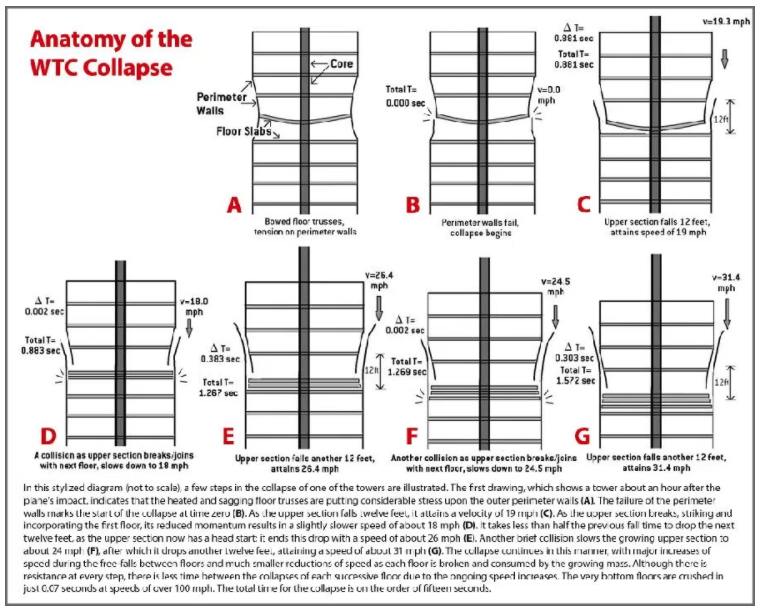
Therefore, the impact and fires “eventually caused floor trusses to sag, pulling the perimeter walls inward until they finally snapped. At this instant, the entire upper section of each tower fell the height of one floor, initiating an inevitable, progressive, and utterly catastrophic collapse of each of the structures.”

Screen Shot 2017-11-17 at 10.21.41 AM

via Committee for Skeptical Inquiry

As noted in the diagram, the collapse of perimeter walls under the weight of the structure above created a chain reaction of increasing mass and speed (quick, but not free fall).

During the collapse,

…air—along with the concrete and other debris pulverized by the force of the collapse—was ejected with enormous energy. “When you have a significant portion of a floor collapsing, it’s going to shoot air and concrete dust out the window,” NIST lead investigator Shyam Sunder [says].

This explains the blasts from the sides of the Towers as they fell, which Truthers point to as evidence of other explosions inside the buildings.

Again, as with Building 7, Truthers believe thermite was used to intentionally lower the melting point of steel (even though this is never used in actual demolitions!). They believe molten iron, iron oxide (rust), and pure aluminum found at Ground Zero are evidence of thermite reactions, rather than the more natural explanations anti-conspiracy theorists insist upon.

The Achilles Heel

This is just the tip of the iceberg when it comes to the 9/11 conspiracy theory.

Much more is claimed by organizations like 9/11 Truth and Architects and Engineers for 9/11 Truth and countered by scientists, architects, and engineers in publications like Popular Mechanics and Scientific American.

For instance, that only explosives could send debris sailing hundreds of feet away from the Towers as they fell; that the hole in the Pentagon was too small to have been made by a Boeing airliner and was therefore created by a missile; that the government issued an Air Force stand down order to allow planes to reach their targets; that the government destroyed evidence; etc.

Yet certain questions point to, rather than diabolical genius on the part of Bush’s government, almost unimaginable incompetence should this be an inside job.

Most striking: any controlled demolition of Building 7 would carry some risk of exposure. Why demolish Building 7 as part of some sinister plot in the evening of 9/11, when the World Trade Center was already in ruins? The pointlessness and absurdity of such a plan are astounding. It offers no benefit whatsoever, only increased risk of actual evidence being found linking the State to the crime.

Likewise, the events after 9/11 make little sense were this a government conspiracy.

It is well-established that Bush and his inner circle sought to attack Iraq from the moment the planes struck the Twin Towers.

Richard A. Clarke, the National Security Council counterterrorism coordinator at the time, said, “When the 9-11 attacks occurred, Bush cabinet members immediately discussed how that tragedy could be used to justify an invasion [of Iraq]” and “Bush himself asked me to try to pin the blame for 9-11 on Iraq.”

The administration was so eager to blame Iraq, Donald Rumsfeld ordered strike plans against Iraq on September 11, while the ruins of the twin towers still smoldered (see Stone and Kuznick).

A false case was made for war against Iraq; real evidence that Iraq participated in the attack or was planning to do so in the future never materialized; the “evidence” the government presented—that one of the 9/11 hijackers met with an Iraqi intelligence official, that Iraq was buying uranium from Niger, kept mobile biological weapons labs, and helped train Al-Qaeda—all turned out to be forgeries and lies.

Secretary of State Collin Powell presented all this to the United Nations (Bush told him, “Maybe they’ll believe you”), but later called it a low point in his career (see Stone and Kuznick).

Michael Morell, a CIA official who served as Bush’s intelligence briefer, admitted in 2015 that the Bush administration took the information he provided and distorted it. Later, Bush administration officials like Cheney and Rumsfeld ordered the use of torture in Iraq in an attempt to turn their lie into a truth, to establish a link between Saddam Hussein and Al-Qaeda operations (see Chomsky, Hopes and Prospects).

In reality, after 9/11 the Bush Administration saw an easy opportunity to eliminate an enemy dictator, who had formerly been a close U.S. ally but had since gone rogue, and seize control over one of the largest oil reserves in the world (see Chomsky, Imperial Ambitions; Hegemony or Survival).

Iraq, one of the richest prizes in the world, was both militarily weak and, with a little dishonesty, could be made into an enemy with weapons of mass destruction that supported the 9/11 attacks.

9/11 Truthers rightly insist that before 9/11 the U.S. sought to expand its control of the Middle East for its natural resources. In 1999, Dick Cheney told oil industry leaders, “The Middle East, with two-thirds of the world’s oil and the lowest cost, is still where the prize ultimately lies.” Cheney even set up a secret energy task force to plan how the U.S. could best control the world’s oil (see Stone and Kuznick).

Truthers also correctly note how 9/11 was used as justification for any foreign or domestic policy whim of American leaders, no matter how violent, deadly, authoritarian, or barbaric.

Seizing Afghanistan and Iraq could open the door to further interventions and tighter control of the region. “Pentagon officials foresaw a five-year campaign with a total of seven targeted countries, beginning with Iraq, followed by Syria, Lebanon, Libya, Somalia, Sudan, and the biggest prize of all, Iran” (see Stone and Kuznick).

In the National Security Strategy of 2002, the Bush administration declared it had the right to launch pre-emptive wars against any nation that it perceived to be a future threat, and that no nation should be allowed to challenge America’s global dominance (see Foner, Give Me Liberty!).

Yet based on the historical facts, had the government orchestrated, or allowed, the 9/11 attacks, and was going to craft the greatest lie in American history, it seems more likely it would have simply pinned the blame on Saddam Hussein.

First, not only is it clear Iraq was a U.S. target from the beginning, it is obvious why Iraq would have been seen as a more valuable conquest than Afghanistan. While Afghanistan is extremely rich in natural gas and minerals, its oil wealth is estimated at 3.6 billion barrels (but 0 proved reserves). Contrast this to Iraq, which has 144 billion barrels of proved reserves (the Bush administration quietly announced it would be American oil companies such as Halliburton, whose former CEO was Dick Cheney, that would rebuild the Iraqi oil industry, reaping billions in profits).

Second, dismissing Al Qaeda and simply blaming Iraq would have saved the Bush administration from having to conjure up tall tales of Hussein having weapons of mass destruction or that he supported the 9/11 attacks.

Again, here we have a redundant fabrication. Just as there was no need to demolish Building 7 after the World Trade Center was demolished, there was no need to lie about Iraq having biological, chemical, or nuclear weapons, or being a haven for Al Qaeda terrorists, or supporting the 9/11 plot, when a simpler, earlier lie would have sufficed (and likely have been immediately accepted by the American populace without question): that Iraq planned and executed the destruction of the Twin Towers.

For more from the author, subscribe and follow or read his books.