Is Standing with Israel Standing with a Violent Oppressor?

In the United States, there is widespread support for Israel, owing to both a longtime American-Israeli alliance, and empathy concerning both the intimate Christian-Jewish historical connection and the Nazi Holocaust (the long history of Christian atrocities against the Jews before the Second World War is either unknown or ignored). A February 2016 Gallup poll showed 62% of Americans sympathize more with Israelis than Palestinians, while the opposite is true for only 15%. The factors that influence such support can make it easy to view Israel as “the good guy” regardless of its actions, quite similar to the black-and-white vision of American foreign policy, where the U.S. is a hero no matter its actual motivations for violence or how many innocent people it kills.

When considering the Israeli-Palestinian conflict, several things must be kept in mind. First, nations with an official state religion historically tend to mistreat and marginalize citizens that do not follow the official dogma. Second, more powerful states tend to be able to cause more widespread destruction and death than smaller powers. Finally, terrorist violence tends to be a reaction to both the first and second points — a violent response to mistreatment, dehumanization, invasions, occupations, bombings, and so on.

The land that is called Israel today was long ruled by Muslim powers like the Ottoman Empire, until the end of World War I, when the Allied Powers, principally Britain and France, dissolved the Ottoman state and carved up the Middle East for themselves. Israel, called Palestine then, was a place Jews, Muslims, and many other religious people had lived together for centuries, not always peaceably, not always at odds. Britain, however, favored the Jews, and went along with mounting pressure from Zionist groups that had organized in the late 1890s to create a national homeland for Judaism — that is, a religious state, regardless of the pesky Muslims and other religionists that currently also lived there.

After World War II and the Holocaust, support for a Jewish state grew immensely among Western powers, particularly the U.S. Zionist groups grew stronger. So in 1947, the U.N. crafted a plan to give most of Palestine to the Jews. This sparked violent uprisings from Palestinians, and then the Arab-Israeli war of 1948-1949 after the Jews of Palestine declared their independence and formed Israel — which of course was the vast majority of Palestine, per the U.N. plan. The Jews, backed by the U.S. and the West, won the war. Hundreds of thousands of Palestinians were driven from the country by Jewish forces.

Israel had its state, and the Arabs who hadn’t fled the war and become refugees in neighboring countries found themselves in one of two places: either within the official borders of the new Jewish state, or in Gaza or the West Bank, the land of Palestine left to them.

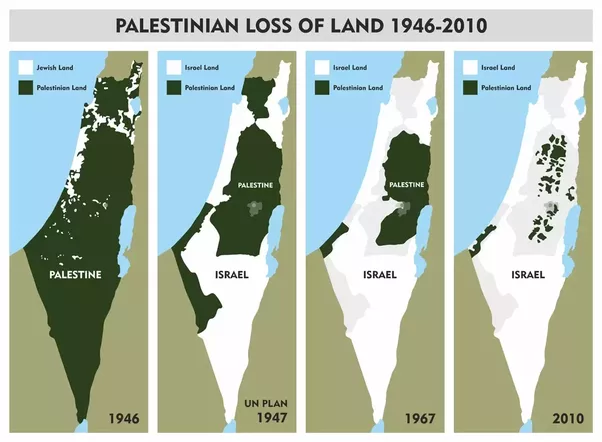
After the Six Day War of 1967, Israel occupied Gaza and the West Bank. Palestinians fought for decades to push the Israeli military out, and while in 2005 a victory was won when Israel agreed to end its occupation of Gaza, the State still controls over 60% of the West Bank, by force. So 40% of the West Bank is controlled by the Palestinian Authority, but this does not allow us to disregard the fact that this leaves hundreds of thousands of other Palestinians, many who want their own state, under military occupation. Palestinians who want nationhood and self-determination face an increasingly difficult challenge, as their control over the land continues to be whittled away to nearly nothing:
main-qimg-8533c9651a3166d0307bffb7c06ab83a

Today, Israel is a client state of the U.S., which supports it with weapons (including nuclear weaponry), military machines, billions of dollars in economic aid, and unwavering support to do essentially whatever it wishes to the Palestinians, no matter how brutal. Israel in turn is a market for U.S. arms manufacturers, allows the U.S. military to use it as a base of operations, and consistently supports deadly U.S. foreign policy against Arabs and others around the world.

Quite predictable for a nation with no separation of church and state, Israel over the decades has left Muslims marginalized, victimized, oppressed, and exploited. Palestinians have been rounded up and removed from their homes, denied city services, excluded from government, and abused, kidnapped, and killed by the State. Many were forced from their lands and confined by military force onto the reservations of Gaza and the West Bank (not dissimilar to U.S. treatment of Native Americans). In one place (within Israel’s borders), Palestinians live under apartheid, in another (Gaza and the West Bank), countless innocents have been victims of bombing campaigns and invasions when the military giant that is Israel seeks revenge for terrorist attacks or decides to further chip away at Palestinian territory.

Let us first consider the worst crimes, those against Palestinians in Gaza and the West Bank.

In the West Bank, Israel breaks international law (repeatedly noted by the U.N. Security Council and the International Court of Justice, and even acknowledged by Israel’s highest courts in 1967; see Chomsky, Who Rules the World?as it annexes more Palestinian territory (usually the most valuable land in terms of resources and arability) and constructs settlements, overseen by the military. Israeli citizens are given huge state subsidies to build homes and businesses on Palestinian land, and receive protection from tanks and soldiers and new border walls. Palestinian poverty in the West Bank is nearly 60%.

In Gaza, 80% of residents are refugees. It is one of the poorest, most overpopulated areas on Earth. In 2014, 70% lived below the poverty line. Gaza has limited natural resources — making it less attractive to Israeli settlement, but still worthy of Israeli abuse. There is nearly no private sector. Its economy is strangled by economic warfare waged by Israel, which maintains tight restrictions on access to outside markets — a permanent blockade. For example, Israel at will banned the entry of construction materials into Gaza, despite a massive housing crisis, which left some 80% of factories in Gaza empty, sapping $500 million from Gaza’s economy.  

As Trudy Rubin writes:

Gaza’s men, women and children remain locked in a virtual prison. Since Hamas took control in 2007, Israel has kept the strip under an economic blockade; the Israelis control its sea space, airspace and borders, except for the Rafah crossing with Egypt. Gazans are rarely allowed to exit for medical treatment or to study.

Tens of thousands of Gazans who once worked as laborers inside Israel were locked out of Israeli jobs nearly two decades ago for security reasons. Unemployment is sky-high, and local businesses have been crippled by the blockade, or by previous battles between Israel and Hamas. Gaza lives off the international dole.

Noam Chomsky describes the situation in detail in Hopes and Prospects. Israeli shelling and military incursion into Gaza starting in 2006 destroyed homes, businesses, infrastructure. 80% of their crops were destroyed, and 96% of 1.4 million Gazans now depend on humanitarian aid — food, medicine, water. While Israel, its economic blockade total and complete, used to allow 4,000 commercial products to be shipped into Gaza before 2006, afterwards only allowed 30-40. It can cut off electricity (and water and sewage systems) to Gaza at any time, as it did in February 2008, threatening to cut a megawatt every week until rocket attacks against Israel by Palestinian terror groups stopped — essentially, punishing the many for the crimes of the few.

Israel can tighten the blockade in other ways. In late 2008, Israel cut off spare parts for water-related equipment for over a year, and from October to November 2008, reduced the humanitarian aid entering Gaza from 123 food trucks a day to 4.6 on average. In December 2008, water use was limited to 6 hours every 3 days, and electricity was scarce. Israeli bombings of power plants and sewage facilities have made near-shore fishing impossible — but the Israeli navy blocks Palestinian fishing boats from entering Gaza’s lawful territorial waters. Israel has also targeted ambulances and farmers trying to plant crops too close to the border (see Hopes and Prospects). 

Other crimes include preventing UNRWA, the United Nations Relief and Works Agency, from aiding Gaza during the Israeli siege of 2008-2009 (which killed about 1,500 Palestinians, 70% civilians; Israel lost 3 civilians, 10 soldiers); breaking cease-fire agreements even when Hamas and other enemies honored them, as in 2012, something Israeli officials even admitted to; and bombing refugee shelters, as in the 2008-2009 conflict (see Who Rules the World?). 

Although nearly all the world’s governments have agreed to recognize a Palestinian nation, two nations have consistently voted against this: Israel and the U.S. Palestinians are divided on the issue: many want one state, a state without an official religion, where a civil rights movement for true equality could be launched. To Israel, this is unthinkable. Other Palestinians favor their own nation, with their own government, their own laws, their own way of life. 

Palestinians within Israel itself are not a “free people.” Not as free as Israeli Jews, at any rate. They were subjected to military rule until 1966. Today, Palestinians are kept out of Jewish neighborhoods and contained in Arab ones. Arab neighborhoods don’t receive equal services — their streets and electric networks are left to deteriorate (Hopes and Prospects). As the Institute for Middle East Understanding documents, “there are more than 50 laws that discriminate against Palestinian citizens of Israel. directly or indirectly, based solely on their ethnicity, rendering them second or third class citizens in their own homeland.” A brief sampling of the types of discrimination include:

  • More than seventy Palestinian villages and communities in Israel, some of which pre-date the establishment of the state, are unrecognized by the government, receive no services, and are not even listed on official maps. Many other towns with a majority Palestinian population lack basic services and receive significantly less government funding than do majority-Jewish towns.
  • 93% of the land in Israel is owned either by the state or by quasi-governmental agencies, such as the Jewish National Fund, that discriminate against non-Jews. Palestinian citizens of Israel face significant legal obstacles in gaining access to this land for agriculture, residence, or commercial development.
  • Government funding for Arab schools is far below that of Jewish schools. According to data published in 2004, the government provides three times as much funding to Jewish students than it does to Arab students.
  • The Nationality and Entry into Israel Law prevents Palestinians from the occupied territories who are married to Palestinian citizens of Israel from gaining residency or citizenship status. The law forces thousands of Palestinian citizens of Israel to either leave Israel or live apart from their families.
  • In November 2010 the chief rabbi of the town of Safed, Shmuel Eliyahu, issued a ruling forbidding Jews from renting property to Arabs. [In support, another rabbi said, “Racism originated in the Torah… The land of Israel is designated for the people of Israel.”]
  • In July, 2009, Israel’s Housing Minister, Ariel Atlas, warned against the “spread” of Israel’s Arab population and said that Arabs and Jews shouldn’t live together, stating: “if we go on like we have until now, we will lose the Galilee. Populations that should not mix are spreading there. I don’t think that it is appropriate for [Jews and Arabs] to live together.”
  • A poll done by the Israel Democracy Institute and released in January 2011 found that nearly half of Israeli Jews don’t want to live next door to an Arab.
  • According to a September 2010 poll, half of Israeli Jewish students don’t want Arabs in their classrooms, while an earlier survey found about the same number oppose equal rights for Arabs.

And so on. The U.N. condemned “harsher punishments for Palestinians for the same offense” in the Israeli criminal justice system (and the reverse: when a Palestinian girl named Intissar al-Atar was shot by a Jewish man, he did not go to prison, as the judge decided he only meant to scare the girl when firing at her, not kill her; see Who Rules the World?), discrimination by Israeli police, anti-Palestinian hiring practices, unequal education, housing discrimination, etc. “Within Israel, 48 percent of Palestinian Israelis live in poverty, compared with a poverty rate of 15 percent for Jewish Israelis,” to quote the Seattle Mideast Awareness Campaign. How all this goes should be quite familiar to Americans, given our racial history.

And, of course, so should terrorism.

One should not be an apologist for Hamas or the PLO, Palestinian groups that engage in terrorism, showing utter disregard for Israeli life, to end Jewish rule of Palestine. But one should not be an apologist for Israeli oppression, occupation, and murder either.

These things are intimately connected. Extremism and terrorism are often birthed and encouraged by brutal policies, not just religious hatred. Americans (at least those with any understanding of U.S. foreign policy in the Middle East) understand that all too well. 

The Jews, supported by foreign powers like Britain and the United States, carved a nation out of land where many non-Jews lived too, and began immediately oppressing them, by law and with deadly force. Israel has killed two Palestinian children per week on average for the past 14 years (Chomsky, Who Rules the World?). Extremism and terrorism were predictable — a violent reaction to violent oppression.

Israel has a right to defend itself, but at the same time must change the vicious policies, military occupation, and atrocities that breed terrorism.

Insisting Israel uses all precaution to limit civilian casualties is just pandering to State power and parroting State propaganda. Israel has been accused of war crimes by the international community many times, and not without reason. Take the Israeli-Gaza conflict of 2014, which killed over 2,000 Palestinians (wounding some 10,000) and about 70 Israelis (over 500 wounded). The vast majority (the U.N. estimated 80%) were noncombatants. The High Commissioner for Human Rights at the U.N. called Israel’s bombing of civilians war crimes, and the U.N. Human Rights council voted to investigate Israel for crimes against humanity. There was only one “no” vote: the United States. In 1971, Israel refused to sign a peace treaty with Egypt because it wanted to maintain its occupation of Egypt’s Sinai (Global Discontents, Chomsky).

Like other battles between Israel and the Palestinians, terror attacks by the few justify the mass killing of the many. Israeli shells that rained down in Gaza did so indiscriminately, blowing up neighborhoods, shops, schools, hospitals. Hamas has indeed used homes and mosques and other public facilities to store weapons and plan their vicious terrorist attacks (where else would they do it?), yet it is important to remember Israel, like most states, has a history of bombing civilian areas, and even if all the civilians killed were collateral damage when destroying Hamas fighters or weapon caches, one still might ask: Should we tolerate the slaughter of innocents if it brings about the deaths of terrorists (as Presidents Bush and Obama seem to deem acceptable)? Among decent human beings, it is unacceptable for the State to slaughter terrorist enemies if innocent people burn in the same fires.

In any case, the death toll of innocent Palestinians is almost always far greater than that of innocent Israelis. This is because Israel has much better weaponry.

The residents of Gaza are bombed by cutting edge F-16 fighter jets and drones, yet they do not have bomb shelters, and they have nowhere to flee. Israel’s residents are bombed mostly by makeshift rockets, many of which have been intercepted by Iron Dome missiles. The majority of the population in Israel has access to shelters and can flee out of the rocket’s range.

Clearly, there are two types of terrorism. One is a group against a State. The other, a State against a group. We can continue to condemn horrific anti-Israeli terrorism. But we should also condemn brutal Israeli State terror. Oppose the atrocities of both parties partaking in a cycle of violence, from Israeli soldiers shooting 10-year-olds to Arab shooting sprees in busy Israeli markets.

Though peace is elusive, there is still much hope for it among Israelis and Palestinians alike. Look no further than a short statement released by the Jews for Palestinian Right of Return organization. These are prominent Jews from around the world who want to see an end to both Israeli terrorism and Palestinian terrorism: the statement was called “Apartheid Israel Doesn’t Speak for Us.” Then, look to the social media movements like Israel Loves Palestine and Palestine Loves Israel.

For more from the author, subscribe and follow or read his books.

When the U.S. Banned Machine Guns, it Worked

In the wake of the mass murder of homosexuals at a nightclub in Orlando, Florida, much attention has been turned to the legal status of assault rifles. These weapons, sometimes easier to legally obtain than a pistol, are semiautomatic — bullets fire as quickly as the user can pull the trigger. This is distinct from an automatic weapon (a machine gun), where the user can hold down the trigger and spray a continuous stream of bullets.

Though there are ways to modify a semi-automatic weapon to make it fire like a full automatic, machine guns are not readily available in the United States, due to a limited supply, strict regulations, and a federal ban.

This wasn’t always the case. In the first decades of the 20th century, machine guns were widely used by the mob, and by criminal figures like John Dillinger, or Bonnie and Clyde. In 1929, the Chicago police estimated Chicago gangs had some 500 machine guns. “It is no trouble to buy machine guns,” V. A. Daniels, a gun runner, told a local newspaper at the time.

After repeated incidents of machine gun violence — such as Bonnie and Clyde’s demise or the St. Valentine’s Day Massacre — the U.S., in 1934, passed the National Firearms Act, which imposed strict requirements on machine gun ownership: there was a huge tax upon purchase (originally $200, which translates to $3,500 in today’s dollars), and buyers had to be fingerprinted, photographed, and entered into a national ownership registry. The measure was even approved by the National Rifle Association, which used to be much more concerned with sensible gun control.

Robert Spitzer, a gun law scholar at the State University of New York at Cortland, says this caused machine gun sales to evaporate. In other words, regulations had a profound affect on the number of machine guns in circulation.

Spitzer told NPR:

It is a good example of something that is little known, which is a gun control law that was pretty effective in keeping such weapons out of civilian hands. So by 1986, when the provision was added to the Firearm Owners’ Protection Act to bar any newly produced fully automatic weapon from possession by civilians, it was really a fairly small step to make, because so few of them were in circulation to begin with.

Indeed, after 50 years of strict guidelines for machine gun ownership (and an essentially doubled price), the U.S. went a step further. While the Firearm Owners’ Protection Act on 1986 wiped out some gun controls, it had a provision that banned the sale of machine guns to civilians (they are still produced for and sold to law enforcement). That law is still in place.

The only exception is gun collectors who want to buy old machine guns (generally very pricey); they must get a license from the Bureau of Alcohol, Tobacco, and Firearms, undergo a background check, pay a tax, and so on. Law enforcement near your residence even have to sign off on it. Machine guns cannot simply be bought with no questions asked. Perhaps it is then understandable semiautomatic assault rifles, so easily purchased, are a mass murderer’s best friend (whether modified or not).

Perhaps not surprisingly, from 1934-2010 there has only been one homicide involving a civilian with a licensed and registered machine gun (today there are just under half a million machine guns registered with the ATF, many belonging to law enforcement).

Illegal machine guns — those unregistered, unlicensed, illegally sold, stolen, brought in from other countries, etc. — were, predictably, more of a problem, but not enormous. Statistics are scant, but some include:

  • From 1983-1992 in the U.S., 0.6% of police deaths involving civilians with guns involved machine guns.
  • In 1980 in Miami (when homicides were peaking and the city was dubbed the “machine gun mecca”), less than 1% of homicides involved machine guns.
  • From 1987-1989, the Minneapolis police recovered 2,200 guns, with zero machine guns.
  • From 1980-1989, Chicago drug arrests yielded 375 guns, with zero machine guns.
  • 0.7% of the guns taken by Detroit police from 1991-1992 were machine guns.

We must consider the implications here. Some of the most powerful guns are owned by very few people and are used in very few crimes. Why? Is it coincidence that a weapon that is so strictly regulated and quite rare, as it’s not mass produced, is rarely used in crime, while weapons that are loosely regulated and are mass produced are widely used?

Machine guns aren’t produced for civilians, so there is a limited supply; that limited supply is very hard to access — you must either steal one, illegally buy one, smuggle one in, or go through an extremely strenuous registration and licensing process, which you may not even pass if you have a criminal record or the FBI deems you suspicious. It is simply very difficult to get your hands on one — prohibitively difficult. And hence, you go with weapons easier to obtain (and/or modify), not to mention cheaper.

Making certain weapons (machine guns, bazookas, stinger missiles, grenade launchers, nukes, etc.) nearly impossible to get prevents their use. The old “gun bans don’t work” idea isn’t wholly accurate. They may not work perfectly (some machine guns will be stolen, some bought and sold on the black market), but they can work to an encouraging degree.

No, strict regulations and a halt of production didn’t stop all machine gun crime. No, semiautomatic assault rifles are not used in most crimes today. And no, the 1994-2004 assault weapons ban in the U.S. wasn’t as effective as some hoped, due to enormous loopholes that rendered it partly inert, and due to a lack of registration, licensing, and other machine-gun level regulations.

Yet if the measures the U.S. enacted to curb machine gun violence has made machine guns rare and difficult to get, and kept machine gun crime to a minimum, one might wonder if enacting the same sort of regulations on old semiautomatic assault rifles and banning new ones (and devices that turn them into fully automatic weapons) could work to reduce the number of casualties during mass shootings (or even the total number of mass shootings), perhaps saving some innocent lives.

For more from the author, subscribe and follow or read his books.

“Politicizing” the Orlando Shooting is a Matter of Life and Death

Politics is life and death.

There is no divorcing a mass shooting from the public policies that directly determine the availability and ease of obtaining firearms.

We happen to live in a rather strange sort of society, where 40% of gun sellers don’t have to conduct criminal background checks on buyers, where we have license and registration requirements (“government databases”) for cars but not firearms, where people on the terror watch list/no fly list can legally purchase guns and ammo, where people largely aren’t required to report stolen guns, and where people can buy assault rifles (used to kill homosexuals in Orlando, children at Newtown, theatergoers in Aurora, students at Roseburg, and workers in San Bernardino) legally. There is ample evidence (see The Last Article on Guns You Will Ever Need to Read) that correcting these problems, while not a perfect solution that will prevent all gun deaths, can make it more difficult for would-be killers to obtain weapons, give authorities better means and more time to track and apprehend would-be killers, and reduce the number (and scale) of mass shootings and petty crimes involving guns.

There is, further, no separating the murder of homosexuals from the political climate of civil rights.

It is true, unquestionably, that religion — whether Islam, Christianity, or other — is a driving force behind the disgust and hatred toward homosexuals (see Hysteria Over Homosexuality Linked to Too Much Religion, Too Little Science). America has Christian church leaders who say gays should be executed, pastors who celebrated the mass killing in Orlando (Steven Anderson: “The good news is that there’s 50 less pedophiles in this world, because, you know, these homosexuals are a bunch of disgusting perverts and pedophiles”), and Christian citizens who murder homosexuals, using the Old Testament as justification. This could easily have been a Christian terrorist.

People will have to let go of ancient religious ideas to help solve this problem, but our public policies regarding homosexual and trans Americans can create either a climate of acceptance, tolerance, and equality, or discrimination, derision, and second-class citizenship. Gay marriage was only legalized across the country in mid-2015. In early 2016, Mississippi — the last holdout — was forced to allow gay couples to adopt children. Republican states are fighting viciously to allow private businesses and organizations to refuse service to gay people, using religious beliefs as justification. You can still be fired for being gay in 28 states — equal opportunity laws are not extended to LGBT citizens. The idea of trans people using bathrooms that match their gender identity, despite the fact they had been doing so for some time, suddenly caused mass hysteria among conservatives, with states in the South trying to make it illegal. Gay men are largely restricted from giving blood, adding an unthinkable level of absurdity to the Orlando attack, only the latest among yearly hate crimes against gays, some 20% of all hate crimes.

Can it be imagined that public policies that teach citizens that discrimination and inequality is acceptable somehow do not contribute to a climate of intolerance and hostility, its most extreme form being violence? Would it not be more sensible to push for and implement political ideas that encourage total inclusion and equality? While not a perfect solution, it may help create a society where anti-gay thought and action is less socially acceptable (similar to how anti-black racism has become much less acceptable and more subtle in recent decades, since the political successes of the civil rights movement), on top of being the right thing to do in a country that speaks of all people being equal. This holds true whether or not the Orlando killer was a homosexual — a tolerant environment can reduce self-hate as well.

Finally, there’s the political causes of terrorism. Again, religion plays a role — Islamic terror groups sincerely believe they are doing God’s will, as so many others believed when committing atrocities throughout history, including Christians.

But the focus of groups like ISIS and Al Qaeda on the United States is largely a result of American politics — namely, a foreign policy that killed many Arabs and Muslims long before 9/11 (see A History of Violence: Facing U.S. Wars of Aggression).

Both U.S. intelligence officials and Osama bin Laden himself made it quite clear that American military intervention and support for brutal Middle East dictators and official enemies over the past few decades made the U.S. a symbol of evil, worthy of revenge attacks. A Pentagon advisory panel explained, “Muslims do not ‘hate our freedom,’ but rather they hate our policies”; bin Laden put it less politely when he wrote, “Why are we fighting and opposing you?… Because you attacked us and continue to attack us… Your forces occupy our countries; you spread your military bases throughout them.” Further enraging Islamic extremists were U.S. military bases near Mecca and Medina in Saudi Arabia, U.S. support for Israel, the massive death toll of innocent Muslim civilians in Somalia, Lebanon, and especially Iraq during and after the 1991 Gulf War (over 500,000 Iraqi children under age 5 died as a result of economic sanctions imposed on Iraq by the U.S. after the Iraqi army was driven from Kuwait; U.S. Ambassador to the U.N. Madeline Albright infamously said, “We think the price is worth it”).

The U.S. of course is not the only nation to be targeted. When the British and French occupied the Middle East after World War I, they were the targets of terror. When the Soviets invaded Afghanistan in the 1980s, the U.S.S.R. was the “Great Satan.” Nations that joined the U.S. invasion of Iraq became bombing targets, like Spain in 2004 (191 killed) and Britain in 2007 (52 killed). After France took a major role in bombing ISIS, the terror group killed 129 people in Paris in November 2015 — not a coincidence, according to French intelligence officials and ISIS itself, who warned France would stay at “the top of the target list” if they continued their “strikes…in Muslim lands.” After predicting and even welcoming the rise of ISIS, the U.S. began bombing the barbaric terror group when it took over Syria and northern Iraq. ISIS publicly promised revenge.

In other words, the U.S. is caught in a cycle of violence, where extremist terror attacks and U.S. bombings or invasions feed each other. This is not difficult to understand. No need to wonder why 9/11 did not happen to Switzerland. Or why ISIS currently is not attacking Japan. U.S. foreign policy will have consequences. To avoid future terror attacks, we will have to make drastically different political decisions.

This is not to say if the U.S. military was not mired in the Middle East that 50 people who enjoyed an evening at a gay club in Orlando would still be alive. There is no way to know at this moment how greatly ISIS-type violence inspired the Orlando shooter to act on his extreme hatred for homosexuals — or if it had much influence at all. But there is no question ending foreign wars and embracing peace would lead to fewer and fewer calls from murderous terror groups to attack the United States. Fewer extremists will deem it necessary. Then, as in other nations not currently on terror groups’ “target lists,” the U.S. might find the safety and security it longs for.

The voices that insist tragedies should not be “politicized” are, quite frankly, crafting an excuse for inaction. People are right to immediately begin discussing political issues like gun control when a mass shooting occurs. True, there will be politicization that one does not care for — immediate calls to increase American bombings against ISIS, say, or calls for “more guns” to “increase safety” — but it is necessary during times of tragedy to consider a change of course. Tragedies are sometimes a sign that our country is moving down the wrong path, and that perhaps we should find a different one. Changing course will require different political decision-making, and it will need to happen quickly — American memory is fleeting.

Politics is life and death.

For more from the author, subscribe and follow or read his books.

What Isn’t the Matter with Kansas?

Thomas Frank’s What’s the Matter with Kansas? asked why conservative voters in Kansas (and elsewhere) tend to vote against their own interests. That is, why vote for Republican politicians who consistently create policies that benefit the wealthy and privileged, but oppose measures that could very much improve the lives of most Kansans, such as pro-union policies, higher minimum wages, expanded government investment in public schools or healthcare, and so on.

The book was written in 2004, and tracked Kansas’ march to the right over the last few decades. Today, 12 years later, Kansas is so far to the right it could arguably be called the most conservative state in the nation.

Currently, the Kansas government is in crisis. In a matter of weeks, on June 30, we will reach the deadline the Kansas Supreme Court set for the Legislature to fix the unconstitutional manner in which Kansas funds public schools. The Court decreed this year that the Republican-led Legislature couldn’t use a new “local option” edict that benefited wealthier districts, leading to increasingly unequal educational opportunities for rich and poor students. $1 billion, or 25% of Kansas’ education funding, would be used in an unconstitutional manner, the Court ruled.

If the Kansas government fails to present a plan that would address the funding problem, Kansas schools will shut down. Summer school, where still going on, will have to end. Further,

Schools do much of their hiring of teachers and other staff during the summer. Crews clean, repair and ready buildings for a new year, and they maintain and inspect school buses. Some districts operate summer child care programs or driver’s education, as well as programs that provide federally funded free meals for children.

And if that isn’t critical enough, imagine the chaos in August when the regular school year is supposed to begin.

While the Court could extend the deadline if the Legislature makes progress on a plan, it is unclear if Republican Governor Sam Brownback and his congressional allies will be open to granting a special session of the Legislature, currently on break. Democrats are invoking Article 5, Section 1 of the Kansas Constitution to try to force a special session, but don’t have near the numbers to actually vote that into reality.

In other words, our “representatives” won’t even meet to address the problem.

While a few conservatives are also urging a special session, Brownback seems to fiddle while the state burns — he could call a special session himself, right away, but has not indicated he will do so. Other Republicans, to quote the Topeka Capital Journal are “looking for a confrontation with the Kansas Supreme Court.”

Apparently, some are having difficulty comprehending the idea that the Kansas Supreme Court actually has the authority to require legislative action to correct unconstitutional laws. Republican State Senator Greg Smith of Overland Park declared, “They can’t tell us what to do.”

Shutting down the schools for the regular academic year would mean some 67,000 jobs threatened, not to mention the health of an already fragile economy, as the roughly $6 billion the 286 public school districts spend each year would be largely frozen. “If schools shut down and people aren’t working, they would no longer have taxes withdrawn from their paychecks, and state revenue would take a hit. There could be further damage to the economy as those workers put purchases on hold…”

This disaster is, as Kansas residents know well, just the tip of the iceberg.

Brownback at one point explained to the Wall Street Journal, “My focus is to create a red-state model that allows the Republican ticket to say, ‘See, we’ve got a different way, and it works.’” Kansas would therefore be a great Republican experiment to prove that slashing taxes for wealthy individuals and businesses would lead to substantial economic prosperity for all Kansans. The New Republic writes:

Brownback established an Office of the Repealer to take a scythe to regulations on business, he slashed spending on the poor by tightening welfare requirements, he rejected federal Medicaid subsidies and privatized the delivery of Medicaid, and he dissolved four state agencies and eliminated 2,000 state jobs. The heart of his program consisted of drastic tax cuts for the wealthy and eliminating taxes on income from profits for more than 100,000 Kansas businesses. No other state had gone this far…

In addition to his sweeping tax cuts, Brownback wanted to eliminate the earned-income tax credit, which had benefited the working poor. He cut about $200 million in the state’s spending on education — the largest such reduction in the state’s history; and he proposed changing the school financing formula at the expense of poorer, urban districts…

He obtained the power to nominate judges. He reduced tax cuts on the wealthy even more: The rate for the top bracket fell from 6.45 percent to 3.9 percent, and Brownback promised to eventually reduce it to zero when revenues from other sources made up for any potential losses. The economic benefits, he boasted, would be immense.

Due to a far-right Legislature, Brownback was able to conduct his experiment, especially after 2012. Republican leader Mitch McConnell declared, “This is exactly the sort of thing we want to do here, in Washington.”

The results were largely disastrous.

The tax cuts lowered government revenue by $700 million, and somehow failed to trickle down and lead to new jobs and higher wages for ordinary workers. Kansas job growth was an absolutely dismal 1.1% in 2013, in 2015 0.1% (the seventh-worst in the nation). Kansas will likely be running deficits for years, worsened by the fact that Moody’s and Standard & Poor’s dropped Kansas’ credit rating due to the massive revenue shortfall, meaning worse borrowing terms and snowballing debt.

With a huge revenue shortfall, more services had to be slashed (undoing the tax cuts was unthinkable). Early 2015 saw $44 million cut from public schools, $16 million from colleges. In mid-2016, $97 million was cut from Medicaid, the healthcare program for poor, elderly, or disabled Kansans, and higher education. Kansas colleges lost $30 million — the University of Kansas lost $7 million, the K.U. Medical Center nearly $4 million, Kansas State over $5 million. In spring 2015, a couple school districts closed early because they ran out of funds. All this had countless harmful effects for many students, parents, teachers, and school workers, such as “larger class sizes, rising fees for kindergarten, the elimination of arts programs, and laid-off janitors and librarians.” There were many other cuts beyond these, and many other side-effects.

Efforts to stave off massive deficits entered the realm of the absurd: the Brownback government even tried to profit off the auction of sex toys.

Even though the writing was already on the wall in 2014, Kansas voters somehow reelected Brownback to a second term, buying his promises that his tax cuts just needed more time to work. They voted against their own interests — again. Bad habits, it seems, are hard to break.

By 2016, Kansas had gained only a couple thousand jobs, and the state still had a $228 million revenue shortfall; Brownback determined that pensions, colleges, highways, and children’s programs would have to take a hit. The only taxes he would consider were taxes on cigarettes and liquor; taxes on goods are of course regressive, hurting those with the most money least and those with the least money most.

All this while childhood poverty doubled in Kansas since 2003.

Gone are the days we had the luxury to ask, “What’s the matter with Kansas?” Now we must ask a slightly different question.

For more from the author, subscribe and follow or read his books.

The Last Article on the Minimum Wage You Will Ever Need to Read

Conservatives posit many criticisms of raising the minimum wage, and this article intends to address the four most prominent: that a higher minimum wage only leads to firings, as businesses cannot afford as many workers if everyone earns more; that businesses also hike up prices to cover the costs of a higher minimum wage; that minimum wage jobs are “meant” for young people without families to support; and that unskilled workers don’t “deserve” as comfortable a wage as a skilled worker.


Does a higher minimum wage increase unemployment?

Studies and historical trends show that when the minimum wage has been raised nationally or at the state level, it has not meant an automatic rise in unemployment.

Comparing historic minimum wage rates and unemployment levels from the Department of Labor, one notes when minimum pay nearly doubled in 1950, increased throughout the 60s, or rose yearly from 1978-1981, unemployment remained steady or declined. In fact, from 1950 to 2009, the only time unemployment rose after a minimum wage increase was 1970-1975, which also happened to be during a deep recession.

In 1996, a minimum wage increase boosted wages for many millions, but did not decrease the number of jobs, according to the Economic Policy Institute. Robert Reich writes, “When I was Labor Secretary in 1996 and we raised the minimum wage, business predicted millions of job losses; in fact, we had more job gains over the next four years than in any comparable period in American history.”

The National Employment Law Project provides a long list of studies showing fears of higher unemployment are baseless. Importantly, in 2009, their meta-analysis of over 60 studies on the U.S. minimum wage concluded there was “little or no evidence” of increased wages causing unemployment.

The NELP looked at the 22 times the national minimum wage was increased between 1938 and 2009, finding that after 68% of the raises employment actually increased, even higher in heavily impacted sectors like hospitality and retail. Declines in employment after an increased minimum wage tended to be in times of recession. There was “no correlation” between wage increases and lower employment levels.

Some interesting research from 2010, published in the Review of Economics and Statistics, examined two decades of data on counties on both sides of state borders across the country (i.e., adjacent counties that have different minimum wages) and found “no adverse employment effects” in counties with higher minimum wages. In April 2015, the Seattle minimum wage rose to $10-$11 an hour, and by the end of 2016 unemployment was lower than at the time of the raise. In 2016, the Council of Economic Advisors examined workers from the hospitality and leisure industry affected by minimum wage increases since 2014 (18 states plus D.C. enacted raises). It found no evidence that employment nor hours offered to workers were decreasing — in fact, this industry saw a bit more hiring compared to states without raises.

What’s going on here? Business large and small are supposedly unable to afford higher wages. Where is the apocalyptic mass unemployment?

A central contradiction of capitalism is that the business class keeps labor’s wages as low as possible to reap more profit, collectively creating a massive part of the citizenry with little purchasing power, resulting in under-consumption, which in turn negatively impacts those corporations’ profits.

But providing more purchasing power changes everything. Creating a stronger consumer base leads to greater profits for the capitalists, the business owners. Liberal economists wouldn’t argue for higher minimum wages if they did not understand that higher salaries means more spending, which reaps businesses more profits. The system balances out.

It seems reasonable to conclude higher minimum wages do not increase unemployment. Now, this does not mean that businesses aren’t seeking to replace human labor with machines to save money, as with self-checkout screens at retail stores and fast food joints. Indeed, this is a huge problem that may one day leave all of us jobless. But given this evidence, it seems likely higher minimum wages do not exacerbate the problem — under the profit motive, it seems sensible that businesses would be working on installing new technologies as quickly as possible, regardless of what happens to the minimum wage.

Further, to address another possible criticism, some claim higher minimum wages hurt the labor participation rate, the percentage of adults in the labor force (a bit different than unemployment, the percentage of those in the labor force without a job). The participation rate has gone down since 2000 by about 5%, after rising from 1962 to 2000 by about 9%. That 1960-1997 saw many minimum wage increases should perhaps cast suspicion on the idea that higher wages automatically kill the participation rate (as should the fact there wasn’t a federal minimum wage increase from 1997-2006, the time when participation actually went south). But more importantly, there may not be enough economic research yet to draw a correlation. Economists point to many factors that may be lowering the labor participation rate (but not necessarily unemployment, as they measure different things): more young people going to college and graduate school instead of right into the workforce, the mass retirement of the baby boomers, a large increase in disability claims, more women staying home with children than in past decades, and so on.


Does a higher minimum wage increase prices?

Perhaps where that argument fails, another will triumph. If workers receive higher wages, will prices rise (inflation)?

Actually, yes. But as Karl Marx noted a century ago, this is not the end of the economic story. The rise in prices will be all but insignificant, and “supply and demand” reveals why.

Higher wages lead to increased demand. Increased demand leads to higher prices. If an individual has an increased salary, he or she will spend more on commodities in a specific industry. Working-class people will spend more on “necessities,” wealthier people will spend more on “luxuries.” Wherever there is increased demand, prices will rise.

But then, as happens in capitalism, production follows demand. This is the part of “supply and demand” people forget. When working people start buying more X, the owners in that industry begin producing more X. The supply of the necessity increases, and when supply increases, what happens to price? It falls.

Marx wrote (Value, Price, and Profit) that when higher incomes for working people lead to a greater demand in an industry,

…capital and labour would be transferred from the less remunerative [financially rewarding] to the more remunerative branches [industries]; and this process of transfer would go on until the supply in the one department of industry would have risen proportionately to the increased demand…

As the whole derangement originally arose from a mere change in the proportion of the demand for, and the supply of, different commodities, the cause ceasing, the effect would cease, and prices would return to their former level and equilibrium.

Marx provided evidence from his day. He noted the U.S. agricultural worker made double the wage of an English worker, but both prices and productive output were lower in the U.S. He explained how from 1849 to 1859, agricultural workers in England saw wages rise 40%, while the price of wheat actually dropped, even despite wars abroad and unfavorable harvests.

One need not look far for current evidence. Research from 2001 showed a 10% rise in the minimum wage translated to a 0.4-0.7% hike in restaurant prices, a 1.5% hike at fast food joints.

A 2004 study in the Journal of Economic Surveys looked at 20 price effect studies and concluded a 10% increase in the minimum wage leads to a 4% rise in food prices, but a mere 0.4% increase in overall prices.

A colossal 26% increase in the minimum wage in San Francisco caused only a 2-3% increase in restaurant prices; restaurants still ended up hiring thousands more workers in the following decade, even with another 25% minimum wage raise on top of that.

A 2012 report from the Food Labor Research Center estimates upping the minimum wage to $9.80 would raise fast food prices less than 1.5% and grocery prices less than 3% over three years if the entire cost of the increase was passed on to the consumer (and not taken out of profits).

A University of Washington study found that one year after Seattle raised its minimum wage to $15 an hour, retail, rent, and grocery prices had remained the same — despite mass promises by employers to sharply raise prices.

Fortunately, the capitalist drive to keep prices down (to undercut competitors and seize a larger share of the market) makes it more sensible to take most of the cost of higher wages out of profits, rather than raise prices. And again, greater purchasing power for the consumer class helps offset the cost and balances out the system.

And, FYI, a moment’s thought makes one realize that rather than the minimum wage creating crippling inflation, it is inflation that devalues the minimum wage.

Since the wage is not indexed to inflation, if the cost of living rises, the power of $7.25 decreases. Adjusting for inflation, today’s minimum wage is lower than that of 1968 (it would be $10.52 an hour if it kept up with inflation, $21.72 if it kept up with worker productivity, which has massively enriched corporate owners).

But since 1978, the cost of college rose 1,000%, medical care 601%, food prices 244% (inflation is driven by factors independent of minimum wage raises). Very low wages and a very high cost of living is why it is difficult to “pull yourself up by your bootstraps” and “just get an education,” as conservatives demand of poorer people. Stagnant wages and a skyrocketing cost of living is a recipe for entrenched poverty, and that’s on top of the ways poverty perpetuates itself (see Beyond Bootstraps: Why Poverty is So Hard to Escape).


Are minimum wage jobs “designed” for young people without families?

“Fast food and other low-wage jobs were designed for teenagers, not to actually support a family!”

This is an interesting objection, and seems dubious, considering there’s no evidence for it. So allegedly businesses (or, vaguely, society?) have “designed” or “designated” certain low-skill, low-wage jobs for teenagers and therefore teenagers work there. Could it not be that low-skill jobs are only “designed” or “designated” for low-skill workers, and since teenagers have no training or degree that is where they are most likely to end up when working after class?

Regardless, in reality these jobs are designed to make a profit; capitalists care nothing about age, as long as you’re physically capable of doing the job. There exists a large pool of impoverished people viciously competing for jobs, taking what they can to avoid bankruptcy and homelessness. 48% of Americans live in poverty or make low wages, so (unsurprisingly) 88% of workers benefiting from a minimum wage increase would be over 20 (and 44% have some college education; half a million college graduates currently make minimum wage; in 2014, 46% of employed college graduates under 27 were working in a job that did not require a college degree, and about 15% had part-time work but wanted full-time work). 52% of fast food workers rely on welfare because they do not make enough money, costing taxpayers billions.

Let it also be said that some teenagers actually are supporting their families — or saving for college. Even though some teenagers have these jobs just to earn spending money, it is unjust to hold back other minimum wage workers struggling to pay the bills because of them.

Adults desperately need these jobs, and need a decent wage to provide for their families. This idea that minimum wage jobs are “designed” for young people, who “deserve” miserable wages — and if you’re an adult worker “you have failed” to make wise life choices — simply ignores economic realities, like how there’s not always enough high-paying jobs available (even for people with college degrees!), how the cycle of poverty limits opportunities, and how corporations keep wages as low as possible for as many people as possible to increase profits.

Working people haven’t “failed.” They are simply trying to provide for their families the best they can at the given moment — a moment in which people do not always have the test scores, time, or money to attend college, a moment where hard work may lead to a job promotion or a new job that pays a bit better, but no guarantees: for every person who “gets in,” there will be many hard-working competitors, many with families to feed, whom there simply isn’t room for. The management jobs are few, the non-management jobs are many. We should not pretend that if all workers at the bottom of society simply worked harder then they could all be managers — who would they manage?

As for the notion that the minimum wage law itself wasn’t intended for ordinary adult workers with families, this is easily revealed to be absurd upon reading the first minimum wage law of 1938 itself (wherein Congress declares its “power…to correct and as rapidly as practicable to eliminate the conditions” that are “detrimental to the maintenance of the minimum standard of living necessary for health, efficiency, and general well-being of workers”) or the words of FDR, the president who signed the law (“Without question it starts us toward a better standard of living and increases purchasing power to buy the products of farm and factory”).


Do unskilled workers “deserve” a low wage because skilled workers are also paid little?

“How dare minimum wage workers ask for the same wages as higher-skilled workers! They don’t deserve it!”

Conservatives — not unreasonably — often draw attention to the fact that a higher minimum wage could elevate people who work in the fast food industry, retail stores, and so on to the pay level of higher-skilled workers like EMTs, military personnel, teachers, and so on.

It is baffling how the low wages of one group is used to justify the low wages of another, despite the fact one group requires extensive training or a college degree. Too many occupations, whether skilled or unskilled, make too little. Too many families — both military and civilian, led by parents in the public education and fast food industries — are struggling to make ends meet. 50% of all American jobs make $34,000 a year or less, some $24,000 after taxes in most states (making it unsurprising 48% of Americans would be poor or making low income).

Obviously, all sectors of industry exist in a capitalist society, where wages are kept low to keep profits high. This downward pressure on wages affects skilled workers, too. Capitalists could award workers a greater share of the wealth workers create, but they do not, because they operate under rules of frantic competition and the obsessive accumulation and increase of profit. So the few become wealthy off the labor of the many. The few grow rich and the many, whether skilled or unskilled, remain poor by comparison.

Talk of what workers “deserve” is absurd. Yes, you don’t “deserve” more, even though your wages are kept low purposefully by owners who wish to increase profits and who are wealthy largely because of your labor (without workers, Steve Jobs could not have produced on a scale larger than himself)! “Worth” need not be determined by whatever low wage a capitalist can get away with paying you, whether you’re skilled or unskilled. You’re not “supposed” to be making a miserable wage — that is simply the rule of the current game. From a more sensible viewpoint, workers deserve every penny a business earns, as nearly all wealth is created by their hands: they create the good or provide the service to be sold.

(Clearly, occupations like the military are a bit different, as workers are paid by the State, and therefore it is the State to blame for inadequate wages, not capitalists. One might wonder that if the State can spend trillions on weapons and war, why can it not pay an E1 private more than $18,000?)

The point is that saying a fast food worker shouldn’t push for a raise because a U.S. private also makes dismal wages simply leaves everyone poor. Let’s not justify low wages for some people using low wages of others.

Instead, could we not support a raise for both? Could we not look approvingly at multiple groups pushing for a better standard of living? It is perfectly fine to still believe skilled, educated workers should earn more (that didn’t go away with the previous minimum wage increases, and is unlikely to go away with future ones) — but surely one can, at the same time, believe that those forced to take a fast food or other minimum wage job to survive deserves an income that can keep them above water and out of poverty. Are not the children of those families as worthy of a decent life as the children of an EMT, a soldier, or a teacher?

For more from the author, subscribe and follow or read his books.