Which Broadened Freedom For the Oppressed? Liberalism or Conservatism?

When liberals and conservatives debate, the latter will sometimes insist conservatism, supposedly the ideology of small government and personal freedom, was the driving political force behind the expansion of freedom for oppressed peoples like African Americans and women. (I write “supposedly” because while perhaps true in modern times concerning taxes, economic regulations, and aid to the poor, it is consistently untrue for social issues like marriage, abortion, drug use, prostitution, pornography, privacy rights during wartime, and so on.)

Such a claim usually comes after a conservative has pointed out Republicans freed black slaves and pushed through civil rights legislation despite Democratic opposition, ignorant to the fact that the Republican Party used to be the more liberal party (already explored in Republicans Used to be Liberal, Democrats Conservative). But even when this interesting history of anti-black voters flocking from one party to another is explained in full, room still exists to consider if liberalism or conservatism did more to broaden freedom for marginalized and mistreated people. We need to disconnect party name from ideology and examine the latter.

Answering such a question may sound easy, but should not be done without historical evidence.

Several things must be addressed. First, what are the definitions of “liberal” and “conservative”? Second, when did the terms as we know them begin to be used? Third, what policies did those who called themselves “liberal” support? What policies did conservatives support?


The terms and their origins

The official modern definition of a liberal is someone “open to new behavior or opinions and willing to discard traditional values,” while a conservative is “a person who is averse to change and holds to traditional values and attitudes.”

Of course, few would think these definitions complete and satisfactory. For example, in modern politics the liberal must be described as someone who believes the government should play a larger role in creating a more prosperous society for all, while conservatives believe this only leaves citizens worse off — that is, when it comes to economics. In terms of social issues, the feelings of conservatives are reversed. Liberals still feel the government should take a leading role (say, protecting abortion rights), while conservatives suddenly agree, in order to protect the moral fabric of the nation (say, banning abortion), no matter whose personal freedoms get trampled. Good definitions don’t contain contradictions. For this reason, the role of the State will take a secondary, marginalized part in this article.

There is also the idea that liberals stress equality over freedom, while conservatives stress freedom over equality. This is mostly nonsense, because if we’re speaking of social issues then “freedom” usually translates to “freedom to discriminate.” If we mean actual freedom, such as an African American’s right to vote, it’s obvious to all that you can’t have freedom without equality, nor equality without freedom. A black American under Jim Crow would never be free until he or she had equal voting rights as whites. Perhaps the definition might work better with economic issues (say, if we pretend a minimum wage is trying to promote wage “equality” with the better-off and takes away businesses’ “freedom” to pay people under $7.25 an hour). But with social issues, the definition is not helpful — it only works if it’s liberals stressing equality over the freedom of a private business to not serve gay people due to religious preferences, or conservatives stressing the freedom to discriminate over equality for people who happen to not be straight. Since one can’t have true freedom without equality, and since the freedom to discriminate is not something most people think is acceptable in a decent society anymore, this definition can be put aside.

Therefore, the first definition is what we must use, even if imperfect.

The root word for “conservative” is the Latin word servare, meaning “to make safe, guard, or protect.” The word “liberal” comes from the Latin word liberalis, meaning “courteous, generous, or gentlemanly.” While those were the Latin roots, the terms as we know them came from England and France.

“Liberal” had different meanings over the years in these countries. In the 14th and 15th centuries, according to the Etymology Dictionary, it meant one who was “nobly born” and “free,” then later one who was “selfless,” “generous,” and “admirable,” then one who was a bit too “extravagant, unrestrained.” In the 16th and 17th centuries, it grew into a more political word, concerning being “free from restraint in speech or action,” which is why Scotsman Adam Smith used the term often in his 1776 Wealth of Nations, which stressed free trade and free markets. According to The Atlantic, another Scotsman, William Robertson, did most to popularize the term on the British Isles, starting with a 1769 work. It spread across Europe and then to North America.

But by the late 1770s and early 1780s, the term was also used to mean “free from prejudice, tolerant, not bigoted or narrow,” and by the first years of the 1800s it concerned being open to personal freedoms, but “also (especially in U.S. politics) tending to mean ‘favorable to government action to effect social change,’ which seems at times to draw more from the religious sense of ‘free from prejudice in favor of traditional opinions and established institutions’ (and thus open to new ideas and plans of reform), which dates from 1823.”

The French followers of Edmund Burke first coined “conservative” after the French Revolution of the 1790s.

Burke opposed revolutions and utopian ideas, and predicted the Reign of Terror and Napoleon’s coup, arguing violent revolutions lead to violent counterrevolutions. As Salvo writes,

Edmund Burke…believed that society should rarely be swayed by new ideas and promises of utopia because such ideas too often reflect the untested preferences of either a single individual or a single generation. Tradition, on the other hand, has been tested by time; it draws on the experience of many generations and is grounded in such important institutions as the Church and the family. Progress, argued Burke, should thus be piecemeal and organic; it should conserve inherited wisdom and avoid hasty modifications based on trendy doctrines or theories.

One of Burke’s followers called his journal Le Conservateurwhich favored the restoration of the French clergy and State. (The terms “left” and “right,” by the way, also came from France, when the French National Convention of 1789 commenced to draft a new constitution and the anti-monarchy revolutionaries sat on the left side of the hall and the pro-monarchy, aristocratic supporters of King Louis XVI sat on the right; the terms took on the meanings of change vs. tradition.) In 1830, the English Quarterly Review wrote that “what is called the Tory might with more propriety be called the Conservative party,” and by the 1840s the terms were linked: the Tories were conservatives (the Whigs in England were the liberals, who opposed monarchy). According to Stanford University,

by 1840 Thomas Carlyle used “conservatism” to describe what he regarded as opposition to progress. (“Tory” survives, as a label for the British party…) Mill’s “Essay on Bentham” (1838) described Bentham as a “Progressive”, and Coleridge as a “Conservative”. Other European languages borrowed “conservative” and “conservatism” from English.

The Whigs in the United States, while taking the same name as the British party (they saw President Andrew Jackson’s policies as too authoritarian, dubbing him “King Andrew”), called itself “conservative” in the Civil War and Reconstruction years. In 1899, Henry Cabot Lodge described Daniel Webster, head of the Whigs in the U.S. before the Civil War, as “the leader of the conservative party,” but although “an unvarying conservative throughout his life, he was incapable of bigotry,” even supporting the removal of a religious test for public office because it was not a necessary “evil.” Lodge wrote that this showed, “more clearly than even ultra-conservatism could, how free he was from any touch of the reforming or innovating spirit,” as “he did not urge, on general principles, religious tests were wrong…and in hopeless conflict with the fundamental doctrines of American liberty and democracy.” He did it because tests were an unnecessary government function. Webster had an “aversion to radical general principles as grounds for change, and [an] inborn hostility to far-reaching change.”

So we see that in American politics, by the mid-1800s the words “liberal” and “conservative” had come to take on modern meanings relating to resistance to change versus the push for change.

In 1911, Ambrose Pierce of Ohio, in his witty Devil’s Dictionary, poked fun at both sides of the aisle when he defined a conservative as: “A statesman who is enamored of existing evils, as distinguished from the Liberal, who wishes to replace them with others.”

In 1939, President Roosevelt said in a radio address, “A Conservative is a man with two perfectly good legs who, however, has never learned to walk forward… A Liberal is a man who uses his legs and his hands at the behest — at the command — of his head.”


Human Freedom and Progress

Here we arrive at our central question. Which ideology did the most to broaden freedom for the oppressed?

To answer this, it seems prudent to find in American history individuals who state clearly that they are liberals and support X, likewise conservatives who oppose X — or vice versa. It is not enough that historians call this “conservative” or that “liberal” — historical figures must describe their views as such. And it is not that there were not some liberals who surprised the majority of liberals by opposing X, nor that some conservatives supporting was impossible. This article is speaking more generally, like how it is well understood today that liberals are more open to gay marriage than conservatives, but a minority of liberals may be opposed or a minority of conservatives be supportive.

Most importantly, this article examines the meaning of each ideology, as we have seen, and how those meanings related to movements for basic rights.

To determine which position broadened freedom (a subjective phrase itself), we will examine issues that today virtually all Americans agree with, no matter their political persuasion. Namely, that women should have the same rights as men and that blacks should have the same rights as white people. We will then look at a third, similar issue.


Women’s Rights

Suffragist Elizabeth Cady Stanton, in The Woman’s Bible (1895), pushed for equality for women in the church and a woman’s right to divorce. She explained the book was created so “that we might have women’s commentaries on women’s position in the Old and New Testaments” and determine if such a position was sensible in the modern era, yet acknowledged that some “distinguished women” would not provide commentary out of

fear that they might compromise their evangelical faith by affiliating with those of more liberal views, who do not regard the Bible as the “Word of God,” but like any other book, to be judged by its merits. If the Bible teaches the equality of Woman, why does the church refuse to ordain women to preach the gospel…?

She urged full equality for women in the church, and said “protest” against a woman’s “present status in the Old and New Testament” was an important way to bring this about:

Come, come, my conservative friend, wipe the dew off your spectacles, and see that the world is moving. Whatever your views may be as to the importance of the proposed work, your political and social degradation are but an outgrowth of your status in the Bible.

Stanton wrote of divorce laws, and which states were more favorable to women:

What Canada was to the Southern slaves under the old regime, a State with liberal divorce laws is to fugitive wives. If a dozen learned judges should get together, as is proposed, to revise the divorce laws, they would make them more stringent in liberal States instead of more lax in conservative States. When such a commission is decided upon, one-half of the members should be women, as they have an equal interest in the marriage and divorce laws… Though I should like to see New York and South Carolina liberalized, I should not like to see South Dakota and Indiana more conservative.

An anonymous commentator in the book said that

Jesus was the great leading Radical of his age. Everything that he was and said and did alienated and angered the Conservatives, those that represented and stood for the established order of what they believed to be the fixed and final revelation of God. Is it any wonder that they procured his death?

Here we have examples of “liberal” and “conservative” being used as they are used today (read the whole book for more), by a feminist who clearly favors liberalism. And Stanton is of course not alone. Teddy Roosevelt said in a 1913 speech supporting women’s right to vote that “we have advanced to a far better ideal, the ideal of equal partnership between man and woman… Conservative friends tell me that woman’s duty is the home. Certainly. So is man’s. The duty of a woman to the home isn’t any more than the man’s… The average woman needs fifteen minutes to vote, and I want to point out to the alarmist that she will have left 364 days, twenty-three hours and forty-five minutes.”

But what of the other side of the coin? Do we also have people seeking to hold women back, using conservative values as justification?

In the 1910s, the National Association Opposed to Woman Suffrage, a New York-based organization, distributed a pamphlet outlining several reasons why women should not be allowed to vote, such as “Because in some States more voting women than voting men will place the Government under petticoat rule.” The last argument, echoing conservative meaning, was: “Because it is unwise to risk the good we already have for the evil which may occur.”

At a February 1907 hearing on an amendment to give women the vote in New York, an anti-suffragist named Emil Kuichling read the “official paper” for her colleagues:

Impulse is a thing which the legislator, of all men, should guard against, the thing be has no right to yield to. The New York legislator, as a rule, is a man who realizes this. We are proud of the fact that New York is a conservative state. She is rightly and truly progressive but she does not make a fetich [sic] of the word “progressive” and sacrifice common sense at its shrine.

Would it not be a rather impulsive act for the New York legislator, moved by the appeals of a minority, to favor the grave social experiment of giving the suffrage to more than two million women whom the suffragists, after sixty years of missionary work, cannot convert into wanting it? Women have been accused of being impulsive, but they are far seeing enough to be conservative on this question. Shall the New York legislator be less conservative than the New York woman?

But Anne F. Miller, a suffragist, gave a clever speech comparing resistance to the female vote with her resistance to owning a telephone:

I sympathize with [anti-suffragists] and I pity them, for I have been, for a short time, in a way an anti myself. Not in regard to the use of the ballot by the women, for I was born suffragist and have continued an enthusiastic suffragist; but I was an anti toward the use of the telephone in my own house! That seems absurd, does it not? But I didn’t want a telephone. I knew that we should come to it some day (as here and there an anti-suffragist admits in regard to the ballot), but I wanted to put off the day, for I knew when it came we should never again consider life complete without a telephone. We had hitherto lived very comfortably, and, hoped usefully, without one… I clung to what I called my freedom from the added responsibility of this new connection with life outside the home, but I knew in my heart that the days of my conservativism were numbered.

They came to an end very naturally, through an awakening to the needs of others. My eyes were open to the selfishness of my position… As I listened yesterday to the anti-suffragists…I was reminded of my own one-time attitude toward the telephone. Their objections seemed to me to be based as mine were. (1) On an entire satisfaction with the old way. (2) On a reluctance to open a new avenue of responsibility in a life which seemed already filled. But I awoke, as I am sure my sister antis will soon awake, to the selfishness of such a position.

The National Association Opposed to Woman Suffrage described its work as “conservative” in 1906, and in 1908, in its “Thirteenth Annual Report,” the association described its principles as “conservative”:

The Executive Committee contributed 1,000 pamphlets for use at the State Fair, held in September, at Syracuse, where through the exertions of the Albany Auxiliary a booth was secured. On this was inscribed the conspicuous words “Opposed to Woman Suffrage.” The conservative principles of the Association were strictly adhered to by Mrs. Miller, Mrs. Hamilton and Mrs. Heath, who had the matter in charge.

In 1909, the Remonstrance, a quarterly publication of the Massachusetts Association Opposed to the Further Extension of Suffrage to Women, wrote with relief: “As to municipal suffrage, in 1894 the House actually passed a municipal suffrage bill by a vote of 122 to 106, and only the conservatism of the Senate prevented its enactment… Does not this look as if the suffrage movement were ‘in process of defeat?'”

Clearly, our terms were used back then in the same manner as they are used today, to defend certain policies, some looked back on with admiration and others with disgust.

While we are on the subject of fierce women, Eleanor Roosevelt’s writings on a wide array of subjects provide later illumination. In the early 1950s, she wrote that “the welfare state, so much denounced, has obviously come to stay: the direct moral responsibility for minimum standards of living and social services which it took for granted, are today accepted without a murmur by the most conservative politicians in Western democracies.” Writing of famed socialist Norman Thomas, Roosevelt declared: “Mr. Thomas has seen many of the ideas that he tried to persuade people to accept finally become acceptable in the most conservative circles. So I think he must have the satisfaction of feeling that he has done something to make the world a better place for the majority of people to live in.”


Black Rights

Many of the most famous black leaders were so far left they called themselves socialists, like A. Phillip Randolph, W.E.B. Du Bois, Martin Luther King, Jr. (sorry, he wasn’t a conservative), and the Black Panther leaders, who were inspired by Malcolm X. While it is tempting to dive into their thoughts on socialism and show how the radical left led the fight for black rights (also vocalized by abolitionists and slaveowners alike), this article is about liberalism and conservatism, so we must not digress.

Where else to begin but with infamous racist George Wallace, governor of Alabama and leading opponent of the civil rights movement, who said in a 1963 speech, “I draw the line in the dust and toss the gauntlet before the feet of tyranny, and I say segregation now, segregation tomorrow, segregation forever.”

In July 1964, Wallace gave a speech called, “The Civil Rights Movement: Fraud, Sham and Hoax.” He called the Civil Rights Act, just signed into law by President Johnson, banning race discrimination and segregation in employment, public places, and schools, “the most monstrous piece of legislation ever enacted by the United States Congress.” He continued:

Never before in the history of this nation have so many human and property rights been destroyed by a single enactment of the Congress. It is an act of tyranny. It is the assassin’s knife stuck in the back of liberty.

With this assassin’s knife and a blackjack in the hand of the Federal force-cult, the left-wing liberals will try to force us back into bondage. Bondage to a tyranny more brutal than that imposed by the British monarchy which claimed power to rule over the lives of our forefathers under sanction of the Divine Right of kings.

He foams at the mouth at great length over how the bill would “enslave our nation,” how it is meant to “destroy the rights of private property” and “will destroy neighborhood schools” and “destroys your right — and my right — to choose my neighbors — or to sell my house to whomever I choose.” After saying the Supreme Court has more power than Hitler ever did, and ranting about Communists, Wallace declares:

I am a candidate for President of the United States… I am a conservative. I intend to give the American people a clear choice. I welcome a fight between our philosophy and the liberal left-wing dogma which now threatens to engulf every man, woman, and child in the United States.

To Wallace, the true conservative stands for “liberty and justice for all,” opposing the “senseless bloodletting now being performed on the body of liberty” by forcing whites to allow blacks into their schools, workplaces, neighborhoods, parks, and so on.

What of the “left-wing liberals”? Did they connect their liberal ideology with black equality, as Wallace clearly implies?

Here we turn to John F. Kennedy.

While JFK was not the most radically pro-civil rights figure, and was too slow on the issue in countless ways, he was on the right side of history. If you recall, the battle to integrate Alabama colleges was a President Kennedy-George Wallace showdown. On June 11, 1963, Wallace stood in the doorway of the University of Alabama auditorium with police and refused to allow black students to enter and register for classes.

Segregation in schools had been illegal in the U.S. since the Brown case nine years ago, but Alabama had not integrated. Wallace had been swearing for a year that he would personally stand in the doorway of any Alabama school that was ordered to let in blacks; the Kennedy administration pressured him for months before the June incident to follow federal law. When he wouldn’t, Kennedy ordered the Alabama National Guard mobilized with the famous Executive Order 11111. Wallace backed down.

In 1960, Kennedy was running for president as a Democrat — and a Liberal. He was nominated as the Democratic candidate in July 1960, but also became the candidate for the Liberal Party in New York in September 1960. The Liberal Party formed in the 1940s, an offshoot of the American Labor Party. Liberal Party members were unionists and liberals who didn’t like the pro-Communist leanings of the Labor Party, but stood for things like rent control, abortion rights, separation of church and state, ending corporate influence in government, and civil rights. Accepting the Liberal nomination helped Kennedy win New York.

On September 14, 1960, Kennedy gave a speech accepting the Liberal Party nomination. He said:

What do our opponents mean when they apply to us the label “Liberal?” If by “Liberal” they mean, as they want people to believe, someone who is soft in his policies abroad, who is against local government, and who is unconcerned with the taxpayer’s dollar, then the record of this party and its members demonstrate that we are not that kind of “Liberal.” But if by a “Liberal” they mean someone who looks ahead and not behind, someone who welcomes new ideas without rigid reactions, someone who cares about the welfare of the people — their health, their housing, their schools, their jobs, their civil rights, and their civil liberties — someone who believes we can break through the stalemate and suspicions that grip us in our policies abroad, if that is what they mean by a “Liberal,” then I’m proud to say I’m a “Liberal.”

“Someone who looks ahead and not behind, someone who welcomes new ideas without rigid reactions” — the textbook definition of a liberal, whether lowercase or uppercase, with a mention of “civil rights” included.

On the evening of June 11, 1963, Kennedy addressed the nation concerning the crisis at the University of Alabama, which ended mere hours before:

This afternoon, following a series of threats and defiant statements, the presence of Alabama National Guardsmen was required on the University of Alabama to carry out the final and unequivocal order of the United States District Court of the Northern District of Alabama. That order called for the admission of two clearly qualified young Alabama residents who happened to have been born Negro.

He made several inspiring calls for integration and equality, before calling for legislation that would soon be called the Civil Rights Act of 1964:

I hope that every American, regardless of where he lives, will stop and examine his conscience about this and other related incidents. This Nation was founded by men of many nations and backgrounds. It was founded on the principle that all men are created equal, and that the rights of every man are diminished when the rights of one man are threatened…

The heart of the question is whether all Americans are to be afforded equal rights and equal opportunities, whether we are going to treat our fellow Americans as we want to be treated. If an American, because his skin is dark, cannot eat lunch in a restaurant open to the public, if he cannot send his children to the best public school available, if he cannot vote for the public officials who will represent him, if, in short, he cannot enjoy the full and free life which all of us want, then who among us would be content to have the color of his skin changed and stand in his place? Who among us would then be content with the counsels of patience and delay?…

One hundred years of delay have passed since President Lincoln freed the slaves, yet their heirs, their grandsons, are not fully free. They are not yet freed from the bonds of injustice. They are not yet freed from social and economic oppression…

Yet he also said something with an untruthful implication:

Difficulties over segregation and discrimination exist in every city, in every State of the Union, producing in many cities a rising tide of discontent that threatens the public safety. Nor is this a partisan issue. In a time of domestic crisis men of good will and generosity should be able to unite regardless of party or politics. This is not even a legal or legislative issue alone. It is better to settle these matters in the courts than on the streets, and new laws are needed at every level, but law alone cannot make men see right. We are confronted primarily with a moral issue.

The truth is political beliefs were a major obstacle to uniting on the race issue. JFK knew it, and so did Wallace.

Ordinary people understood this, too. C. Howard Britain, a doctor, wrote to the American Journal of Nursing in December 1963:

I have read the editorial concerning the merits of integration — if there are any… I rebuke you and the ANA [American Nurses Association] for supporting the Civil Rights Act of 1963 (H.R. 7152). Either you are grossly ignorant or it is your purpose to mislead your readers into thinking that this bill is in the best interests of Americans. I, and millions of other Americans, are fed up with these magazines which are saturated with liberal thinkers and left-wing editors.

As one can see, there is not much difference at all in the way people used these political terms.


Gay Rights

We will not spend much time on this issue — not because it is less important, but because there is far less confusion as to where followers of each ideology usually stand. It is widely accepted that opponents of an issue like gay marriage tend to be conservative, while supporters tend to be liberal. Yet some day in the future, when the hysteria over homosexuality has passed (or at least been confined to the rightwing fringe, such as modern conservative critics of women’s voting rights or conservatives being slightly less likely to approve of interracial marriage), people may forget — just as they have forgotten what conservatism meant to the black American under Jim Crow or the woman in a world ruled exclusively by men.

Thus I will offer quick quotes from two modern political thinkers. Texas Republican Governor Rick Perry said, “I’m an authentic conservative” and made it explicit that “Gay marriage is not fine with me” and that like alcoholism, “Whether or not you feel compelled to follow a particular lifestyle, you have the ability to decide not to do that.” In other words, gay people should practice self-repression. Don’t flirt with members of the same sex, don’t date them, don’t marry them, certainly don’t have sex with them. If homosexuals would just go through life acting like heterosexuals, there’d be no need for bothersome equal rights laws like gay marriage legalization. But Democratic Congressman Barney Frank said:

I do have things I would like to see adopted on behalf of gay, lesbian, bisexual and transgender people: they include the right to marry the individual of our choice; the right to serve in the military to defend our country; and the right to a job based solely on our own qualifications. I acknowledge that this is an agenda, but I do not think that any self-respecting radical in history would have considered advocating people’s rights to get married, join the army, and earn a living as a terribly inspiring revolutionary platform.

He made clear elsewhere: “I am a liberal.”

Remember, dear readers from present or future, that this does not mean all conservatives opposed gay marriage nor all liberals supported it. Just remember that self-described conservatives were consistently more than twice as likely to oppose gay marriage than self-described liberals (Barney Frank is a gay man himself, but that doesn’t change this fact).


The Subjectivity of Freedom

Freedom is subjective.

The white owner wants the freedom to keep black people out of his restaurant; blacks want the freedom to eat where they wish. The man wants the freedom to govern without female interference; the woman wants the freedom to partake in democracy. The Christian owner wants freedom from providing goods or service to gay people, the religious county clerk the freedom to deny legal marriage licenses; the LGBTQ American wants the freedom to shop where he wish or get her marriage license without any worry of discrimination. American progress is defined by a battle between opposing ideas of freedom.

As Ambrose Pierce implied, to one the status quo is evil, to the other the evil is undoing the status quo — change. The definitions of conservative and liberal align neatly, by the way, with modern psychological research indicating a person who thinks in less abstract ways or has a larger right amygdala, which influences fear and anxiety, tends to be conservative. Fear of “the Other” is a real factor of political ideology.

I didn’t mention gay rights in the “Human Freedom and Progress” section because Americans are not in a place of overwhelming agreement like the issues of women’s basic rights or blacks’ basic rights — I wanted the connection of all three to hit home at the end. Eventually, whether in 50 years, 100, or 500, people will look back and likewise marvel that there was such bickering over gay rights. They will be amazed that society appeased the people who wanted the freedom to turn gay people away, justified using religion, for so long! In the future, homosexuality will be considered (because scientific evidence has finally been accepted) a completely natural biological trait, as natural as heterosexuality, and more people will have rejected ancient religious texts as embarrassingly poor codes of moral conduct. People certainly won’t take seriously the argument that sexuality is so different than race or gender that it’s OK to withhold equal rights from homosexuals (that it’s specifically vilified in the Bible won’t matter either, as people will remember that a plethora of verses condoned slavery and the oppression of women but are now ignored).

And of course, future Americans will look at political ideology. They will consider the definitions of “liberal” and “conservative,” and then read of the liberals pushing for one type of freedom and conservatives pushing for another.

They will shake their heads, amazed such a battle was ever necessary.

For more from the author, subscribe and follow or read his books.

We Can End Homelessness in Kansas City Forever

The opening of a brief Kansas City Star article on homelessness from early 2016 said it all:

For the third time in two months, a homeless man intentionally damaged a Kansas City police vehicle because he wanted to go to jail to have a warm place to stay and something to eat.

After smashing a police cruiser’s taillight, the man turned himself in, explaining he didn’t like local shelters and would prefer prison.

Homeless Kansas Citians, specifically their plight and possible solutions, do not make the local news often enough, even while their faces grow familiar to commuters. Kansas City’s homeless are white, black, or brown; old, young, men, women, children, veterans, victims of abuse; disabled, mentally ill, perfectly healthy.

True, the number of homeless Kansas Citians is dropping. According to the National Health Care for the Homeless Council, Kansas City had an estimated 3,307 homeless people in 2011 (in 2010, Kansas City had the seventh largest homeless population per capita in the nation). Data from 2012 shows about 2,500 homeless people, with over 700 unsheltered. Some 350 individuals were “chronically homeless,” of these just over 100 unsheltered.

That year some 600 were mentally ill, 500 were domestic violence victims, 600 abused drugs or alcohol, 300 were veterans. From 2010-2011, of all homeless adults in local shelters, 10-15% of 18-50 year olds had children with them. The majority of the children were 1-5 or 6-12.

Synergy House, a shelter in Kansas City, writes that

  • 43% of homeless youth report being beaten by a caretaker
  • 40% of homeless youth report being gay and abused in their schools and homes for their orientation
  • 44% of homeless youth report that one or both of their parents had at some point received treatment for alcohol, drug or psychological problems

In 2015, according to KMBC,

the number was down to about 1,450 [345 children]. Still, experts said 19 new families get evicted every day.

Eric Peterson has been homeless for nearly two years. He said it can happen to anyone. “Man, it can happen in just an instant,” he said.

Homelessness is both caused and perpetuated by poverty, job loss, eviction or foreclosure, domestic abuse, substance abuse, mental illness, disability, and other factors. Side of the Road is a 12-minute documentary that gives a voice to Kansas City’s homeless.

While it is encouraging local and national numbers of homeless men, women, and children are declining, these causes are unlikely to disappear. And while local organizations such as the Homelessness Task Force, Artists Helping the Homeless, Homeless Services Coalition of Greater Kansas City, Project Homeless Connect KC, reStart, and the shelters themselves deserve immense praise and reverence for helping the homeless find housing, medical and mental health care, transportation, and jobs–and new townhomes for the homeless are easing the problem–there is more Kansas City can do.

I wrote an article in December 2015 entitled, “U.S. and Canadian Governments Ending Homelessness by Offering Jobs,” which examined the efforts of cities hiring homeless workers to improve their communities.

I wrote that Albuquerque, New Mexico, for example,

began a program that pays a small crew of homeless workers $9 an hour (and a small lunch) to clean up blighted areas of the city…

Mayor Richard J. Berry said, “It’s about the dignity of work… If we can get your confidence up a little, get a few dollars in your pocket, get you stabilized to the point where you want to reach out for services, whether the mental health services or substance abuse services — that’s the upward spiral that I’m looking for… The indignity of having to beg for money cuts through the soul.”

One of the workers, Ramona Beletso, who has slept in cardboard boxes and struggled with alcohol use, said, “I worked for my money. And that feels good.”

 And Reno, Nevada

started paying its own small group of homeless residents $10 an hour for three days of work each week to clean up the Truckee River. The city will provide recommendation letters and financial and interview training to help workers find employment in the private sector.

A councilwoman said, “The public has expected something creative and different from us, so I’m glad that we have committed funding to this. It’s not only about instilling pride in the workers from a good hard-day’s work, but also cleaning up the river for the community.”

A homeless worker, through tears, promised at a press conference, “We will make you proud.”

And Winnipeg in Canada launched a program that

pays homeless persons $11 an hour to pick up trash, shovel snow, and other tasks. In 2014, 86 people worked at various times for the city.

An organizer noted it gives workers experience and references for later use, and that the program lets “people see their capabilities and believe in themselves again. They’ve still got gas in the tank. They’re still capable, and it’s a catalyst to get back into the workforce… When we go out you see innate gifts…the leaders, helpers, caretakers…”

A worker named Randy Malbranck…praised the organizers as “tremendous,” and the job has allowed him to move closer to his goal of renting an apartment. “I think it’s very good. If somebody needs work or needs a little bit of money, it helps… The next step is to just get a full-time job.”

Other cities are considering similar job programs, and there is little reason Kansas City cannot follow suit. We need a new, sensible solution to homelessness that might at least partially satisfy those on the Right (no government handouts, people will be paid to work) and the Left (those that fall to the bottom of the social pit will not be left to rot).

And there is precedent here in Kansas City: in 2010 the Missouri Department of Transportation allied with reStart to hire 6 to 9 homeless workers at minimum wage to pick up trash in the urban core. Even disabled persons can be paid for non-physical tasks that improve the community, such as helping children learn to read at public libraries.

In the cities mentioned, work crews were funded through taxes (also supported by donations).

Opponents of a Kansas City jobs program will decry the cost. Yet hopefully someone will point out to them that if Kansas City can afford an Arrowhead Stadium renovation that drew $212 million from tax dollars, Kauffman renovation that cost the people $225 million, or the $6 million from individual transportation sales taxes and a tax on surrounding businesses for the new streetcar, a program to end the joblessness — and homelessness — of the poorest of our neighbors is in the realm of the possible.

For more from the author, subscribe and follow or read his books.
Trump Did So Well Because Many Conservatives Are Just Like Him

In a sensible world, the following statement concerning Donald Trump wouldn’t be controversial:

Donald Trump’s political success is, to a significant degree, explained by conservatives who like him hold virulent disdain and disturbingly disrespectful attitudes toward Muslims, blacks, undocumented Hispanic immigrants, and so on. In other words, people with deplorable views electing a deplorable man.

But such a statement immediately comes under fire from those wishing to defend conservatives and conservatism from accusations of bigotry. Let’s examine the typical counterarguments before exploring the idea.

Many conservatives despise Trump and hate his rhetoric. This is true, and quite a relief, but nowhere does the statement claim all conservatives hold bigoted views — nor that all conservatives support or voted for Donald Trump. In the primaries, Trump won a lower percentage of GOP votes than anyone since Ronald Reagan in 1968, having more votes cast against him than any Republican candidate ever — by a margin of 4-5 million. This can in part be explained by a very large field of GOP candidates, which heavily split the votes. However, Trump received more votes than any other Republican candidate in history, by a margin of 2-3 million. Both are explained by a very high voter turnout. While it is heartening to hear, simply saying “Lots of conservatives voted against him” or “My conservative friends and I hate him” is beside the point. The statement refers to those who did vote for him and do support him.

Trump is not a true conservative. There is some truth in this, but it’s irrelevant. It’s true, in the past Trump held more liberal positions on abortion, gun control, and healthcare — even donating to Democratic campaigns. On other issues he held conservative positions, particularly relating to business. For the purposes of this election, he clearly created an ultraconservative character (not unlike Stephen Colbert’s rightwing blowhard alter ego). This is not to say he isn’t a bigoted, crass, narcissistic, greed-fueled person, but changes to his prior political positions were necessary to win the conservative base; saying so many horrible things about ethnic and religious minorities only helped.

Further, one can say that Trump’s authoritarianism — such as vowing to monitor American mosques, create a registry of Muslims, and ban Muslim immigrants — is antithetical to conservatism. After all, true conservatives believe in small government and personal freedoms. But that is a matter of opinion. Liberals understand that while the “small government” talk is true concerning taxes, economic regulations, and aid to the poor, it is consistently untrue for social issues like marriage, abortion, drug use, prostitution, privacy rights in wartime, and so on. Likewise, to Trump’s supporters and many conservatives, such authoritarianism is precisely what is necessary, according to polls: some 76% of Republicans supported the idea of banning new Muslim immigrants and a plurality supported Big Brother monitoring American Muslims. You may not think Trump is a true conservative, but that’s beside the point. His conservative supporters think his conservatism is just fine, no matter how oppressive or callous toward our neighbors.

There are other explanations for Trump’s appeal. This is true. It should not be claimed that xenophobia and bigotry are the only appealing things about Trump for certain people. It’s more complex than that. Trump’s outsider status is desirable to those who despise the corruption in Washington and eternal rule of establishment politicians. His business experience is appealing to poor conservatives trying to navigate unemployment and low wages. His talk of the corrosive effect of corporate money in politics and how regime change is too dangerous appeals to many, including some liberals (see below), despite the fact he publicly brags of taking advantage of the former and usually opposes U.S. military interventions only after supporting them — Iraq is only one example. If we look beyond the primaries, of course, many who vote for Donald Trump will do so — reluctantly or unhappily — to avoid a Clinton presidency and restore Republican power and policies.

Liberals and Democrats voted for Trump, too. This has some merit, but the scope of the phenomenon is very limited. (Unless of course you trust miserable writers like Michael Harrington at Red State, who “after a lot of work” finished his “math calculations” and found that in the GOP primaries only 3 million Republicans voted for Trump, whereas 12 million Democrats voted for him, many sneakily switching party affiliation in states with closed primaries. The GOP primaries were therefore “electorally gang raped by Democrats,” the “plants” who “stole” the election. Naturally, Harrington offers no data or evidence to support his claim, only the absurd statement that “ten million more Republicans and 12 million less Democrats” voted in the U.S. primaries from 2000 to 2008 — apparently because so many Democrats switched to the Republican Party to subvert elections! This isn’t even remotely true. GOP primary votes in 2008 were up about 4 million compared to 2000, Democrats up by a colossal 23 million in the Democratic primaries in 2008 compared to 2000. If you recall, the 2008 Democratic primaries were exciting for many due to a certain candidate.)

Let me be clear here. Because of all the horrible things Trump has said about so many good people, Democrats and independents voting for Trump is just as despicable as Republicans doing the same. The same can be said for any of his few Hispanic, Muslim, or black supporters. Further, Trump’s hateful venom likely appeals to some moderates and liberals. Neither the left nor the center are immune from prejudice. I will come back to this, but here the only point is this: some Democrats and center-left or liberal independents are voting for Trump, but there is no real evidence they have played a crucial role in his success. They are few. Only self-described moderates could be said to have had a significant impact.

Both liberal and conservative media, from Breitbart to the Atlantictracked down Democrats voting for Trump, their stated reasons typically involving a strong dislike and distrust of Hillary Clinton, economic hard times in former manufacturing hubs, and so on, as mentioned above. Hostility toward minorities and others, I believe, is also a piece of the puzzle, as with conservatives. But the person who claims Democrats played a significant role in Trump’s success have quite a challenge to prove it (unless you wish to simply make stuff up like Harrington), for two reasons: he or she must analyze the crossover vote in each state and determine what portion of the crossover vote went to Trump.

Consider Ohio. Now, every election cycle sees crossover voting (Republicans voting for a Democrat, Democrats voting for a Republican). In Ohio, 115,000 registered Democrats switched to the Republican Party (35,000 Republicans switched to the Democratic Party). This could be evidence of a surge in leftist support of Trump, but to know for sure one would have to track the voting patterns of those who switched. Otherwise it’s mere speculation. After all, John Kasich crushed Trump by 11 percentage points (it was Kasich’s home state). Perhaps Democrats were flocking to Kasich — to help beat Trump! The challenge is obvious. Unless you could somehow examine the votes of Democrats who switched party affiliation (you can’t), you cannot say with confidence Democrats were flocking to Trump to support him. The same can be said of the independents who registered Republican (910,000; 710,000 went to the Democrats).

In all, over 2 million votes were cast in the Ohio Republican primary. If one assumed (foolishly) that all 115,000 Democratic turncoats voted for Trump, that amounts to just over 5% of the total vote. Not quite a figure that would make a reasonable person blame Democrats for Trump’s overall success — and again, 5% is extremely unlikely.

This challenge of not knowing who crossover voters sided with, plus very small numbers of crossover voters anyway, makes blaming Democrats for Trump seem rather childish. The challenge exists in all states, even where Trump won soundly. Consider Massachusetts. Trump won by a massive 30 percentage points. 16,300 Democrats became independents, while 3,500 Democrats became Republicans. With 631,000 people voting in the GOP Massachusetts primary, this means the Democrats-turned-Republican accounted for 0.5% of the vote (Democrats-turned-independent being 2.5%). And it is probably not the case that they all voted from Trump. This suggests leftist support for Trump is quite small.

It is also important to look at the change in the number of Democrats and independents participating in the GOP primaries compared to 2012. For some states, there was an increase in participation, others a decrease — but all changes were quite minute. Iowa saw 2% more Democratic voters, Massachusetts 1%, Oklahoma 1%, etc. But New Hampshire had 1% fewer, Vermont 4%, Michigan 2%, etc. Not thrilling numbers.

“But what of all independents, those beyond the recent converts?” the anti-Trump conservative still wishing to protect the conservative image asks. “Trump did best in open primaries where independents could vote. Those independents must include a ton of liberals!”

True, Trump had his biggest wins in open primaries (his biggest was Massachusetts). But the aforementioned challenge remains. The notion that the independents flocking to him are made up of a large number of liberals is pure speculation; one cannot precisely track how independents intended to vote or voted — one can only rely on polls. Could it not be that Trump simply did well among right-leaning independents in some states? Or moderate independents? Could their high turnout explain it?

It may be valuable to reverse this thinking. On the Democratic side, Hillary Clinton did far better in open primaries than Bernie Sanders. Suppose I were to posit that this was due to significant support from right-leaning independents and indeed Republicans eagerly switching party affiliation to support her! Or perhaps they were conservative “plants” ensuring Clinton would win so Trump could beat the easier opponent in the general election. Possible, but it all starts to feel a bit absurd when I suggest it’s happening in massive numbers.

Since tracking votes is illegal, polls give us the best idea of who is voting for Trump (unless you wish to pander to conspiracy theorists and suppose huge numbers of anonymous liberals polled simply pretend to not be liberal). In an exit poll after the Massachusetts GOP primary, only 5% of participants (whether Democrat, Republican, or independent) described themselves as liberals (moderates were 33% of participants). Expectedly, the rest were conservatives. In the Ohio GOP primary? 3% called themselves liberals (moderates 25%). How about traditional blue states beyond Massachusetts where Trump won big, like New Hampshire (2% of participants calling themselves liberal)? And so on. The participants still calling themselves Democrats were 8% or less for these states. Even assuming (again, without basis) that every liberal participant voted for Trump, these numbers are not impressive. Same with every Democrat.

Compare these primaries to those of 2012. Like Democrats, independents in some states had a stronger showing than in 2012 (Iowa, Oklahoma, etc.), while other states saw a weaker showing (Vermont, Michigan, Massachusetts, New Hampshire, etc.) — and most of the changes were by 1% to 4% either way. Why didn’t the number of Democratic or independent participants skyrocket if there was substantial leftist support for Trump?

Overall, one cannot make the case that people who call themselves Democrats or liberals, nor those who became independents or Republicans for the sake of this election, played a large role in Trump’s success. Moderates, yes. Democrats and liberals, no.

(Update: On November 8, 2016, Trump won the Electoral College, and thus the presidency, while Hillary Clinton won the popular vote by millions of votes. Only 9% of voters calling themselves Democrats and 10% of voters calling themselves liberals voted for Trump; 7% of Republican and 15% of conservative voters cast a ballot for Clinton. In the 2004, 2008, and 2012 elections, 11-13% of liberals and 7-11% of Democrats voted Republican. This year, independents leaned slightly Trump, moderates slightly Clinton. Only 4% of the electorate went from Obama in 2012 to Trump in 2016. Like the primaries before it, it cannot be said Democrats and liberals were particularly enthusiastic about Trump.)

Trump is largely the product of an ugly segment of conservative America, with some moderates close behind.

Screen Shot 2017-07-04 at 12.24.24 PM

Having established that many conservatives hate Trump and his nastiness, Trump is not the typical conservative, there is not just one answer for why people support Trump, and Trump’s support from liberals and Democrats isn’t exactly something to boast about, let us consider all that is left to consider: Trump’s devoted following.

91% of Trump supporters are white. The majority of his followers, all colors included, are not college educated, and they are disproportionately older. (Update: As in the primaries, two-thirds of Trump voters in the general election made over $50,000 a year. It wasn’t the white poor that made up the bulk of his base. It was simply whites, whom Trump took with a 21 point margin overall. At all income levels, whites without college degrees supported Trump at rates 20 points higher (or more) than whites with college degrees.)

65% of people who like Trump believe Barack Obama is a Muslim. Nearly 60% believe he was not born in the U.S. 40% think black people are more “lazy” than white people. 50% believe blacks are more “violent” than whites. 16% think whites to be a “superior race,” while 14% are “not sure.” These answers are much worse than those given by Clinton fans. Support for Trump correlates with stronger racist attitudes (even better than economic dissatisfaction) and greater distress that the U.S. is growing more diverse. One study found that reminding people who care about their whiteness that persons of color would soon make up the American majority led to greater support for Trump. A solid third of Trump supporters think imprisoning Japanese Americans during World War II was the right thing for America to do. 31% express support for banning homosexuals from the U.S. Prejudice among Trump fans is statistically worse than other Republicans.

Nearly 60% of Trump’s supporters dislike Islam, over 50% dislike atheism. 69% believe “immigrants are a burden on the country” and 64% say “Muslims should be subject to more scrutiny.” As mentioned, there is strong support among Republicans for Trump’s proposal to ban Muslim immigrants (as well as the statistically untrue idea that illegal Hispanic immigration increases crime; there is widespread support for deportation). Republicans who believe that a “growing number of newcomers from other countries threatens U.S. values” and that it is “bad for the country that blacks, Latinos, Asians will be the majority of the population” are more likely to favor Trump. Those who use terms like “Holohoax,” “BanIslam,” and “WhiteGenocide” on social media are many times more likely to follow Trump than other GOP candidates like Ted Cruz. A sampling of 10,000 of Trump’s Twitter followers found about 35% also followed white supremacists like David Duke.

38% of Trump supporters think minorities have “too much influence” in the U.S., and 21% believe whites have “too little influence.” 38% of South Carolinians who voted for Trump wish the South had won the Civil War, and 20% disagreed with the “executive order which freed all slaves in the states that were in rebellion against the federal government,” Lincoln’s Emancipation Proclamation. While it could well be a strong stand against executive orders themselves, the supporters of other candidates were a bit more accommodating when it came to executive orders ending the enslavement of black people: only 5% of Marco Rubio’s supporters disagreed, 12% of Jeb Bush’s, 3% of Kasich’s, etc.

As with Obama being a Kenyan Muslim, there is a frightening willingness among Trump supporters to parrot whatever Trump says, for example 69% believing if Clinton wins the election was rigged and 47% claiming to have seen the thus far non-existent video of $400 million being given to Iran that Trump swore he saw.

I don’t think any person who isn’t totally divorced from reality would dispute the idea that a significant factor to Trump’s success has been disproportionate support from Americans infected by nativism and bigotry. White Christian discomfort over increasing racial, religious, cultural, and sexual diversity has been a defining theme of American history and still exists today. All this aligns neatly, by the way, with modern psychological research indicating a person who thinks in less abstract ways or has a larger right amygdala, which influences fear and anxiety, tends to be conservative. Fear of “the Other” is a real factor of political ideology. It helps explain — not excuse — Trump’s appeal and the willingness of ordinary people to verbally or physically abuse the Americans Trump attacks.

When neo-Nazi leaders start calling your chosen candidate “glorious leader,” an “ultimate savior” who will “Make American White Again” and represents “a real opportunity for people like white nationalists,” it may be time to rethink the Trump phenomenon. When former KKK leader David Duke says he supports Trump “100 percent” and that people who voted for Trump will “of course” also vote for Duke to help in “preserving this country and the heritage of this country,” it is probably time to be honest about the characteristics and fears of many of the people willing to vote for Trump. As Mother Jones documents, white nationalist author Kevin McDonald called Trump’s movement a “revolution to restore White America,” the anti-Semitic Occidental Observer said Trump is “saying what White Americans have been actually thinking for a very long time,” and white nationalist writer Jared Taylor said Trump is “talking about policies that would slow the dispossession of whites. That is something that is very important to me and to all racially conscious white people.” Rachel Pendergraft, a KKK organizer, said, “The success of the Trump campaign just proves that our views resonate with millions. They may not be ready for the Ku Klux Klan yet, but as anti-white hatred escalates, they will.” She said Trump’s campaign has increased party membership. Other endorsements from the most influential white supremacists are not difficult to find.

His rhetoric has emboldened and inspired the worst in humanity, from the men who beat a homeless Hispanic with a metal pipe and urinated on him while invoking Trump’s name to the vocal Trump supporter who issued death threats against Muslim worshippers; from the man who screamed “Worthless stupid fucking stupid cunt. Donald Trump 2016! Put them back in the fucking fields where they belong” at a black woman to the Trump voters who, upon seeing a report that showed if women didn’t vote then Trump could win easily, called for a repeal of the 19th Amendment. Peaceful protesters were beaten at numerous rallies, inspired by Trump rhetoric like “I promise I’ll pay the legal fees,” “I’d like to knock the crap of them,” “He should have been roughed up,” “Try not to hurt him. If you do I’ll defend you in court,” and that in the good old days “they’d be carried out on a stretcher.” Not even evidence that contractors working for Democrats may have tried to incite violence at rallies (“It’s not hard to get some of these assholes to pop off”) can explain (or excuse) the scope of violence against innocent people around the country. A spike in murders, assaults, arson, vandalism, and bombings against Muslims just happened to coincide with Trump’s campaign and harshest anti-Muslim rhetoric. Same with hate crimes against Hispanics. Other incidents against anyone Trump has vilified abound, from racial slurs to stabbings.

Observe the glee with which this man glorifies Trump before saying, “Black lives don’t matter” and “You’re a nigger” to an African American.

Even conservative writers who oppose Trump have been subject to “reckless hate”: anti-Semitism, threatening phone calls, messages sent to spouses featuring extreme violence, death, and pornography, emails threatening children, and so on. “They relish your pain,” a National Review staff writer said. “I’ve never experienced anything like this before.”

No one who has ever been online would struggle to understand that people with deplorable attitudes and opinions are numerous — people who use “nigger” and “faggot” with reckless abandon, denouncing “political correctness” (politeness). As a rapper recently put it, “Have you read the YouTube comments lately?” They put Trump’s rhetoric to shame. And such people vote. So do people who may not be as vile but are simply unable to empathize with others, extending to them the treatment and rights they desire for themselves and their children. So a politician suggests monitoring mosques and banning Muslims — why not vote for him, I am not a Muslim. A politician perpetuates stereotypes of brown immigrants and black men — why not vote for him, I am not a brown immigrant or black man. And so on.

(Update: After Trump’s victory on November 8, 2016, hate crimes swept the nation. Trump supporters were emboldened, validated, out for blood. Women were grabbed by the genitals, homosexuals beaten, hijabs ripped off Muslim girls, blacks called “niggers,” Hispanics mocked and told to leave the country. Vandalism featured swastikas, nooses, and racial slurs.)

Now, there is violence and vitriol on the other side. Look no further than the attacks on Trump supporters in San Jose, the firebombing of a GOP headquarters in North Carolina, or the harassment of a black Trump supporter in L.A. Actions like these are equally reprehensible, and demonstrate the tension and divisions of this turbulent election. However, while equally horrific, any rational person can surmise that one is a reaction to the other. Had Trump ran a campaign that encouraged tolerance of all Muslims unless proven guilty and stressed that illegal immigrants commit crimes less often than native citizens because most are careful to obey the law to avoid deportation, Trump supporters would have been much safer from horrible attacks. There is a reason the chaos and violence at San Jose and other places didn’t infect the rallies of other GOP candidates like Bush or Rubio. That does not excuse this violence; it helps explain it. Further, while the violence is equally wrong, it is not equal in scope: of the 867 hate incidents recorded by the SPLC in the ten days after the election, only 23 were anti-Trump (2.6% of all incidents).

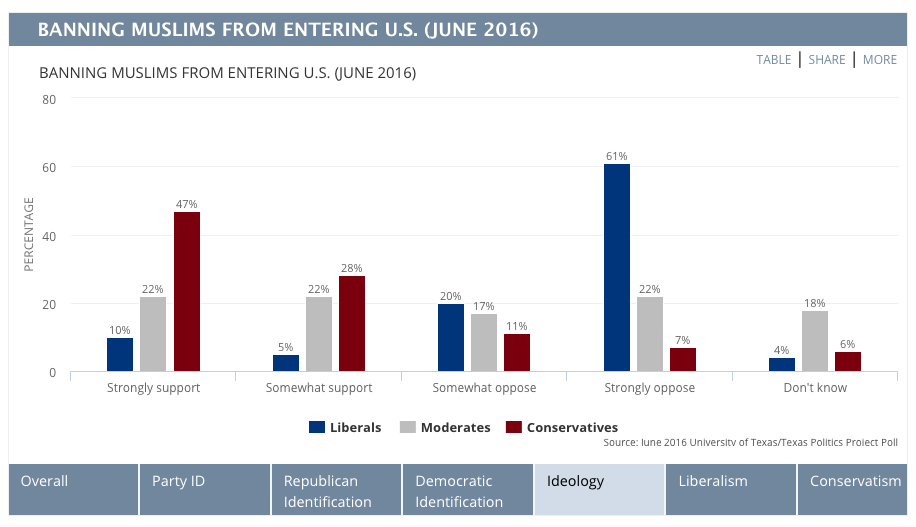
Having established that significant numbers of Trump supporters discriminate on the basis of race, sexual orientation, religion, and immigration status, it must be reiterated that yes, there is prejudice on the left. There are some liberals that also hold reprehensible views similar to Trump supporters. Take for example Trump’s idea to punish the many for the crimes of the few, banning all Muslim immigrants:

Screen Shot 2017-07-04 at 12.25.47 PM

via Texas Politics Project

As you can see, 15% of liberal respondents either strongly support or somewhat support this policy. That is very discouraging for anyone who cares about religious freedom, tolerance of others, and basic human dignity. But if 15% is a tragedy, how much more so is 75% of conservative respondents saying the same? The pattern is replicated elsewhere and is not hard to find. Some liberals embrace disrespectful, disdainful, discouraging views of blacks, immigrants, homosexuals, Muslims, and so on, but it is rarely as egregious as conservative support. Even if it was, we have already established few liberals are voting for Trump, meaning the claim at the beginning of this article remains sound.

That claim was:

Donald Trump’s political success is, to a significant degree, explained by conservatives who like him hold virulent disdain and disturbingly disrespectful attitudes toward Muslims, blacks, undocumented Hispanic immigrants, and so on. In other words, people with deplorable views electing a deplorable man.

While this is not the only piece of the puzzle, it is a large one indeed. Large enough that I believe if Trump had run as a Democrat and said the same things he wouldn’t have gotten very far. Degrading women and talking about sexually assaulting them, threatening to strip Muslims of their civil rights, perpetuating untrue stereotypes of blacks and immigrants, and so on doesn’t work as well on liberal voters.

If Trump’s nonsense and venom worked just as well on leftists, we surely would have seen more liberals voting for Trump in the primaries. We might see liberals abandoning a very unlikable Democratic candidate in droves and helping Trump win in a landslide in November, an unlikely outcome. Most importantly, we might ask why Trump didn’t simply run as a Democrat, since he previously held more liberal views on several issues. Why choose to run as a Republican instead? I think we know why. He wouldn’t have been taken seriously. Any toxic hate would have been rejected by more voters. Going about spouting authoritarianism and blatant stereotypes, mocking disabled people, and telling obvious lies about what you said on camera yesterday wasn’t going to be as successful with non-conservatives.

Donald Trump’s rise has been a valuable opportunity to show Americans (and the world, embarrassingly) what is accepted by and appeals to too many millions. It’s a good time to acknowledge the problems we still face from many on the right, and elsewhere to a lesser degree, who put up obstacles to tolerance and basic human dignity. We have to be honest with ourselves: Donald Trump is not the real problem.

The problem is the millions willing to vote for him.

For more from the author, subscribe and follow or read his books.

The Absurd Sanders-Trump Comparison

Stephen Marche wrote in The Guardian, “The same specter of angry white people haunts Saunders’s rally [as Trump’s], the same sense of longing for a country that was, the country that has been taken away.”

Jonah Goldberg penned in the National Review an article entitled, “Sanders and Trump: Two Populist Peas in a Pod?” He argues government incompetence and lies sparked “populist backlash” on the Right and Left, and that Sanders’ and Trump’s “programs overlap a great deal.”

His “evidence”? He notes “Sanders has praised Trump’s favorable statements on single-payer health care” and juxtaposes Sanders saying capitalists benefit from the cheap labor of illegal immigration and Trump saying “real immigration reform puts the needs of working people first — not wealthy globe-trotting donors.”

In The New York Times, David Brooks writes Sanders and Trump  have “no plausible path toward winning,” that these “cults never last,” and that “these sudden stars are not really about governing. They are tools for their supporters’ self-expression. They allow supporters to make a statement, demand respect or express anger or resentment.”

George Packer in The New Yorker article “The Populists,” while correctly highlighting the stark difference between Sanders’ “plausible reforms” through “elections and legislation” and Trump’s “just let [me] handle it” absurdities, nevertheless echoes Marche and Brooks, and then says:

Responding to the same political moment, the phenomena of Trump and Sanders bear a superficial resemblance. Both men have no history of party loyalty, which only enhances their street cred—their authority comes from a direct bond with their supporters, free of institutional interference. They both rail against foreign-trade deals, decry the unofficial jobless rate, and express disdain for the political class and the dirty money it raises to stay in office.

The whole comparison between Sanders and Trump is truly absurd, and accomplishes nothing except serving as a slur to discredit Sanders, who has 32 years of elected office experience and is the most popular senator in the nation. Whether this is the purpose behind the comparison is up for debate, but the result, obvious to any rational person, is that Sanders is dragged into the mud with a racist with no political but much fear mongering experience.

What other purpose does this serve? What is the point of noting these two politicians have armies of passionate followers and have skyrocketed in the polls in a brief time period? That anti-establishment candidates are popular in a time of great discontent with the establishment?

That is true, and it is right to report it, but if such information isn’t immediately followed by the drastic differences between Sanders and Trump in both personalities and policy goals, if political theorists grasp at straws to show their followers have the same motivations, it likely amounts to nothing more than the establishment of guilt by association. Put Sanders’ name next to Trump’s and hope the disgust toward the latter will somehow shift toward the former.  

This foolishness is not hard to replicate. Watch. Noam Chomsky is a Leftist historian and philosopher who is generally ignored by the mainstream American media. David Duke is a white supremacist, the former Grand Wizard of the K.K.K., and a Republican politician who is generally ignored by the mainstream American media.

Why are they being ignored? There must be parallels between their personalities and beliefs, and of course those of their followers, to explain this. How are they the same? They’re both white and have many passionate white followers. Their followers must be angry, hungry for change. They’ve both written books. The Southern Poverty Law Center called Duke “the most recognizable figure of the American radical right.” David Horowitz called Chomsky “the most prominent leader of the radical Left, with cult status among the group.”

But why go hunting for what they have in common as an explanation for why they are both ignored by the mainstream media, when really their only commonality is they are both ignored? Could it be they are ignored for very different reasons? Perhaps because Chomsky is a fierce critic of the American government’s massacre of innocent people overseas, but Duke openly despises black people? Perhaps their followers have different sentiments, too, explaining why they gravitate towards one or the other, but not both.

Yes, Sanders and Trump both came out of nowhere. Both have huge followings. They aren’t typical candidates. They’re “populist,” i.e. representing the interests of ordinary citizens. Sometimes they talk about the same American problems — joblessness, trade, immigration, corruption — just like every single other political candidate.

After that, there are no similarities. Sanders hugs a young Muslim woman at a rally and promises to do everything in his power to “rid this country of the ugly stain of racism.” The crowd cheers. Trump looks on as a Muslim woman, “Salam: I come in peace” emblazoned on her shirt, stands up at a rally in silent protest. She is removed by security, to the glee of the screaming crowd.

Sanders goes to a mosque to demand an end to religious bigotry; Trump calls for the monitoring of mosques and the banning of Muslim migrants, and is open to registering Muslims in a database or issuing them special identification.  

Sanders stands with striking fast food workers to show solidarity in the push for a higher minimum wage; Trump opposes a higher minimum wage and thinks wages are “too high” already.

Sanders declares, “Black lives matter…we need to combat institutional racism from top to bottom” and fix “a broken criminal justice system”; Trump shares racist misinformation online, takes out ads in newspapers calling for the execution of black suspects, and is sued for refusing to rent to blacks. His supporters beat a black protester. Neo-Nazis call him “glorious leader.”

Sanders wants a path to citizenship for illegal immigrants; Trump stereotypes them as rapists and drug dealers, and wants to round them all up and deport them. His supporters beat Hispanics at rallies and on the streets, chanting “USA! USA!”

Looking at the most common themes of the campaign thus far, Sanders and his followers are most angry at the powerful, the few growing rich off the labor of the many and controlling government policy to boot. Trump and his fans are angriest at the powerless: immigrants escaping dire poverty and drug violence in Central America, blacks protesting police killings of unarmed neighbors, Syrians fleeing a brutal civil war.

In short, Sanders is a good man who genuinely wants to better society for many powerless, marginalized groups, and a lot of Americans agree with him. Trump is a bigot who stokes white pride, anti-immigrant hatred, anti-Muslim terror, and other dangerous ideas, and a lot of Americans — too many — agree with him.

Anyone who has paid any attention to current events (or the candidate platforms) knows the Sanders-Trump comparison, beyond their swift rise, is empty. They are not “peas in a pod.” Their programs in no way “overlap a great deal.” You may find “angry white people” at both candidates’ rallies, but they are not similarly-minded angry white people.

Sanders and Trump are very different men saying very different things and are adored for very different reasons. In such a “political moment,” this isn’t the time for political thinkers to draw parallels that don’t exist just to put something in an editor’s hand for the day, or to feign intellectualism by presenting something true (Sanders and Trump have passionate followers) and expanding it into something false (their passions stem from the same needs and desires), or, worst of all, to slander a good man.

For more from the author, subscribe and follow or read his books.

On Taxpayer-funded Christian Colleges’ Anti-Gay Policies

“The California state Senate has passed a bill that would make it harder for Christian institutions to obtain religious exemptions from anti-discrimination laws protecting LGBT individuals,” writes Eric Metaxas.

An encouraging sentence, but not to the person who wrote it, whose headline declared: “A License to Discriminate: California’s Assault on Christian Colleges.” This neatly echoed other headlines of nearly unadulterated panic: “California Bill Would Ultimately Erase Religious Schools” (Federalist), “An Imminent Attack on Religious Liberty” (Master’s Seminary), “California Bill Called ‘Existential Threat’ to Catholic Education” (Crux), and so on.

California’s bill, S.B. 1146, which passed the state senate and is working its way toward a vote in the state assembly, would decree that only colleges training ministers and theology teachers would be allowed to claim exemption from Title IX laws, which explicitly protect gender-based discrimination but have been used successfully for decades to also protect LGBT Americans from mistreatment (and in late 2015, a federal judge all but sealed the deal).

The bill would “bar colleges receiving state funding from making employment, student housing, admission and other decisions on the basis of gender identity, gender expression or sexual orientation,” as Catholic leaders said in the Crux, calling the whole thing “a restriction of religious freedom.”

In other words, should a religious university that receives state funds wish to deny a homosexual or transgender American entry into the school or a teaching position, among other possibilities, on the sole basis of their sexual orientation or identity, said university would be unable to do so.

This would only apply to a university that “receives, or benefits from, state financial assistance or enrolls students who receive state student financial aid,” in the words of the bill. It would also require schools that do get the exemption to prominently make this known on their websites, at student orientation, and so on, to warn LGBT individuals of certain possibilities. LGBT students or employees at exempted schools would also be able to sue if discriminated against.

Over 40 California colleges currently qualify for Title IX exemptions, and of course many more across the U.S. The Human Rights Campaign, an LGBT civil rights group, calls the exemptions a “license to discriminate” — phrasing Metaxas may appreciate. This issue is only part of a larger social problem —Republican states are fighting to allow private businesses and organizations to refuse service to gay people, and in 28 states you can still be fired just for being a homosexual (California, however, is not one of them).

The law set off the usual hysteria (Holly Scheer, writing in the Federalist above, seems to think this opens the door to government bans on “chapel services,” “prayer events” at graduation, even “theology classes” themselves) and the platitudes that have defined unequal treatment and prejudice throughout American history, such as the we don’t serve your kind here, but plenty of places do (Scheer: “No one forces people to attend religious schools… California alone has hundreds of college and university options…only 42 are religious”).

But proponents of the measure point out that, as one state politician said, “California should not be using taxpayer money to subsidize colleges that choose to discriminate against LGBT students.” American Atheists wrote, “It’s a very simple test for us: If you’re getting taxpayer money, follow the damn law. Accepting government support means accepting government regulation.”

After all, taxpayer funds come from all Californians — gay or straight, trans or cis, close allies and violent bigots. Should religious universities wish to deny, or terminate at will, employment or enrollment for LGBT people, one would think at the very least taxpayers of diverse backgrounds and views should not have to support the universities.

Further, though this would perhaps never cross Scheer’s mind, some LGBT Americans are in fact Christians, and may desire the freedom to attend religious schools without fear of persecution or retribution.

Were taxpayer-funded universities able to legally turn away Christians, one might call it a “license to discriminate” — in the accurate sense, that is.

For more from the author, subscribe and follow or read his books.