Why the Women Marched

Conservative criticism of the Women’s March on Washington seems to be revolving around several poorly considered ideas.

First, the notion that the march was simply a tantrum thrown by sore losers. Second, that women already have all the rights that men do, so why are they bothering? Third, that it is hypocritical to oppose a man who says vile things about and does vile things to women but support a woman who is married to a man who acts in a similar way. There are other criticisms, of course (“Feminists want to emasculate and oppress men!”), too absurd to be worthy of comment.

Let’s consider each point in turn, but first note the obvious: the people who are confused as to what the purpose or motives of the march was probably did not actually bother to read the mission, vision, or principles put forth by the organizers. They likely did not attend the march. They may not have even bothered to ask their friends, male or female, why they personally went. I personally feel that if people were inclined to do such things, the misinformation would not be so egregious. I can’t pretend to speak for every woman that went, but by doing those things I got a fairly informed idea as to what it was all about.

Let’s think through the first point. Was it simply that the Republican candidate won and the Democratic one lost? Is it just liberals being sore losers, without any other context? Well, no thinking person actually believes this. The Women’s March was likely the largest single-day protest in national history, with over 3 million Americans participating. Would we have seen such an event if Marco Rubio had been elected? If Jeb Bush beat Hillary Clinton? Is the victory of every Republican presidential candidate followed by historic-sized protests? Perhaps the protest has more to do with anger over the words and actions of the person elected, rather than the simple fact that he won.

Second, while it is true women have roughly the same legal rights as men, there is a certain right men could never possibly need but women might. That is, the right to an abortion. The Women’s March wasn’t solely about abortion rights (another conservative misconception), but it was a big part of it. The principles included “open access to safe, legal, affordable abortion and birth control for all people, regardless of income, location or education.” Now, staunchly pro-life people won’t agree with that, which is fine. But women (and men) who are pro-choice believe the right to an abortion should be protected and know it is currently under attack, from Texas (which slashed funding for clinics, forcing all but 20 to close in a state with 13 million women) to Ohio (which joined 15 other states in enacting a ban on abortions after 20 weeks). Again, this may sound like good news to you if you are conservative, but the point is that abortion is a right protesters sought to protect. They wanted to voice opposition to anti-abortion policies Trump and Republicans support and will likely move to enact.

Also on the subject of rights is women’s pay. Many conservatives have made it clear they either believe unequal pay for equal work is a myth or don’t even understand what it means (“My man makes more than me because his job is manual labor and mine isn’t”; “Look at how rich this woman is! The idea we’re paid less is stupid”). It’s the radical idea that a woman with comparable education and experience as a man would make the same as him in the same field or industry. Yes, the wage gap is partly explained by men dominating certain high-paying fields (which in turn is partly explained by sexism in schools, which can slowly push girls away from lucrative fields like STEM), but unequal pay for equal work and equal qualifications within the same field is also a real problem. As the Economic Policy Institute put it,

Women are paid less than similarly educated men at every level of education. And the wage gap tends to rise with education level… Women who work in male-dominated occupations are paid significantly less than similarly educated males in those occupations. So even recommending that women choose better-paying occupations does not solve the problem.

Whether or not you trust research into the matter is your business, but just know that protesters do trust this is a problem and wish to voice dissent.

Beyond equal pay, there’s sexism in general. The EPI summarizes:

One famous study found that switching to blind auditions led to a significantly higher proportion of female musicians in orchestras (Goldin and Rouse 1997).

An experimental study of résumés submitted for job openings found bias against women and mothers and a preference for male applicants (Steinpreis, Anders, and Ritzke 1999). Another résumé study showed discrimination against women in the sciences (Moss-Racusin et al. 2012).

Researchers have also found that women are viewed as less competent than men, and that mothers are judged as even less competent than childless women (Ridgeway and Correll 2004).

There are of course other issues, such as the fact that any boy under 18 can buy condoms without a problem, but girls face all kinds of legal barriers to birth control in many states. But abortion, equal hiring practices, and equal pay are the main legal rights women seek to maintain or achieve.

However, this was only part of the event. An equally important matter was standing up to sexual harassment and sexual violence. This protest was not the whine of a losing side in a typical election, it was an outburst of anger against the disrespect and abuse Trump exhibited and the culture that too often excuses, tolerates, or embraces such things — tolerates to the point of voting for a vile man like Trump. Boasting of grabbing women by the vagina, calling women fat, ugly pigs, saying Hillary Clinton couldn’t satisfy her husband, making jokes to women about blow jobs, and going to trial for rape would, in a sensible world, enrage everyone. Most of the speeches, signs, and shirts I saw, and the conversations I heard, were about sexual violence, sometimes Trump’s, sometimes someone else’s. From demeaning catcalls to nasty comments (a government official in New Mexico said women protesting “have the right to be slapped”) to the absurdly light sentences for vicious rapists, feminist liberals wish to build a society where women are safe, treated with respect, and see justice done to the worst of humanity. Surely everyone, regardless of political persuasion, can support what the organizers wrote, that women should be “free of all forms of violence against our bodies.” Days after the march, Oklahoma ruled that oral sex is not rape if the victim is unconscious from drinking.

Which brings us to the third and final point, the infidelities of Bill Clinton and the rape accusations against him, and how these things affect whether the Women’s March was an event worthy of praise or scorn. Conservatives posit: “This march wouldn’t have taken place if Hillary Clinton had won. You oppose Trump and his nastiness, yet support Hillary, whose husband is a cheater, a liar, and an accused rapist. That’s hypocrisy.”

Well, one might suppose not all of the 3 million American marchers supported or voted for Hillary. How many Bernie Sanders loyalists were there, for instance? Just because one despises Trump’s words and deeds against women does not mean he or she is a fan of Hillary or Bill Clinton. Perhaps some, like me, are critics of both. Regardless, even assuming all attendees voted for Hillary, there are obvious problems with this idea.

Most sensible people would consider Hillary a victim in this regard. She was cheated on countless times, likely lied to. Should she be punished for the crimes of her unfaithful husband? I think not — even if she stayed with him to maintain political power and opportunities. He should be frowned upon for infidelity and thrown in prison if rape charges are determined to be true. But his wife shouldn’t have to wear a badge of shame because of what he did. Hillary is the victim of Bill’s infidelity, and that in no way means people should automatically not support or vote for her. Unless she is staying mum about Bill raping women, which there is no evidence for, she is an innocent bystander to his crimes (if factual). Believe it or not, one could support imprisoning someone for a crime and support his wife, a victim, in her career pursuits. Hillary is not Bill.

In the same way I do not pretend Bill was running for president, I do not yet suppose he and Trump are of the same character. If they are both one day found guilty of rape, they can rot in prison together and we can call them equally awful men. But put aside the accusations against both for a moment; suppose they are all false. At the time of the election, and the march, and today, neither person was tried and convicted of rape. So what is left? Bill is a cheating husband, but not known for demeaning women. Trump still brags of sexual assault, tears down women for their appearance, and makes lewd remarks about contestants on his show, political enemies, etc. So is it hypocrisy to protest Trump but not Bill over how they treat women? Perhaps there is a tinge of hypocrisy, but not much. When it comes down to it, if using what we know at the moment, Donald Trump is more worthy of a protest than Bill Clinton when it comes to the treatment of women. If you add in the other stated principles of the Women’s March (like “Disability Rights” and “Civil Rights”) and consider Trump’s treatment of other groups (disabled Americans, Muslims) compared to Bill’s, this might make the case that Trump deserves a Women’s March more than Bill even stronger. His support for restrictions on abortion and other right-wing policies would make the case stronger still, in the eyes of those on the left.

(Conservatives speaking of hypocrisy should ask themselves: If Bill is worthy of protest and disdain, is not Trump worthy of even more? Those crying hypocrisy shouldn’t be saying the Women’s March, this stand against Trump, was wrong. They should be saying it was right. More specifically, “It was the right thing to do, but you should protest against Bill as well, to avoid hypocrisy.” The alternative is to protest neither. But that does no good for anyone — including Bill’s alleged victims. Liberals must ask ourselves: If Trump is worthy of protest, is Bill? I think Trump is much more worthy of protest than Bill, yet am not opposed to a mass stand against infidelity or worse crimes that he committed. I believe both would be positive things. If conservatives wish to make accusations of hypocrisy, they must also decide if both are right or if both are wrong. Currently, the absence of a theoretical march against injustice is being used to criticize a march against injustice.)

The idea that Trump is more worthy of a protest than Bill (putting aside unconfirmed accusations) when it comes to treatment of women is my view, and you are free to think differently. However, given that view, you can see why I don’t see much hypocrisy between a Women’s March for Trump and none for a theoretical First Man Bill Clinton. Same for opposing Trump’s presidential campaign in general but supporting Hillary’s. For there to be full-blown hypocrisy, different standards must be applied to two things that are essentially the same.

A man running for president is not the same as a man married to a woman running for president. Committing infidelity is not the same as committing sexual assault. A man may be worthy of protest, but a worse man can be even more worthy. And so on.

For more from the author, subscribe and follow or read his books.

I Was Arrested For Civil Disobedience in Kansas City. Here’s What Happened.

Last week I received a phone call. Someone from Stand Up KC was calling.

Are you interested in participating in an act of civil disobedience — the peaceful violation of the law ending with a voluntary arrest — with about 100 other people in Kansas City and thousands across the country?

The words of two men flashed through my mind. One man was a black writer and abolitionist of the Civil War era, Frederick Douglass: “If there is no struggle there is no progress. Those who profess to favor freedom and yet deprecate agitation are men who want crops without plowing up the ground; they want rain without thunder and lightning. They want the ocean without the awful roar of its many waters… Power concedes nothing without a demand. It never did and it never will.”

The other was a white historian from the time of the great civil rights and anti-Vietnam movements, Howard Zinn: “Civil disobedience…is not our problem. Our problem is civil obedience… Our problem is that people are obedient all over the world in the face of poverty and starvation and stupidity and war and cruelty. Our problem is that people are obedient while the jails are full of petty thieves, and all the while the grand thieves are running the country.”

Civil disobedience.

This tactic has long been used by ordinary people — from the Revolutionary War to the civil rights struggle, from Vietnam to today’s battle against poverty — to get what they demand from the powerful, whether the State or corporations.

What did Stand Up KC demand? A living wage for all workers in all occupations.

I believe that no matter what occupation you find yourself in — by choice or circumstance — you should not have to live in poverty. You should not have pennies left over after paying for rent, groceries, and gas. You should not have to decide between paying the electric bill or paying the water bill. Not in the richest nation in the history of humanity. Not even if your work is flipping burgers. I trust the economic studies and historical research that make it exceptionally plain raising the minimum wage does not lead to higher unemployment (often it’s the opposite) and only raises the costs of goods and services by a couple percentage points, easily offset by higher wages. I understand how the cycle of poverty functions, ensuring the children of poor parents typically become poor adults due to limited opportunities compared to middle-income and wealthy people.

“Yes, I am.”

We trained. We met at a small church for instruction in the art of civil disobedience. Ignore police orders to leave. But when they come to handcuff you, comply. Don’t resist. You will be taken into custody, perhaps for minutes, perhaps hours, perhaps overnight. We have three lawyers ready to represent you. Bond money has already been raised. Charges could be equivalent to jaywalking…or trespassing. We will work to get any charges tossed out.

I asked if there would be official observers filming the arrests. I didn’t want anyone to be falsely accused of resistance or violence. Yes, there would be observers.

On Tuesday, November 29, 2016, hundreds of Kansas Citians, many abandoning their workplaces and going on strike, gathered at 63rd and Paseo at 5 p.m., as the light began to fade.

I parked my car in a neighborhood, and left my wallet and phone behind. We were told to carry only our driver’s license, which I kept in my front pocket.

Weaving through the crowd, I found the check-in table. I gave the woman my name. I wrote my name and phone number on a bag, put my keys inside it, and gave it to her. I pulled up the sleeve of my coat, took a permanent marker from a box, and scribbled a lawyer’s number on my skin, as instructed. The woman tied a yellow band around my arm — distinguishing protesters participating in civil disobedience.

I made small talk with a few people I knew. Watched people hand out American flags, hats and gloves, and pizza. Noticed the lawyers getting into position.

Then the speeches began at a podium. Men, women, Muslim, Christian, Jewish, black, white, and Latina speakers. We do not make enough to provide our children with comfortable lives. People have to work multiple jobs. And the new administration…attacks on the poor are already underway. Medicare, Social Security. Will nativism and bigotry divide the working class? United we stand, divided we fall. An injury to one is an injury to all.

Horns from passing cars blared in solidarity. Fists rose through lowered car windows. I and others raised our fists back.

But wait, what was that? Someone screaming from a pickup truck as it passed. Unintelligible from my spot, but it hardly sounded friendly.

Moments later, shouting from the back of the crowd. The speaker, a rabbi, ignored it and pressed on at the microphone, but the crowd was not so easily distracted.

“Get better jobs! Get better jobs! Get better jobs!”

A middle-aged white man walked forward along the edge of the crowd, screaming. He was not pleased with this gathering of low-wage fast food and retail workers.

“Why don’t you go fuck yourself?” someone from our gathering said. Others admonished him.

Folks on the edge of the crowd blocked the man from entering the area, and eventually the man’s voice trailed off and he disappeared.

Get better jobs, I mused. What luck this man arrived to bestow this wisdom. Christ. Why not just shout, “Don’t be poor! Don’t be poor!”

The final speaker ordered those getting arrested to the front of the crowd, so I pressed forward. The rest of the gathering clapped for us. Then the march began, down the sidewalk — toward a McDonald’s. Signs and fists were raised. Chants sounded in the darkness.

What do we want? / Fifteen and a union! When do we want it? / Now!

Everywhere we go / People want to know… Who we are / So we tell ’em… We are the workers / The mighty, mighty workers… Fighting for Fifteen / And good jobs for all…

I saw the first police car after we’d been walking for 10 minutes or so. He was just driving alongside us. We reached the McDonald’s down the street after a quick 20 minute march.

We followed our organizer into the street, and he lowered his hands. Over 100 of us sat down on the road, locked arms, and started to sing. The rest of the protesters remained on the sidewalk behind us.

The Kansas City and Jackson County police materialized from all directions. Five or so officers on horseback. Another fifteen or twenty on foot. One or two with gas masks. One with a shotgun. Cruisers were positioned to keep traffic away. Most officers wore serious expressions, but a few looked amused, some friendly, others angry.

The media appeared next. Cameras rolling and flashing. KCUR, the Star, the local TV news channels.

After a police announcement (something about how if we didn’t return to the sidewalk we’d be arrested) was drowned out by song and chant, officers began cuffing protesters, with disposable bonds. With so many people, it was a long process. We just continued to chant, even — especially — those getting arrested.

“If you don’t get out of the street, you’re going to jail.” It was my turn.

I nodded and remained seated.

“OK,” the officer said, and helped me up. He was a friendly man. He cuffed me and we walked across the street to where the other arrested folk were being loaded into police vans. “Thanks for your cooperation,” the officer said, and left to arrest someone else.

“What’s your name?” a man in a suit called to me. One of our lawyers! I told him.

The protesters on the sidewalk and those arrested chanted in call-and-response fashion from the two sides of the street.

Stand up / KC!

Stand up / KC!

I was helped into a van with eight others — black, white, Asian, male, female. Things were festive, the adrenaline rushing. An officer took us on a drive of only a few minutes, to a nearby station, but we didn’t end up going inside. Everyone would be identified outside and then taken to different jails for processing.

We sat in the van for perhaps three-quarters of an hour. We sang hip-hop and pop songs. Somebody come get her, she’s dancing like a stripper… A man and I talked about the Walking Dead for a few minutes. A few folks wiggled out of their cuffs. A guy next to me was hot, so I helped him by biting his hood and pulling it off his head. A blonde girl had to use the bathroom badly; we had to warn her against going in the van. Could it be another charge? Destruction of police property? I had made sure not to drink much a few hours before the march, in hopes of not having to ask a policeman to use a bathroom; this mission was successful, but I was very dehydrated by the end of the night.

We were taken out of the vehicle and joined other protesters from other vans. We spent another hour outside, as we were identified person-by-person. We talked amongst ourselves and with the police, who were polite and amiable. Stand Up KC had communicated what would occur in advance so the police could be prepared — and perhaps that lightened the mood. “This guy’s got some pipes,” the officer from our van said, pointing to the most enthusiastic singer from our group. This officer was part of a K9 unit, so we asked him about his dog.

It was a cold night. We huddled together for warmth, a fine way to meet new people. My arms were in pain from being restrained behind my back, but fortunately the officers cut our bonds and redid them in front. The girl urinated on the ground at the back of our group; somehow she went unnoticed by basically everyone.

Eventually I was searched (not the first time, nor the last), identified, and sat in a new van, with the heat blasting, for a while. A protester and police officer, both formerly from Chicago, recognized each other. “You used to be a cop?” another woman asked the protester. “I’m a mechanic, I used to work on the cop cars.”

Then the men and women were separated. I was taken to a paddy wagon with seven other men, three white and four black. A reverend. A Ford worker. A Burger King employee. They would be my fellow prisoners.

Our new officer explained to us that the downtown station and nearby stations were full, so we were going up to the Shoal Creek facility near Liberty. The mood was still jovial. The reverend, a union organizer, and I discussed politics for a while. A couple guys in the car had been to jail before, and told us their experiences. After a fifteen or twenty minute drive, I was beginning to feel carsick, and worried for a moment I might throw up inside this hot, cramped, jostling box.

“Can we play some tunes?” one of my fellows asked the officer.

“No, I wish!”

We were taken into the station and waited to be booked. We chatted with our officer about firearms, martial arts, Missouri and Kansas laws, and so on. He said officers were really feeling like targets these days; the black men with me said they knew how he felt. We talked about Stand Up KC and the Fight for $15. “I totally understand that,” the officer said when we told him workers weren’t making enough to provide for their families and how historically civil disobedience helps push change forward. “But a lot of us had to be called out to take you in, and there was a shooting tonight.”

I wondered then if those who believed civil disobedience wasn’t worth the risk — distracting the police or delaying ambulances or fire trucks — were also the fiercest critics of the World Series victory parade and similar events.

He was a kind man, but wasn’t supportive of the movement. He explained he used to work for low wages, but worked his way to a bigger paycheck. The implication was unstated but clear: Why weren’t we doing the same? Why weren’t we willing to work hard? Too lazy? Too misguided? Too foolish? Get a better job!

Also: “I work a dangerous job, other types of work are much safer,” he told us, dismissive of higher wages for retail, childcare, and fast food workers.

Apparently it’s only dangerous work that deserves a decent wage, I thought. The millionaire CEOs won’t be happy to hear this.

A couple of the officers at Shoal Creek were frustrated, both at us protesters and some internal disorganization. Though Stand Up KC told the KCPD how many people would need to be arrested, they did not seem entirely prepared. A few griped about how higher-ups had decided to handle the protests. “But hey, we’re here to serve!” one said loudly, in our direction. It is likely the higher-ups wanted the whole process to take a while, to discourage future civil disobedience.

I was the last of us eight to be booked, and got stuck sitting next to a drunk the police dragged in after a domestic violence call. My comrades were safe in the cell, and I longed to join them. The man, white and near 60, droned on and on about how “protests won’t do anything,” how “all you’re doing is disrupting the crack flow in the inner city,” how Communism is evil, how “we just gotta give Trump a chance,” how Somalis are foolish because they choose to drive taxis instead of finding better work, how people need to work hard like him and get off welfare, how the people in Africa are poor “because they’re just so stupid,” and how if I ever start a business I should take on one of my black comrades in the cell as a partner because “he looks like he could use a helping hand, if you know what I mean.”

Countering his drunken, racist word vomit was difficult and tiresome. I was relieved when it was my turn for a mug shot, fingerprinting, and at last imprisonment in the cell with my partners in crime. Back to chatting and telling stories.

We were at the station for three hours, and were slowly processed and released on bond. We were charged with failing to obey a lawful order.

When we were freed, the lawyer I had spoken to earlier was waiting outside for us. We tried to nap in a Stand Up KC van while a group of women, who had also been sent to this station due to overflow elsewhere, were also freed. (At one point the window of our cell was covered up and the male police officers shooed away so female officers could remove the hijab of a Muslim woman protester for a search and mug shot.) Eventually, we drove back to the church where we trained, got our keys and other items, and from there rode back to our homes or parked cars. I was home by 4 a.m. — it was an 11-hour experience.

As I prepared for rest, I thought of what one of my companions had asked: “You think we made a difference?”

Civil disobedience can do many things. It can make potential allies realize they are not alone, swelling the ranks of a cause. It can show opponents that such a cause, to those who care about it, is worth being arrested or jailed for — and maybe, just maybe, this will change the way some people think. Most importantly, it can make an employer or the State realize trouble won’t stop until demands are met, and therefore can push policy change through faster. Since the Fight for $15 troublemakers began protesting just four years ago, nearly 20 million workers have won raises in places like California, New York, and Massachusetts. It pushed the Kansas City council to support a higher minimum wage. “Protests won’t do anything” indeed.

To the officer, the drunk, and the counter-protester, civil disobedience like this might not make much sense. But that cannot be the case for long. For while these things start small, as they grow they become more easy to grasp. When 100 turns into 1,000, it is easier to see. When it grows to 5,000 or 10,000, it’s clearer still. The truth is, if enough ordinary people unite and organize, they can do more than shut down a street. They can shut down a city, a state, or an entire nation. From Kansas City’s Valentine’s Day strike of 1918, in which 15,000 workers brought the city to a halt, to India’s 2016 strike of 180 million workers that froze a country, the people have the power to take whatever they want — by leaving their workplaces and flooding the streets. We the people can plow up the earth, we will be the flash of lightning and clap of thunder, we will be the mighty roar of the ocean.

We part with the words of the great black poet Langston Hughes:

You could stop the
factory whistle blowing,
Stop the mine machinery
from going,
Stop the atom bombs
exploding,
Stop the battleships
from loading,
Stop the merchant
ships from sailing,
Stop the jail house keys
from turning
…You could
If you would

For more from the author, subscribe and follow or read his books.

You’re Not a Bigot, You Just Didn’t Care Enough About Those Trump Attacked

Simply put, when you cast your ballot for Donald Trump, you decided his attacks on your neighbors were not vicious or vulgar enough to disqualify him.

This decision was made in the light of other factors. You had other priorities. You opposed Hillary Clinton’s deception and corruption. Perhaps you wanted to shock and dismantle the establishment — the media, corporate, and political elites. Likely you were concerned with restoring Republican power, particularly over the Supreme Court, and advancing conservative policies like curtailing abortion rights and protecting the all-important Second Amendment. You perhaps thought Trump, as a businessman, could offer economic policies that would benefit you.

Whatever your reasons, you prioritized. You weighed factors such as these against the things Trump said about your neighbors and the things he promised to do to them. And such factors were more important to you.

Now, don’t get me wrong, many bigots voted for Trump. For example, polls show 38% of Trump supporters think minorities have “too much influence” in the U.S., 40% believe blacks are lazier than whites, and so on. But you do not think that way. This article is for you, not for them.

You simply did not care enough to put the people Trump threatened and degraded before the other factors important to you.

You didn’t care enough about women to reject Trump when he called women ugly and fat, when he bragged about being able to grab women’s vaginas because he was a celebrity. The rape cases against him were surely nothing but rumors.

You were too insensitive toward Muslims to not vote for Trump when he said mosques should be monitored, Muslims should be registered in a database or made to wear special identification, and no more Muslims should be allowed to enter the land of the free.

You didn’t care enough about African Americans to abandon Trump when he retweeted white supremacists lying about blacks being the main killers of whites, perpetuating stereotypes of the violent, criminal black man, called for the return of harsh, discriminatory police policies like stop-and-frisk, or refused to rent to blacks. You didn’t care enough that he delayed in denouncing KKK support or had an open white supremacist like Stephen Bannon running his campaign.

You didn’t care enough about the children of undocumented immigrants, whose mothers and fathers, grandmothers and grandfathers, will be arrested, throw into trucks, and taken away forever if Trump’s deportation plan comes to pass. You didn’t care enough about Trump stereotyping the people escaping bloody wars and extreme poverty in Central and South America as rapists, drug dealers, and job thieves.

You didn’t care enough about the disabled when he heartlessly mocked a disabled reporter or had a protester in a wheelchair removed from his rally.

You didn’t care enough about veterans when Trump said a P.O.W. wasn’t a war hero.

You certainly didn’t care enough about homosexuals to not vote for Trump when he said a conservative Supreme Court could toss out the gay marriage decision.

Whether Trump intends to carry out his threats, whether he believes what he says or was using such rhetoric as a political strategy to appeal to the conservative base, is irrelevant. Regardless of motive, people who speak of authoritarianism and use demagoguery must be opposed.

This is not only directed at conservative straight white men, but rather every single person who cast a ballot for Trump. The 58% of white voters, 8% of black voters, 29% of Latino voters. The 10% of liberals, 41% of moderates, 81% of conservatives. The 14% of LGBT voters. The 58% of Christians. The 53% of women.

Perhaps you’re an African American who didn’t care enough about Muslim rights. Perhaps you’re liberal who didn’t care enough about respect for women. Regardless, you prioritized. You voted against many of your own interests. You’re a Muslim who has helped bring to power a man vowing to strip you of your civil liberties. Or an LGBT American who may have set in motion the undoing of much progress. You put other considerations, other interests, ahead of the respect and civil rights you deserve as a human being and citizen of the United States — and which your neighbors deserve, as well.

Sadly, people voting against their own interests is nothing new in American politics. Look to the conservative whose family could immensely benefit from higher taxes on the rich strengthening social programs like Social Security or covering the cost of college for anyone who wishes to attend, but takes a valiant stand against it. Voting against one’s own well-being is an act too many people on both Right and Left seem eager to partake in, and it is as disheartening as it is amazing.

That a cis straight white man is telling minority people what’s in their best interests will evoke no apology here. One cannot denounce whites and conservatives for accepting and enabling an assault on certain groups’ rights and basic human dignity — plus the emboldening of the most vile of people, who celebrated Trump’s triumph by grabbing women by the vagina, ripping hijabs off Muslim girls’ heads, screaming “nigger!” at blacks, mocking Hispanics, beating homosexuals, and a slew of other hate crimes — without likewise denouncing the liberals, women, and minorities who also participated in this American tragedy.

We have to hold all people, and ourselves, to the same standards, whether it’s criticizing folks on the Right and Left who were apologists for Trump’s policies and slander or condemning both citizen violence against the people Trump threatened and against Trump supporters.

That’s what empathy entails. You hold others to the same standards you hold for yourself. You want the same rights and treatment for others you want for yourself. Trump’s victory was fueled by many factors — hatred for the establishment (the ruling class) and corrupt politicians, economic uncertainty and strife, advancement of conservative ideals and policy, bigotry and xenophobia, and so on — but in the end a lack of empathy on the Right, and to an extent elsewhere, may be the most serious problem.

Too many are simply unable to empathize with others, extending to them the way of life and respect they desire for themselves and their children. Too many support or tolerate cruel policies because they will not personally be affected. So a politician suggests monitoring mosques and registering Muslims — why not vote for him, I am not a Muslim. A politician perpetuates stereotypes of brown immigrants and black men — why not vote for him, I am not a brown immigrant or black man. And on and on. People are looking out for themselves, caught up in a society that celebrates individualism instead of solidarity with others. We are selfish, callous to the plight of citizens of different races, religions, sexual orientations, and so on. Truly, this election renounced empathy.

You and tens of millions of others simply did not care enough about the people Trump threatened to not vote for him. Others, less guilty, were so apathetic they didn’t even vote, or voted third party in swing states.

Had we loved our neighbors, had we treated others the way we want to be treated — and rejected politicians who refused to do the same — Donald Trump would have failed. Miserably.

Perhaps your conscience is clear, your trust in your priorities unshaken, the outcome of all this satisfactory.

The rest of us mourn the death of American empathy.

For more from the author, subscribe and follow or read his books.

Why Liberals and Conservatives Think Differently, From Someone Who’s Been Both

Whether we believe the foundations of morality come from a deity or from the natural processes of evolution, surely liberals and conservatives, religious persons and atheists, can agree that, given the broad array of religious, political, and ethical beliefs across time and cultures, human values are changeable and varied, constructed by those who came before you and largely determined by the home and society into which you were born.

Your society, and your place in it, will decide how you think and feel about everything. Morality is affected by many factors: geography, resources and wealth, political systems, class structure, religion, education and literacy, scientific progress, individual observation and experience, economics, and so on, all unique in a complex society. No one denies someone born in a Muslim home (or nation) is likely to be Muslim, one born in a liberal home (or nation) likely to be liberal, one born in a polygamist home (or nation) likely to have different thoughts on polygamy than someone without that experience, and so on. As uncomfortable as this may be, particularly to deeply religious people like Christians, we are largely products of our environment.

But these factors can change, and so can moral values. As a former religious conservative and current liberal atheist, I understand how new ideas can over time drastically alter your way of thinking. Two intriguing questions are: Can thought processes or brain structure beyond your control contribute to your political beliefs? and How does political thinking change?


What We Think: Different Moral Foundations

First, we should look at the areas of morality conservatives and liberals say they care about. Jonathon Haidt and Craig Joseph, building off prior research, propose five foundations of morality, explored in Haidt’s popular TED Talk:

  • Harm/care: As Haidt says, “We’re all mammals here, we all have a lot of neural and hormonal programming that makes us really bond with others, care for others, feel compassion for others, especially the weak and vulnerable. It gives us very strong feelings about those who cause harm.”
  • Fairness/reciprocity: A willingness to exchange things for mutual benefit, whether something physical like a trade in goods or something nonphysical like kindness — expecting the same in return. This is the “foundation of so many religions.”
  • In-group mentality/loyalty: The drive to join together into groups and remain loyal to your group, such as your nation, state, city, or sports team.
  • Authority/respect: Awarding reverence, sometimes due to love, to others and being willing to follow their directives.
  • Purity/sanctity: The desire to achieve virtue by being selective of what you put into or do with your body.

Looking at responses from 23,000 Americans to questions related to these five foundations, Haidt and his colleagues discovered that liberals based their morality directly on harm/care and fairness/reciprocity. They cared about these foundations slightly more than conservatives, and cared far less for in-group/loyalty, authority/respect, or purity/sanctity. Conservatives, comparatively, put a great emphasis on these final three foundations, but still had harm/care and fairness/reciprocity toward the top of their concerns:

morality-for-liberals-and-conservatives-500

via Patheos

I imagine such a result makes those on the Right and Left equally proud. Conservatives may think themselves more loyal to their country, trust in government authority when the State insists war or mass surveillance are needed to keep us safe, or tend to think that homosexuality or sex outside marriage is wrong. Liberals might say human beings are far more important than artificial manmade creations like countries, may question State warnings of imminent danger given a history of government dishonesty, or see no “impurity” in something as biologically natural as sex or indeed homosexuality.

Considering the standard definitions of “liberal” and “conservative,” Haidt’s results make sense. The definition of a liberal is someone who is more open to new ways of doing things, new ways of thinking, and willing to forsake tradition. The definition of a conservative is someone who prefers to preserve tradition and traditional values, someone more closed to or cautious of change. (There are of course broader definitions; for example, one might include the conservative emphasis on personal responsibility or small government [that is, when it comes to taxes or economic regulations, not issues like abortion, drug, or marriage rights]. Yet those things are not exclusive to conservatism. Anarchism, for example, is a radical leftist ideology that calls for no State at all.)

Looking at Haidt’s results, an ideology that aims to preserve traditional values would in theory need, for example, deep loyalty and respect for the State or the Church or parents and their ways of doing things. Haidt says, “Conservatives…speak for institutions and traditions. They want order, even at some cost to those at the bottom. The great conservative insight is that order is really hard to achieve. It’s really precious, and it’s really easy to lose.”

Likewise, an ideology that is open to new ideas and radical change would need to dismiss authority and focus on bold new ways to improve the human condition. “Liberals reject three of these foundations. They say ‘No, let’s celebrate diversity, not common in-group membership.’ They say, ‘Let’s question authority.’ And they say, ‘Keep your laws off my body.’ Liberals have very noble motives for doing this. Traditional authority, traditional morality can be quite repressive, and restrictive to those at the bottom, to women, to people that don’t fit in. So liberals speak for the weak and oppressed. They want change and justice, even at the risk of chaos.”

Haidt concludes, “Liberals and conservatives both have something to contribute, [as] they form a balance on change versus stability.”

Fair enough, liberals and conservatives emphasize different moral values. But can we go deeper? Are there differences in cognitive styles or physiology that might explain why?


Why We Think How We Do: Different Cognitive Processes

Our cognitive processes determine who we are. As neuroscientist Sam Harris writes, political conservatism is

correlated with dogmatism, inflexibility, death anxiety, need for closure, and anticorrelated with openness to experience, cognitive complexity, self-esteem, and social stability. Even the manipulation of a single of these variables can affect political opinions and behavior. For instance, merely reminding people of the fact of death increases their inclination to punish transgressors and to reward those who uphold cultural norms. One experiment showed that judges could be led to impose especially harsh penalties on prostitutes if they were simply prompted to think about death prior to their deliberations.

“Cognitive complexity” deserves attention. One important difference between liberals and conservatives may be abstract reasoning abilities. As defined by Mosby’s Medical Dictionary, abstract thinking is

the final, most complex stage in the development of cognitive thinking, in which thought is characterized by adaptability, flexibility, and the use of concepts and generalizations. Problem solving is accomplished by drawing logical conclusions from a set of observations, for example, making hypotheses and testing them. This type of thinking is developed by 12 to 15 years of age, usually after some degree of education.

Abstract reasoning comes in handy when one needs to

understand subjects on a complex level through analysis and evaluation and the ability to apply knowledge in problem-solving by using theory, metaphor or complex analogy.

Abstract thinkers are better at transferring knowledge learned from one context to another, better at seeing relationships or understanding analogies between very different things.

Less complex stages of thought like syncretic (2-7 years old) and concrete reasoning (7-11 years old) are characterized by basing thought on personal experiences and perceiving the world without bothering to generalize and categorize (a child sees a bike and a car as both useful, understanding their functionality, but may not think about transportation itself, a more abstract idea, one that is not representative of a physical object). There is less transferring of knowledge to new contexts, less recognition of relationships, less flexibility, less adaptability.

Fortunately, abstraction is a

relative concept, related to the age of the child. For a two year old, “the day after tomorrow” is a highly abstract concept. For a college student, the day after tomorrow is relatively concrete, as opposed to highly abstract ideas like Heisenberg’s Indeterminancy Principle. And of course there are many degrees of abstraction between these two extremes. A major component of intellectual development is this process of gradually moving from extremely concrete thinking to increasingly abstract thinking in an ever increasing array of content areas.

In a 2015 study published in the Personality and Social Psychology Bulletin, liberals and conservatives were given a triad test. Participants were asked to look at three items and decide which two were more closely related; for example, a panda, a monkey, and a banana.

Liberals tended to group objects by their abstract category, putting the panda and the monkey together, as they are both animals. “Animals” is not one physical (concrete) thing, it is a non-physical idea or generalization. Conservatives tended to group together items by their use, their “functional relation,” for example putting the monkey and the banana together. Conservatives employed a method of thinking that focused on concrete objects and their functionality. Do not think this somehow means conservatives simply think like children or have failed to advanced past an adolescent way of thinking; sheer nonsense — conservatives understand perfectly what concepts like animals or transportation mean. What this indicates is there may be something about being liberal that makes one more easily or automatically engage in abstract thinking — or that engaging in abstract thinking may tend to lead to liberalism.

To see which might be the case, the researchers then tried a different experiment. They told one group of random participants to organize the triad by concept, the other group to organize by relationship — that is, use in the real world. The researchers then gave both groups an article that compared

two contrasting welfare programs — a generous, liberal one and a stricter, conservative one — and “vote” for a plan. Those in the categorical group chose the liberal plan significantly more often than those in the relational group, suggesting that changing thought style can alter political views.

Remember, these were not two groups where one was intentionally liberal, the other conservative; they were randomized. So this bears repeating: changing thought styles may alter political views. Asking people to think in more complex ways, a more abstract way, primed them to liberalism.

Other studies also indicate a relationship between conservatism and lower abstract reasoning, showing how the latter correlates with conservative ideas such as disgust toward homosexuality.

A 2010 study found that participants with the lowest abstract reasoning skills tended to hold the most anti-gay prejudice. Rightwing authoritarianism and limited contact with gay people were the two best correlates with anti-gay prejudice, followed by lower abstract thinking skills and then sex of the respondent (men tend to be more homophobic than women). While low abstract reasoning was not the strongest predictor of anti-gay thought, it was found that this factor had a negative correlation with rightwing authoritarianism — that is, the most conservative participants tended to have the lowest abstract reasoning skills.

A 2012 study published in Psychological Science had similar findings:

[An] analysis of a U.S. data set confirmed a predictive effect of poor abstract-reasoning skills on antihomosexual prejudice, a relation partially mediated [brought about] by both authoritarianism and low levels of intergroup contact… Our results suggest that cognitive abilities play a critical, albeit underappreciated, role in prejudice.

They also found lower I.Q. in childhood correlated with greater racism in adulthood, “largely mediated by conservative ideology,” as “all analyses controlled for education and socioeconomic status.” (Note that I.Q. is not an accurate or holistic measure of intelligence — like most tests, poor children tend to do worse than wealthy kids, due to environment — but it is a measure of progress in reasoning and problem-solving skills, suggesting that if these things were poorly developed in childhood and during one’s education it could contribute to racial prejudice and political conservatism.) Other studies have found the reverse — that higher I.Q. scores in childhood are associated with antiracism and social liberalism in adulthood. Recent research showed self-described liberals scored on average 6 to 11 percentage points higher on I.Q. tests than self-described conservatives.

(Another article explores more research on the link between conservatism and prejudice.)

Studies into the topic do not end there. One study showed Republican voters were more likely to describe nonsensical axioms (what the researchers dubbed “bullshit”) as profound. So statements such as “Hidden meaning transforms unparalleled abstract beauty” or “Consciousness is the growth of coherence, and of us” were considered profound more often by conservatives than liberals. Scientific American wrote:

After Cruz supporters, Rubio enthusiasts were found most likely to draw inspiration from prosaic dung piles, followed by Trump acolytes. To test whether or not Republicans’ supporters were also more easily inspired by non-BS than Democrats’ supporters, the scientists looked at the subjects’ reactions to true but mundane statements. They found Clinton and O’Malley supporters were most likely to find meaning in the mundane. In other words, conservatives were not more easily inspired than liberals by statements in general—just by what the researchers deemed pseudo-profound BS.

A Personality and Social Psychology Bulletin study from 2011 called “Low-effort Thought Promotes Political Conservatism” tested whether time constraints, mental overload, and even alcohol consumption affected political thought, finding that each tends to make participants move to the Right:

In Study 1, alcohol intoxication was measured among bar patrons; as blood alcohol level increased, so did political conservatism (controlling for sex, education, and political identification). In Study 2, participants under cognitive load reported more conservative attitudes than their no-load counterparts. In Study 3, time pressure increased participants’ endorsement of conservative terms. In Study 4, participants considering political terms in a cursory manner endorsed conservative terms more than those asked to cogitate; an indicator of effortful thought (recognition memory) partially mediated the relationship between processing effort and conservatism. Together these data suggest that political conservatism may be a process consequence of low-effort thought; when effortful, deliberate thought is disengaged, endorsement of conservative ideology increases.

In other words, in the same way people can be primed to liberalism by tasks requiring more advanced cognitive processes, people can be primed to conservatism by requiring, through constraints, less advanced cognitive processes.

Conservative political ideology in Western democracies may be identified by several components, including an emphasis on personal responsibility, acceptance of hierarchy, and a preference for the status quo… Attitudes and behaviors consistent with these components increase as a consequence of thinking that requires little time, effort, or awareness. From this starting point, we develop the argument that political conservatism is promoted when people rely on low-effort thinking. When effortful, deliberate responding is disrupted or disengaged, thought processes become quick and efficient; these conditions promote conservative ideology.

It may be that conservatism, then, was an evolutionary necessity (xenophobia may have been as well). Relying on your own merits, accepting hierarchy and orders without question, and resisting change may have helped survival (already hinted at in Haidt’s five foundations above). As a friend put it, conservatives want “clear-cut values. Everything is black-and-white… This approach is not without its benefits. It’s easier to arrive at ethical/moral conclusions, to act quickly in a moment of crisis, and to remain steadfast in a stance, for better or worse.”

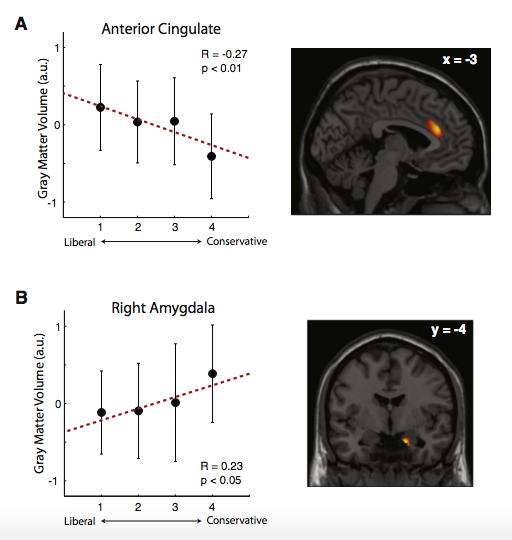
There may even be something physiological about the difference between liberals and conservatives. Self-described liberals were found in one study to have more grey matter in the anterior cingulate cortex, a region of the brain that has influence over error detection, decision-making, emotion control, and handling uncertainty, plus some autonomic functions. Self-described conservatives had a larger right amygdala, which has influence over fear and anxiety. (Another study found “greater liberalism was associated with stronger conflict-related anterior cingulate activity, suggesting greater neurocognitive sensitivity to cues for altering a habitual response pattern” — being more open to change.)

Screen Shot 2017-07-04 at 12.00.11 PM

via Cell

The researchers were careful to note that these differences likely do not tell the whole story of why one is conservative or liberal — these regions themselves are not likely the sole cause of political beliefs — but their findings do “converge with previous work to suggest a possible link between brain structure and psychological mechanisms that mediate political attitudes.” Specifically:

Although these results suggest a link between political attitudes and brain structure, it is important to note that the neural processes implicated are likely to reflect complex processes of the formation of political attitudes rather than a direct representation of political opinions per se. The conceptualizing and reasoning associated with the expression of political opinions is not necessarily limited to structures or functions of the regions we identified but will require the involvement of more widespread brain regions implicated in abstract thoughts and reasoning.

We speculate that the association of gray matter volume of the amygdala and anterior cingulate cortex with political attitudes that we observed may reflect emotional and cognitive traits of individuals that influence their inclination to certain political orientations. For example, our findings are consistent with the proposal that political orientation is associated with psychological processes for managing fear and uncertainty. The amygdala has many functions, including fear processing. Individuals with a large amygdala are more sensitive to fear, which, taken together with our findings, might suggest the testable hypothesis that individuals with larger amygdala are more inclined to integrate conservative views into their belief system.

Similarly, it is striking that conservatives are more sensitive to disgust, and the insula is involved in the feeling of disgust. On the other hand, our finding of an association between anterior cingulate cortex volume and political attitudes may be linked with tolerance to uncertainty. One of the functions of the anterior cingulate cortex is to monitor uncertainty and conflicts. Thus, it is conceivable that individuals with a larger ACC have a higher capacity to tolerate uncertainty and conflicts, allowing them to accept more liberal views. Such speculations provide a basis for theorizing about the psychological constructs (and their neural substrates) underlying political attitudes. However, it should be noted that every brain region, including those identified here, invariably participates in multiple psychological processes. It is therefore not possible to unambiguously infer from involvement of a particular brain area that a particular psychological process must be involved.

Indeed, it cannot at all be concluded that people are born liberal or conservative; environment can change brain structure during childhood development. For example, a 2015 study showed that parts of the brain tied to academic performance are 8-10% smaller in children from very poor households, likely linked to a miserable environment. The researchers looking at political affiliation and brain structure write that “a longitudinal study [is needed] to determine whether the changes in brain structure that we observed lead to changes in political behavior or whether political attitudes and behavior instead result in changes of brain structure.”

That question has yet to be answered.


How We Change: A Personal Story and Analysis

So, can thought processes or brain structure beyond your control contribute to your political beliefs?

While we should always bear in mind correlation is not the same as causation, and acknowledge that untangling possible causal factors is not easy (i.e., religious fundamentalism and conservatism are so intertwined it may be difficult to determine which contributes more to anti-Muslim sentiment), the evidence suggests the answer is likely yes.

As hard as it may be to hear, conservative thought may be based on more simplistic modes of thinking (or, conversely, conservative thought may lead to more simplistic modes of thinking). An emphasis on in-group/loyalty, authority/respect, and purity/sanctity could stem from “low-effort” or “less abstract” or “fear-based” thought, which could create an ideology resistant to social changes like racial integration, access to contraceptives, the sexual revolution, immigration, gay marriage, and so on, and fear of losing the rights they value and believe moral, hence the aversion to gun control, government regulation of business, restrictions on religious rights, and so on.

While fear of losing certain rights is not a bad thing (especially things like the right to privacy, freedom to protest, freedom of speech and religion, etc.), resistance to changing traditional ethics and societal rules that are “restrictive” and “oppressive,” as Haidt put them, can be extremely harmful to those who don’t “fit in,” be they Muslims, blacks, gays and lesbians, trans people, Hispanic immigrants, and so forth. In this way, the same cognitive processes that inspire fear of losing important rights may also make conservatives resistant to extending those same rights to others (hence, the sensible desire for Christians to be able to worship free of State control exists alongside mass support for monitoring mosques and banning Muslim immigration, the hypocrisy barely noticed).

This is not to say that all conservatives always struggle with more complex, abstract thinking or always experience fear-based motivations that lead to the mistreatment of certain groups. Nor is it to say that every liberal has a superior cognitive style in comparison to the average conservative, nor that liberals cannot be prejudiced or discriminate against the “Other.” Saying any of these things would simply be untrue. Rather, it is as one psychologist put it, “Reality is complicated and messy. Ideologies get rid of the messiness and impose a simpler solution. So, it may not be surprising that people with less cognitive capacity will be attracted to simplifying ideologies.” It is to say, those with less complex thought processes may create or gravitate toward less complex values and political ideas.

As my friend put it, conservatives tend to see things in black and white. While perhaps some on the Right would criticize this, I’ve heard it upheld as a point of pride (and in my conservative days, I did the same). The Right dislikes moral relativism and grey areas. What’s right is right. What’s wrong is wrong. So for example, it is always wrong to burn the American flag, no matter your reasons for doing so — even if your government is killing countless civilians overseas. What is trounced upon in an act like flag burning? Loyalty to your nation, respect for the State and the troops, perhaps even your purity or the sanctity of the object? To best protect these things, an issue should be black and white. This is where Haidt’s findings come together with prior and later research. Less complex thought (more black and white, less abstract, lower effort, more fear-based) would quite predictably lead to a greater emphasis on the types of moral foundations Haidt shows conservatives care about.

But more complex and abstract thought opens the door to a very grey world indeed, a world requiring “adaptability” and “flexibility” to navigate, a world where loyalty, authority, and notions of sanctity deserve to be questioned, simply because there are so many different perspectives that exist (while respecting an authority may benefit you, it may get someone else killed).

None of this means, as some vitriolic liberal writers gleefully declare, that conservatives are less intelligent or stupid. Is the person who engages in less complex thought (and this would include some liberals, even if more common among conservatives) incapable of anything else? Recall that abstraction is a relative concept — what’s abstract can gradually become concrete (also, there is evidence that, due to factors like literacy and scientific knowledge, humanity’s abstract reasoning skills are improving…and perhaps humanity is thus growing more liberal). Further, remember that an I.Q. test supposedly measures intelligence, yet scores vary by socioeconomic status. Capability is being stunted. In the same way, I imagine these differences between liberals and conservatives have less to do with actual intelligence and more to do with factors that stunt capabilities.

For example, I used to be deeply conservative and am now quite liberal, but I don’t believe I somehow grew less stupid in a transition period of a couple years. I don’t think I’m more intelligent, but rather more knowledgeable. Exposure to new ideas, a growing collection of perspectives and facts — basically, education — perhaps broke the restraints on my capabilities, leading to more abstract thinking and more liberalism (this may help explain why people who earn the highest degrees are disproportionately liberal).

When I consider my own conversion from far Right to far Left, I can see myself beginning on the right side of the Haidt graphic above and moving left, experiencing the changes in the importance of the moral categories as I go, caring more for care/harm and fairness/reciprocity and less and less for the other three. I can look back and consider issues, how they relate to the foundations, and how they changed.

  • Harm/care: I used to rarely give a second thought to the foreign civilians who die in the fires of American bombs; today, I consider these people as worthy of life as any American. The U.S. might as well be dropping bombs in Wyoming.  
  • Fairness/reciprocity: I used to think that illegal immigrants deserved to be shipped back wherever they came from because they broke our laws; now I think of how I would want to be treated, had I escaped dire poverty or violence in Central or South America.
  • In-group/loyalty: I used to pledge my loyalty to the U.S. and the American people; now I pledge allegiance to the human race, remembering what Jack London said, that we should “care more for men and women and little children than for imaginary geographic lines.”
  • Authority/respect: I used to think the U.S. could do no wrong; now I gravitate toward what Malcolm X said, “You’re not supposed to be so blind with patriotism that you can’t face reality” and what I.F. Stone said, “All governments lie.”
  • Purity/sanctity: I used to think drug use was a sin and a sign of social and moral decay, and therefore approved of drug bans, feeling drug users in prison got what they deserved; now I believe what’s morally wrong is only that which hurts others, and think people should have the freedom to choose for themselves what they do with their own bodies.

How did these changes come about? How does political thinking change? I can’t speak for others (nor for any who transitioned from liberal to conservative!) but my answer is more information. Exposure to new ideas. Opening a book written by a liberal or an atheist (religion perpetuates the ideas found in the five moral foundations, including an immense influence over the final three, thus tying in nicely with conservatism; one might wonder what conservatism would be like had religion never existed — perhaps not so much hysteria over sex and sexuality?).

To quote Helen Keller, “How did I become a socialist? By reading.” When I was a conservative, I somehow went about life arrogantly dismissing evolution without ever bothering to read a book, essay, or even a mere sentence by an evolutionary biologist with evidence to offer. The same can be said of global warming. I thought criminalizing abortion would end abortions, without every studying the time in U.S. history when abortion was illegal. And why would I not see the United States as the international good guy, a force of pure good, when I had never read an honest history of American foreign policy, one that hadn’t been sugarcoated?

I was the living embodiment of argumentum ad consequentiam: the belief that X is true or false depending on whether the outcome is desirable or undesirable. I was resistant to change, shied away from exposure to new ways of thinking. I thought in black and white terms, and did not spend much time reflecting on my beliefs, thinking critically, cross-examining them. But slowly, over a process that lasted years, new information and foreign ways of thinking changed my mind about many things (it is difficult to support the criminalization of abortion after you learn just how popular self-induced abortions were in the era of actual criminalization). I found liberal ideas and arguments thoroughly more convincing and best able to improve society for all people.

I don’t know for sure if my brain structure or abstract reasoning changed or improved. But I do know that, whether our cognitive processes and abilities develop our political beliefs or vice versa, nothing is written in stone. Anyone can change.

For more from the author, subscribe and follow or read his books.

Republicans Used to be Liberal, Democrats Conservative

Blame it on a poorly educated populace.

In the course of everyday political conversation, there can arise counterintuitive historical facts concerning the actions and ideas of Republicans and Democrats in American history. This can throw any discourse into chaos.

Many conservatives seem very concerned with repairing the modern Republican image. Thus many leap at the chance to point out, for example, that President Lincoln, the Great Emancipator of black slaves, was a Republican, and that Republicans pushed through the 13th, 14th, and 15th Amendments to offer freedom and equality to blacks. Or, conversely, that Democrats were the ones to break away from the Union to preserve slavery, and later create and protect brutal Jim Crow laws, partly through supporting the Klan. Many conservatives either forget (or wish to ignore) that Republicans used to be somewhat liberal, Democrats more conservative. And many liberals likewise don’t know their history, and cannot provide much-needed historical knowledge.

Originally, the Republicans were the Northerners, some of them abolitionists, progressives, liberals, radicals. In fact, the Republican Party was founded by Alvan Bovay and other socialists in the former utopian community of Ripon, Wisconsin in March 1854. It was founded as an anti-slavery party, a response to political setbacks in the abolition struggle. (See The “S” Word: A Brief History of an American Tradition…Socialism, John Nichols.)

While the Republican Party Platform of 1860 does contain language familiar to modern Republicans, such as a condemnation of the “reckless extravagance which pervades every department of the Federal Government” and the need to “return to rigid accountability,” as well as the “preservation of our…Constitution [and] the Rights of States,” it set the stage for a (somewhat) liberal Republican party.

The Platform called for the passage of the Homestead Act, which gave government land to Western settlers for free or very little cost. It demanded the expansion of slavery in U.S. territories be halted and called the recent resumption of the African slave trade “a crime against humanity and a burning shame to our country.” It supported the government funding the “railroad to the Pacific Ocean” in “the interests of the whole country” (admittedly, primarily the interests of big business, Northern industry). It supported duties (taxes) on imports from foreign nations to protect Northern industry, partly because this “secures to the workingmen liberal wages.” Impressively, the Republicans even took a stand for immigrants, writing:

The Republican Party is opposed to any change in our naturalization laws… [where] the rights of citizens hitherto accorded to immigrants from foreign lands shall be abridged or impaired; and [the Republican Party is] in favor of giving a full and efficient protection to the rights of all classes of citizens, whether native or naturalized, both at home and abroad.

Free stuff? Trying to improve the condition of blacks and immigrants? Massive government spending on programs for the common good? Rejecting free trade? Liberal wages? Not the usual rhetoric of most Republican politicians today. So it was natural for Lincoln, the first Republican president, to work to terminate slavery, or say things like this in his 1861 State of the Union address:

Labor is prior to and independent of capital. Capital is only the fruit of labor, and could never have existed if labor had not first existed. Labor is the superior of capital, and deserves much the higher consideration… A few men own capital, and that few avoid labor themselves, and with their capital hire or buy another few to labor for them.

Language like this hints at Lincoln’s friendships with Marxists exiled from Europe (see Nichols) and his positive interactions with Karl Marx.

The Democratic Party was the party of the South, the slave-owners, the conservatives.

They opposed these liberal ideas Republicans were coming up with, and of course Democrats in some states were willing to declare independence to continue enslaving black people (wouldn’t it be interesting if people who today love the Confederacy and fly the stars and bars actually thought they were honoring a liberal empire?). Thus it was natural for a Democrat like Alexander Stephens, the Vice President of the Confederate States of America, to explain that the Confederacy’s foundations laid “…upon the great truth that the negro is not equal to the white man; that slavery, subordination to the superior race, is his natural and normal condition” (see James Loewen, Lies My Teacher Told Me).

This in no way means there were no Democrats who opposed slavery, nor that all Republicans cared about freeing slaves, much less black equality. Most Republicans did not care about ending slavery until the Civil War was well underway. However, the progressives congregated in the Republican Party. The die-hard abolitionists were called “Radical Republicans,” separating their ideology from mainstream Republicans, and they cursed Lincoln for being too slow on the issue of black freedom.

As much as modern conservatives would like to take credit for freeing the slaves, a bit of historical knowledge reveals the Republican Party was the more liberal party during that era. And the events very much make sense when you consider what it means to be conservative (preserve traditions, resist broad social change) or liberal (open to new ideas and broad social change), which aligns neatly with modern psychological research indicating the person who thinks in less abstract ways or has a larger right amygdala, which influences fear and anxiety, tends to be conservative. Fear of “the Other” is a real factor of political ideology.

Similar to forgetting the Democratic Party of the mid-1800s was made up of secessionist conservatives, present-day conservatives are likewise eager to point out Democrats opposed the civil rights acts of a century later. This fails to take into account that the ideology prevalent in the 1860s was still prevalent in the 1950s and 1960s South, and the vessel of that ideology was still the Democratic Party.

How was it that after the Brown v. Board of Education ruling, 99 congressmen issued a “Southern Manifesto” condemning the decision, and 97 of them were Democrats? How was it that Eisenhower, a Republican, lost nearly all the South in 1956? The South voted for Adlai Stevenson, the Democrat. Stevenson was from Illinois, a bit on the conservative side when it came to civil rights but a supporter of labor and unions — a good example of the change occurring within the Democratic Party.

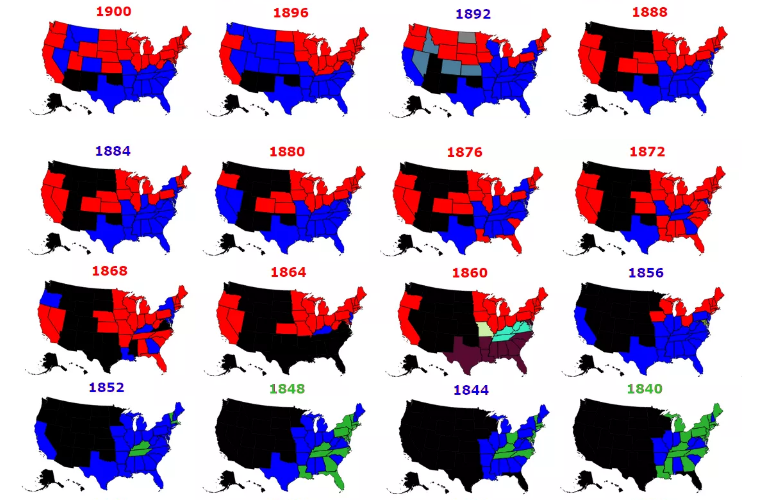
The transition from liberal Republicans/conservative Democrats to liberal Democrats/conservative Republicans was not a short one. We see that in African American voting patterns (see below). Not surprisingly, freemen voted and held political office as Republicans after the Civil War. It was the party Lincoln, the party of freedom, the progressive party, the slightly-less-racist party. But as time went on, the Republican Party enthusiasm for equality, the idealism of the Civil War, waned. Democrats in Northern cities (blacks congregated in cities because smaller towns across the entire nation banned black residents, and it was harder for larger cities to exile larger populations) were able to take advantage of this abandonment and court black voters with public policy expanding human rights. In Kansas City, Missouri, for example, the Democratic machine in the 1920s earned African American loyalty by prosecuting police abuse and ensuring voting rights. From the end of the Reconstruction era (1890s) to the 1970s and 80s, more liberal and progressive voices arose within the Democratic Party in Northern cities and states.

Let’s consider how George Wallace, the bigot who stood in the doorway of the University of Alabama and refused to allow court-ordered integration, drawing condemnation from African Americans and liberals across the country, was a Democrat. He was the one who glorified racism and states’ rights when he declared, “In the name of the greatest people that have ever trod this earth, I draw the line in the dust and toss the gauntlet before the feet of tyranny, and I say segregation now, segregation tomorrow, segregation forever!” He was a Democrat until the 1980s.

Now, looking at history, you notice we had a Democrat like Wallace, and racist Democratic governors and congressmen controlling the entire South, in the 1950s but also had a Democrat like Franklin Roosevelt (from New York) become president in the 1930s and a Democratic Kennedy from Massachusetts do the same in 1961!

If you recall, the battle to integrate Alabama colleges was a President Kennedy-George Wallace showdown. On June 11, 1963, Wallace stood in the doorway of the University of Alabama auditorium with police and refused to allow black students to enter and register for classes. The Kennedy administration pressured him for months before the incident to follow federal law. When he wouldn’t, Kennedy ordered the Alabama National Guard mobilized with the famous Executive Order 11111. Wallace backed down.

Though both Democrats, Wallace and Kennedy made their ideologies clear.

In July 1964, Wallace gave a speech called, “The Civil Rights Movement: Fraud, Sham and Hoax.” He called the Civil Rights Act, just signed into law by Democratic President Lyndon Johnson, banning race discrimination and segregation in employment, public places, and schools, “the most monstrous piece of legislation ever enacted by the United States Congress.” He continued:

Never before in the history of this nation have so many human and property rights been destroyed by a single enactment of the Congress. It is an act of tyranny. It is the assassin’s knife stuck in the back of liberty.

With this assassin’s knife and a blackjack in the hand of the Federal force-cult, the left-wing liberals will try to force us back into bondage. Bondage to a tyranny more brutal than that imposed by the British monarchy which claimed power to rule over the lives of our forefathers under sanction of the Divine Right of kings.

He foams at the mouth at great length over how the bill would “enslave our nation,” how it is meant to “destroy the rights of private property” and “will destroy neighborhood schools” and “destroys your right — and my right — to choose my neighbors — or to sell my house to whomever I choose.” After saying the Supreme Court has more power than Hitler ever did, and ranting about Communists, Wallace declares:

I am a candidate for President of the United States… I am a conservative. I intend to give the American people a clear choice. I welcome a fight between our philosophy and the liberal left-wing dogma which now threatens to engulf every man, woman, and child in the United States.

To Wallace, the true conservative stands for “liberty and justice for all,” opposing the “senseless bloodletting now being performed on the body of liberty” by forcing whites to allow blacks into their schools, workplaces, neighborhoods, parks, and so on.

What of the “left-wing liberals”?

On September 14, 1960, Kennedy gave a speech in which he said:

What do our opponents mean when they apply to us the label “Liberal?” If by “Liberal” they mean, as they want people to believe, someone who is soft in his policies abroad, who is against local government, and who is unconcerned with the taxpayer’s dollar, then the record of this party and its members demonstrate that we are not that kind of “Liberal.” But if by a “Liberal” they mean someone who looks ahead and not behind, someone who welcomes new ideas without rigid reactions, someone who cares about the welfare of the people — their health, their housing, their schools, their jobs, their civil rights, and their civil liberties — someone who believes we can break through the stalemate and suspicions that grip us in our policies abroad, if that is what they mean by a “Liberal,” then I’m proud to say I’m a “Liberal.”

“Someone who looks ahead and not behind, someone who welcomes new ideas without rigid reactions” — the textbook definition of a liberal, with a mention of “civil rights” included.

On the evening of June 11, 1963, Kennedy addressed the nation concerning the crisis at the University of Alabama, which ended mere hours before:

This afternoon, following a series of threats and defiant statements, the presence of Alabama National Guardsmen was required on the University of Alabama to carry out the final and unequivocal order of the United States District Court of the Northern District of Alabama. That order called for the admission of two clearly qualified young Alabama residents who happened to have been born Negro.

He made several inspiring calls for integration and equality, before calling for legislation that would soon be called the Civil Rights Act of 1964:

I hope that every American, regardless of where he lives, will stop and examine his conscience about this and other related incidents. This Nation was founded by men of many nations and backgrounds. It was founded on the principle that all men are created equal, and that the rights of every man are diminished when the rights of one man are threatened…

The heart of the question is whether all Americans are to be afforded equal rights and equal opportunities, whether we are going to treat our fellow Americans as we want to be treated. If an American, because his skin is dark, cannot eat lunch in a restaurant open to the public, if he cannot send his children to the best public school available, if he cannot vote for the public officials who will represent him, if, in short, he cannot enjoy the full and free life which all of us want, then who among us would be content to have the color of his skin changed and stand in his place? Who among us would then be content with the counsels of patience and delay?…

One hundred years of delay have passed since President Lincoln freed the slaves, yet their heirs, their grandsons, are not fully free. They are not yet freed from the bonds of injustice. They are not yet freed from social and economic oppression…

He lost significant white Southern support.

Ordinary people spoke in the same way, too, explaining which ideologies support what. C. Howard Britain, a doctor, wrote to the American Journal of Nursing in December 1963:

I have read the editorial concerning the merits of integration — if there are any… I rebuke you and the ANA [American Nurses Association] for supporting the Civil Rights Act of 1963 (H.R. 7152). Either you are grossly ignorant or it is your purpose to mislead your readers into thinking that this bill is in the best interests of Americans. I, and millions of other Americans, are fed up with these magazines which are saturated with liberal thinkers and left-wing editors.

The division between Northern liberal Democrats and Southern conservative Democrats explains why most blacks consistently voted Democrat since the 1920s and 30s. According to the Joint Center for Political and Economic Studies, the percentage of blacks voting Democratic has been 70-90% since the 1930s. Rest assured, they weren’t voting for the segregationist conservative Democrats of the South, but rather Northern liberal Democrats.

One might infer that if blacks voted for Republicans (and even held office as Republicans) after the Civil War, but after a time shifted support toward Democrats — and overwhelmingly vote Democratic today — something must have changed in party ideologies.

During a transition like this, it is expected that the Democratic Party would for several decades be a mix of ideologies. That mix was largely determined by geography: liberal Democrats in the North, conservative ones in the South. Even conservative author Paul Johnson, in A History of the American People, acknowledged a “classic coalition of Southern conservatives and Northern and Western progressives that was to remain the Democratic mainstay till the end of the 1960s.” Likewise, you would have liberal Republicans in the North and conservative ones in the South. A wonderful example is Everett Dirksen, who helped push the 1964 Civil Rights Act. He was a Republican from Illinois, the North. And Eisenhower himself, while born in Texas, grew up in Kansas, and was certainly a more enlightened Republican in matters of race, thanks to where he was raised, but also to his interactions with black soldiers in the Army.

But you can of course look back further for an ideological mix in the Republican party. When Republican president and progressive Teddy Roosevelt failed to win the GOP nomination for a third term in 1912 (a more conservative candidate, Taft, was nominated), he and others formed the Progressive Party (Bull Moose). It was built on the Republican Progressive League. This split the Republican voting base and gave the White House to the Democrat, Woodrow Wilson. The Republican and Progressive parties reunited in 1916 to ensure that mistake did not repeat.

Having more liberal Northern Democrats and more liberal Northern Republicans meant that these groups could come together to work for racial progress. In 1938, for example, they joined forces to try to pass a federal anti-lynching bill. This enraged the southern Democrats, of course, one of whom (Senator Josiah Bailey) declared:

Just as when the Republicans in the [1860s] undertook to impose the national will upon us with respect to the Negro, we resented it and hated that party with a hatred that has outlasted generations; we hated it beyond measure; we hated it more than was right for us and more than was just; we hated it because of what it had done to us, because of the wrong it undertook to put upon us; and just as that same policy destroyed the hope of the Republican party in the South, that same policy adopted by the Democratic party will destroy the Democratic party in the South.

His prediction would quickly come true.

However, this does not mean the transition was solely driven by divisions over black dignity and equality. Eric Rauchway of the University of California – Davis believes William Jennings Bryan, a Democrat who started preaching social justice through government action, served as the tipping point:

One of them has to be the 1896 election, when the Democratic Party fused with the People’s Party, and the incumbent Grover Cleveland, a rather conservative Democrat, was displaced by the young and fiery William Jennings Bryan, whose rhetoric emphasized the importance of social justice in the priorities of the federal government. The next time the Democrats had a Congressional majority, with the start of Wilson’s presidency in 1913, they passed a raft of Bryanish legislation, including the income tax and the Federal Reserve Act. And the next Democratic president after that was FDR. So from Bryan onward, the Democratic Party looks much more like the modern Democratic Party…

Rauchway also points to the mix of ideology:

Oddly though, during the first part of this period, i.e., the time of Bryan, the Republican Party does not immediately, in reaction, become the party of smaller government; there’s no do-si-do. Instead, for a couple of decades, both parties are promising an augmented federal government devoted in various ways to the cause of social justice. It’s not until the 1920s, and the era of Coolidge especially, that the Republican Party begins to sound like the modern Republican Party, rhetorically devoted to smaller government. And that rhetorical tendency doesn’t really set in firmly until the early 1930s and the era of Republican opposition to the New Deal.

During this time, both parties tried to win voters in the West with promises of government aid and programs. Republicans eventually abandoned such promises, favoring free markets and fiscal conservatism.

Things came to a head when liberal Democrats embraced the Civil Rights Movement, to the delight of liberal Republicans but dismay of conservative Democrats and the small but growing number of conservative Republicans. As The New York Times writes,

When President Lyndon B. Johnson championed the Civil Rights Act of 1964 and the Voting Rights Act of 1965, some Republican strategists saw a potential bonanza in the South. They thought their party could reap the votes of white people uneasy with Democrats, or downright hostile to them, for advancing the cause of black people.

Johnson knew it, too, saying to a White House aide after the 1964 act passed: “I think we just delivered the South to the Republican Party for a long time to come.” Seizing on this crisis was Republican Richard Nixon, and allies like Harry Dent, Howard Calloway, Clarke Reed, and Strom Thurmond.

As William Greider writes for The Nation, Nixon

brokered the deal with Dixiecrat leader Strom Thurmond at the ’68 convention in Miami, wherein states of the old slave-holding Confederacy would join the Party of Lincoln. It took two election cycles to convert the “Solid South,” but Nixon and GOP apparatchiks made it clear with private assurances that Republicans would discreetly retire their historic commitment to civil rights.

This was Nixon’s “Southern Strategy,” which allied “traditional wing of the party — ‘country club’ Republicans, who include corporate leaders, financiers and investors…with poor, rural, church-going voters, among them the Southern ‘segs’ who had previously always voted for Democrats.” Appealing to race hatred was key. H.R. Haldeman, a Nixon advisor, said Nixon “emphasized that you have to face the fact that the whole problem is really the blacks. The key is to devise a system that recognizes this while not appearing to.” Nixon’s special counsel, John Ehrlichman, said that “the subliminal appeal to the anti-black voter was always present in Nixon’s statements and speeches,” and summarized Nixon’s 1968 campaign strategy as “We’ll go after the racists” (see Alexander, The New Jim Crow). Ehrlichman was the one who admitted:

The Nixon campaign in 1968, and the Nixon White House after that, had two enemies: the antiwar left and black people. You understand what I’m saying? We knew we couldn’t make it illegal to be either against the war or black, but by getting the public to associate the hippies with marijuana and blacks with heroin, and then criminalizing both heavily, we could disrupt those communities. We could arrest their leaders, raid their homes, break up their meetings, and vilify them night after night on the evening news. Did we know we were lying about the drugs? Of course we did.

However, large cracks already existed in the foundation of the Democratic Party itself. Bitterly racist politicians (like Thurmond, who once screamed about how equal rights for the “nigger race” would lead to “totalitarianism”) were already leaving the Democratic Party after the Civil Rights Acts of 1964 and 1965 and joining the Republican Party. Barry Goldwater, a Republican, won several deep South states in 1964 (a first since Reconstruction) but lost miserably elsewhere, both due to his opposition to black rights.

With more Republicans and fewer Democrats preaching segregation, the South gradually switched its allegiance. Nixon, who advocated “states’ rights” and other ideas pleasing to white supremacists, won even more of the South in 1968 than Goldwater before him. Any liberals or blacks who still sided with Republicans started rethinking things. At the time of the Goldwater campaign, in fact, the number of blacks voting Republican “dropped to near zero.”

Even some leading conservative intellectuals will speak honestly about what happened. Avik Roy admits:

Goldwater’s nomination in 1964 was a historical disaster for the conservative movement because for the ensuing decades, it identified Democrats as the party of civil rights and Republicans as the party opposed to civil rights… The fact is, today, the Republican coalition has inherited the people who opposed the Civil Rights Act of 1964 — the Southern Democrats who are now Republicans.

Head of the RNC Ken Mehlman gave a near-apology to the NAACP in 2005:

By the ’70s and into the ’80s and ’90s, the Democratic Party solidified its gains in the African American community, and we Republicans did not effectively reach out. Some Republicans gave up on winning the African American vote, looking the other way or trying to benefit politically from racial polarization. I am here today as the Republican chairman to tell you we were wrong.

And RNC head Michael Steele said five years later: “For the last 40-plus years we had a ‘Southern Strategy’ that alienated many minority voters by focusing on the white male vote in the South.”

Looking at the electoral maps of U.S. elections, you can watch the change taking place. One might infer that if Democrats had strong support in the South from the Reconstruction era to 1960, but then witnessed a transition to strong Republican support that something changed within party ideologies:

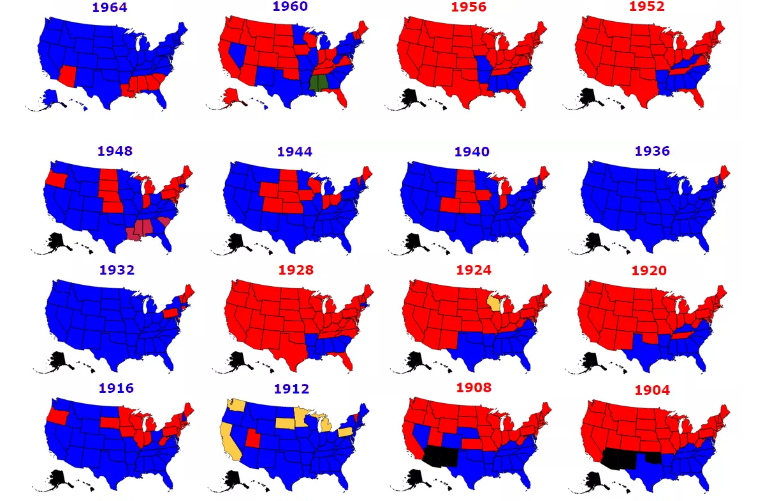
12

3

via Metrocosm

In 1981, Republican political strategist, advisor to Reagan, and future head of the RNC Lee Atwater gave an interview (at first anonymous) that was quite honest about the strategy: “As to the whole Southern strategy that Harry S. Dent, Sr. and others put together in 1968, opposition to the Voting Rights Act would have been a central part of keeping the South.” He went on to describe the “coded” appeals to racist attitudes that served a similar function as “blatant” discrimination, while saying Reagan’s 1980 campaign didn’t rely on this and indeed had “washed [it] away”:

So what you have is two things happening that totally washed away the Southern strategy, the Harry Dent type Southern strategy, and that is, that whole strategy was based, although it was more sophisticated than a Bilbo or a George Wallace, it was nevertheless based on coded racism. The whole thing, busing, we want a Supreme Court judge that won’t have busing, anything you look at can be traced back to the issue [of race], in the old southern strategy. It was not done in a blatantly discriminatory way.

His interviewer asked if Reagan’s slashing of welfare appealed to the “racist” voters. Atwater gave a “maybe,” but argued since coded racism was growing so coded and as Reagan and the Republicans no longer needed to use it (“race was not a dominant issue” in 1981), the issue was moot:

You start out in 1954 by saying, “Nigger, nigger, nigger.” By 1968 you can’t say “nigger”—that hurts you. Backfires. So you say stuff like forced busing, states’ rights and all that stuff. You’re getting so abstract now [that] you’re talking about cutting taxes, and all these things you’re talking about are totally economic things and a byproduct of them is blacks get hurt worse than whites. And subconsciously maybe that is part of it. I’m not saying that. But I’m saying that if it is getting that abstract, and that coded, that we are doing away with the racial problem one way or the other. You follow me—because obviously sitting around saying, “We want to cut this,” is much more abstract than even the busing thing, and a hell of a lot more abstract than “Nigger, nigger.”

The transition continued through the 1980s and even 1990s, until the polarization became complete (with perhaps the exception of conservative Blue Dog Democrats).

That is our history. The number of liberal Republicans waned as more and more progressives voted or ran as Democrats, and the number of conservative Democrats lessened as the Republican party took up the mantle of protector of the white race.

Without this history lesson, it is impossible to understand American society, to separate party name from ideology. How could Democrats support segregation, but a 2013 ABC News poll find a pathetic 5% of conservative Americans support more non-whites in Congress, vs. 50% of liberals? How could Republicans oppose Jim Crow laws, but conservatives today be slightly less likely to approve of interracial marriage, according to polls? How could Democrats of old join and support the KKK, but today areas with histories of strong Klan activity correlate with strong Republican loyalty? How did Democrats formerly rule the South and found the Confederacy, but today conservatives and Republicans rule the South? If the Confederate flag is a flag of the liberals of old, why is it only conservatives and Republicans fly it today? And so on.

For more from the author, subscribe and follow or read his books.