Evolution is a simple idea: that over time, lifeforms change. In a small timespan, changes are subtle yet noticeable; in a massive one, changes are shockingly dramatic — descendants look nothing like their ancestors, becoming what we call new species.
Changes occur when genes mutate during the imperfect reproduction process, and are passed on if the mutation helps an individual creature escape predators, find food or shelter, or attract a mate, allowing it to more successfully reproduce than individuals without its new trait (natural selection). Some mutations, of course, hurt chances of survival or have no impact at all.
Naturalist and geologist Charles Darwin provided evidence for this idea in his 1859 book On the Origin of Species and other works, and over the century and a half since, research in multiple fields has consistently confirmed Darwin’s idea, irreparably damaging religious tales of the divine creation of life just as it exists today.
The Myths of Man
While many people of faith have adopted scientific discoveries such as the age of the earth and evolution into their belief systems, many have not. Hardline Christian creationists still believe humans and all other life originated 6,000 years ago, with a “Great Flood” essentially restarting creation 4,000 years ago, with thousands of “kinds” of land animals (tens of thousands of species) rescued on Noah’s ark.
The logical conclusion of the story is utterly lost on believers. There are an estimated 6.5 million species that live on land today, perhaps 8-16 million total species on Earth (that’s a conservative estimate; it could be 100 million, as most of our oceans remain unexplored). People have cataloged 2 million species, discovering tens of thousands more each year. Put bluntly, believing that in four millennia tens of thousands of species could become millions of species requires belief in evolution at a pace that would make Darwin laugh in your face.
To evolve the diversity of life we see today, much time was needed. More than 4,000 years, a planet older than 6,000 years. We know the Earth is 4.5 billion years old because radioactive isotopes in terrestrial rocks (and crashed meteors) decay at consistent rates, allowing us to count backward. Fossil distribution, modern flora and fauna distribution, and the shape of the continents first indicated the continents were once one, and satellites proved the continents are indeed moving apart from each other at two to four inches per year, again allowing us to count backward (Why Evolution is True, Jerry Coyne). When we do so, we do not stop counting in the thousands.
Naturally, criticisms of myths can be waved away with more magic, which is why it’s mostly futile to tear them apart, something I learned after wasting time doing so during my early writing days. Perhaps God decided to make new species after the flood. Perhaps he in fact made millions of species magically fit on a boat roughly the size of a football field, like a bag from Harry Potter. It’s the same way he got pairs of creatures on whole other continents to, and later from, the Middle East; how one family, through incest, rapidly evolved into multiple human races immediately after the flood (or did he make new human beings, too?); how a worldwide flood and the total destruction of every human civilization left behind no evidence. The power of a deity — and our imagination — can take care of such challenges to dogma. But it cannot eviscerate the evidence for evolution. Science is the true arrow in mythology’s heel.
Still, notions of intelligent design bring up many curious questions, such as why a deity would so poorly design, in identical ways, the insides of so many species (see below), why said deity would set up a world in which 99% of his creative designs would go extinct, and so on.
It seems high time we set aside ancient texts written by primitive Middle Eastern tribes and listened to what modern science tells us. And that’s coming from a former creationist.
It Wasn’t Just Darwin
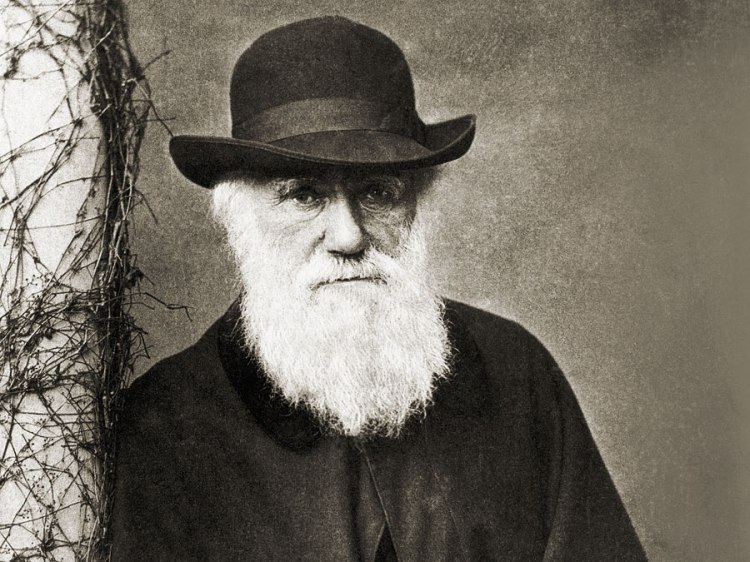
Charles Darwin, 1809-1882. via Britannica
Creationists attempt to discredit evolution by attacking the reliability and character of Darwin, but forget he was just one man. Darwin spent decades gathering the best evidence for evolution of his day, showed for the first time its explanatory powers across disciplines (from geography to embryology), and brought his findings to the masses with his accessible books. But there were many who came before him that deepened our and his understanding of where diverse life came from and how the biblical Earth wasn’t quite so young. For example:
- In the sixth century B.C., the Greek philosopher Anaximander studied fossils and suggested life began with fishlike creatures in the oceans.
- James Hutton argued in the 1700s that the age of the earth could be calculated based on an understanding of geologic processes like erosion and the laying down of sediment layers.
- In 1809, Jean-Baptiste Lamarck theorized that physical changes to an individual acquired during its life could be passed to offspring (a blacksmith builds strength in his arms…could that lead to stronger descendants?).
- By the 1830s, Charles Lyell was putting Hutton’s ideas to work, measuring the rate at which sediments were laid, and counting backward to estimate Earth’s age.
- Erasmus Darwin, Charles’ grandfather, suggested “all warm-blooded animals have arisen from one living filament,” with “the power of acquiring new parts…delivering down those improvements by generation.”
- Alfred Wallace theorized natural selection independently of and at the same time as Charles Darwin!
In other words, if it wasn’t Darwin it would have been Wallace. If not Wallace then someone else. Like gravity or the heliocentric solar system, the scientific truth of evolution could not remain hidden forever.
Creationists also seize upon Darwin’s unanswered questions and use them to argue he “disproved” or “doubted” the validity of his findings. For example, Darwin, in his chapter on “Difficulties of the Theory” in The Origin of Species, said the idea that a complex eye “could have been formed by natural selection, seems, I freely confess, absurd in the highest possible degree.”
Emphasis on seems. He went on to say:
When it was first said that the sun stood still and the world turned round, the common sense of mankind declared the doctrine false… Reason tells me, that if numerous gradations from an imperfect and simple eye to one perfect and complex, each grade being useful to its possessor, can be shown to exist, as is certainly the case; if further, the eye ever slightly varies, and the variations be inherited, as is likewise certainly the case; and if such variations should ever be useful to any animal under changing conditions of life, then the difficulty of believing that a perfect and complex eye could be formed by natural selection, though insuperable by our imagination, cannot be considered real.
In other words, the evolution of eye is possible and there is no real difficulty in supposing this given other evidence he had found. Darwin knew he was not the end of the line. He made predictions concerning future discoveries, and supposed that other scientists would one day show how eyes could develop from non-existence to simple lenses to complex eyes, as they indeed have. It began with cells that are more sensitive to light than others. Biologists believe, in the words of Michael Shermer (God Is Not Great, Hitchens), that there was
Initially a simple eyespot with a handful of light-sensitive cells that provided information to the organism about an important source of the light; it developed into a recessed eyespot, where a small surface indentation filled with light-sensitive cells provided additional data on the direction of light; then into a deep recession eyespot, where additional cells at greater depth provide more accurate information about the environment; then into a pinhole camera eye that is able to focus an image on the back of a deeply-recessed layer of light sensitive cells; then into a pinhole lens eye that is able to focus the image; then into a complex eye found in such modern mammals as humans.
Earth has creatures with no eyes, creatures with “a handful of light-sensitive cells,” and all the other stages of eye development, right up to our complex camera eye. Given this, there is no reason to believe the evolution of the eye is impossible. As creatures evolved from lower lifeforms, there were slight variations in their ability to detect light, which proved useful for many, which helped creatures survive, which passed on the variations to offspring. This is how life can go from simple to complex over the generations. See The Evidence for Evolution, Alan Rogers, pp. 37-49, for a detailed study.
While the natural process has yet to be observed by humans — it takes eons, after all — we are able to create computer models that mimic beneficial mutations. Dan-Eric Nilsson and Susanne Pelger at Lund University in Sweden, for instance, made a simulation wherein a group of light-sensitive cells on top of a retina experienced random mutations in the tissues around them. The computer was programmed to keep mutations that improved vision in any way, no matter how small. So when the tissue pulled backward, for example, forming a “cup” for the primitive eye, this was preserved because it was an improvement. After 1,829 mutations (400,000 years), the simulation had a complex camera eye (Coyne). Computer models are a great tool for showing how evolution works. Simulations aren’t programed to build something complex, only to follow the simple laws of natural selection. Check out Climbing Mount Improbable by Richard Dawkins for more.
Strange Coincidences

Homologous limbs. via University of California Museum of Paleontology
While the study of homologous structures is fascinating, most won’t impress creationists. Humans, bats, birds, whales, and other creatures all have a humerus, radius, ulna, carpals, metacarpals, and phalanges in their forelimbs, with simple variations in size and sometimes number, suggesting they are related via a common ancestor yet have changed, evolved. But the creationist can simply say a sensible deity created them with similar structures.
Yet there are some coincidences and oddities that no serious person would call intelligent design, and in fact scream common ancestry.
Modern whales have tiny leg bones inside their bodies that are detached from the rest of the skeleton. We humans have three muscles under our scalps that allow some of use to wiggle our ears, which do nothing for our hearing but are the precise same muscles that allow other animals to turn their ears toward sounds. Goosebumps, now worthless, are vestiges of an era when our ancestors had fur. Our sinus cavities, behind our cheeks, have a drainage hole on top — our ancestors walked on all fours, and thus the location made sense, allowing better drainage. Cave salamanders have eyes but are totally blind. Koalas, which spend most of their time in trees, have pouches for their young that open up-side-down — their ancestors were diggers on the ground, so this was useful to protect young from dirt and rock thrown about, but now threatens to allow koala cubs to plunge from trees (The Greatest Show on Earth, Richard Dawkins).
Even more astonishing, within the neck of Earth’s mammals, the vagus/recurrent laryngeal nerve, instead of simply going the short distance from your brain to your voicebox, extends from the brain, goes down into your chest, twists around your aortic arch by the heart, and then travels back up to the voicebox! It’s three times longer than necessary.
Incredibly, this same lengthy, senseless detour is found in other mammals, even the towering giraffe, in which it is fifteen to twenty feet longer than needed (see evolutionist Richard Dawkins cut one open and look here). In fish, which evolved earlier than us, the nerve connects the brain to the gills in a simple, straightforward manner (Coyne). This indicates our common ancestors with fish did not have this issue, but our common ancestors with other, later species did. As our mammalian ancestors evolved, the nerve was forced to grow around other developing, growing, evolving structures.
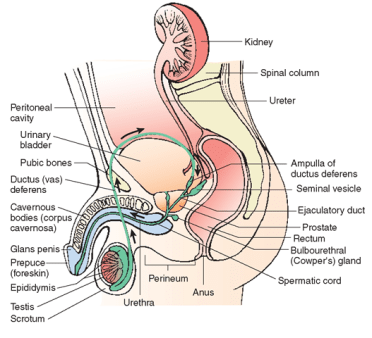
Human males have another interesting detour. As explained by Dawkins, the vans deferens, the tube that carries sperm from testes to penis, is also longer than necessary — and indeed caught on something. The vans deferens leaves the testes, travels up above the bladder and loops around the ureter like a hangar on a department store rack. It then finally finds its target, the seminal vesicle, which mixes secretions with the sperm. Then the prostate adds more secretions, finalizing the product (semen), which ejaculates via the urethra. The vans deferens could go straight to the seminal vesicle (under instead of around the bladder and ureter), but it doesn’t.
This same trait is found in other male mammals, like pigs. Creatures like fish again do not have this mess. Our ancestors had testes within the body, like many modern species, and as they descended toward the scrotum, toward the skin for cooler temperatures, the wiring got caught on the ureter. Perhaps one could see an intelligent (?) designer having to jam some things together to make them work — a detour for the van deferens here, another for the recurrent laryngeal nerve there — in one species. But in mammals across the board? How does that make more sense than all this being the imperfect byproduct of mindless evolution over time?

via Laryngopedia
via Anatomy-Medicine
And it doesn’t end there. Vertebrates (species that have a backbone) like us happen to have eyes with retinas installed backward. Rogers writes:
The light-sensitive portion of the retina faces away from the light… The nerves, arteries, and blood vessels that serve each photocell are attached at the front rather than the back. They run across the surface of the retina, obscuring the view. To provide a route for this wiring, nature has poked a hole in the retina, which causes a substantial blind spot in each eye. You don’t notice these because your brain patches the image up, but that fix is only cosmetic. You still can’t see any object in the blind spot, even if it is an incoming rock.
But cephalopods (squid, octopi, and other advanced invertebrates) have a more sensible set-up, with wiring in the back (Rogers). Guess what kind of creature appeared on this planet first? Yes, the invertebrates. These coincidences and bad engineering suggest that as life evolved to be more complex there were greater opportunities for messy tangles of innards.
The best creationists can do is declare there are good reasons for these developments, that evolutionists “fail to demonstrate how this detour…disadvantages the male reproductive system” for example, which is completely beside the point. There were indeed biological reasons behind the development of these systems, which served as an advantage, not a hindrance (breaking the vans deferens or recurrent laryngeal nerve to let other organs grow and evolve would not be good for survival). The point is that if some species share this trait, it hints at a common ancestor.
So does embryology, the study of development in the womb. The field of genetics, which we explore further in the next section, helped us discover dead genes or pseudo genes in lifeforms. These are genes that are usually inactive but carry traits that, if developed, would be viewed as abnormal. In light of evolution it makes sense that we still have them. And sometimes dead genes wake up.
Humans have just under 30,000 genes, with over 2,000 of them pseudo genes. We have dead genes for growing tails, for instance. We all have a coccyx, four fused vertebrae that make up the end of our spine — four vertebrae that are larger and unfused in primates, thus being the base of their tails (Coyne). Not only are some humans born with an extensor coccygis, the muscle that moves the tail in primates but is worthless in us due to our vertebrae being fused, some people are born with a tail anywhere from one inch long to one foot! It has to be surgically removed.

Arshid Ali Kahn, born in India in 2001, was worshiped as a reincarnation of the Hindu monkey god Hunaman. He had his tail removed in 2015. via Mirror
In fact, all human embryos begin with a fishlike tail, which is reabsorbed into the body around week seven. We develop a worthless yolk sac that is discarded by month two, a vestige of reptilian ancestors that laid eggs containing a fetus nourished with yolk. We develop three kidneys, the first resembling that of fish, the second resembling that of reptiles; these are also discarded, leaving us with our third, mammalian version. From month six to eight, we are totally covered in a coat of hair (lanugo) — primates develop their hair at the same stage, only they keep it. These marvels exist in other life, too. Horse embryos begin with three-toed hooves, then drop to one; they descended from creatures with more than just one toe. Occasionally, a horse is born with more than one hoof, or toe, on each foot (polydactyl horse), similar to its ancestors. Birds carry the genes necessary to grow teeth, minus a single vital protein; they descended from reptiles with teeth. Dolphin and whale embryos have hindlimb buds that vanish later; baleen whale embryos begin to develop teeth, then discard them (Coyne).

Premature infants still have some of their lanugo coat. They will soon lose it. via Mipediatra
It should also be noted that people with hypertrichosis are covered in fur like other primates — perhaps the reactivation of a “suppressed ancestral gene. In the course of evolution genes causing hair growth have been silenced and the appearance of hair in healthy humans can be explained by an erroneous reactivation of such genes.” We all have the genes for a full coat.

Supatra “Nat” Sasuphan, who has hypertrichosis, is the Guinness Book of World Records holder for hairiest person. via Fox News
Quite interesting that God would give us genes to grow tails and fur.
Our fetal development, you likely noticed, actually mimics the evolutionary sequence of humanity. This is most noticeably true with our circulatory system, which first resembles that of fish, then that of amphibians, then that of reptiles, then finally develops into our familiar mammalian circulatory system (Coyne). Strange coincidences indeed.
But there are more. As one would expect if evolution occurred, fossils of creatures found in shallower rock more closely resemble species living today; fossils found in deeper, older sedimentary layers are more different than modern life. This pattern has never been broken by any fossil discovery, and supports Darwin’s idea (Coyne).
Similarly, consider islands. The species found on islands consistently resemble those on the nearest continent. This at first does not sound surprising, as one would predict that life (usually birds, insects, and plant seeds) that colonized islands would do so from the closest landmass. But the key word is “resemble.” What we typically see are a few species native to a continent (the ancestors) and an explosion of similar species on the nearby islands (the descendants). Hawaii has dozens of types of honeycreepers (finches) and half the world’s 2,000 types of Drosophila fruit flies; Juan Fernandez and St. Helena are rich in different species of sunflower; the Galapagos islands have 14 types of finches; 75 types of lemurs, living or extinct, have been documented on Madagascar, and they are found nowhere else; New Zealand has a remarkable array of flightless birds; and Australia has all the world’s marsupials, because the first one evolved there. To the evolutionist, a tight concentration of similar species on islands (and individual islands having their own special species) is the result of an ancestral explorer from a nearby landmass whose descendants thrived in a new environment unprepared for them (a habitat imbalance), reproducing and evolving like crazy. Thus a finch on a continent has a great number of finch cousins on nearby islands — like her but not the same species (Coyne). Darwin himself, still a creationist at the time, was shocked by the fact that each island in the Galapagos, most in sight of each other, had a slightly different type of mockingbird (Rogers).
To the creationist, God simply has an odd affinity for overkill on islands.
Shared DNA
In the 20th century, geneticists like Theodosius Dobzhansky synthesized Darwin’s theory with modern genetics, showing how the random, natural mutation of genes during the copying of DNA changes the physiology of lifeforms (should that altered state help a creature survive, it will be passed on to offspring). The study of DNA proved once and for all that Darwin was right. By mapping the genetic code of Earth’s lifeforms, scientists determined — and continue to show — that all life on Earth shares DNA.
DNA is passed on through reproduction. You get yours from your parents. You share more DNA with your parents and siblings than you do with your more distant relatives. In the same way, humans share more DNA with some living things than with others. We share 98% with chimps, 85% with zebra fish, 36% with fruit flies, and 15% with mustard grass. By share, we mean that 98% of DNA base pairs (adenine, guanine, cytosine, and thymine) are in the precise same spot in human DNA compared to chimp DNA. (These four nucleobases can be traded between species. There is no difference between them — we’re all made of the same biochemical stuff.)
It is not surprising that creatures similar to us (warm-blooded, covered in hair, birth live young, etc.) are closer relatives than less similar ones. It’s no coincidence that apes look most like us and share the most DNA with us (and are able to communicate most directly with us, with one of our own languages, learning and holding entire conversations in American Sign Language). Evolutionary biologists used to use appearance and behaviors (such as gills or reproductive method) to suppose creatures were related, like the trout and the shark or the gorilla and the human being. But DNA now confirms the observations, as trout DNA is more similar to shark DNA than, say, buffalo DNA, and gorilla DNA is more similar to human DNA than, say, fruit fly DNA.
But all life shares DNA, no matter how different (for a deeper analysis, see Rogers pp. 25-31, 86-92). That simple truth proves a common forefather. A god would not have to make creations with chimp and human DNA nearly the same, all the nucleobases laid out in nearly the same order; why do so, unless to suggest that evolution is true? When mapped out by genetic similarity, we see exactly what Darwin envisioned: a family tree with many different branches, all leading back to a common ancestor.
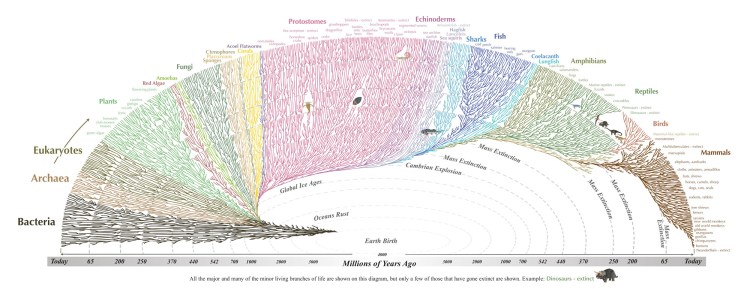
Our tree of life. Click link in text above to zoom. via Evogeneao
Transitional Forms
Darwin predicted we would find fossils of creatures with transitional characteristics between species, for example showing how lifeforms moved from water to land and back again. Unfortunately, the discovery of such fossils has done nothing to end the debate over evolution.
For instance, as transitional fossils began to accumulate, it became even more necessary to attack scientific findings on Earth’s age. If you can keep the Earth young, evolution has no time to work and can’t be true. So, as mentioned, creationists insist radiometric dating is flawed. Rocks cannot be millions of years old, thus the fossils encased within them cannot either. This amounts to nothing more than a denial of basic chemistry. Rocks contain elements, whose atoms contain isotopes that decay into something else over time at constant rates. So we can look at an isotope and plainly see how close it is to transformation. We know the rate, and thus can count backward. If researchers only had a single isotope they used, perhaps creationist would have a prayer at calling this science into question. But rubidium becomes stronium. Uranium changes to lead, potassium to argon, samarium to neodymium, rhenium to osmium, and more (see Rogers pp. 73-80 to explore further). This is something anyone devote study to, grab some rocks, and measure themselves. All creationists can do is say we aren’t positive that “the decay rate has remained constant”! Can you imagine someone saying that during Isaac Newton’s time gravity’s acceleration wasn’t 9.8 meters per second squared? Anyone can make stuff up!
(You’ll find most denials of evolution rest on denials or misunderstandings of the most basic scientific principles. Some creationists insist evolution is false because it betrays the Second Law of Thermodynamics, which states that the energy available for work in a closed system will decrease over time — that things fall apart. So how could simple mechanisms become more complex? How could life? What they forget is that the Earth’s environment is not a closed system. The sun provides a continuous stream of new energy. Similarly, some believe in “irreducible complexity,” the idea that complex systems with interconnected parts couldn’t evolve because one part would have no function until another evolved, therefore the first part would never arise, and thus neither could the complex system. But the “argument from complexity” fails per usual. [Other arguments, such as the “watchmaker” and “747” analogies, are even worse. Analogy is one of the weakest forms of argument because it inappropriately pretends things must be the same. No, a watch cannot assemble itself. That does not mean life does not evolve. Analogies fighting evidence are always doomed.] Biologists have discovered that parts can first be used for other tasks, as was determined for the bacterial flagellum, the unwise centerpiece of creationist Michael Behe’s skepticism. Independent parts can evolve to work together on new projects later on. Rogers writes:
Many hormones fit together in pairs like a lock and key. What good is the lock without the key? How can one evolve before the other? Jamie Bridgham and his colleagues studied one such pair and found that the key evolved first — if formerly interacted with a different molecule. They even worked out the precise mutations that gave rise to the current lock-and-key interaction.
A part of this process is sometimes scaffolding, where parts that helped form a complex system disappear, leaving the appearance that the system is too magical to have arisen. The scaffolding required to build our bridges and other structures is the obvious parallel.)
Let’s consider the fossils humanity has found. Tiktaalik was a fish with transitional structures between fins and legs. “When technicians dissected its pectoral fins, they found the beginnings of a tetrapod hand, complete with a primitive version of a wrist and five fingerlike bones… [It] falls anatomically between the lobe-finned fish Panderichthys [a fish with amphibian-like traits], found in Latvia in the 1920s, and primitive tetrapods like Acanthostega [an amphibian with fish-like traits], whose full fossil was recovered in Greenland not quite two decades ago.” Tiktaalik had both lungs protected by a rib cage and gills, allowing it to breath in air and water, like the West African lungfish and other species today. Its fossil location was actually predicted, as researchers knew the age and freshwater environment such a missing link would have to appear in (Coyne).
Ambulocetus had whale-esque flippers with toes (Rodhocetus is similar). Pezosiren was just like a modern manatee but had developed rear legs. Odontochelys semitestacea was an aquatic turtle with teeth. Darwinius masillae had a mix of lemur traits and monkey traits. Sphecomyrma freyi had features of both wasps and ants. Archeopteryx was more bird-like than other feathered dinosaurs (that’s feathered reptiles), yet not quite like modern birds. Its asymmetrical feathers suggest it could fly. The Microraptor gui, a dinosaur with feathered arms and legs, could likely glide. Other featured dinosaurs were found fossilized sleeping with their head tucked under their forearm or sleeping on a nest of eggs, just like modern birds (Coyne; see also Dawkins pp. 145-180).
Australopithecus afarensis, Australopithecus africanus, Paranthropus, Homo habilis, Homo erectus, and many more species had increasingly modern human characteristics. Less and less like a primate, closer and closer to modern Homo sapiens. Fossils indicate increasing bipedality (walking upright on two legs), smaller jaws and teeth, increasingly arching feet, larger brains, etc. (Also important to note are the increasingly complex tools and shelters found with such fossils. Homo erectus left behind huts, spears, axes, and bowls. Our planet had not-fully-human creatures crafting quite human-like things. Think on that. See The History of the World, J.M. Roberts.)

A: chimp skull. B-N: transitional species from pre-human to modern human. via Anthropology
It doesn’t stop there, of course. Evolution can been seen in both the obvious and minuscule differences between species.
See for example “From Jaw to Ear” (2007) and “Evolution of the Mammalian Inner Ear and Jaw” (2013). It was theorized that three important bones of a mammal’s ear — the hammer, anvil, and stirrup — were originally part of the jaw of reptilian ancestors (before mammals existed). In modern mammals there is no connecting bone between the jaw and the three inner-ear bones, but if there was an evolution from reptilian jaw bone to mammalian inner-ear bone, fossils should show transitional forms. And they do: paleontologists have found fossils of early mammals where the same bones are used for hearing and chewing, as well as fossils where the jaw bones and inner-ear bones are still connected by another bone.
Creationists have a difficult time imagining how species could evolve from those without wings to those with, from those that live on land to water-dwellers, from aquatic lifeforms back to land lovers, and so on, because they believe intermediary, transitional traits would be no good at all, could not help a creature survive. “What good is half a wing?”
Yet today species exist that show how transitional traits serve creatures well. Various mammals, marsupials, reptiles, amphibians, fish, and insects glide. It is easy to envision how reptiles could have evolved gliding traits followed by powered flight over millions of years. Or consider creatures like hippos, which are closely related to and look like terrestrial mammals but spend almost all their days underwater, only coming ashore occasionally to graze. They mate and give birth underwater, and are even sensitive to sunburn. Give it eons, and couldn’t such species change bit by bit to eventually give up the land completely? The closest living genetic relative to whales are in fact hippos (Coyne). And finally, what of the reverse? What of ocean creatures that head to land?Crocodiles can gallop like mammals (up-down spine flexibility) as well as walk like lizards (right-left spine flexibility; see Dawkins). The mangrove rivulus, the walking catfish, American eels, West African lungfish, four-eyed fish, snakeheads, grunions, killifish, the anabas, and other species leave the waters and come onto land for a while, breathing oxygen in the air through their skin or even lungs, flopping or slithering or squirming or walking to a new location to find mates, food, or safety. Why is it so difficult to imagine a species spending a bit more time on land with each generation until it never returns to the water?
“Half a wing” is not a thing. There are only traits that serve a survival purpose in the moment, like membranes between limbs for gliding. Traits may develop further, they may remain the same, they may eventually be lost, all depending on changes in the environment over time. Environment (food sources, mating options, predators, habitability) drive evolutionary changes differently for all species. That’s natural selection. When some members of a species break away from the rest (due to anything from mudslides to migration to mountain range formation), they find themselves in new environments and evolve differently than their friends they left behind. Coyne writes, “Each side of the Isthmus of Panama, for example, harbors seven species of snapping shrimp in shallow waters. The closest relative of each species is another species on the other side.” Species can change a little or change radically, unrecognizably, but either way they can be called a new species — in fact, unable to reproduce with their long-lost relatives, because their genes have changed too greatly. That’s speciation.
There is no question that the fossil record starts with the simplest organisms and, as it moves forward in time, ends with the most complex and intelligent — all beginning in the waters but not staying there. Single-cell organisms before multicellular life. Bacteria before fungi, protostomes before fish, amphibians before reptiles, birds before human beings.
If they wish, creationists can believe the fossil record reflects the chosen sequence of a logical God, even if it does not support the Judeo-Christian creation story (in which birds appear on the same “day,” Day 5, as creatures that live in water, before land animals, which appear on Day 6; the fossil record shows amphibians, reptiles, and mammals appearing long before birds — and modern whales, being descendants of land mammals, don’t appear until later still, until after birds, just 33 million years ago). Yet they must face the evidence and contemplate what it indicates: that a deity created fish, then later fish with progressively amphibious features, then later amphibians; that he created reptiles, then later reptiles with progressively bird-like features, then birds; and so forth. No discovery has ever contradicted the pattern of change slowly documented since Darwin. God is quite the joker, laying things out, from fossils to DNA, in a neat little way to trick humans into thinking we evolved from simpler forms (note: some creationists actually believe this).
Yes, the believer can simply claim these were all their own species individually crafted by God, with no ancestors or descendants who looked or acted any different. The strange fact that we have birds that cannot fly and mammals in the oceans that need to come up to the surface for air doesn’t engage the kind of critical thinking one might hope for. It’s all just a creative deity messing with animals!
Watching Evolution Occur

Renee, an albino kangaroo at Namadgi National Park, Australia. via Telegraph
Most creationists are in fact quite close to accepting evolution as true.
First, they accept that genes mutate and can change an individual creature’s appearance. They know, for instance, about color mutations. We’re talking albinism, melanism, piebaldism, chimeras, erythristics, and so on.
Second, most creationists accept what they call “microevolution”: mutations help individuals survive and successfully reproduce, passing on the mutation, changing an entire species generation by generation in small ways, but of course not creating new species. They accept that scientists have observed countless microevolutionary changes: species like tawny owls growing browner as their environments see less snowfall, Trinidad guppies growing larger, maturing slower, and reproducing later when predators are removed from their environments, green anole lizards in Florida developing larger toepads with more scales to escape invaders, and more, all within years or decades. They understand evolution is how some insects adapt to pesticides and some viruses, like HIV and TB, adapt to our vaccines over time, and how we human beings can create new viruses in the lab. They acknowledge that humanity is responsible, through artificial selection, or selective breeding, for creating so many breeds of dogs with varying appearances, sizes, abilities, and personalities (notice the greyhound, bred for speed by humans, closely resembles the cheetah, bred for speed by natural selection). In the same way, we’ve radically changed crops like corn and farm animals like turkeys (who are now too large to have sex), and derived cabbage, broccoli, kale, cauliflower, and brussels sprouts from a single ancestral plant, to better sate our appetites, simply by selecting individuals with traits we favor and letting them reproduce.

Wild banana (below) vs. artificially selected banana. via NBC News
The evidence presented thus far should push open-minded thinkers toward the truth, but for those still struggling to make the jump from microevolution to evolution itself, we are not done yet. The resistance is understandable given that small changes can easily be observed in the lab or nature, but large changes require large amounts of time — thousands, millions of years — and thus we mostly (but not entirely) have to rely on the evidence from DNA, fossils, embryology, and so on. Here are some points of perspective that can bridge the gap between small changes and big ones.
1. Little changes add up. If you accept microevolution, you accept that species can evolve to be smaller or bigger, depending on what helps them survive and reproduce. Scott Carroll studied soapberry bugs in the U.S. and observed some colonizing bigger soapberry bushes than normal; he predicted they would also grow larger, as larger individuals would be more successful at reaching fruit seeds. Over the course of a few decades, the bugs’ “beak” length grew 25%. That’s significant. Now imagine what could theoretically be done with more time. As Coyne writes, “If this rate of beak evolution was sustained over only ten thousand generations (five thousand years), the beaks would increase in size by a factor of roughly five billion…able to skewer a fruit the size of the moon.” This is unlikely to happen, but shows how little changes later yield dramatic results. Imagine traits other than size — all possible traits you can think of — changing at the same time and evolution doesn’t sound so impossible.
2. Genes are genes. This relates closely to the point above. If some genes can mutate, why can’t others? Genes determine everything about every creature. People who believe in microevolution accept that genes for size or color can change, but not genes for where your eyes are, whether you’re warm- or cold-blooded, whether you have naked skin or a thick coat of fur, whether you have a hoof or a hand, and so on. But there is no scientific basis whatsoever for this dichotomy of the possible. It’s simply someone claiming “These genes can mutate but not these, end of story” to protect the idea of intelligent design. Genes are genes. They are all simply sequences of nucleotides. As far as we know, no gene is safe from mutation.

Octogoat, a goat with eight legs, born in Kutjeva, Croatia. via ABC News
3. Mutations can be huge. We’ve seen how humans can have tails, but we also see “lobster claw hands,” rapid aging, extra limbs, conjoined twins, and other oddities. Consider other mutations: snakes with two heads, octopi with only six tentacles, ducks with four legs, cats with too many toes. For the common fruit fly, the antennapedia mutation will mean you get legs where your antenna are supposed to be! Dramatic mutations are possible. Survival is possible. Passing on new, weird traits is possible. With evolution, sometimes groups with new traits totally displace and eliminate the ancestral groups; sometimes they live side-by-side going forward. If you came across a forest and discovered one area was occupied by two-headed snakes and another by single-headed snakes, all other traits being the same, wouldn’t you be tempted to call them different species? Declare something new had arisen on Earth?
4. We are currently watching evolution occur. Scientists have observed speciation. They’ve taken insects, worms, and plants, put small groups of them in abnormal environments for many generations, and then seen they can no longer reproduce with cousins in the normal environments because they have evolved. It’s easy to create new species of fruit flies in particular because their generations are so short. Evolution for other species is typically much slower, but significant changes are being observed.
Say you were instead on the African Savanna and came upon two groups of elephants. They are the same but for one startling difference: one group has no tusks. Like two-headed snakes, what a bold difference in appearance! Should we classify them as different species or the same? (Technically, they aren’t different species if they can still reproduce offspring together, but in the moment you aren’t sure.) Well, African elephants are increasingly being born without tusks. After all, those without are less likely to be killed by poachers for ivory. This is natural selection at work. Could not a changing environment and millions of years change more? Size, color, skin texture, hair, skeletal layout, teeth, and all other possible traits determined by all other genes?
Next, take a remarkable experiment involving foxes launched by Dmitry Belyaev and Lyudmila Trut in the Soviet Union in the late 1950s, which Trut is still running to this day. No, we can’t watch a species for 500,000 years to see dramatic evolution in action. But 60 years gives us something.
At the time, biologists were puzzled as to how dogs evolved to have different coats than wolves, since they couldn’t figure out how the dogs could have inherited those genes from their ancestors. Belyaev saw silver foxes as a perfect opportunity to find out how this happened. Belyaev believed that the key factor that was selected for was not morphological (physical attributes), but was behavioral. More specifically, he believed that tameness was the critical factor.
In other words, Belyaev wanted to see if foxes would undergo changes in appearance if they evolved different behaviors. So Belyaev and Trut set about taming wild silver foxes.

Wild silver fox. via Science News
They took their first generation of foxes (which were only given a short time near people) and simply allowed the least aggressive to breed. They repeated this with every generation. They had a control group that was not subjected to selective breeding.
The artificial selection of course succeeded for fox behavior. They became much more open to humans, whining for attention, licking them, wagging their tails when happy. But there was more:
A much higher proportion of experimental foxes had floppy ears, short or curly tails, extended reproductive seasons, changes in fur coloration, and changes in the shape of their skulls, jaws, and teeth. They also lost their “musky fox smell.”
Spotted coats began to appear. Trut wrote that skeletal changes included shortened legs and snouts as well. Belyaev said they started to sound more like dogs (Dawkins). Geneticists are now seeking to isolate the genes related to appearance that changed when selectively breeding for temperament.
Belyaev was right. And his foxes, through evolution, came to look more and more like dogs. This is the same kind of path that some wolves took when they evolved into dogs (less aggressive wolves would be able to get closer to humans, who probably started feeding them, aiding survival; tameness increased and physical changes went with it).
If such changes can occur in just 60 years, imagine what evolution could do with a hundred million years.

Dr. Lyudmila Trut with domesticated silver fox. via WXXI
In the Beginning
It’s true, scientists are still unsure how life first arose on Earth. And because it is an enduring mystery without hard evidence, scientists with hypotheses and speculations openly acknowledge this. Note that’s a big difference compared to evolution, which scientists speak confidently about due to the wealth of evidence.
But one professor at MIT believes that far from being unlikely, nonliving chemicals becoming living chemicals was inevitable.
From the standpoint of physics, there is one essential difference between living things and inanimate clumps of carbon atoms: The former tend to be much better at capturing energy from their environment and dissipating that energy as heat… When a group of atoms is driven by an external source of energy (like the sun or chemical fuel) and surrounded by a heat bath (like the ocean or atmosphere), it will often gradually restructure itself in order to dissipate increasingly more energy. This could mean that under certain conditions, matter inexorably acquires the key physical attribute associated with life.
Researchers have discovered lipids, proteins, and amino acids beneath the seafloor, suggesting the chemical interaction between the mantle and seawater could produce the building blocks of life. From there, time and proper conditions could give rise to the first self-replicating molecule. Evolution would then continue on, spending billions of years developing the diverse flora and fauna we see today (a single cell leading to complex life under the right conditions should not be so shocking; as J.B.S. Haldane said, “You did it yourself. And it only took you nine months”).
Determining precisely how the first cell arose is the next frontier of evolutionary biology, and it is exciting to be here to witness the journey of discovery. New findings and experiments will wipe away “watchmaker” arguments used against the first cell. They will once again crush the “God gap,” the bad habit of the faithful to fill gaps in our scientific knowledge with divine explanations. I imagine in our lifetime someone will successfully complete Stanley Miller’s famous 1950s experiment, in which he tried to recreate the Earth’s early conditions and create life itself.
Yet lack of knowledge concerning the beginning of life in no way hurts the case for evolution. Evolution is proven, as definitively as whether the earth orbits the sun.
For more from the author, subscribe and follow or read his books.
