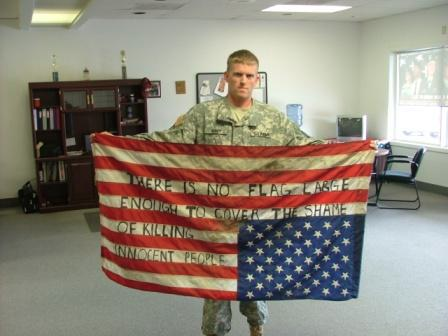
The Other American Soldier: Anti-War and Anti-Empire

Many Americans tend to view the military as a homogeneous group, an army of automatons with the same beliefs and values — namely, that when it comes to war the American government is always in the right. Therefore, civilian opposition to U.S. invasions, bombings, huge military budgets, global military presence, or glorification of the army, the flag, and the State are all called “disrespectful,” “not supporting our troops,” “un-American,” “anti-American,” “spitting in the face of” or “giving the middle finger to” our soldiers.

Yet what of the soldiers who oppose war? What of the veterans who wish to see the military budget slashed and the 800 American bases in 80 nations shuttered? As easy as this may be for patriotic civilians (and perhaps soldiers) to ignore, some of the loudest voices demanding we “ring the bells of peace” and put “an end to war” are veterans or active servicemen.

The military (despite the immense pressure to conform and follow orders) does not seem to be full of single-minded, patriotic drones, but rather a group of independent, diverse thinkers.


Thousands of veterans join passionate anti-war groups

One example is Veterans for Peace, founded in the 1980s during the horrific U.S. military interventions into Central America under Reagan that killed tens of thousands of innocent people. Their mission is to raise awareness of the true costs of war, aid our victims, “restrain our government from intervening, overtly and covertly, in the internal affairs of other nations,” “abolish war as an instrument of national policy,” and move toward peace. After all, who better than veterans might understand the true horrors of America’s wars (see A History of Violence: Facing U.S. Wars of Aggression)?

Their ideas and language are as fierce as any supposedly “unpatriotic” civilian. Veterans for Peace wrote on Facebook on November 11, 2014 that Veteran’s Day had “devolved into a hyper-nationalistic worship ceremony for war and the valiant warriors who wage it.” On December 10, 2014 it wrote:

Sometimes it may seem that our leaders and fellow citizens simply cannot understand that militaristic values and ongoing war creates only more problems, both internationally and here within our own country. The battle is definitely uphill. However, history tells us that lessons about the futility of war has been understood in the past, no doubt by those fighting on the front-lines.

Similar groups include Iraq Veterans Against the War and Vietnam Veterans Against the War — yes, it’s still active. To quote A History of Violence: The American Slaughter in Vietnam, during that conflict, many

veterans joined Vietnam Veterans Against the War, which “exposed the ugly truth about US involvement in Southeast Asia and our first-hand experiences helped many other Americans to see the unjust nature of that war.” The VVAW still exists today, as “our government is still financing and arming undemocratic and repressive regimes around the world. Recently, American troops have been sent into combat in the Middle East and Central America, for many of the same misguided reasons that were used to send us to Southeast Asia.” Several other groups, like the Concerned Officers Movement, also formed and protested the war.


Many soldiers question what they are doing

Soldiers’ anti-war writings are as easy to find as anti-war groups. Smedley Butler, a Marine Corps major general and two-time recipient of the Medal of Honor, wrote a book in the 1930s called War is a Racket. He said, “War is a racket. It always has been. It is possibly the oldest, easily the most profitable, surely the most vicious.” And:

I spent 33 years and four months in active military service and during that period I spent most of my time as a high class muscle man for Big Business, for Wall Street and the bankers. In short, I was a racketeer, a gangster for capitalism. I helped make Mexico and especially Tampico safe for American oil interests in 1914. I helped make Haiti and Cuba a decent place for the National City Bank boys to collect revenues in. I helped in the raping of half a dozen Central American republics for the benefit of Wall Street. I helped purify Nicaragua for the International Banking House of Brown Brothers in 1902-1912. I brought light to the Dominican Republic for the American sugar interests in 1916. I helped make Honduras right for the American fruit companies in 1903. In China in 1927 I helped see to it that Standard Oil went on its way unmolested.

Looking back on it, I might have given Al Capone a few hints. The best he could do was to operate his racket in three districts. I operated on three continents.

Thomas Young, a man who enlisted after 9/11, was paralyzed by a sniper in Iraq and spent the rest of his life denouncing the war (he died in 2014, at 34).

He wrote to Bush and Cheney in 2013:

I write this letter on behalf of husbands and wives who have lost spouses, on behalf of children who have lost a parent, on behalf of the fathers and mothers who have lost sons and daughters and on behalf of those who care for the many thousands of my fellow veterans who have brain injuries. I write this letter on behalf of those veterans whose trauma and self-revulsion for what they have witnessed, endured and done in Iraq have led to suicide and on behalf of the active-duty soldiers and Marines who commit, on average, a suicide a day. I write this letter on behalf of the some 1 million Iraqi dead and on behalf of the countless Iraqi wounded. I write this letter on behalf of us all — the human detritus your war has left behind, those who will spend their lives in unending pain and grief.

I write this letter, my last letter, to you, Mr. Bush and Mr. Cheney. I write not because I think you grasp the terrible human and moral consequences of your lies, manipulation and thirst for wealth and power. I write this letter because, before my own death, I want to make it clear that I, and hundreds of thousands of my fellow veterans, along with millions of my fellow citizens, along with hundreds of millions more in Iraq and the Middle East, know fully who you are and what you have done. You may evade justice but in our eyes you are each guilty of egregious war crimes, of plunder and, finally, of murder, including the murder of thousands of young Americans — my fellow veterans — whose future you stole.

After Al-Qaeda bombed American embassies in 1998, Vietnam veteran Robert Bowman wrote:

We are not hated because we practice democracy, value freedom, or uphold human rights. We are hated because our government denies these things to people in Third World countries whose resources are coveted by our multinational corporations. That hatred we have sown has come back to haunt us in the form of terrorism…. Instead of sending our sons and daughters around the world to kill Arabs so we can have the oil under their sand, we should send them to rebuild their infrastructure, supply clean water, and feed starving children…. In short, we should do good instead of evil. Who would try to stop us? Who would hate us? Who would want to bomb us? (Zinn, People’s History of the United States)

A young American soldier wrote home during Vietnam:

Dear Mom and Dad:

Today we went on a mission and I am not very proud of myself, my friends, or my country. We burned every hut in sight! It was a small rural network of villages and the people were incredibly poor. My unit burned and plundered their meager possessions… We fired into all the huts we could… Everyone is crying, begging, and praying that we don’t separate them and take their husbands and fathers, sons and grandfathers. The women wail and moan.

Then they watch in terror as we burn their homes, personal possessions and food. Yes, we burn all the rice and shoot all the livestock.


Some soldiers refuse to follow orders, and commit “treason”

While some call them “cowards,” it is obvious that it takes tremendous courage to disobey or desert the military — risking being hunted down like an animal and imprisoned, in earlier years executed.

Screen Shot 2017-11-17 at 10.16.07 AM

via The Grind

Whether opposing war or simply fearing for one’s life, desertion is a way servicemen can make a political statement or take back control of their fate. 40,000 deserted the U.S. military during World War II, 13,000 during the Korean War, nearly half a million from 1966-1972 during Vietnam, and 8,000 in 2006-2007 alone during the invasion of Iraq.

Other soldiers defy the State by attempting to bring to light atrocities the military seeks to cover up, such as Hugh Thompson and Ron Ridenhour after fellow U.S. soldiers massacred innocent people in My Lai, Vietnam. Or Chelsea (Bradley) Manning, a private who in 2010 exposed U.S. war crimes in Iraq, and is now imprisoned for it. Perhaps people like them understand what Howard Zinn, a World War II veteran, once wrote (and a young soldier took to heart): “There is no flag large enough to cover the shame of killing innocent people” (“Terror Over Tripoli,” Zinn).

For more from the author, subscribe and follow or read his books.
God Ordered Abortions

The Judeo-Christian God instructs his followers to do many disturbing and barbaric things, and indeed does many himself, in the bible — mostly in the Old Testament, but to an extent in the New Testament (see Absolutely Horrific Things You Didn’t Know Were in the Bible).

One interesting decree was in Numbers 5, where God is explaining to Moses how to maintain “The Purity of the Camp,” to quote the chapter title. According to the story, this is when Moses is leading the Hebrews through the wilderness toward the Promised Land, and receives laws of conduct from God at Mount Sinai.

God outlines a way for men to determine if their wives have been unfaithful, and it involves forced abortion for the women who became pregnant due to infidelity.

Women are made to drink a “bitter” “holy water” containing “dust from the Tabernacle floor.” If the woman is innocent of adultery, the water will not harm her. If she is guilty, it will cause her to miscarry, should she be pregnant.

Numbers 5:11-22 (NIV):

Then the Lord said to Moses, “Speak to the Israelites and say to them: ‘If a man’s wife goes astray and is unfaithful to him so that another man has sexual relations with her, and this is hidden from her husband and her impurity is undetected (since there is no witness against her and she has not been caught in the act), and if feelings of jealousy come over her husband and he suspects his wife and she is impure—or if he is jealous and suspects her even though she is not impure—then he is to take his wife to the priest…

“‘The priest shall bring her and have her stand before the Lord. Then he shall take some holy water in a clay jar and put some dust from the tabernacle floor into the water. After the priest has had the woman stand before the Lord, he shall loosen her hair and place in her hands the reminder-offering, the grain offering for jealousy, while he himself holds the bitter water that brings a curse.

“‘Then the priest shall put the woman under oath and say to her, “If no other man has had sexual relations with you and you have not gone astray and become impure while married to your husband, may this bitter water that brings a curse not harm you. But if you have gone astray while married to your husband and you have made yourself impure by having sexual relations with a man other than your husband”—here the priest is to put the woman under this curse—“may the Lord cause you to become a curse among your people when he makes your womb miscarry and your abdomen swell. May this water that brings a curse enter your body so that your abdomen swells or your womb miscarries.”'”

For the people in Moses’ camp, God’s will was for adulterous women to be made to have an abortion, and God himself was the abortion doctor, as the magic potion is presumably magic due only to the power of God. Note that “he makes your womb miscarry” (pronouns for God are not capitalized in the NIV).

The woman, of course, must submit to this without question: “Then the woman is to say, ‘Amen. So be it'” (Numbers 5:22). Unfortunately for her, she may have to do this more than once, as this can occur whenever a man “suspects his wife,” even if there is “no witness,” the act being “undetected” — in other words, when there exists little or no evidence.

One might assume, when a miscarriage or a swollen abdomen tells the priests and husband she is guilty, the woman will be afterwards put to death, given the law of adultery outlined in the previous biblical book.

For nonbelievers, who imagine God is fictional (like so many other deities), this is just another example of primitive peoples behaving in a primitive way. For believers, forcing suspected adulterers to drink a potion that will allegedly kill a fetus is just another example of a perfectly good, all-loving God behaving in a perfectly good, all-loving way. That is, that this law, like so many other equally disturbing ones, was all a part of God’s Plan, which involved humans being cruel to each other long ago, but loving and merciful in modern times (see Either God Changes or He’s Psychotic: Comparing Testaments Old and New).

Of course, God’s Plan would also include 70% of conceptions never resulting in live birth. The natural failure rate of pregnancy is very high. If all things transpire according to his will, God is personally conducting abortions every day of the week.

For more from the author, subscribe and follow or read his books.
How Technology Under Capitalism Will Leave All of Us Jobless

The march toward the obsolescence of human labor is an inevitability of capitalism.

In a capitalist society, a business is structured like a dictatorship: an owner or small group of owners, board members, and investors hold all the power and make all the decisions, including how company profits are used — to increase production, to open new plants or stores, invest in new technology, increase advertising, hire more workers, increase worker pay, increase owner pay, and so on. They also decide, when times are rough, when to close the stores or factories, when to lay off workers, when to sell the business, etc.

As a business owner, investing in technology can make your workplace(s) more automated, allowing you to reduce your workforce. While technology costs money to create, install, and maintain, it can save huge sums compared to human labor, and is much more efficient. Ford, for example, needs only one-third of the workers it needed in the 1970s for the same production levels (Imagine, Goldwin and Smith). Fukoku Mutual Life Insurance recently replaced dozens of employees with A.I., expecting a 30% increase in productivity. This leads to greater profits.

(There is little evidence, by the way, that higher minimum wages exacerbate this process; studies overwhelmingly show that raising the minimum wage does not cause unemployment, as more money in people’s pockets leads to more spending at businesses, creating equilibrium.)

The owners benefit immensely, massively increasing their wealth, but the workers are sent packing, forced to find work elsewhere (this has contributed to severe inequality in the U.S., where the bottom 80% of Americans now own just 7% of the national wealth and the top 1% owns 40%; recent income growth has gone almost exclusively to the rich; CEO pay has skyrocketed, worker wages have stagnated).

New technology and broader divisions of labor (think of the assembly line) constantly make specialized labor obsolete. The pursuit of profit tends to make a worker “an appendage of the machine, and it is only the most simple, most monotonous, and most easily acquired knack that is required of him,” to quote The Communist Manifesto. When a task that originally required advanced training or higher education can be accomplished by low-skill labor, a capitalist has no need for someone with a college degree and needs not pay the higher salary. Then competition among workers for that job is broadened, driving the wage down further. If a task can be totally replaced by a machine, the job opportunity vanishes completely (“technological unemployment”).

Supporters of capitalism will protest, saying the advent of new technology often creates new high-skill, high-wage jobs, which is true. New technologies, from computers to jets, require trained personnel to build, maintain, upgrade, and operate them. However, the people who can take advantage of these new opportunities are not usually the ones who are displaced by the new technology. The losers (usually older folks) find their once-valuable skills irrelevant and their jobs eliminated. As Erik Olin Wright (Envisioning Real Utopias) points out, firms do not wish to spend the money to retrain older workers, and the new opportunities may be in far away cities, requiring obsolete workers to move even if they got new training. Perhaps they would have to stop working and go back to school, something most adults with families can’t do. And even the winners may not be safe for long, as the cycle continues: firms divide labor, automate tasks, and turn high-skill work into low-skill work. The winners’ jobs are eventually obsolete, and then they are fired and must find new work, sometimes a low-skilled, low-wage job.

Now, it is also true that new technology can create low-skill work. Uber lets more people be personal drivers, Postmates creates delivery jobs, the relative ease of launching, running, and monetizing a website and social media creates work for many. A cheerful analysis by economists in 2015 declared technology, because it builds a more advanced, prosperous society, created more jobs than it destroyed in the U.K. in the last 140 years; so while jobs for farmers, secretaries, washers, and launderers vanished, jobs for teachers, caretakers, social workers, and nurses increased. They also noted how increased personal wealth in a more advanced society leads to more spending on luxuries, hence a rise in the demand for bartending and hairdressing jobs. In other words, as a separate analysis put it, it is often the case that “growth of jobs at low risk of automation outpaces loss of jobs at high risk” (in the case of the U.K., from 2001 to 2015, 3.5 million low-risk jobs were added to the economy, 800,000 high-risk jobs lost).

Yet this does not mean there will always and for all time be enough jobs free of automation for every citizen that needs work (even today during economic boom times, there are not always enough jobs for everyone, low- or high-risk).

Most unskilled labor, if we think of 50, 100, 500, or 1,000 years from now, will surely be abolished by automation and robotics. Machines can already operate a warehouse, pick and inspect fruit, build cars, and lay bricks. Google and Uber are already working on driverless cars, Amazon on drone delivery systems. U.S. restaurants are installing tablets at tables or counters that take orders and payments, China perfecting a weaponized police robot (Anbot), Toshiba placing a temporary robot employee (ChihiraAico) in a Japanese department store, Nanyang Technical University unveiling a robotic secretary (Nadine), the PR2 robot at MIT can bake, and even sex robots are under construction, perhaps one day threatening prostitution! Amazon Go is a cashier-less grocery store.

High-skilled work is not free of risk either (who wouldn’t want a robotic lawyer with advanced knowledge of every legal case ever argued, able to easily out-think a human attorney?). Radiologists and journalists are threatened by technology able to do parts of their jobs faster, cheaper, with fewer errors.

A 2013 study by Oxford economists estimated 47% of jobs in the U.S. are currently at high risk of automation, perhaps fully automated “over the next decade or two” (including service, sales, office and administrative, production, and transportation jobs), 19% of jobs at medium risk of automation, and 33% at low risk (including other service jobs, plus education, media, legal, healthcare, business management, and engineering jobs).

Screen Shot 2017-11-17 at 10.13.26 AM

via Oxford Martin

Other analysts declared in 2015, “Our research suggests that as many as 45 percent of the activities individuals are paid to perform can be automated by adapting currently demonstrated technologies. In the United States, these activities represent about $2 trillion in annual wages.”

Wren Handman writes, “Boston Consulting Group predicts that by 2025, up to a quarter of jobs will be replaced by either smart software or robots. Gartner, a technology research firm, ramps that estimate up and predicts that one third of all jobs will be eliminated by 2025…” The number of factory robots in manufacturing centers like Detroit, Toledo, Grand Rapids, Louisville, and Nashville tripled between 2010 and 2015 alone. Capitalist owners will increasingly be able to do away with human labor, increasing profits—and the wealth gap between them and everyone else. The workers will have to compete for fewer and fewer non-automated jobs.

Albert Einstein wrote that under capitalism, “Technological progress frequently results in more unemployment rather than in an easing of the burden of work for all” (“Why Socialism?,” Einstein). Advances in technology and productivity (and thus profits) could allow for higher wages and shorter work weeks for workers at their workplaces — if workers owned their workplaces and called the shots. Yet over the past four decades—a time of skyrocketing productivity—wages barely budged, and while human beings are working fewer hours than centuries past, particularly in Europe, four in ten Americans are still working over 50 hours a week and full-time employees average 47 hours per week. Some of our neighbors work 60, 70 hours a week to make ends meet. Technological progress for each capitalist firm, instead of changing work for the better for each worker, exiles more people from the firm and from that type of work, creating a larger pool of laborers needing to compete for jobs elsewhere — usually low-skill and low-wage jobs.

What will happen to the vast majority of human beings when machines can outperform them at any job? When business owners can automate any task imaginable, increasing efficiency and profits?

There will surely always be demand for some human workers — perhaps citizens won’t want a robot teacher for their child or robot caretaker for their ailing parents. Perhaps business owners will always want to provide a human face to consumers, and will always preserve a partially human staff. Perhaps we’ll want human writers and human preachers. But can we all be teachers, childcare providers, business reps, and clergymen?

Surely for the vast majority of us, when all the freight trucks no longer need drivers, when machines can take an order, prepare your meal, and accept a credit card, when robotic clerks serve you at retail stores and police the streets — whether this happens in 100 years or 1,000 — we will need a new form of social organization to avoid extreme poverty, unemployment, homelessness, and hunger.

There are essentially two solutions.

One is a guaranteed basic income: the State simply provides each citizen with a monthly stipend, citizens spend the money where they will, taxes are collected on the businesses and organizations where people spent their money, and the cycle continues. Switzerland is already moving closer to adopting a guaranteed income. In this way, those who own the technology that made work a thing of the past make survival possible for the masses.

The other solution is worker ownership: businesses will have to be owned by all their workers, so that no worker will be fired as technology improves. In an authoritarian capitalist firm, robotic labor means fewer human workers. In a worker-owned firm, it means participants in the firm can switch to more fulfilling and enjoyable tasks, and work fewer hours each week for the same income, if not more. In this way, the technology would be owned by the masses, and the profits would be shared, making survival possible.

Worker ownership is already a reality in the U.S. and around the world, as explored in “What is Socialism?” This solution is a bit more complex than a guaranteed income (if there are more people looking for work than worker cooperatives need, it may be necessary for the State — or local governments — to launch New Deal-style public work projects, using tax dollars to pay people to improve their communities, even if machines could do it better). But it may be a better option than paying citizens who don’t work, as there may be work that could improve society but is unaddressed because worker cooperatives can’t profit from it (i.e., cleaning up streets and rivers, or tutoring struggling students).

Either solution, of course, is socialism.

Oscar Wilde contrasts in The Soul of Man Under Socialism how machinery operates under capitalism and how it should operate under socialism:

Up to the present, man has been, to a certain extent, the slave of machinery, and there is something tragic in the fact that as soon as man had invented a machine to do his work he began to starve. This, however, is, of course, the result of our property system and our system of competition. One man owns a machine which does the work of five hundred men. Five hundred men are, in consequence, thrown out of employment, and, having no work to do, become hungry and take to thieving. The one man secures the produce of the machine and keeps it, and has five hundred times as much as he should have, and probably, which is of much more importance, a great deal more than he really wants.

Were that machine the property of all, every one would benefit by it. It would be an immense advantage to the community. All unintellectual labour, all monotonous, dull labour, all labour that deals with dreadful things, and involves unpleasant conditions, must be done by machinery. Machinery must work for us in coal mines, and do all sanitary services, and be the stoker of steamers, and clean the streets, and run messages on wet days, and do anything that is tedious or distressing. At present machinery competes against man. Under proper conditions machinery will serve man.

Jack London said something similar:

Let us not destroy those wonderful machines that produce efficiently and cheaply. Let us control them. Let us profit by their efficiency and cheapness. Let us run them for ourselves. That, gentlemen, is socialism… (A People’s History of the United States, Zinn)

As technology approaches a point where human labor will be all but obsolete, these ideas become increasingly relevant. When physicist Stephen Hawking was asked in 2015 whether technology would lead to mass unemployment, he replied:

If machines produce everything we need, the outcome will depend on how things are distributed. Everyone can enjoy a life of luxurious leisure if the machine-produced wealth is shared, or most people can end up miserably poor if the machine-owners successfully lobby against wealth redistribution. So far, the trend seems to be toward the second option, with technology driving ever-increasing inequality.

With so many jobs under threat of extinction in the next few decades alone, we know what option humanity must choose.

Screen Shot 2017-11-17 at 10.14.15 AM

via Vice

For more from the author, subscribe and follow or read his books.
A History of Violence: The American Slaughter in Vietnam

From a young age, Americans — like citizens of other nations — are indoctrinated with nationalism, the belief that the United States is the “good guy” in world affairs, even if sometimes making mistakes in the pursuit of its noble aims. We are taught the U.S. uses its military might to protect the freedom of Americans and foreigners, expand democracy and peace, or in simple self-defense.

While sometimes this is true, the actual history of American foreign policy is far darker and more complex. The view of our moral superiority, however, serves an important function for the State. With the glorification of one’s country inherent in nationalism and patriotism comes the belief that the lives of foreigners are less valuable than your own countrymen. So because the U.S. is in the right, it really doesn’t matter how many innocent people perish in the pursuit of its goals.

The History of Violence series takes a less nationalistic and more honest look at the reasons the U.S. uses violence and the kinds of violence it deems acceptable. The series raises a key question: Would Americans deem it permissible for other powers to do to us what we did to them, for identical purposes and using identical violence? That is, if Vietnam bombed millions of Americans to prevent us from electing a Communist government, if Mexico conquered half the U.S. for more land and resources, if Guatemala helped overthrow our democracy in the interest of its corporations, and so on.

Despite the more rosy picture of U.S. benevolence, throughout its history the American government used military force to protect its economic interests and global power at the expense of weaker (often defenseless) nations. Presidents of both political parties authorized hundreds of military interventions into foreign nations, particularly in Latin America.

The boldest tactics included invasion and occupation, aerial bombings, terror attacks and assassinations, forcing open markets, and enacting trade blockades using naval and air power. Other methods included secretly arming and training rebel and terrorist groups, organizing and supporting coups, rigging ballots, and arming and funding brutal dictators. Usual targets included popular socialistic and communistic groups or governments pushing for land reform to help peasants or seizing national resources from foreign corporations, usually American.

These actions killed millions, and led to civil war, totalitarianism, genocide, and dire poverty in many countries.

*   *   *

The conventional story of the American invasion of Vietnam usually goes something like this: Communist North Vietnam launched an invasion of democratic South Vietnam. The United States, always the defender of freedom and justice, came to South Vietnam’s defense. Through a series of unpredictable events, such as the liberal media “turning the American people against the war,” the ability of the enemy to blend in with the civilian population, and the enemy’s superior knowledge and use of their land, a peasant society defeated the most powerful military machine in human history.

Elements of this narrative are true, others have no basis in reality.

The real story begins in late 1945. Vietnam celebrated the surrender of Japan, which occupied Vietnam during World War II, having seized it from the French, who occupied it since 1887. There was immense hope that the decades of brutal foreign rule were over. To quote the U.S. Defense Department, “for a few weeks in September, 1945, Vietnam was — for the first and only time in its modern history — free of foreign domination, and united from north to south…” (A People’s History of the United States, by U.S. veteran Howard Zinn).

Much like the French and other peoples occupied by Axis forces, the Vietnamese formed a resistance movement against the Japanese and fought a guerrilla war to drive out their occupiers. This Vietnamese movement was led by a Communist named Ho Chi Minh. His nationalist organization, the Viet Minh, was a U.S. ally — because it was battling Japan.

Ho Chi Minh was thus enormously popular among the Vietnamese, as popular as George Washington among the American patriots who overthrew the British. With the Japanese gone, 1 million people celebrated in the streets of Hanoi, and the resistance fighters issued a Declaration of Independence, based on similar documents created by freedom fighters elsewhere. The first words read:

“All men are created equal. They are endowed by their Creator with certain inalienable rights; among these are Life, Liberty, and the pursuit of Happiness.” This immortal statement was made in the Declaration of Independence of the United States of America in 1776. In a broader sense, this means: All the peoples on the earth are equal from birth, all the peoples have a right to live, to be happy and free.

The Declaration of the French Revolution made in 1791 on the Rights of Man and the Citizen also states: “All men are born free and with equal rights, and must always remain free and have equal rights.” Those are undeniable truths.

Nevertheless, for more than eighty years, the French imperialists, abusing the standard of Liberty, Equality, and Fraternity, have violated our Fatherland and oppressed our fellow­ citizens.

Just as the American colonial leaders listed grievances against the British, so did the Vietnamese against the French: “They have mercilessly slain our patriots, they have drowned uprisings in rivers of blood… They have robbed us of our rice fields, our mines, our forests, and our raw materials… They have invented numerous unjustifiable taxes and reduced our people, especially our peasantry, to a state of extreme poverty… The whole Vietnamese people…are determined to fight to the bitter end against any attempt by the French colonialists to reconquer their country.”

In their moment of self-rule, Ho Chi Minh founded the Democratic Republic of Vietnam.

Of course, to the West this was unacceptable. Powers like France and Britain still held large worldwide colonial empires that benefited them materially. The raw materials of Vietnam would not be willingly given to the Vietnamese. Vietnam could not be allowed to give other Third World colonies ideas concerning freedom.  

Britain’s armies quickly occupied the southern region of Vietnam and returned it to France. China took over the northern part of Vietnam, and the United States pressured the Chinese to give it back to France, which it did. Ho Chi Minh wrote letters to President Truman and the United Nations to ask for self-rule, which the U.S. and other Western powers had fought for and promised to the peoples of the world in their Atlantic Charter; he further pleaded for humanitarian aid for his country, which saw some 2 million people die of starvation due to a combination of French policies, natural disasters, and the world war. Truman ignored the letters.

As promised, the Viet Minh went to war with the French. But the French were quite weak from battling Germany during World War II, and when Communist movements suddenly came into power in China (1949) and Korea (1950), the U.S. decided it was time to aid the French. It began pouring weapons and money into Vietnam, by 1954 covering 80% of French war costs.

Did the U.S. want to stop Communism, as the narrative goes?

Certainly, there was fear that more nations would convert to Communism if Vietnam did, but actual democracy and freedom in Vietnam were not a priority of the United States, self-evident from the support of French rule and later the establishment of a brutal dictatorship in South Vietnam. As documented in Part I of the History of Violence Series: Facing U.S. Wars of Aggression, the U.S. was also very interested in keeping open access to Vietnam’s “immense wealth” of rubber, tin, oil, coal, and other raw materials. As Communist states had a pesky habit of nationalizing economic industries, kicking foreign corporations out, and in general maintaining tight control over the resources on their own land (see Part I), Communism was a severe threat to U.S. economic interests. This is not to say the U.S. did not also want to prevent the Soviet Union from gaining another ally — indeed, a closer relationship between Vietnam and the U.S.S.R. would expand the latter’s sphere of influence and access to Vietnam’s natural resources. Limiting the Soviet sphere of influence during this Cold War was highly important to American officials.

Yet the reasons may not even end there. For example, protecting the American image (we’re already involved, we can’t back out now and “lose”) and Washington politics (Republicans vilified Truman for “losing” China, thus Democrats that came after him aimed not to experience the same).  

The question to ask ourselves is: Should we use violence to prevent another nation from creating a government we don’t approve of or won’t serve our interests? Even if it’s the will of that nation’s people? Would we think it acceptable for a foreign power, perhaps more democratic than our own, to wage war against us because we devised our own form of government or tried to the elect the “wrong” leader?

Ho Chi Minh was immensely popular and the U.S. government knew it. As an ally to the West during World War II and having based his Declaration of Independence on Western ones, he was also quite open to a relationship with the West. The U.S. Defense Department wrote that

…Ho had built the Viet Minh into the only Vietnam-wide political organization capable of effective resistance to either the Japanese or the French. He was the only Vietnamese wartime leader with a national following, and he assured himself wider fealty among the Vietnamese people when…he overthrew the Japanese…established the Democratic Republic of Vietnam, and staged receptions for in-coming allied occupation forces… (see Zinn)

In 1947, the State Department noted Ho Chi Minh was “the symbol of nationalism and the struggle for freedom to the overwhelming majority of the population.” It called it an “unpleasant fact” that “Communist Ho Chi Minh is the strongest and perhaps the ablest figure in Indochina” (Manufacturing Consent, Chomsky and Herman).

Despite U.S. support, the French lost their war to hold Vietnam in 1954. A peace conference at Geneva determined the French would withdraw to the southern half of the nation immediately, then after two years there would be reunification: North Vietnam would join with South Vietnam and an election would be held to form a new government.

The United States was determined to prevent that. After all, a Joint Chiefs of Staff memo from 1954 declared that “free elections would be attended by almost certain loss…to Communist control” (Zinn). And what was an international peace conference to Washington power?

That was the path the U.S. chose. To prevent an undesirable outcome of free elections, it would go to any means necessary. The U.S. would battle Vietnam’s George Washington and its patriots. The peasants may have defeated the French, but they would surely fall to the whims of the United States of America. And by waging war in a place with mass Communist support among the people, mass killing of civilians was almost the logical path to victory. As a U.S. army officer said of a town in the Ben Tre province, “It became necessary to destroy the town to save it” (James W. Loewen, Lies My Teacher Told Me), a way of thinking easily applied to the entire country of Vietnam.

Screen Shot 2017-07-04 at 1.56.41 PM

The U.S. government’s first method was to strengthen South Vietnam, make it its own state (the Pentagon Papers explained, “South Viet Nam was essentially a creation of the United States”). But it couldn’t be a democracy. The people supported Ho Chi Minh and unification. What the U.S. needed was a dictator. To quote General Maxwell Taylor, a “satisfactory government” would need to be “established,” perhaps with “a military dictatorship” (Manufacturing Consent, Chomsky and Herman).

It selected Ngo Dinh Diem, a former Vietnam government official. It flew him from his home in New Jersey and installed him as South Vietnam’s leader. Diem set about replacing local governors with military officials and imprisoning critics of his regime, one of obscene violence. He was responsible for the deaths of tens of thousands, Communist and anti-Communist alike. The largest anti-Communist political group protesting Diem were the Buddhists; they were crushed. The U.S. issued his government weapons and cash, and he rejected the promised elections, requested by Ho Chi Minh, repeatedly. In protest of the dictatorship, a Buddhist monk named Quang Duc burned himself alive in Saigon — he would not be the last.

Nor would Diem be the last dictator the U.S. installed in South Vietnam; he was followed by the likes of Khanh, Thieu, and Ky, all equally dispicable. Replacing leaders the U.S. grew unhappy with usually required U.S.-organized coups.

The Vietnamese understood they had been betrayed, understood the worthlessness of Western promises. In 1958, resistance fighters began a guerrilla war against Diem, with the support of Ho Chi Minh in North Vietnam. In 1960, rebels formed the National Liberation Front (called the Viet Cong by the West), which had widespread support among the peasant population. South Vietnam was already falling apart.

In the early 1960s, the U.S. started sending military agents into North Vietnam to commit acts of sabotage. The U.S. had already sent thousands of military advisors into South Vietnam in the 1950s. Between U.S.-installed regimes and U.S. military actions, about 150,000 people had already died before the U.S. land invasion.

President Johnson and his administration, in 1964, invented a North Vietnamese attack on U.S. naval forces to justify a full-scale invasion. After all, as revealed in the Pentagon Papers, when U.S. leaders met in Honolulu two months before the alleged attack to discuss the possibility of war, they recognized that “public opinion on our Southeast Asia policy was badly divided in the United States at the moment and that, therefore, the President needed an affirmation of support.” So, as happened in the past, the government lied to rally the people to its cause.

The Gulf of Tonkin incident was, according to the State, an unprovoked attack on the U.S. destroyer Maddox, “while on routine patrol in international waters.” This was nonsense, of course. The Maddox was actually on a spying mission, in North Vietnamese waters, and no torpedoes were fired at it. Even before this, the CIA had secretly attacked North Vietnamese coastal installations. Johnson told an aide of the Gulf of Tonkin incident: “Those dumb stupid sailors were just shooting at flying fish” (Loewen).

The lie served Johnson’s purposes. Congress granted him a war resolution, and American bombers attacked North Vietnam while U.S. troops flooded the South (the U.S. also hired hundreds of thousands of mercenaries from Korea and Thailand, also responsible for many atrocities). 

Screen Shot 2017-07-04 at 1.59.22 PM

1964 to 1975 were years of unimaginable horror. The North Vietnamese and the National Liberation Front in the South committed some atrocities, of course, but nothing compared to the better-armed United States.

The U.S. used two to three times as many bombs as used in World War II by all parties — some 7 million tons of bombs (some of these were dropped on Laos and Cambodia, wars the U.S. government tried to keep secret, killing hundreds of thousands of innocent people). There were an estimated 20 million bomb craters in Vietnam by the end of the war. The U.S. established “free fire zones,” in which any person, young or old, male or female, was considered an enemy combatant and could be bombed with abandon. Villages suspected of harboring Viet Cong were obliterated.

U.S. troops launched surprise attacks on villages, shooting all males of military age. American and South Vietnamese military officials beat, tortured, and executed prisoners of war and critics of the conflict, Washington, or the South Vietnamese regime; the U.S. financed and set up hundreds of prisons. In places like Con Son prison island, people were kept in chains in “tiger cages” for years, growing paralyzed due to lack of limb use. In the cities, American soldiers enjoyed prostitutes, and in the countryside countless women and girls were raped, including “extremely violent gang rapes, or raping women with inanimate objects like bottles or even rifles.”

Most Americans have heard of the My Lai Massacre of March 16, 1968, when U.S. soldiers entered a small village in the Quang Ngai province, pushed nearly 500 infants, children, women, men, and elderly people into a ditch and mowed them all down. Yet most Americans do not realize that this was standard practice in Vietnam. Colonel Oran Henderson, charged with covering up the My Lai slaughter, said, “Every unit of brigade size has its My Lai hidden someplace” (Zinn). A soldier named John Kerry said killings like My Lai were “not isolated incidents but crimes committed on a day-to-day basis with the full awareness of officers at all levels of command” (Loewen).

Kerry described how U.S. soldiers had

raped, cut off ears, cut off heads, taped wires from portable telephones to human genitals and turned up the power, cut off limbs, blown up bodies, randomly shot at civilians, razed villages in fashion reminiscent of Genghis Kahn, shot cattle and dogs for fun, poisoned food stocks, and generally ravaged the countryside of South Vietnam…in addition to the normal ravage of war.

GIs even collected and displayed Vietnamese ears as trophies. As Nick Turse put it:

…the way to prove the body count was to bring in an ear. This was a practice in some units. There were incentives tied to body count, winning R&R at a beach resort in country or extra beer, medals, badges…

There was also an active trade in body parts in Vietnam. Ears were worn on necklaces, one ear or maybe even a whole chain of ears. Some guys wore these to show their combat prowess. Others would collect these ears and sell them to people who wanted to project this image. In one unit they were cutting off the heads of enemies, and anyone who presented it to the commander got an extra beer ration. In one case, a sergeant had cut off a head and he boiled the flesh of it, and then traded the skull for a radio.

A soldier wrote back home of an incident (Zinn):

Dear Mom and Dad:

Today we went on a mission and I am not very proud of myself, my friends, or my country. We burned every hut in sight! It was a small rural network of villages and the people were incredibly poor. My unit burned and plundered their meager possessions… We fired into all the huts we could… Everyone is crying, begging, and praying that we don’t separate them and take their husbands and fathers, sons and grandfathers. The women wail and moan.

Then they watch in terror as we burn their homes, personal possessions and food. Yes, we burn all the rice and shoot all the livestock.

Turse again:

I would talk to Vietnamese who would tell me about what it was like just to try and eke out an existence in the war zone. About having their home burned down five, six seven times. And then finally giving up rebuilding and starting to live a semi-subterranean life in their bomb shelter. About how they figured out ways to get out of that shelter, to get water or food or relieve themselves. And how their entire lives were just predicated on figuring out a way not to get killed.

Kerry and many other veterans joined Vietnam Veterans Against the War, which “exposed the ugly truth about US involvement in Southeast Asia and our first-hand experiences helped many other Americans to see the unjust nature of that war.” The VVAW still exists today, as “our government is still financing and arming undemocratic and repressive regimes around the world. Recently, American troops have been sent into combat in the Middle East and Central America, for many of the same misguided reasons that were used to send us to Southeast Asia.” Several other groups, like the Concerned Officers Movement, also formed and protested the war.

After My Lai, the Army formed the Vietnam War Crimes Working Group, whose archives Turse used for his book Kill Everything That Moves: The Real American War in Vietnam. The group, while doing nothing to prevent or punish war crimes, kept records of “massacres, murders, rape, torture, assault, mutilation.”

Screen Shot 2017-07-04 at 2.02.45 PM

Turse says:

There was a shorthand in Vietnam: the MGR, or Mere Gook Rule. The idea is that the Vietnamese weren’t real people. They were subhumans. Mere gooks who could be abused or even killed at will. And this is something that was inculcated in troops from the earliest days of training. I talked to a lot of veterans who told me that as soon as they arrived at boot camp, they were told you never call them Vietnamese. You call them gooks, dinks, slants, slopes. Anything to take away their humanity. Anything to make it easier to kill them. They were told by their superiors that all Vietnamese were likely the enemy. That children might carry grenades, women were probably the wives or girlfriends of guerillas, and they were probably making booby traps. And even if there were rules of engagement on paper, or little cards handed out saying to treat the Vietnamese properly, the message that they were really given was that it was a lot safer to shoot first because no one was going to ask questions later.


He explained the American strategy:

You would kill your way to victory by piling up Vietnamese bodies, and the Americans were always chasing this crossover point when they would be killing more Vietnamese guerrillas than the enemy could put into the field. And the idea was that at that moment, the enemy would give up the fight…

The troops in the field, they were pressed for bodies. Their commanders were leaning on them heavily. You were told to produce Vietnamese bodies, and if you didn’t you were going to stay out in the field longer. They learned pretty quickly that the command wasn’t discerning about what bodies were turned in, that just about any Vietnamese bodies would do. This pushed American troops toward at least calling in all Vietnamese who were filled as enemies, and also to the killing of detainees and prisoners and civilians, and calling them in as enemy dead.

This coupled with the much higher level of strategic thinking like the use of “free fire zones,” which was basically a legal fiction that the US came up with to open wide swaths of the countryside to unrestrained bombing and artillery shelling. This caused tremendous amounts of death and destruction in the country side. And it opened it up to all this heavy firepower and made it inevitable that large numbers of civilians would be killed or wounded.

In 1966, Assistant Secretary of Defense John McNaughton suggested the U.S. turn its attention from bombing villages in North Vietnam to causing mass starvation through attacks on infrastructure:

Destruction of locks and dams, however — if handled right — might…offer promise. It should be studied. Such destruction doesn’t kill or drown people. By shallow-flooding the rice, it leads after a time to widespread starvation (more than a million?) unless food is provided — which we could offer to do “at the conference table”… (Zinn)

Rice fields had long been a target. In 1961 and 1962, Kennedy authorized the use of chemical weapons on South Vietnamese rice fields. Noam Chomsky and Edward S. Herman write in Manufacturing Consent:

Between 1961 and 1971…the U.S. Air Force sprayed 20 million gallons of concentrated arsenic-based and dioxin-laden herbicides (mainly Agent Orange) on 6 million acres of crops and trees, besides using large quantities of the “super tear gas” CS and vast amounts of napalm and phosphorus bombs. An estimated 13 percent of South Vietnam’s land was subjected to chemical attacks. This included 30 percent of its rubber plantations and 36 percent of its mangrove forests, along with other large forest areas, destroyed by toxic chemicals in programs that included multiple “large-scale intentional effort[s] combining defoliation with incendiaries to produce a forest fire in South Vietnam.”

A 1967 study prepared by the head of the Agronomy Section of the Japanese Science Council concluded that U.S. anticrop warfare had already ruined more than 3.8 million acres of arable land in South Vietnam, killing almost 1,000 peasants and over 13,000 livestock. This policy of attempting to force enemy capitulation by destroying its food supply was not only contrary to the rules of war, it was notable in that it “first and overwhelmingly affected small children.”

Among the millions wounded, about 2 million Vietnamese were wounded from exposure to chemical weapons. But most were in the South. Why?

One reason for this was that North Vietnam had a government with links to other countries, so that the use of these barbarous and illegal weapons against it would have been widely publicized. South Vietnam was occupied by the United States and its client regime, so that the victimized people of the South were voiceless and could be treated with unlimited savagery.

With Agent Orange and CS soaked into Vietnam’s soil, trees, and plants, hundreds of thousands of children would be born with often lethal birth defects — this is still occurring today, with photos available for all to see.

Screen Shot 2017-07-04 at 1.55.27 PM

Likewise, 16 million acres of Vietnam today contain unexploded bombs and landmines left behind by the United States. Over 40,000 people died from them from 1975 to 2009, including many children.

What was left behind in the United States?

Of course, among some ultraconservatives, a belief that American intentions were pure and noble and — even more disturbing — that the means the U.S. used to meet its goals were “necessary,” even if a “necessary evil.” Clearly, a superpower working to keep poor people who longed for independence under foreign rule and killing millions to ensure they didn’t elect the “wrong” leader or political party (or restrict said superpower’s access to natural resources) would be seen as simply “evil” had the culprit been Vietnam and the victim the United States. Most Americans would suggest that America, even if on the verge of electing leaders that could one day oppress them, should be allowed to take that (possibly benign) risk, as “democracy” would suggest, without other nations deciding to “bomb them into the stone age” (U.S. General Curtis LeMay). But that courtesy was not extended to foreigners. So the United States was the “good guy” that somehow tripped over its own feet on its way to help others.

Some feel our military assault was “not sufficiently severe” (CIA director John McCone, 1965; see Zinn) to subdue the Vietnamese. In other words, if only the U.S. had dropped more bombs, sent more young American men into the bloodbath, killed more of the “enemy.”

Others hold to the idea that the U.S. would have won the war, had the “liberal media” not been so “pessimistic” and “critical,” turning the American people against the government, leading to the mass protests (nevermind the veterans participating in or leading the marches). Manufacturing Consent examines the reporting on the war at the time by the major media and shows that, with extraordinarily rare exceptions, the media supported U.S. government policy, preserving important narratives like that the South Vietnam people supported their U.S.-appointed dictators, even at times ignoring or covering up America’s most horrific crimes (for example, big publications like Life refused to report on My Lai when the story first broke).

And, as one might expect from a nation with so many patriots, detailed reporting on the war often caused popular support for the war to increase, not decrease. For example, conservatives often point to the Tet offensive (a massive Vietnamese counterattack that showed the U.S. had not in any way succeeded in crushing the enemy’s morale) as the best example of media reporting turning the people against the war. However, in early February 1968, the first few weeks of the Tet offensive, public opinion polls showed a shift toward increased American violence, toward the “hawks.” By the summer, when the Tet offensive was over, support for the war weakened.

Finally, comparing internal military documents, opinion polls, and media broadcasts and articles, Manufacturing Consent shows that the military and the common people were convinced long before the media that Vietnam could not be won (as documented above, public opinion was “badly divided” from the beginning). Not that this matters when considering the morality of the U.S. attack on Vietnam — whether the media turned the public against the war is irrelevant.

Despite last-ditch efforts (massive bombings called a “pacification campaign” by the State and the media), the U.S., with no victory in sight and its population near rebellion against the war, was forced to withdraw its military in 1975. North Vietnamese and National Liberation Front forces overwhelmed the last South Vietnam regime and captured Saigon.

They renamed it Ho Chi Minh City.

The United States lost about 60,000 soldiers in the war; hundreds of thousands more were maimed or cursed with PTSD. It is estimated that 3 million people perished in Vietnam, mostly civilians. We do not know for sure, because we do not count the bodies of our victims.

For more from the author, subscribe and follow or read his books.

Is it White Privilege for a White Person to Write a Book on Race?

A number of weeks ago, an African American woman sent me a message concerning my book, Racism in Kansas City: A Short History, which chronicles 200 years of white hatred and anti-black oppression in Kansas City, Missouri.

The woman seemed disappointed that a white person wrote the book. She told me it was “time for reparations” and asked when I would donate some of the profits of the book to the black community in Kansas City. She disliked the idea of me “making money off” and “taking advantage” of the black community.

I assured her that indeed a portion of the money garnered from the book is donated and that profiting off the black struggle and our ugly racial history was not my intent. She pointed out, rightly, that intent and impact are not the same thing. In a public social media post (not a message directed to me), she said I was exercising white privilege.

White privilege clearly exists. If whites bothered to study the evidence of modern prejudice or had any understanding of how past discrimination created disproportionate, intergenerational minority poverty (I recommend Racism in Kansas City: A Short History), the idea that whites generally have an easier time landing a job, getting a good home loan, or driving without being stopped and searched wouldn’t be controversial in the slightest (see How Whites Misunderstand White Privilege). Being divorced from the very possibility of experiencing racism is white privilege. I cannot actually understand how racism feels, having never experienced it. It’s certainly white privilege to write a book on something you will never experience.

The conversation echoed one I had with my brothers (also white) two years ago, in the early stages of writing the book. While documenting a truly horrific local history of segregation, discrimination, and violence, I told my brothers that once the book was in print I would be profiting off that horrific history — profiting off the retelling of the suffering black families and individuals went through and their valiant fight for equality and justice. Was that ethical?

Thus I feel this woman had a point (the foreknowledge that a white person telling this story might raise some eyebrows led me to decide I couldn’t publish it unless it had a foreword from a respected black Kansas Citian — namely, Alvin Brooks). Not that I’m making a great deal of money off Racism in Kansas City — some of the profits go to justice causes, most go to buying more copies of the book or social media advertising — but I am making something.

So indeed, I am benefiting financially from racism past and present — that’s white privilege at its finest. A sentence disturbing to write, but not untrue. Clearly, had so many white Kansas Citians throughout history not been barbaric toward our black neighbors, had slavery and Jim Crow and ideas of racial inferiority or deviancy never existed, Racism in Kansas City: A Short History never would have existed. Who could deny such a statement? In this way, I am benefiting from white privilege in a way most whites are not.

Yet at the same time, my justifications are perhaps reasonable. It wasn’t financial gain that motivated me to create the book, but rather an interest in American racial history and its effects, sparked by writers black and white — from Howard Zinn and Tim Wise to Malcolm X and Cornel West covering our national racial history, with Charles Coulter (Take Up the Black Man’s Burden) and Kevin F. Gotham (Race, Real Estate, and Uneven Development) and others examining race relations in Kansas City. (The book I envisioned, unlike these other local works, would cover all 200 years of Kansas City history, be readable for a high school audience, and sharply focus on the darkest moments.)

Further, the alternatives to writing the work seemed unsatisfactory. Simply not writing the book, to someone kept awake at night obsessing over it, couldn’t be the answer. It was a story I thought Kansas City — particularly white Kansas Citians — needed to read. (One won’t be reading long before figuring out who the book is for.) What other alternatives existed? Finding a black writer and encouraging him or her to take up the project in my stead?

Lastly, it occurs to me that while this is white privilege, surely it must also be “the historian’s privilege,” if you will. Some historians focus on “feel-good” history, where everything is loving Pilgrims feasting with Native Americans. But most histories must contain brutality, oppression, and death, as this is what makes up much of history (and, I will add, makes history important and relevant to today). Can it not be said that any historian who writes and sells a book is in some way profiting from human misery — someone’s misery — of the past?

And when I think of all the people, of all colors, who have told me, often with great emotion, how the book impacted their lives, what it meant to them… Hopefully, despite the brutal history that afforded a young white person the opportunity to write a successful book, history will judge me as having done something good for Kansas City.

For more from the author, subscribe and follow or read his books.