Study Shows No Racial Bias in Police Shootings. Or Does It?

Harvard economics professor Roland Fryer, Jr., in what he calls “the most surprising result of my career,” found in a new study that during police-civilian interactions officers were not more likely to shoot African Americans than whites.

After the New York Times reported the study, conservative outlets were quick to declare “Harvard Study Debunks Shooting Myth” (Commentary Magazine), “Does Race Play a Role When Police Kill Civilians? The Crime Data Say No, Not Likely” (National Review), and even “The New York Times and the Left Have Blood on Their Hands” (Real Clear Politics) — because apparently both have been pushing lies that ended up killing officers in Dallas (the writer didn’t explain why the Times would break now from its liberal propaganda and publish information that countered the narrative of its untruthful agenda, but no matter).

The results of Fryer’s study are encouraging, but should be taken with a grain of salt, as anyone who actually read the New York Times piece or the study itself might surmise.

First, it’s wise to keep in mind what police departments (and how many) were examined. The study looked at about 1,300 shootings in 10 police departments in three states from 2000-2015. Cities included Houston, Austin, Orlando, Los Angeles, and Jacksonville. The Times noted that Fryer’s

results may not be true in every city. The cities Mr. Fryer used to examine officer-involved shootings make up only about 4 percent of the population of the United States, and serve more black citizens than average.

Though 10 police departments of 12,000 in the U.S. may or may not be an adequate sample size, perhaps more important is that the areas examined had higher black populations, which could have a positive effect on police-minority relations.

Screen Shot 2017-11-17 at 10.10.20 AM

via The New York Times

After all, Intergroup Contact Theory, the idea that increased contact between majority and minority groups reduces prejudice, is well established, and studies specifically relating to African Americans and the police align neatly: a 2006 study showed that “officers with positive contact with Black people in their personal lives were particularly able to eliminate [racial] biases with training.” Police departments around the country are trying to increase contact between the officers and the people they serve. Areas with more African Americans may have more African American police officers, too — a benefit for both white officers and relations with the black community.

In other words, it could very well be that American cities and towns with fewer black citizens — less interaction — may see more bias in police shootings.

And, as Dara Lind wrote,

Different cities have different approaches to police-community relations; different tensions; different standards for use of force… In fact, the cities Fryer and his team worked with are all members of a White House initiative on policing data launched in 2015 — and the kind of department that thinks data collection and transparency are important is likely to have different priorities in other regards than one that isn’t.

The 10 police departments involved in this study may be more pro-active in preventing police abuse than others.

Secondly, the 10 departments were examined to see who the police shot at and what the victims were doing (for example, “Black and white civilians involved in police shootings were equally likely to have been carrying a weapon”), finding they shot blacks and whites at equal rates, but this didn’t examine frequency of encounters — and higher frequency can mean a higher death toll. Fryer and colleagues, as the Times puts it,

focused on what happens when police encounters occur, not how often they happen. (There’s a disproportionate number of tense interactions among blacks and the police when shootings could occur, and thus a disproportionate outcome for blacks.)

In other words, Fryer did not look into the frequency of incidents and how that might affect the total killed. He looked at what happened when there was an incident. So even if, and we can hope this is true, cops shoot blacks and whites at equal rates, wouldn’t increased incidents lead to higher death tolls for blacks — not just increased incidents resulting from blacks disproportionately living in poor neighborhoods, which tend to have higher crime, but also through police harassment and racial profiling, where blacks are much more likely to be pulled over or searched than whites exhibiting the same behaviors (which Fryer did find to be a severe problem)?

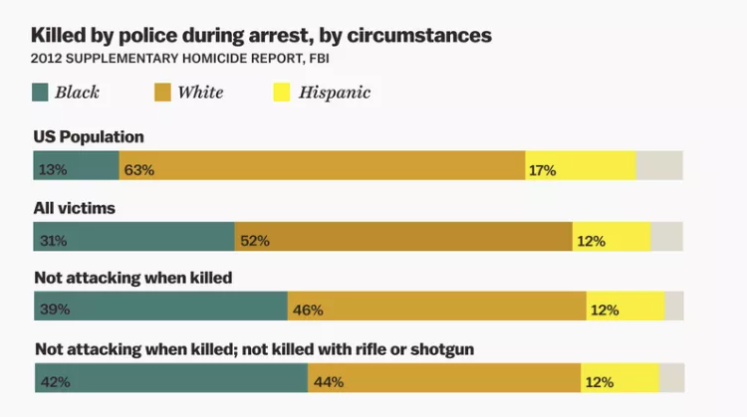
Perhaps a grave issue, then, still exists. Perhaps this research does not contradict disturbing trends found in policing previously, like unarmed Americans killed by the police being twice as likely to be black than white, across the entire nation, in the first half of 2015, or blacks who were not attacking an officer when killed making up 39% of total deaths in 2012, way out of proportion to a small black population, 13% of Americans (compared to 46% of total deaths being white, who are nearly 70% of the American population).

Screen Shot 2017-11-17 at 10.10.38 AM

via Vox

As Lind put it,

when people talk about racial disparities in police use of force, they’re usually not asking, Is a black American stopped by police treated the same as a white American in the same circumstances?… They’re saying that black Americans are more likely to get stopped by police, which makes them more likely to get killed.

Putting aside the fact that people are indeed asking that first question, you get the point. As Fryer writes in the study,

The empirical thought experiment here is that a police officer arrives at a scene and decides whether or not to use lethal force. Our estimates suggest that this decision is not correlated with the race of the suspect. This does not, however, rule out the possibility that there are important racial differences in whether or not these police-civilian interactions occur at all.

Glenn C. Loury, a mentor and colleague of Fryer, made this point as well (Making Sense, Harris) when he noted that because the study only looked at arrest data (if there is no arrest or violent incident, there is no police report), it “assumed that the processes leading to an arrest work in the same way regardless of race of the suspect.” The study showed that among the black arrestees there were more women and more unarmed persons, for instance, compared to white arrestees. Loury notes that the police may be “discriminatory in how they decide about arresting people and are quicker to arrest blacks who are less threatening than whites,” and this could possibly explain why the rate of blacks being shot is lower in the study. If the police are arresting blacks who are less of an actual danger, there may be less need to fire a weapon at them. This fact, if indeed a fact, could even coexist with the more abusive behavior against blacks. Discriminatory initiation of interactions and arrests, discriminatorily roughing someone up, but not actually needing to pull the trigger. It’s not contradictory.

Third, this study has not yet been peer-reviewed — where fellow scholars analyze Fryer’s methods to determine validity — nor published in an academic journal. It is currently a working paper for the National Bureau of Economic Research. Now, this does not at all mean it is seriously flawed, but it may be prudent to wait until the academic process is complete before celebrating the end of racism. Studies that have undergone peer scrutiny are usually the most reliable.

Fourth, Fryer’s data was provided by police departments, whose reports are not always truthful. The Guardian, which the FBI director called a leader in the documentation of police shootings, wrote that Fryer collected his information

largely by coding police narratives rather than considering the testimonials of witnesses or suspects (assuming that the suspects were not killed by the police in the shooting). The study therefore assumes police reports are unbiased sources of information about facts like whether or not the officer shoots the suspect before being attacked.

For this and other reasons, the Guardian sees the study as “misleading.”

Fryer admits that “the penalties for wrongfully discharging a lethal weapon in any given situation can be life altering, thus, the incentive to misrepresent contextual factors on police reports may be large” and that “we don’t typically have the suspect’s side of the story and often there are no witnesses.”

Fifth, and finally, it would be very remarkable if blacks were discriminated against in every arena of policing except for police shootings. Again, Fryer’s look at incidents where shots weren’t fired found significant differences in how blacks and whites are treated in comparable situations:

Screen Shot 2017-11-17 at 10.11.03 AM

via The New York Times

It would also be miraculous if experiments conducted with civilians and police officers where both were quicker to shoot armed and unarmed blacks than armed or unarmed whites did not translate into similar problems in the real world.

Studies show police officers associate blacks — innocent blacks included — with aggression and criminality (a stereotype most civilians have as well, whether or not they are aware of it). Studies like one in 2002 show that ordinary civilians in simulations are far quicker to shoot armed blacks than armed whites, and decide quicker to spare an unarmed white than an unarmed black. 2005 research in Psychological Science showed police officers were more likely to mistakenly shoot unarmed blacks than unarmed whites. Happily, the bias diminished with extensive time in the simulation.

The 2006 study mentioned earlier, published in Basic and Applied Psychology, found that during simulations, as Fair and Impartial Policing put it,

Officers with negative attitudes toward Black suspects and negative beliefs regarding the criminality of Black people tended to shoot unarmed Black suspects more often in the simulation than officers with more positive attitudes and beliefs toward Blacks.

Studies from 2007 and 2009 suggest that officers with anti-black biases won’t act on them if they’ve gone through high-quality use-of-force training that diminishes implicit prejudice, a factor related to our first point above — some police departments have much more effective training than others, which can be the difference between life and death for civilians.

Jordan Weissmann writes:

Why would police officers be more likely to get rough with black and Hispanic subjects, but not more likely to fire on them? Fryer suggests it might be a matter of stakes. In theory, police stand to lose a lot more if they shoot the wrong guy than if they give him a blow with a nightstick. But there isn’t hard proof for that narrative, and frankly, given how rarely police appear to be punished after shootings, it’s not especially satisfying.

The Guardian wrote:

Fryer assumed shootings are not necessarily linked to a more general use of police force. Such an assumption seems hard to support: a black person in New York who is stopped by the police is 24% more likely to have a gun pointed at them than a white person, so why would they be no less likely to be shot by an officer? The two seem inextricably linked.

All this is not to say with certainty that Fryer’s work is flawed. But there are reasons to ask serious questions.

Inarguably, it is hardly time for black and white liberals to breathe a sigh of relief and make the Black Lives Matter movement a thing of the past, nor is it time for conservative Americans to pat themselves on the back for being right about racism being fictional. One study — or even two or three — isn’t quite enough for that, especially one that hasn’t been published and may not even contradict other research.

There is a mountain of evidence that both overt and subconscious racism greatly affect the lives of people of color (see The Evidence of Widespread American Racism). Even if, somehow, American police officers were never affected by implicit or explicit biases when reacting or deciding, there would still be much work to be done in the battle against discrimination.

Likewise, even if the police killed civilians without racial bias, mass protests against unnecessary police force would be a very positive thing for our society.

For more from the author, subscribe and follow or read his books.

Do People Who Resist Arrest Have a Right to Life?

Many questions follow in the wake of police shootings.

Primarily, what could the victim — whether black, white, brown, or other — have done differently? Did he or she remain calm and respectful, doing just as an officer asked?

In some cases, the suspect had no time to be respectful, as the police gave no opportunity to surrender. Look no further than the murder of 12-year-old Tamir Rice. In other cases, such as that of Joseph Carlton, the suspect raises a firearm at an officer, who is then without question justified in opening fire.

Few would argue the suspect who points a gun at the authorities hasn’t sacrificed his or her right to physical safety. The less clear-cut cases are obviously where the controversies lie. Couldn’t the Baton Rouge officers have each grabbed an arm of Alton Sterling if they thought he was reaching for a gun, instead of shooting him repeatedly in the chest? Did Philando Castile tell the officer he had a firearm and a concealed carry permit before he was shot to death? Did Mike Brown actually attack a policeman?

Questions like this have torn the country apart, and won’t be settled here. But perhaps there is a sliver of room for common ground, concerning other cases, that should be explored.

Putting aside the obvious fact that many lives could be spared if American police were armed with rubber-coated bullets and the studies that show implicit biases against minorities make officers more likely to kill them, it does not seem like such a radical idea that when suspects resist arrest — disobey or struggle but do not grab a gun and do not assault an officer — they still have a right to life. That is, they still have a constitutional right, under the 14th Amendment, not to be deprived of life without due process of law (this is not to say those who assault officers deserve to die on the spot — officers should do all they can to prevent civilian deaths while defending themselves; we are simply trying to find common ground here).

After all, this is what each of us would want if the suspect was our own son, brother, father, or husband. We would want our sister, wife, mother, or daughter to retain the right to life even if she makes a terrible decision and grows angry or disrespectful with an officer, disobeys, or even struggles while being handcuffed. We tend to look at people who resist arrest as “criminals” who “get what they deserve” when they are riddled with bullets and bleed out on the sidewalk. Yet this is a standard unlikely to be applied to our own friends and family members were they to exhibit the same behaviors and make the same mistakes. As I wrote elsewhere, in that case people

would expect the police to find a nonviolent, nonlethal solution to the situation. He or she would want to live, or want his or her child to live, to see a constitutionally-guaranteed day in court…

If [one who defends police actions] could say honestly, “If it was my son, the police acted reasonably in killing him” then he or she has been morally consistent… If [one] has a change of heart, and says, “If it was my son, the police actions were not justified,” we can see how bankrupt [our ethics actually are].

If you think the police justified in shooting your father if he was being disrespectful or struggling out of anger, you may as well stop reading this now. But if you think that’s simply not egregious enough to justify the police killing him, you have to extend that standard to others and say that yes, people who resist arrest — excluding those who brandish a gun or actually assault an officer — have an unquestionable right to life.

So when Walter Scott was shot in the back as he ran from an officer, his right to life was violated. When Eric Garner became frustrated and resisted handcuffs and was choked to death, his right to life was violated. When Laquan McDonald, armed only with a small knife, walked past officers at a distance, ignoring their commands, and was shot 16 times, his right to life was violated. When Sam DuBose tried to prevent an officer from opening his car door, also starting his car, and the officer shot him in the head, his right to life was violated. Had an officer in McKinney, Texas, gunned down the girl screaming at him or the boys antagonizing him, he would have violated their rights.

The answer to “Do those who resist arrest have the right to life?” in America today is, in practice, most certainly no. In theory, for too many Americans, it is only yes if your own family is involved. Both of these must change.

And if they do, police officers who violate a citizen’s right to life must spend time behind bars. That is not only justice but also may prevent tragedies in the future.

For more from the author, subscribe and follow or read his books.
The Bible is Rife With Contradictions and Changes

During discourse on religion, nonbelievers generally acknowledge that criticism of character doesn’t prove fictionality.

In other words, showing that the Judeo-Christian god is a monster because he murders innocent people for the crimes of others, commands his followers to commit genocide against women and children, orders the execution of nonbelievers, non-virgins, and homosexuals, or simply lies to people (see Absolutely Horrific Things You Didn’t Know Were in the Bible) does not mean he does not exist. Showing God is an evil madman because he crafts a divine plan in which one age calls for followers to destroy their neighbors and the next calls for them to love their neighbors (see Either God Changes or He’s Psychotic: Comparing Testaments Old and New) does not mean he’s complete fiction.

A deity could exist but simply be violent, morally inept, or unpleasant. Or, from the perspective of the religious, God could use violence and oppression out of “love” for his favored creations, wiping out civilizations so the Jews could get their land or destroying sinners so others would be scared straight.

Now, there are many sensible reasons to suppose the Judeo-Christian god, like so many others, is a man-made fiction, but they are not addressed here. Instead, our attention must turn to the common claims that the Bible has never been changed over time by various scribes nor contains internal contradictions.

Showing that it has and does will of course not disprove God either (just as showing changes to or contradictions in Homer’s works will not disprove the Greek gods). It could be a deity exists that does not mind flawed or edited scriptures. Yet showing such common claims are demonstrably false is valuable in itself, because the truth seems important to most people.

Contradictions

The Bible’s internal contradictions vary in their degree of debatability.

Take for example Genesis 6:3, where God says to himself, “My Spirit will not contend with humans forever, for they are mortal; their days will be a hundred and twenty years.” Yet in Genesis 9:29, Noah dies at the ripe old age of 950. Other characters live for many centuries after this as well. Though this is strange, perhaps we can say God changed his mind (if that is even possible for a being that knows the future), only meant average people and not special folks like Noah, or was actually speaking of how many years remained before the flood that destroyed humanity.

Next, as Moses is trying to free his people from Pharaoh, God’s fifth plague is the “plague on livestock,” during which “all the livestock of the Egyptians died” (Exodus 9:6). But during the seventh plague, the hail, the Egyptians have livestock again: “Those who ignored the word of the Lord left their slaves and livestock in the field” (Exodus 9:21-22). After the hail, the firstborn of the livestock then died in the tenth plague (Exodus 12:29). Perhaps we can imagine that Egypt quickly imported new cattle.

When God says “And of every living thing of all flesh, two of every sort shalt thou bring into the ark, to keep them alive with thee; they shall be male and female” in Genesis 6:19, but then says “Take with you seven pairs of every kind of clean animal, a male and its mate, and one pair of every kind of unclean animal, a male and its mate” in Genesis 7:2-3, was he changing his mind? Or was he simply clarifying, in that all creatures would have at least one pair, but some special ones would have more?

Sometimes reimagining the timing of events can help fix contradictions. Why would Matthew 26:17-20, Mark 14:12-17, and Luke 22:7-14 explicitly state that Jesus and the 12 ate the Passover the evening before he was killed, but the pharisees in John 18:28, when Jesus is being convicted and murdered, be thinking of eating the Passover that evening — indicating it hasn’t happened yet? John 19:14 stresses the point: the crucifixion occurs on the “day of Preparation of the Passover” — the Passover meal is coming up. (Mark 15:42 mentions a day of preparation, but for the Sabbath, something different that occurs each week.) John 13:1 has a last supper, but it isn’t described as the Passover. So which is it, was Jesus killed after Passover or before? Well, one can imagine Jesus simply broke tradition and ate his own private Passover a day early (on the evening the Day of Preparation begins rather than on the evening it ends, when Jews were supposed to, for those of you who know how Jewish days worked). Jesus knew he would be killed the next day, after all, and wouldn’t get to eat the Passover on the appropriate evening. The first three gospels never indicate this is an early, non-traditional Passover, they simply say it was the Passover meal. The last supper in John is described as “just before” the Passover festival, but isn’t called the Passover at all. Still, the gospels never say it wasn’t an early Passover meal, so why not assume it was to avoid contradiction? People say the Bible has never been changed, but we can change it in our heads.

It has been pointed out, we should note, that placing the crucifixion before the Passover neatly makes Jesus the symbolic, sacrificial lamb — lambs were killed on the Day of Preparation, after noon. John is the only gospel to refer to Jesus as the “lamb of God” and also the gospel that moved up the execution to before Passover (Jesus, Interrupted, Ehrman).

Now, consider who went to Jesus’ tomb with Mary Magdalene. Is Mary Magdalene seemingly alone (as in John 20:1), with “the other Mary” (Matthew 28:1), with the other Mary and Salome (Mark 16:1-2), or with Mary the mother of James, Joanna, and “the other women” (Luke 24:10)? Are these conflicting accounts? Or do some authors just not bother to mention some of the folks with Mary Magdalene? (Note also how Peter appears to run to the tomb alone in Luke 24:9-12, but has John with him in John 20:1-10.) Likewise, it’s interesting that while both Matthew and Luke have Jesus born in Bethlehem and then settle down in Nazareth, the two stories are dramatically different, in that neither mentions the events of the other. King Herod kills children and Jesus flees to Egypt in Matthew, but Luke doesn’t bother mentioning either. Luke has the ludicrous census (everyone in the Roman Empire returning to the city of their distant ancestors, creating mass chaos, when the point of a census is to see where people live currently), the full inn, and the manger, but Matthew doesn’t. The family seems to move to Nazareth from Egypt in Matthew (2:8-23), after Herod dies, but in Luke (2:16-39) the move to Nazareth appears to occur just after the family visit to Jerusalem, which took place after Jesus was thirty-three days old (see Leviticus 12, which outlines the rituals conducted in Luke), no flight to Egypt mentioned. These stories can be jammed together into a mega-narrative successfully, but it takes some work. Other musings should be made concerning who buried Jesus. Was it Joseph of Arimathea, a member of the Sanhedrin council, seemingly alone (Mark 15:43-46)? Did Nicodemus, also a member of the Sanhedrin (John 3:1) help him (John 19:39-40)? Or was it seemingly the Sanhedrin as a whole (Acts 13:27-29), even though “all the council sought testimony against Jesus to put Him to death” (Mark 14:55)? Why would they all help bury him if they were the ones who pushed Pilate to kill him?

And what of the incident in the temple-turned-market? While Matthew (21:12-13) and Mark (11:15-17) have Jesus driving the merchants from the temple at the end of his ministry, John has it at the beginning (2:15-16), right after Jesus’ very first miracle! The stories are clearly the same: he overturns the tables of the money changers and dove sellers, then says, “It is written…‘My house will be called a house of prayer,’ but you are making it ‘a den of robbers'” (Matthew, Mark) or “Stop turning my Father’s house into a market!” (John). Are we to believe the same incident happened twice? And each author ignored one of them? Or does temporal sequence really not matter at all?

Next look at Matthew 16:27-28, when Jesus, after describing returning with his angels and rewarding all according to his or her deeds, says to the people with him, “Some who are standing here will not taste death before they see the Son of Man coming in his kingdom.” Matthew 24:3-35 says at “the end of the age” the “stars will fall from the sky,” with “the Son of Man coming on the clouds of heaven, with power and great glory,” sending forth “his angels with a loud trumpet call.” Jesus tells his followers that “this generation will certainly not pass away until all these things have happened.” (The same is promised in Mark 8:38-9:1 and 13:24-30, with the same context: “after that tribulation” [NASB].) This very much sounds like the Last Judgement discussed in Revelation, when Jesus will be “coming with the clouds” (1:7), the “armies of heaven” (19:14) with him, but also his “reward,” to “give to each person according to what they have done” (22:12-13).

Yet the people Jesus spoke to are all dead.

They tasted death before the Last Judgement. (The myth of the Wandering Jew, someone from Jesus’ time who is still alive today and will be until Jesus’ return, arose in the Middle Ages to “fix” this problem.) But we shall keep an open mind. Perhaps Jesus changed his mind or was speaking about his crucifixion and resurrection as many believers insist, despite blatant references and similarities to the Last Judgement story.

Consider another example. Although we are assured that “it is impossible for God to lie” (Hebrews 6:16-18), we are also assured God can in fact “deceive” people (Ezekiel 14:9, Ezekiel 20:25-26), even that “God shall send them strong delusion, that they should believe a lie” (2 Thess. 2:11-12). So is it possible for God to “deceive” and “delude” people, but not “lie” to them? Perhaps a believer would insist a lie has to be spoken, whereas a deception or delusion doesn’t, so there is no contradiction. But others would say that because a lie is a deception, and God is capable of deception, that it is possible for God to lie — meaning this is a contradiction.

Excuses become a bit harder to create with other verses.

Consider:

Mark 15:37-38: “With a loud cry, Jesus breathed his last. The curtain of the temple was torn in two from top to bottom. And when the centurion, who stood there in front of Jesus, saw how he died, he said, ‘Surely this man was the Son of God!'”

Matthew 27:50-52: “And when Jesus had cried out again in a loud voice, he gave up his spirit. At that moment the curtain of the temple was torn in two from top to bottom. The earth shook, the rocks split and the tombs broke open.”

Both describe the same event: the temple curtain is torn in two when Jesus dies.

Now to Luke 23:44-46:

It was now about the sixth hour, and there was darkness over the whole land until the ninth hour, while the sun’s light failed. And the curtain of the temple was torn in two. Then Jesus, calling out with a loud voice, said, “Father, into your hands I commit my spirit!” And having said this he breathed his last.

In Luke, the temple curtain is torn before Jesus dies. There is even enough time for Jesus to say his final words in between.

Believers may shrug this off (“What difference does it make?”), but this is precisely what nonbelievers mean when we talk about internal contradictions. Both stories cannot be true — unless we suppose the Bible breaks out of chronological patterns at our convenience (so Luke is accurate, and Mark and Matthew align neatly because “the curtain of the temple was torn in two” refers to an event before Jesus breathes his last, even though it’s positioned after, alongside other events that do happen after, such as an earthquake). In this effort, the word “then” is simply ignored as meaningless.

Other contradictions have even less wiggle room.

  • Matthew 8:5, Luke 7:3, and Luke 7:6 are confused as whether the centurion found Jesus himself or if he sent elders (or “friends”).
  • In Matthew 27:3-8, Judas hangs himself; in Acts 1:16-19 he falls headlong and his body bursts, spewing his bowels on the ground.
  • In Matthew 27:3-10, the chief priests buy a field (the Field of Blood) with the blood money Judas returned to them; in Acts 1:16-19, Judas himself bought the Field of Blood with the blood money, which he kept.
  • Mark 5:21-43 and Matthew 9:18-26 tell the story of a synagogue leader (named Jairus in Mark) who comes to Jesus begging him to heal his daughter. Jesus goes with the man, but is interrupted by a woman, who has suffered from bleeding for 12 years, touching Jesus’ clothing to heal herself. The woman is magically cured, and Jesus continues on and raises Jairus’ daughter from the dead. But in Mark, Jairus says his “daughter is at the point of death” (5:23) to Jesus but is informed when he arrives home that “your daughter is dead” (5:35). But in Matthew, Jairus originally says to Jesus, “My daughter has just died” (9:18). Did Jairus believe his daughter was about to die or already had passed?
  • Exodus 33:20 and John 1:18 claim no one has ever seen God and lived, forgetting Moses, Aaron, Nadab, Abihu, and 70 other people (Exodus 24:9-11), Adam and Eve during their time in the Garden, Hagar (who seems amazed to have “stayed alive here after seeing Him,” Genesis 16:13, NLV), and Abraham (Genesis 18:1-13).
  • Matthew 21:12-19 and Mark 11:12-17 can’t agree on whether Jesus cursed a fig tree before driving merchants from the temple or the day after.
  • 2 Kings 8:26 says Ahaziah was 22 when he began to reign; some versions of 2 Chronicles 22:2 say 42. (Some Biblical scholars, even those at Ken Ham’s ultraconservative Answers in Genesis, admit this may be a copyist’s error!) Biblical footnotes acknowledge this error:
Screen Shot 2017-11-17 at 9.33.45 AM

via Biblehub

  • 2 Kings 24:8 says Jehoiachim was 18 when he became king; 2 Chronicles 36:9 says he was 8. (This difference has likewise been called a copyist error by Christian groups like Third Millennium Ministries.) This is also described as a mistake in Bible footnotes:
Screen Shot 2017-11-17 at 9.35.55 AM

via Biblehub

  • Mark 15:25 says Jesus was crucified at the third hour (9 a.m.), after being convicted by Pilate, mocked, beaten, and made to carry his cross; John 19:14-15 says Jesus wasn’t even convicted by Pilate until the sixth hour (noon). Some apologists insist Mark was using Jewish timekeeping (so the third hour was 9 a.m., three hours after sunrise) and John was using Roman timekeeping (so the sixth hour was actually 6 a.m., six hours after midnight — not noon). Yet two dozen translations of John (NIV, NLT, MSG, etc.) say it was “noon.” Only four say it was “six in the morning” (GW, HCSB, ICB, NOG). Which is it?
  • 2 Samuel 6:23 says Michal had no children before she died; 2 Samuel 21:8 says she had five (at least, some versions do; as Answers in Genesis explains, some manuscripts have “Michal” but others have “Merab,” Michal’s sister, which is now widely used in modern Bibles).
  • Acts 9:7 says the men with Paul on the road to Damascus heard the sound of the Lord; Acts 22:9 says they did not.
  • In Matthew 28:2, the stone of Jesus’ tomb is rolled away by an angel in front of the women who come to visit, during an earthquake; in the other gospels, the stone has already been rolled away when they arrive.
  • Matthew 28:2-7 and Mark 16:5 say one angel (Mark actually says “man”) appeared to the women; Luke 24:4 and John 20:12 say it was two (Luke actually says “men”).
  • Mark 16:8 says the women said nothing of their experience; in the other gospels they report it immediately.
  • In Matthew 28:2-9, Mary does not see Jesus before going back from the tomb to the disciples; in John 20:2-14, she does.
  • Jesus first appears to all 11 disciples either on a mountain in Galilee (Matthew 28:5-17) or in a room in Jerusalem (Luke 24:33-39, John 20:1-20).
  • While Matthew 10 and Mark 3 include Thaddeus in the 12 disciples, he is not mentioned in Luke, John, or Acts (instead, there is a Jude/Judas, son of James, who is not in Matthew or Mark). Also, in John chapter 1, it is implied that a Nathanael joins Christ’s 12. He is not mentioned in the other gospels or Acts.
  • In John 13-17, the Last Supper scene, Jesus marvels, saying, “Now I am going to the one who sent me, yet none of you asks me, ‘Where are you going?'” (John 16:5) right after Peter asks him, “Lord, where are you going?” (13:36) and Thomas says, “Lord, we do not know where you are going” (14:5).
  • Deuteronomy 5:1-22 makes clear the 10 Commandments we all know were written on the first stone tablets, the ones Moses later smashed apart (Exodus 20 and 31:18 imply the same). Exodus 34:1-27 makes clear that the new, second tablets have a very different 10 Commandments (“Do not cook a young goat in its mother’s milk”). A rewrite isn’t necessarily a contradiction, but Exodus 34:1 says God was going to “write on them the words that were on the first tablets,” as does Deuteronomy 10:1-5. Did God change his mind last minute?
  • In Acts 9:17-27, it very much appears that Paul, after seeing Jesus on the road to Damascus, spends some time in Damascus and then goes to Jerusalem and meets the apostles. But in Galatians 1:15-20, Paul insists he did not go to Jerusalem for years after his conversion and only met one apostle there. In verse 20, he even insists he is not lying — suggesting some controversy around this issue.
  • Genesis 1:11-27 says plants and vegetation were created before Adam; Genesis 2:4-7 says Adam was created first.
  • 2 Samuel 24:1-10 and 1 Chronicles 21:1-8 disagree over the count of David’s census (and while they were perhaps both involved, the former ignores Satan’s role and the latter ignores God’s role).
  • When Jesus sends out the 12, he either orders them to take a staff (Mark 6:6-11) or forbids it (Matthew 10:1-14).     

Though the human imagination can conjure explanations for why two stories are radically different (“Judas hung himself, but the rope snapped and his body exploded when he hit the ground”), this doesn’t rule out the possibility that one of the stories, or both, are flawed or fictional.

Changes

An easy way to begin this topic is to simply consider the names of biblical characters. Christians don’t want to believe that biblical translations over time altered original stories, but one small way they obviously did was by giving characters altered names. Jesus did not consort with John and James. They were in the Middle East, not an English pub. Instead, Yeshua (ישוע) consorted with Yohhanan (יוחנן) and Ya’akov (יעקב). Hebrew and Aramaic names were translated into Greek and later into English (and other tongues), resulting in names of different pronunciation than were actually used. Mattityahu became Matthaios and finally Matthew. (No, English speakers did not independently have a name like “John” and then “translated” Yohhanan [Hebrew] or Ioannes [Greek] to the pre-existing John, as if there was some magical lingual match or a “Hey, this name sounds a bit like one of ours” situation! Study the etymology of these names. The only reason John existed in English is because over centuries the name Yohhanan, thanks to the bible, spread beyond Palestine, through other parts of Europe, and finally to the English-speaking world, changing along the way.) If something as simple as names and their pronunciations could change from actual people to written text, and then translation to translation, could other things have changed, too?

New Testament scholar Bart Ehrman (Misquoting Jesus) was shocked to discover for himself the story of Christ and the adulteress (“Let he who is without sin throw the first stone”) is not in our oldest copy of John. He says:

The story is not found in our oldest and best manuscripts of the Gospel of John; its writing style is very different from what we find in the rest of John (including the stories immediately before and after); and it includes a large number of words and phrases that are otherwise alien to the Gospel. The conclusion is unavoidable: this passage was not originally part of the Gospel.

This is admitted by Biblical scholars and often found in footnotes to John in both physical and online Bibles:

Screen Shot 2017-11-17 at 9.36.55 AM

via Bible Gateway

Likewise, the last 12 verses of the Gospel of Mark are missing in our earliest manuscripts (see biblical footnotes). They end with Mary Magdalene and two women finding the empty tomb and meeting an angel who says Jesus has risen from the dead. The earliest texts end with verse 16:8: “Trembling and bewildered, the women went out and fled the tomb. They said nothing to anyone, because they were afraid.”

Perhaps we can give these texts the benefit of the doubt, and suppose they were included but were lost over time — even though many New Testament scholars admit this is probably not the case, and Biblical footnotes are quite open about the issue:

Screen Shot 2017-11-17 at 9.37.46 AM

via Bible Gateway

In addition, there’s the Comma Johanneum. While later New Testament texts included an explicit mention of a Trinity in 1 John 5:7-8, earlier texts do not. The Latin Vulgate reads:

These are three that bear witness in heaven: the Father, the Word, and the Spirit, and these three are one; and there are three that bear witness on earth, the Spirit, the water, and the blood, and these three are one.

But earlier Greek manuscripts read:

These are three that bear witness: the Spirit, the water, and the blood, and these three are one.

Christian sites like Compelling Truth admit:

The evidence for this longer, more direct statement as part of the original text of 1 John, however, is not strong. Its presence was not known in Greek until manuscripts of the fifteenth century. Even then, most versions are found only in Latin translations. The Greek linguist Erasmus did not include this longer ending in his earlier editions of the Greek New Testament, yet included it in later editions (beginning with the third edition) after pressure from the Roman Catholic Church.

Today, some Bibles stick with the original Greek, admitting in footnotes that the later Latin Vulgate speaks of the Trinity but that it’s “not found in any Greek manuscript before the fourteenth century”:

Screen Shot 2017-11-17 at 9.39.23 AM

via Bible Gateway

Further, the traditional ending of the Lord’s Prayer (“For yours is the kingdom and the power and the glory…”) was an addition to later manuscripts of Matthew 6, as stated in biblical footnotes. Some manuscripts added the appearance of an angel to John 5:3-4 and words from Philip to Acts 8:36-37. The Book of Daniel had three stories added to it when translated into Greek; these additions were mostly removed, but can still be found in some translations, such as the NABRE. Greek-speaking translators also altered Psalms 40:6 from “ears you have opened” to “body you have prepared.” In Mark 14:30, Jesus tells Peter that Peter will deny him before the rooster crows twice, but the word “twice” does not appear in some early manuscripts. (The addition creates a contradiction with Matthew 26:34, Luke 22:34, and John 13:38, where Jesus says this will occur before the rooster crows at all.) Today 2 Samuel 21:19 may say Elhanan “killed the brother of Goliath,” but the original Hebrew does not have “the brother of.”

As Ian McEwan notes in “The End of the World Blues,” one of the earliest copies we have of Revelations 13:18, the Oxyrhynchus P115, gives the number of the beast as 616, not 666!

The same is true of a few other younger manuscripts (Codex C/04 from the 1500s, for example). So even while Christian writers point out that many more manuscripts contain 666, they must admit that “two equally old papyri have both readings – 666 and 616” — our two oldest papyri, to be specific, both from the 3rd century. A famous bishop named Irenaeus, writing Against Heresies around 175-185 A.D., even had to argue that 666 was the correct number: “I do not know how it is that some have erred following the ordinary mode of speech, and have vitiated the middle number in the name, deducting the amount of fifty from it, so that instead of six decads they will have it that there is but one.” Whichever number came first is up for debate (perhaps we can trust Irenaeus had seen the original texts or was incapable of error, though we have zero evidence of this), it doesn’t really matter to our purposes here.

What matters is that someone, at some point, changed something. Bibles with errors existed — and still do.

For more of the thousands of changes enacted accidentally (through translation and copy errors) and intentionally (to serve personal preferences and beliefs, and to try to create a consistent doctrine) by Christian scribes and church leaders, see Misquoting Jesus. (There also exist stories that have simply been recycled in the Bible: see Genesis 19:4-8 and Judges 19:22-24 for similar stories of men surrounding a house to rape male houseguests and the homeowner offering his virgin daughters to them instead. A patriarch pretends his wife is his sister to avoid being killed by foreigners, but the foreign king learns the truth, at the start of Genesis 12, 20, and 26.)  

When you read the New Testament you may become suspicious right off the bat regarding changes to the stories. The following is more speculative than what we’ve seen thus far, but interesting to think about. Just as the earliest copies of Mark lack the final 12 verses, the book contains no virgin birth story or claim. Jesus first appears as an adult. It may seem odd that Mark, the earliest gospel, did not mention such an incredible, supernatural origin (nor did Paul’s letters, most written even earlier!). That tale isn’t told until several years later, with the Book of Matthew. Believers typically insist that when a gospel doesn’t mention a miracle, speech, or story it’s because it’s covered in another. (When the gospels tell the same stories it’s “evidence” of validity, when they don’t it’s no big deal.) This line only works from the perspective of a later gospel: Luke was written after Matthew, so it’s fine if Luke doesn’t mention the flight to Egypt to save baby Jesus from Herod. Matthew already covered that. But from the viewpoint of an earlier text this begins to break down. It becomes: “No need to mention this miracle, someone else will do that eventually.” So whoever wrote Mark ignored one of the biggest miracles in the life of Jesus, proof of his divine origins? Or did the author, supposedly a disciple, not know about it? Or did gospel writers conspire and coordinate: “You cover this, I’ll cover that later.” Is it just one big miracle, with God ensuring that what was unknown or ignored (for whatever reason, maybe the questionable “writing to different audiences” theory) by one author would eventually make it into a gospel? That will satisfy most believers, but an enormous possibility hasn’t been mentioned. Perhaps the story of Jesus was simply being embellished — expanding over time, like so many other tales and legends (see Why God Almost Certainly Does Not Exist).

Consider a similar example. The last gospel written, John (90-95 AD), is quite different from Mathew, Mark, and Luke (which are called the synoptic gospels because they are more similar in stories and phrasing — scholars suspect plagiarism). Not only does John contain tales and miracles the earlier authors don’t bother to mention, but Jesus is more clear about who he is. In the synoptic gospels, Jesus says he is the messiah (Christ), the Son of Man, and the Son of God (for example, Mark 14:61-62), but nowhere explicitly claims he is God himself. (This is not to say the gospel writers did not believe Jesus to be God himself — Matthew 1:23 gives Jesus a name meaning “God with us” — but rather this is about changes to the words attributed to Jesus, changes to make him more clear about who he was.) As such terms were applied to others who were not believed to be God (angels in Genesis 6:1-2, for example), scholars debate their meaning; one can at best say Jesus only implied oneness or equality with God. Regardless, all agree John is more explicit. Jesus says, “I and the Father are one” (10:30) and “The one who has seen me has seen the Father” (14:9). Jesus refers to himself as “I AM,” the name God called himself with Moses. We know such things were bolder and more explicit because in the gospels the Jews only pick up stones to kill Jesus after he says this in John 8:58-59 — it was more blasphemous. All this raises an obvious question. If Jesus said such bold things (in public, to disciples and observers, not just to John), why do Matthew, Mark, and Luke not bother to include them? Jesus clearly calling himself God is a hugely important statement. The most sensible answer is that the story of Christ was growing more embellished — new words were put in his mouth to clarify once and for all who he was. There were in fact various Christian sects at this time that had different ideas of whether Jesus was God, less than God, just a man, etc. The author of John appears to be joining this debate, and taking a side. See How Jesus Became God, Ehrman.

The scriptures are still changing in substantial ways today, from the English Standard Version making it sound like women are the source of marital conflict to the Christian Standard Bible replacing male-centric language with gender-inclusive language (or “political correctness,” as critics put it). There have also been efforts to make the text less explicitly sexist. For example, most translations of Isaiah 19:16 (NLT, KJV, NASB, ESV, etc.) say that Egyptians will become fearful “like women,” accurately using the original Hebrew word nashim (women), the NIV changes it to “weaklings.” It does the precise same thing with Nahum 3:13.

The places where different translations of the bible substantially change the text are indeed too numerous to list here in full, but one common one is 1 Samuel 6:19, where God either kills 70 people or 50,070 people.

Screen Shot 2018-03-21 at 10.21.06 PM

via Bible Gateway

Another is 1 Chronicles 20:3. Some translations have David putting captives “to work with saws” (NRSV), others say David “cut them with saws” (KJV). The psalmist is either instructed by his heart (NIV), his kidneys (JUB) or reins (KJV), or his mind (NASB) in Psalm 16:7. God has the strength of wild ox (NIV) or unicorn (KJV) in Numbers 24:8 and 23:22. Isaiah 59:5 speaks of either vipers (NIV) or cockatrices (KJV), a mythical dragon creature with legs, plus the head of a rooster. Isaiah 13:21 features either wild goats (NIV) or satyrs (KJV), the mythological half-man, half-beast creature. Multiple versions of Deuteronomy 32:22 say “poison of dragons” instead of “poison of serpents.” The King James Version is older, more seeped in ancient thought (though Job still describes a dragon in any version of Job 41:12-34).

Finally, does Isaiah 7:14 say a virgin will give birth to a son, to be named Emmanuel? Or a young woman? The NAB Revised Edition switched from virgin to young woman, as did the Revised Standard Version and others, to better reflect what biblical scholars mostly agree on: the Hebrew word almah did not have anything to do with virginity in this context. Even devout Christian scholars argue this, further insisting that Isaiah 7:14 is not a prophecy of the messiah at all. How can anyone believe their bible has never been changed when “Revised” is in fact in the title? The latest NRSV contains 20,000 changes.

The Most Interesting Contradiction of All

Finally, a closer look at one of the most fascinating contradictions in the Bible.

The lineages of the Hebrews offered in 1 Chronicles 1-3, Matthew 1:1-17, and Luke 3:23-38 are radically different, in the number of generations between certain people, and the people included. All use the “son of” or “father of” line, and all go back at least to Abraham, winding their way to David and later Joseph along different routes.

Matthew has 28 generations from David and Jesus, whereas Luke has 44. Only a few names in these lists are the same, and different people are given for Joseph’s father (Jacob v. Heli), grandfather (Matthan v. Mathat), great-grandfather (Eleazar v. Levi), and more. 1 Chronicles obviously doesn’t go all the way to Jesus, but after David it includes 5 people Matthew leaves out, and has only 3 people Luke mentions. (We’ll put aside the fact that Jesus, not being Joseph’s biological son, wouldn’t actually be part of David’s bloodline — not through his father’s side of the family, anyway.)

Screen Shot 2017-11-17 at 9.41.49 AM

Screen Shot 2017-11-17 at 9.42.22 AM

via The Atheists

Believers think each list was recording something different. Perhaps Matthew was documenting the passing of the rightful title of king (not always biological descendants, some adopted, nor always direct between generations, as some were not worthy of the title and denied it), Luke was documenting Mary’s lineage (using the males, likewise adopted at times), and Chronicles the direct, biological descendants of Adam. 

Plausible enough. After David, the royal line goes one way with one of his sons, Solomon, Mary’s ancestors another way with an unlucky son, Nathan. Different lists, different people. Some people could end up on both lists, like Shealtiel and Zerubabbel, through adoption, marriage, remarriage, incest — the typical shuffling around of family in ancient times. Zerubabbel is called Shealtiel’s son in Matthew, Luke, and elsewhere, but in Chronicles it’s his nephew; believers speculate that Shealtiel adopted Zerubabbel. There is no problem imagining an adopted son, a nephew, would be called “son” in a lineage. 

Believers speculate, further, that a son-in-law would be called a son, so while in Luke it says Joseph was Heli’s son, perhaps he was Heli’s son-in-law, and the actual son of Jacob. They conclude Heli was Mary’s father, and though the Bible doesn’t say this anywhere, it is possible. And again, Christians claim part of the reason why Matthew has so few generations from David to Jesus is because the royal line could be disrupted or delayed, with the crown, literal or figurative, denied.

But questions persist. If you study the lineages closely, you will notice two interesting things:

First, Matthew leaves out 5 kings from Chronicles. Why doesn’t really matter. Believers claim it was no human error (because that’s impossible when it comes to the Bible), that there were valid reasons: 3 of the kings were evil and thus stripped of or denied their royal title, for example.

But perhaps it was on purpose for a different reason. By leaving out names, Matthew is able to say (Matthew 1:17): “All the generations from Abraham to David were fourteen generations, and from David to the deportation to Babylon fourteen generations, and from the deportation to Babylon to the Christ fourteen generations.” Implied in this is some sort of divine significance.

Perhaps it was indeed a miracle that the royal line was disrupted in such a way that led to numerical balance between major events in Jewish history. But it’s possible the author created the pattern, by leaving out people from the Chronicles lineage. It could easily be man’s miracle, not God’s.

Second, Matthew 1:17 essentially speaks of 42 generations from Abraham to Jesus: if you include Abraham’s generation and Jesus’ generation, that’s 14 individual generations in 3 eras, 14 x 3 being 42. Yet he only mentions 41 names, including Abraham and Jesus, in 1:1-16. It’s a mathematical contradiction. If you included Abraham and Jesus and everyone in between in your total time period in Matthew 1:17 (42 generations in all), you should list 42 specific names to match. The names don’t align with the generations.

  • Abraham to David: Verse 1:17 says 14 generations. The name list confirms: Abraham to David, including David, is 14 people.
  • David to Exile (which begins in Josiah’s generation): 1:17 says 14 generations, but you shouldn’t count David twice, in two generations. It must mean after David. So we don’t include David. The list says Solomon to Josiah is 13 people.
  • Exile to Jesus: 1:17 says 14 generations. Obviously, we can’t count Josiah again. Leave him out. Jechoniah to Christ is 14 people.

41 people total.

The only way to get to 42 names between Abraham and Christ (including Abraham and Christ) is to count someone twice. You can count anyone twice, but it’s usually David, since he is mentioned by name in 1:17. One has to say, “David counts for one person, but two generations” to make it all fit. That doesn’t make sense.

More reasonable? The author left someone out accidentally. A human error, dropping his name count to 41. Or perhaps it was a simple miscount of his total. Intentionality, positioning David back-to-back in 1:17 and hoping no one noticed there weren’t actually 42 generations, is possible as well, if less likely.

For more from the author, subscribe and follow or read his books.

Liberals, Conservatives Agree on Watchlist Danger

What a remarkable sentence to write: liberals and conservatives actually agree on something.

Currently, Democrats in Congress are staging a sit-in to push for gun policy reforms, such as expanding background checks for gun buyers to cover the large percentage of sales that don’t include one and banning people on terror watchlists, like the no-fly list, from purchasing guns. The first policy is enormously popular among the citizenry: some 90% of Americans favor universal background checks (including 85% of gun owners). The second policy also has mass support: about 85% of Americans think banning individuals on federal watchlists from buying firearms is a proper regulation.

Yet there also exists common ground among liberals and conservatives concerned with the watchlists themselves. Take Gawker — no conservative enclave — which opined that “The Democrats Are Boldly Fighting For a Bad, Stupid Bill”:

The no-fly list is a civil rights disaster by every conceivable standard. It is secret, it disproportionately affects Arab-Americans, it is error-prone, there is no due process or effective recourse for people placed on the list, and it constantly and relentlessly expands. As of 2014, the government had a master watchlist of 680,000 people, forty percent of whom had “no recognized terrorist group affiliation.”

The ACLU (American Civil Liberties Union), which has long opposed federal watchlists (for which conservative Fox News host Bill O’Reilly called the liberal civil rights organization a “terrorist group”), declared that “The Use of Error-Prone and Unfair Watchlists Is Not the Way to Regulate Guns in America,” writing:

Regulation of firearms and individual gun ownership or use must be consistent with civil liberties principles, such as due process, equal protection, freedom from unlawful searches, and privacy…

It may sound appealing to regulate firearms by using the government’s blacklisting system for what it calls “known or suspected terrorists,” but we have long experience analyzing the myriad problems with that system, and based on what we know, it needs major overhaul…

Our nation’s watchlisting system is error-prone and unreliable because it uses vague and overbroad criteria and secret evidence to place individuals on blacklists without a meaningful process to correct government error and clear their names.

That’s why we have argued that if the government chooses to blacklist people, the standards it uses must be appropriately narrow, the information it relies on must be accurate and credible, and its use of watchlists must be consistent with the presumption of innocence and the right to due process.

Compare this with the words of the National Rifle Association. The NRA said in a statement:

The NRA believes that terrorists should not be allowed to purchase or possess firearms, period. Anyone on a terror watchlist who tries to buy a gun should be thoroughly investigated by the FBI and the sale delayed while the investigation is ongoing. If an investigation uncovers evidence of terrorist activity or involvement, the government should be allowed to immediately go to court, block the sale, and arrest the terrorist. At the same time, due process protections should be put in place that allow law-abiding Americans who are wrongly put on a watchlist to be removed.

House Speaker Paul Ryan stressed at a press conference:

We do not take away a citizen’s rights without their due process. And so, if you had a quick idea in the heat of the moment that says, “Let’s take away a person’s rights without their due process,” we’re going to stand up and defend the Constitution.

The ultraconservative Federalist, in an article entitled “Democrats: We Shall Overcome the Constitution,” wrote that the Democrats’

message was clear. If we recklessly cling to the presumption of innocence, the terrorists have already won. If we fail to let bureaucrats create extrajudicial secret government lists that deny Americans their right to due process, we are, in essence, selling ISIS weapons of mass destruction.

Civil rights-era heroes like John Lewis, who lent his considerable legacy to this vacuous grandstanding, was once himself on the terror watch list. He didn’t know how he got on it. He didn’t know how to get off of it. Yet today he believes this Kafkaesque system is a sound way to deny his fellow citizens their rights.

There are numerous other examples, such as the more liberal The Daily Beast highlighting the story of a Muslim woman who had to fight in court for 8 years to get off the no-fly list, the far-left Intercept calling watchlists “secret” and “racist,” and the editor of the rightwing National Review editorializing that

In free countries such as the United States, we insist that the government distinguish between those who are “suspected” of lawbreaking and those who have been arrested, charged, convicted, or — at the very least — named in a time-limited warrant that has been signed by a judge. We also demand that any restriction on an individual’s liberty is subject to the due process of law.

Perhaps the popular idea of blocking people on federal watchlists from buying firearms can become reality only after Republicans and Democrats come together to, as Joe Scarborough put it, “fix the list!”

For more from the author, subscribe and follow or read his books.

Is Standing with Israel Standing with a Violent Oppressor?

In the United States, there is widespread support for Israel, owing to both a longtime American-Israeli alliance, and empathy concerning both the intimate Christian-Jewish historical connection and the Nazi Holocaust (the long history of Christian atrocities against the Jews before the Second World War is either unknown or ignored). A February 2016 Gallup poll showed 62% of Americans sympathize more with Israelis than Palestinians, while the opposite is true for only 15%. The factors that influence such support can make it easy to view Israel as “the good guy” regardless of its actions, quite similar to the black-and-white vision of American foreign policy, where the U.S. is a hero no matter its actual motivations for violence or how many innocent people it kills.

When considering the Israeli-Palestinian conflict, several things must be kept in mind. First, nations with an official state religion historically tend to mistreat and marginalize citizens that do not follow the official dogma. Second, more powerful states tend to be able to cause more widespread destruction and death than smaller powers. Finally, terrorist violence tends to be a reaction to both the first and second points — a violent response to mistreatment, dehumanization, invasions, occupations, bombings, and so on.

The land that is called Israel today was long ruled by Muslim powers like the Ottoman Empire, until the end of World War I, when the Allied Powers, principally Britain and France, dissolved the Ottoman state and carved up the Middle East for themselves. Israel, called Palestine then, was a place Jews, Muslims, and many other religious people had lived together for centuries, not always peaceably, not always at odds. Britain, however, favored the Jews, and went along with mounting pressure from Zionist groups that had organized in the late 1890s to create a national homeland for Judaism — that is, a religious state, regardless of the pesky Muslims and other religionists that currently also lived there.

After World War II and the Holocaust, support for a Jewish state grew immensely among Western powers, particularly the U.S. Zionist groups grew stronger. So in 1947, the U.N. crafted a plan to give most of Palestine to the Jews. This sparked violent uprisings from Palestinians, and then the Arab-Israeli war of 1948-1949 after the Jews of Palestine declared their independence and formed Israel — which of course was the vast majority of Palestine, per the U.N. plan. The Jews, backed by the U.S. and the West, won the war. Hundreds of thousands of Palestinians were driven from the country by Jewish forces.

Israel had its state, and the Arabs who hadn’t fled the war and become refugees in neighboring countries found themselves in one of two places: either within the official borders of the new Jewish state, or in Gaza or the West Bank, the land of Palestine left to them.

After the Six Day War of 1967, Israel occupied Gaza and the West Bank. Palestinians fought for decades to push the Israeli military out, and while in 2005 a victory was won when Israel agreed to end its occupation of Gaza, the State still controls over 60% of the West Bank, by force. So 40% of the West Bank is controlled by the Palestinian Authority, but this does not allow us to disregard the fact that this leaves hundreds of thousands of other Palestinians, many who want their own state, under military occupation. Palestinians who want nationhood and self-determination face an increasingly difficult challenge, as their control over the land continues to be whittled away to nearly nothing:

main-qimg-8533c9651a3166d0307bffb7c06ab83a

Today, Israel is a client state of the U.S., which supports it with weapons (including nuclear weaponry), military machines, billions of dollars in economic aid, and unwavering support to do essentially whatever it wishes to the Palestinians, no matter how brutal. Israel in turn is a market for U.S. arms manufacturers, allows the U.S. military to use it as a base of operations, and consistently supports deadly U.S. foreign policy against Arabs and others around the world.

Quite predictable for a nation with no separation of church and state, Israel over the decades has left Muslims marginalized, victimized, oppressed, and exploited. Palestinians have been rounded up and removed from their homes, denied city services, excluded from government, and abused, kidnapped, and killed by the State. Many were forced from their lands and confined by military force onto the reservations of Gaza and the West Bank (not dissimilar to U.S. treatment of Native Americans). In one place (within Israel’s borders), Palestinians live under apartheid, in another (Gaza and the West Bank), countless innocents have been victims of bombing campaigns and invasions when the military giant that is Israel seeks revenge for terrorist attacks or decides to further chip away at Palestinian territory.

Let us first consider the worst crimes, those against Palestinians in Gaza and the West Bank.

In the West Bank, Israel breaks international law (repeatedly noted by the U.N. Security Council and the International Court of Justice, and even acknowledged by Israel’s highest courts in 1967; see Chomsky, Who Rules the World?as it annexes more Palestinian territory (usually the most valuable land in terms of resources and arability) and constructs settlements, overseen by the military. Israeli citizens are given huge state subsidies to build homes and businesses on Palestinian land, and receive protection from tanks and soldiers and new border walls. Palestinian poverty in the West Bank is nearly 60%.

In Gaza, 80% of residents are refugees. It is one of the poorest, most overpopulated areas on Earth. In 2014, 70% lived below the poverty line. Gaza has limited natural resources — making it less attractive to Israeli settlement, but still worthy of Israeli abuse. There is nearly no private sector. Its economy is strangled by economic warfare waged by Israel, which maintains tight restrictions on access to outside markets — a permanent blockade. For example, Israel at will banned the entry of construction materials into Gaza, despite a massive housing crisis, which left some 80% of factories in Gaza empty, sapping $500 million from Gaza’s economy.  

As Trudy Rubin writes:

Gaza’s men, women and children remain locked in a virtual prison. Since Hamas took control in 2007, Israel has kept the strip under an economic blockade; the Israelis control its sea space, airspace and borders, except for the Rafah crossing with Egypt. Gazans are rarely allowed to exit for medical treatment or to study.

Tens of thousands of Gazans who once worked as laborers inside Israel were locked out of Israeli jobs nearly two decades ago for security reasons. Unemployment is sky-high, and local businesses have been crippled by the blockade, or by previous battles between Israel and Hamas. Gaza lives off the international dole.

Noam Chomsky describes the situation in detail in Hopes and Prospects. Israeli shelling and military incursion into Gaza starting in 2006 destroyed homes, businesses, infrastructure. 80% of their crops were destroyed, and 96% of 1.4 million Gazans now depend on humanitarian aid — food, medicine, water. While Israel, its economic blockade total and complete, used to allow 4,000 commercial products to be shipped into Gaza before 2006, afterwards only allowed 30-40. It can cut off electricity (and water and sewage systems) to Gaza at any time, as it did in February 2008, threatening to cut a megawatt every week until rocket attacks against Israel by Palestinian terror groups stopped — essentially, punishing the many for the crimes of the few.

Israel can tighten the blockade in other ways. In late 2008, Israel cut off spare parts for water-related equipment for over a year, and from October to November 2008, reduced the humanitarian aid entering Gaza from 123 food trucks a day to 4.6 on average. In December 2008, water use was limited to 6 hours every 3 days, and electricity was scarce. Israeli bombings of power plants and sewage facilities have made near-shore fishing impossible — but the Israeli navy blocks Palestinian fishing boats from entering Gaza’s lawful territorial waters. Israel has also targeted ambulances and farmers trying to plant crops too close to the border (see Hopes and Prospects). 

Other crimes include preventing UNRWA, the United Nations Relief and Works Agency, from aiding Gaza during the Israeli siege of 2008-2009 (which killed about 1,500 Palestinians, 70% civilians; Israel lost 3 civilians, 10 soldiers); breaking cease-fire agreements even when Hamas and other enemies honored them, as in 2012, something Israeli officials even admitted to; and bombing refugee shelters, as in the 2008-2009 conflict (see Who Rules the World?). 

Although nearly all the world’s governments have agreed to recognize a Palestinian nation, two nations have consistently voted against this: Israel and the U.S. Palestinians are divided on the issue: many want one state, a state without an official religion, where a civil rights movement for true equality could be launched. To Israel, this is unthinkable. Other Palestinians favor their own nation, with their own government, their own laws, their own way of life. 

Palestinians within Israel itself are not a “free people.” Not as free as Israeli Jews, at any rate. They were subjected to military rule until 1966. Today, Palestinians are kept out of Jewish neighborhoods and contained in Arab ones. Arab neighborhoods don’t receive equal services — their streets and electric networks are left to deteriorate (Hopes and Prospects). As the Institute for Middle East Understanding documents, “there are more than 50 laws that discriminate against Palestinian citizens of Israel. directly or indirectly, based solely on their ethnicity, rendering them second or third class citizens in their own homeland.” A brief sampling of the types of discrimination include:

  • More than seventy Palestinian villages and communities in Israel, some of which pre-date the establishment of the state, are unrecognized by the government, receive no services, and are not even listed on official maps. Many other towns with a majority Palestinian population lack basic services and receive significantly less government funding than do majority-Jewish towns.
  • 93% of the land in Israel is owned either by the state or by quasi-governmental agencies, such as the Jewish National Fund, that discriminate against non-Jews. Palestinian citizens of Israel face significant legal obstacles in gaining access to this land for agriculture, residence, or commercial development.
  • Government funding for Arab schools is far below that of Jewish schools. According to data published in 2004, the government provides three times as much funding to Jewish students than it does to Arab students.
  • The Nationality and Entry into Israel Law prevents Palestinians from the occupied territories who are married to Palestinian citizens of Israel from gaining residency or citizenship status. The law forces thousands of Palestinian citizens of Israel to either leave Israel or live apart from their families.
  • In November 2010 the chief rabbi of the town of Safed, Shmuel Eliyahu, issued a ruling forbidding Jews from renting property to Arabs. [In support, another rabbi said, “Racism originated in the Torah… The land of Israel is designated for the people of Israel.”]
  • In July, 2009, Israel’s Housing Minister, Ariel Atlas, warned against the “spread” of Israel’s Arab population and said that Arabs and Jews shouldn’t live together, stating: “if we go on like we have until now, we will lose the Galilee. Populations that should not mix are spreading there. I don’t think that it is appropriate for [Jews and Arabs] to live together.”
  • A poll done by the Israel Democracy Institute and released in January 2011 found that nearly half of Israeli Jews don’t want to live next door to an Arab.
  • According to a September 2010 poll, half of Israeli Jewish students don’t want Arabs in their classrooms, while an earlier survey found about the same number oppose equal rights for Arabs.

And so on. The U.N. condemned “harsher punishments for Palestinians for the same offense” in the Israeli criminal justice system (and the reverse: when a Palestinian girl named Intissar al-Atar was shot by a Jewish man, he did not go to prison, as the judge decided he only meant to scare the girl when firing at her, not kill her; see Who Rules the World?), discrimination by Israeli police, anti-Palestinian hiring practices, unequal education, housing discrimination, etc. “Within Israel, 48 percent of Palestinian Israelis live in poverty, compared with a poverty rate of 15 percent for Jewish Israelis,” to quote the Seattle Mideast Awareness Campaign. How all this goes should be quite familiar to Americans, given our racial history.

And, of course, so should terrorism.

One should not be an apologist for Hamas or the PLO, Palestinian groups that engage in terrorism, showing utter disregard for Israeli life, to end Jewish rule of Palestine. But one should not be an apologist for Israeli oppression, occupation, and murder either.

These things are intimately connected. Extremism and terrorism are often birthed and encouraged by brutal policies, not just religious hatred. Americans (at least those with any understanding of U.S. foreign policy in the Middle East) understand that all too well. 

The Jews, supported by foreign powers like Britain and the United States, carved a nation out of land where many non-Jews lived too, and began immediately oppressing them, by law and with deadly force. Israel has killed two Palestinian children per week on average for the past 14 years (Chomsky, Who Rules the World?). Extremism and terrorism were predictable — a violent reaction to violent oppression.

Israel has a right to defend itself, but at the same time must change the vicious policies, military occupation, and atrocities that breed terrorism.

Insisting Israel uses all precaution to limit civilian casualties is just pandering to State power and parroting State propaganda. Israel has been accused of war crimes by the international community many times, and not without reason. Take the Israeli-Gaza conflict of 2014, which killed over 2,000 Palestinians (wounding some 10,000) and about 70 Israelis (over 500 wounded). The vast majority (the U.N. estimated 80%) were noncombatants. The High Commissioner for Human Rights at the U.N. called Israel’s bombing of civilians war crimes, and the U.N. Human Rights council voted to investigate Israel for crimes against humanity. There was only one “no” vote: the United States. In 1971, Israel refused to sign a peace treaty with Egypt because it wanted to maintain its occupation of Egypt’s Sinai (Global Discontents, Chomsky).

Like other battles between Israel and the Palestinians, terror attacks by the few justify the mass killing of the many. Israeli shells that rained down in Gaza did so indiscriminately, blowing up neighborhoods, shops, schools, hospitals. Hamas has indeed used homes and mosques and other public facilities to store weapons and plan their vicious terrorist attacks (where else would they do it?), yet it is important to remember Israel, like most states, has a history of bombing civilian areas, and even if all the civilians killed were collateral damage when destroying Hamas fighters or weapon caches, one still might ask: Should we tolerate the slaughter of innocents if it brings about the deaths of terrorists (as Presidents Bush and Obama seem to deem acceptable)? Among decent human beings, it is unacceptable for the State to slaughter terrorist enemies if innocent people burn in the same fires.

In any case, the death toll of innocent Palestinians is almost always far greater than that of innocent Israelis. This is because Israel has much better weaponry.

The residents of Gaza are bombed by cutting edge F-16 fighter jets and drones, yet they do not have bomb shelters, and they have nowhere to flee. Israel’s residents are bombed mostly by makeshift rockets, many of which have been intercepted by Iron Dome missiles. The majority of the population in Israel has access to shelters and can flee out of the rocket’s range.

Clearly, there are two types of terrorism. One is a group against a State. The other, a State against a group. We can continue to condemn horrific anti-Israeli terrorism. But we should also condemn brutal Israeli State terror. Oppose the atrocities of both parties partaking in a cycle of violence, from Israeli soldiers shooting 10-year-olds to Arab shooting sprees in busy Israeli markets.

Though peace is elusive, there is still much hope for it among Israelis and Palestinians alike. Look no further than a short statement released by the Jews for Palestinian Right of Return organization. These are prominent Jews from around the world who want to see an end to both Israeli terrorism and Palestinian terrorism: the statement was called “Apartheid Israel Doesn’t Speak for Us.” Then, look to the social media movements like Israel Loves Palestine and Palestine Loves Israel.

For more from the author, subscribe and follow or read his books.