In a sensible world, the following statement concerning Donald Trump wouldn’t be controversial:
Donald Trump’s political success is, to a significant degree, explained by conservatives who like him hold virulent disdain and disturbingly disrespectful attitudes toward Muslims, blacks, undocumented Hispanic immigrants, and so on. In other words, people with deplorable views electing a deplorable man.
But such a statement immediately comes under fire from those wishing to defend conservatives and conservatism from accusations of bigotry. Let’s examine the typical counterarguments before exploring the idea.
Many conservatives despise Trump and hate his rhetoric. This is true, and quite a relief, but nowhere does the statement claim all conservatives hold bigoted views — nor that all conservatives support or voted for Donald Trump. In the primaries, Trump won a lower percentage of GOP votes than anyone since Ronald Reagan in 1968, having more votes cast against him than any Republican candidate ever — by a margin of 4-5 million. This can in part be explained by a very large field of GOP candidates, which heavily split the votes. However, Trump received more votes than any other Republican candidate in history, by a margin of 2-3 million. Both are explained by a very high voter turnout. While it is heartening to hear, simply saying “Lots of conservatives voted against him” or “My conservative friends and I hate him” is beside the point. The statement refers to those who did vote for him and do support him.
Trump is not a true conservative. There is some truth in this, but it’s irrelevant. It’s true, in the past Trump held more liberal positions on abortion, gun control, and healthcare — even donating to Democratic campaigns. On other issues he held conservative positions, particularly relating to business. For the purposes of this election, he clearly created an ultraconservative character (not unlike Stephen Colbert’s rightwing blowhard alter ego). This is not to say he isn’t a bigoted, crass, narcissistic, greed-fueled person, but changes to his prior political positions were necessary to win the conservative base; saying so many horrible things about ethnic and religious minorities only helped.
Further, one can say that Trump’s authoritarianism — such as vowing to monitor American mosques, create a registry of Muslims, and ban Muslim immigrants — is antithetical to conservatism. After all, true conservatives believe in small government and personal freedoms. But that is a matter of opinion. Liberals understand that while the “small government” talk is true concerning taxes, economic regulations, and aid to the poor, it is consistently untrue for social issues like marriage, abortion, drug use, prostitution, privacy rights in wartime, and so on. Likewise, to Trump’s supporters and many conservatives, such authoritarianism is precisely what is necessary, according to polls: some 76% of Republicans supported the idea of banning new Muslim immigrants and a plurality supported Big Brother monitoring American Muslims. You may not think Trump is a true conservative, but that’s beside the point. His conservative supporters think his conservatism is just fine, no matter how oppressive or callous toward our neighbors.
There are other explanations for Trump’s appeal. This is true. It should not be claimed that xenophobia and bigotry are the only appealing things about Trump for certain people. It’s more complex than that. Trump’s outsider status is desirable to those who despise the corruption in Washington and eternal rule of establishment politicians. His business experience is appealing to poor conservatives trying to navigate unemployment and low wages. His talk of the corrosive effect of corporate money in politics and how regime change is too dangerous appeals to many, including some liberals (see below), despite the fact he publicly brags of taking advantage of the former and usually opposes U.S. military interventions only after supporting them — Iraq is only one example. If we look beyond the primaries, of course, many who vote for Donald Trump will do so — reluctantly or unhappily — to avoid a Clinton presidency and restore Republican power and policies.
Liberals and Democrats voted for Trump, too. This has some merit, but the scope of the phenomenon is very limited. (Unless of course you trust miserable writers like Michael Harrington at Red State, who “after a lot of work” finished his “math calculations” and found that in the GOP primaries only 3 million Republicans voted for Trump, whereas 12 million Democrats voted for him, many sneakily switching party affiliation in states with closed primaries. The GOP primaries were therefore “electorally gang raped by Democrats,” the “plants” who “stole” the election. Naturally, Harrington offers no data or evidence to support his claim, only the absurd statement that “ten million more Republicans and 12 million less Democrats” voted in the U.S. primaries from 2000 to 2008 — apparently because so many Democrats switched to the Republican Party to subvert elections! This isn’t even remotely true. GOP primary votes in 2008 were up about 4 million compared to 2000, Democrats up by a colossal 23 million in the Democratic primaries in 2008 compared to 2000. If you recall, the 2008 Democratic primaries were exciting for many due to a certain candidate.)
Let me be clear here. Because of all the horrible things Trump has said about so many good people, Democrats and independents voting for Trump is just as despicable as Republicans doing the same. The same can be said for any of his few Hispanic, Muslim, or black supporters. Further, Trump’s hateful venom likely appeals to some moderates and liberals. Neither the left nor the center are immune from prejudice. I will come back to this, but here the only point is this: some Democrats and center-left or liberal independents are voting for Trump, but there is no real evidence they have played a crucial role in his success. They are few. Only self-described moderates could be said to have had a significant impact.
Both liberal and conservative media, from Breitbart to the Atlantic, tracked down Democrats voting for Trump, their stated reasons typically involving a strong dislike and distrust of Hillary Clinton, economic hard times in former manufacturing hubs, and so on, as mentioned above. Hostility toward minorities and others, I believe, is also a piece of the puzzle, as with conservatives. But the person who claims Democrats played a significant role in Trump’s success have quite a challenge to prove it (unless you wish to simply make stuff up like Harrington), for two reasons: he or she must analyze the crossover vote in each state and determine what portion of the crossover vote went to Trump.
Consider Ohio. Now, every election cycle sees crossover voting (Republicans voting for a Democrat, Democrats voting for a Republican). In Ohio, 115,000 registered Democrats switched to the Republican Party (35,000 Republicans switched to the Democratic Party). This could be evidence of a surge in leftist support of Trump, but to know for sure one would have to track the voting patterns of those who switched. Otherwise it’s mere speculation. After all, John Kasich crushed Trump by 11 percentage points (it was Kasich’s home state). Perhaps Democrats were flocking to Kasich — to help beat Trump! The challenge is obvious. Unless you could somehow examine the votes of Democrats who switched party affiliation (you can’t), you cannot say with confidence Democrats were flocking to Trump to support him. The same can be said of the independents who registered Republican (910,000; 710,000 went to the Democrats).
In all, over 2 million votes were cast in the Ohio Republican primary. If one assumed (foolishly) that all 115,000 Democratic turncoats voted for Trump, that amounts to just over 5% of the total vote. Not quite a figure that would make a reasonable person blame Democrats for Trump’s overall success — and again, 5% is extremely unlikely.
This challenge of not knowing who crossover voters sided with, plus very small numbers of crossover voters anyway, makes blaming Democrats for Trump seem rather childish. The challenge exists in all states, even where Trump won soundly. Consider Massachusetts. Trump won by a massive 30 percentage points. 16,300 Democrats became independents, while 3,500 Democrats became Republicans. With 631,000 people voting in the GOP Massachusetts primary, this means the Democrats-turned-Republican accounted for 0.5% of the vote (Democrats-turned-independent being 2.5%). And it is probably not the case that they all voted from Trump. This suggests leftist support for Trump is quite small.
It is also important to look at the change in the number of Democrats and independents participating in the GOP primaries compared to 2012. For some states, there was an increase in participation, others a decrease — but all changes were quite minute. Iowa saw 2% more Democratic voters, Massachusetts 1%, Oklahoma 1%, etc. But New Hampshire had 1% fewer, Vermont 4%, Michigan 2%, etc. Not thrilling numbers.
“But what of all independents, those beyond the recent converts?” the anti-Trump conservative still wishing to protect the conservative image asks. “Trump did best in open primaries where independents could vote. Those independents must include a ton of liberals!”
True, Trump had his biggest wins in open primaries (his biggest was Massachusetts). But the aforementioned challenge remains. The notion that the independents flocking to him are made up of a large number of liberals is pure speculation; one cannot precisely track how independents intended to vote or voted — one can only rely on polls. Could it not be that Trump simply did well among right-leaning independents in some states? Or moderate independents? Could their high turnout explain it?
It may be valuable to reverse this thinking. On the Democratic side, Hillary Clinton did far better in open primaries than Bernie Sanders. Suppose I were to posit that this was due to significant support from right-leaning independents and indeed Republicans eagerly switching party affiliation to support her! Or perhaps they were conservative “plants” ensuring Clinton would win so Trump could beat the easier opponent in the general election. Possible, but it all starts to feel a bit absurd when I suggest it’s happening in massive numbers.
Since tracking votes is illegal, polls give us the best idea of who is voting for Trump (unless you wish to pander to conspiracy theorists and suppose huge numbers of anonymous liberals polled simply pretend to not be liberal). In an exit poll after the Massachusetts GOP primary, only 5% of participants (whether Democrat, Republican, or independent) described themselves as liberals (moderates were 33% of participants). Expectedly, the rest were conservatives. In the Ohio GOP primary? 3% called themselves liberals (moderates 25%). How about traditional blue states beyond Massachusetts where Trump won big, like New Hampshire (2% of participants calling themselves liberal)? And so on. The participants still calling themselves Democrats were 8% or less for these states. Even assuming (again, without basis) that every liberal participant voted for Trump, these numbers are not impressive. Same with every Democrat.
Compare these primaries to those of 2012. Like Democrats, independents in some states had a stronger showing than in 2012 (Iowa, Oklahoma, etc.), while other states saw a weaker showing (Vermont, Michigan, Massachusetts, New Hampshire, etc.) — and most of the changes were by 1% to 4% either way. Why didn’t the number of Democratic or independent participants skyrocket if there was substantial leftist support for Trump?
Overall, one cannot make the case that people who call themselves Democrats or liberals, nor those who became independents or Republicans for the sake of this election, played a large role in Trump’s success. Moderates, yes. Democrats and liberals, no.
(Update: On November 8, 2016, Trump won the Electoral College, and thus the presidency, while Hillary Clinton won the popular vote by millions of votes. Only 9% of voters calling themselves Democrats and 10% of voters calling themselves liberals voted for Trump; 7% of Republican and 15% of conservative voters cast a ballot for Clinton. In the 2004, 2008, and 2012 elections, 11-13% of liberals and 7-11% of Democrats voted Republican. This year, independents leaned slightly Trump, moderates slightly Clinton. Only 4% of the electorate went from Obama in 2012 to Trump in 2016. Like the primaries before it, it cannot be said Democrats and liberals were particularly enthusiastic about Trump.)
Trump is largely the product of an ugly segment of conservative America, with some moderates close behind.

Having established that many conservatives hate Trump and his nastiness, Trump is not the typical conservative, there is not just one answer for why people support Trump, and Trump’s support from liberals and Democrats isn’t exactly something to boast about, let us consider all that is left to consider: Trump’s devoted following.
91% of Trump supporters are white. The majority of his followers, all colors included, are not college educated, and they are disproportionately older. (Update: As in the primaries, two-thirds of Trump voters in the general election made over $50,000 a year. It wasn’t the white poor that made up the bulk of his base. It was simply whites, whom Trump took with a 21 point margin overall. At all income levels, whites without college degrees supported Trump at rates 20 points higher (or more) than whites with college degrees.)
65% of people who like Trump believe Barack Obama is a Muslim. Nearly 60% believe he was not born in the U.S. 40% think black people are more “lazy” than white people. 50% believe blacks are more “violent” than whites. 16% think whites to be a “superior race,” while 14% are “not sure.” These answers are much worse than those given by Clinton fans. Support for Trump correlates with stronger racist attitudes (even better than economic dissatisfaction) and greater distress that the U.S. is growing more diverse. One study found that reminding people who care about their whiteness that persons of color would soon make up the American majority led to greater support for Trump. A solid third of Trump supporters think imprisoning Japanese Americans during World War II was the right thing for America to do. 31% express support for banning homosexuals from the U.S. Prejudice among Trump fans is statistically worse than other Republicans.
Nearly 60% of Trump’s supporters dislike Islam, over 50% dislike atheism. 69% believe “immigrants are a burden on the country” and 64% say “Muslims should be subject to more scrutiny.” As mentioned, there is strong support among Republicans for Trump’s proposal to ban Muslim immigrants (as well as the statistically untrue idea that illegal Hispanic immigration increases crime; there is widespread support for deportation). Republicans who believe that a “growing number of newcomers from other countries threatens U.S. values” and that it is “bad for the country that blacks, Latinos, Asians will be the majority of the population” are more likely to favor Trump. Those who use terms like “Holohoax,” “BanIslam,” and “WhiteGenocide” on social media are many times more likely to follow Trump than other GOP candidates like Ted Cruz. A sampling of 10,000 of Trump’s Twitter followers found about 35% also followed white supremacists like David Duke.
38% of Trump supporters think minorities have “too much influence” in the U.S., and 21% believe whites have “too little influence.” 38% of South Carolinians who voted for Trump wish the South had won the Civil War, and 20% disagreed with the “executive order which freed all slaves in the states that were in rebellion against the federal government,” Lincoln’s Emancipation Proclamation. While it could well be a strong stand against executive orders themselves, the supporters of other candidates were a bit more accommodating when it came to executive orders ending the enslavement of black people: only 5% of Marco Rubio’s supporters disagreed, 12% of Jeb Bush’s, 3% of Kasich’s, etc.
As with Obama being a Kenyan Muslim, there is a frightening willingness among Trump supporters to parrot whatever Trump says, for example 69% believing if Clinton wins the election was rigged and 47% claiming to have seen the thus far non-existent video of $400 million being given to Iran that Trump swore he saw.
I don’t think any person who isn’t totally divorced from reality would dispute the idea that a significant factor to Trump’s success has been disproportionate support from Americans infected by nativism and bigotry. White Christian discomfort over increasing racial, religious, cultural, and sexual diversity has been a defining theme of American history and still exists today. All this aligns neatly, by the way, with modern psychological research indicating a person who thinks in less abstract ways or has a larger right amygdala, which influences fear and anxiety, tends to be conservative. Fear of “the Other” is a real factor of political ideology. It helps explain — not excuse — Trump’s appeal and the willingness of ordinary people to verbally or physically abuse the Americans Trump attacks.
When neo-Nazi leaders start calling your chosen candidate “glorious leader,” an “ultimate savior” who will “Make American White Again” and represents “a real opportunity for people like white nationalists,” it may be time to rethink the Trump phenomenon. When former KKK leader David Duke says he supports Trump “100 percent” and that people who voted for Trump will “of course” also vote for Duke to help in “preserving this country and the heritage of this country,” it is probably time to be honest about the characteristics and fears of many of the people willing to vote for Trump. As Mother Jones documents, white nationalist author Kevin McDonald called Trump’s movement a “revolution to restore White America,” the anti-Semitic Occidental Observer said Trump is “saying what White Americans have been actually thinking for a very long time,” and white nationalist writer Jared Taylor said Trump is “talking about policies that would slow the dispossession of whites. That is something that is very important to me and to all racially conscious white people.” Rachel Pendergraft, a KKK organizer, said, “The success of the Trump campaign just proves that our views resonate with millions. They may not be ready for the Ku Klux Klan yet, but as anti-white hatred escalates, they will.” She said Trump’s campaign has increased party membership. Other endorsements from the most influential white supremacists are not difficult to find.
His rhetoric has emboldened and inspired the worst in humanity, from the men who beat a homeless Hispanic with a metal pipe and urinated on him while invoking Trump’s name to the vocal Trump supporter who issued death threats against Muslim worshippers; from the man who screamed “Worthless stupid fucking stupid cunt. Donald Trump 2016! Put them back in the fucking fields where they belong” at a black woman to the Trump voters who, upon seeing a report that showed if women didn’t vote then Trump could win easily, called for a repeal of the 19th Amendment. Peaceful protesters were beaten at numerous rallies, inspired by Trump rhetoric like “I promise I’ll pay the legal fees,” “I’d like to knock the crap of them,” “He should have been roughed up,” “Try not to hurt him. If you do I’ll defend you in court,” and that in the good old days “they’d be carried out on a stretcher.” Not even evidence that contractors working for Democrats may have tried to incite violence at rallies (“It’s not hard to get some of these assholes to pop off”) can explain (or excuse) the scope of violence against innocent people around the country. A spike in murders, assaults, arson, vandalism, and bombings against Muslims just happened to coincide with Trump’s campaign and harshest anti-Muslim rhetoric. Same with hate crimes against Hispanics. Other incidents against anyone Trump has vilified abound, from racial slurs to stabbings.
Observe the glee with which this man glorifies Trump before saying, “Black lives don’t matter” and “You’re a nigger” to an African American.
Even conservative writers who oppose Trump have been subject to “reckless hate”: anti-Semitism, threatening phone calls, messages sent to spouses featuring extreme violence, death, and pornography, emails threatening children, and so on. “They relish your pain,” a National Review staff writer said. “I’ve never experienced anything like this before.”
No one who has ever been online would struggle to understand that people with deplorable attitudes and opinions are numerous — people who use “nigger” and “faggot” with reckless abandon, denouncing “political correctness” (politeness). As a rapper recently put it, “Have you read the YouTube comments lately?” They put Trump’s rhetoric to shame. And such people vote. So do people who may not be as vile but are simply unable to empathize with others, extending to them the treatment and rights they desire for themselves and their children. So a politician suggests monitoring mosques and banning Muslims — why not vote for him, I am not a Muslim. A politician perpetuates stereotypes of brown immigrants and black men — why not vote for him, I am not a brown immigrant or black man. And so on.
(Update: After Trump’s victory on November 8, 2016, hate crimes swept the nation. Trump supporters were emboldened, validated, out for blood. Women were grabbed by the genitals, homosexuals beaten, hijabs ripped off Muslim girls, blacks called “niggers,” Hispanics mocked and told to leave the country. Vandalism featured swastikas, nooses, and racial slurs.)
Now, there is violence and vitriol on the other side. Look no further than the attacks on Trump supporters in San Jose, the firebombing of a GOP headquarters in North Carolina, or the harassment of a black Trump supporter in L.A. Actions like these are equally reprehensible, and demonstrate the tension and divisions of this turbulent election. However, while equally horrific, any rational person can surmise that one is a reaction to the other. Had Trump ran a campaign that encouraged tolerance of all Muslims unless proven guilty and stressed that illegal immigrants commit crimes less often than native citizens because most are careful to obey the law to avoid deportation, Trump supporters would have been much safer from horrible attacks. There is a reason the chaos and violence at San Jose and other places didn’t infect the rallies of other GOP candidates like Bush or Rubio. That does not excuse this violence; it helps explain it. Further, while the violence is equally wrong, it is not equal in scope: of the 867 hate incidents recorded by the SPLC in the ten days after the election, only 23 were anti-Trump (2.6% of all incidents).
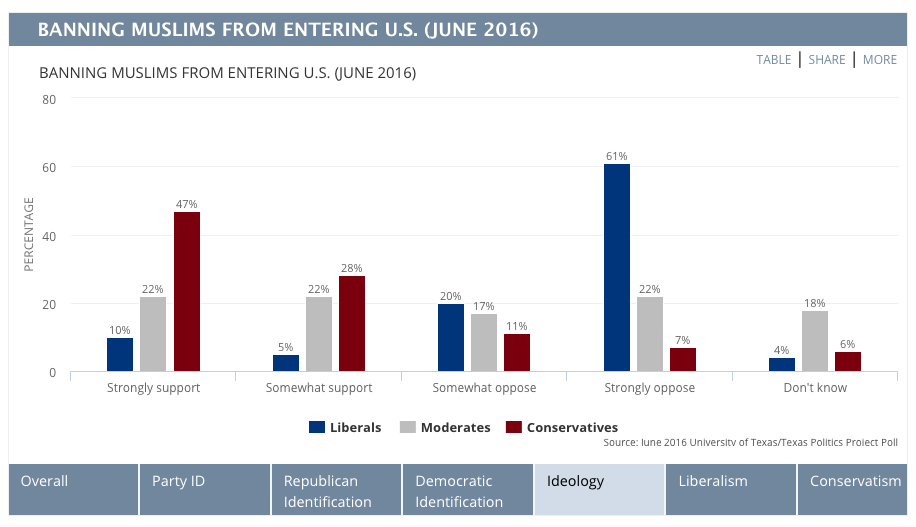
Having established that significant numbers of Trump supporters discriminate on the basis of race, sexual orientation, religion, and immigration status, it must be reiterated that yes, there is prejudice on the left. There are some liberals that also hold reprehensible views similar to Trump supporters. Take for example Trump’s idea to punish the many for the crimes of the few, banning all Muslim immigrants:
via Texas Politics Project
As you can see, 15% of liberal respondents either strongly support or somewhat support this policy. That is very discouraging for anyone who cares about religious freedom, tolerance of others, and basic human dignity. But if 15% is a tragedy, how much more so is 75% of conservative respondents saying the same? The pattern is replicated elsewhere and is not hard to find. Some liberals embrace disrespectful, disdainful, discouraging views of blacks, immigrants, homosexuals, Muslims, and so on, but it is rarely as egregious as conservative support. Even if it was, we have already established few liberals are voting for Trump, meaning the claim at the beginning of this article remains sound.
That claim was:
Donald Trump’s political success is, to a significant degree, explained by conservatives who like him hold virulent disdain and disturbingly disrespectful attitudes toward Muslims, blacks, undocumented Hispanic immigrants, and so on. In other words, people with deplorable views electing a deplorable man.
While this is not the only piece of the puzzle, it is a large one indeed. Large enough that I believe if Trump had run as a Democrat and said the same things he wouldn’t have gotten very far. Degrading women and talking about sexually assaulting them, threatening to strip Muslims of their civil rights, perpetuating untrue stereotypes of blacks and immigrants, and so on doesn’t work as well on liberal voters.
If Trump’s nonsense and venom worked just as well on leftists, we surely would have seen more liberals voting for Trump in the primaries. We might see liberals abandoning a very unlikable Democratic candidate in droves and helping Trump win in a landslide in November, an unlikely outcome. Most importantly, we might ask why Trump didn’t simply run as a Democrat, since he previously held more liberal views on several issues. Why choose to run as a Republican instead? I think we know why. He wouldn’t have been taken seriously. Any toxic hate would have been rejected by more voters. Going about spouting authoritarianism and blatant stereotypes, mocking disabled people, and telling obvious lies about what you said on camera yesterday wasn’t going to be as successful with non-conservatives.
Donald Trump’s rise has been a valuable opportunity to show Americans (and the world, embarrassingly) what is accepted by and appeals to too many millions. It’s a good time to acknowledge the problems we still face from many on the right, and elsewhere to a lesser degree, who put up obstacles to tolerance and basic human dignity. We have to be honest with ourselves: Donald Trump is not the real problem.
The problem is the millions willing to vote for him.
For more from the author, subscribe and follow or read his books.
